
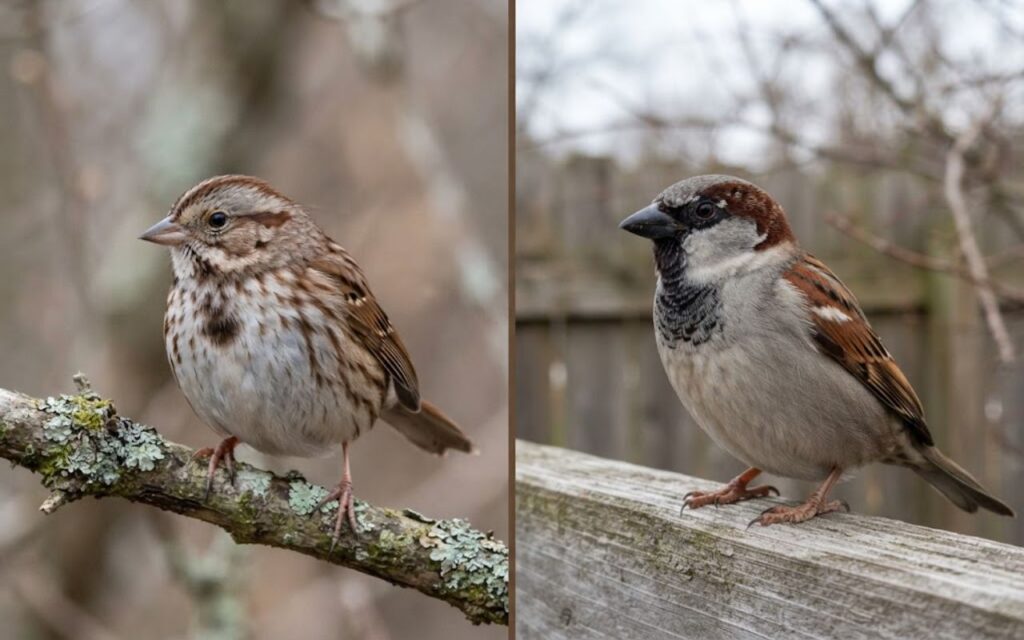
Mastering the song sparrow vs house sparrow identification challenge requires looking past generic brown plumage and examining specific anatomical traits in your backyard. Many casual observers confuse these two common birds because both frequent seed trays and garden borders across North America.
However, confusing native New World sparrows with non-native Old World weavers often leads to misidentifications on community counts and wildlife tracking platforms. Understanding their structural differences, behavioral tendencies, and seasonal feather changes will quickly clarify what is hopping beneath your feeders.
Quick-Glance Field Summary
Distinguishing these two species relies on evaluating breast streaking patterns alongside bill shape and tail action. Song Sparrows display coarse, dark brown streaks merging into a central chest spot with an elongated, rounded tail; House Sparrows show unstreaked underparts, sexual dimorphism, and a thick, conical seed-cracking beak.
- Song Sparrow (Melospiza melodia): Coarse breast streaks, dark central breast smudge, long rounded tail pumped downward during flight, slightly decurved bill culmen.
- House Sparrow (Passer domesticus): Plain unstreaked breast and flanks, dimorphic plumage, short notched tail, heavy conical bill.
- Primary Habitat: Dense shrubs, wetlands, and low garden borders for Song Sparrows; urban structures, open barnyards, and suburban rooflines for House Sparrows.
- Feeder Deterrent Options: Monofilament line spacing disrupts House Sparrows while ground trays with safflower attract native Song Sparrows.
Breast Streaking Mechanics and the Central Smudge Trap
A frequent diagnostic mistake highlighted on platforms like Reddit’s r/whatsthisbird involves relying solely on a single dark breast spot. Novice birders often spot a dark cluster of feathers on an avian chest and immediately label the specimen a Song Sparrow. While adult Song Sparrows (Melospiza melodia) commonly exhibit a central breast spot, this feature is simply the convergence of dense, dark brown streaks running down the chest.
In contrast, adult House Sparrows (Passer domesticus) never exhibit streaked breasts. Female House Sparrows show completely clean, unstreaked, dingy grayish-buff underparts that remain uniform from the throat to the lower belly. Male House Sparrows feature a solid black throat patch or bib during the breeding season, which can appear mottled or reduced in winter but never takes the form of independent streaks.
Juvenile plumage can occasionally confuse this dynamic, as young House Sparrows may temporarily exhibit very faint, indistinct smudging along the upper flanks. However, true crisp streaks composed of dark brown and rufous edging belong strictly to the native Song Sparrow. Examining the clarity and density of these ventral streaks provides the fastest separation in poor lighting conditions.
- Song Sparrow Underparts: Bold brown streaks on a pale white background with feathers converging toward the center of the breast.
- Female House Sparrow Underparts: Entirely unstreaked, flat grayish-tan feathers across the chest and abdomen.
- Male House Sparrow Underparts: Solid black throat bib surrounded by pale gray, showing zero vertical streaking.
| Anatomical Mark | Song Sparrow (Melospiza melodia) | House Sparrow (Passer domesticus) | Field Identification Clue |
|---|---|---|---|
| Ventral Patterning | Dense, thick brown vertical streaks that converge into a distinct center chest spot. | Completely smooth, unstreaked dingy pearl-gray underparts with no central spot. | Look at the breast; heavy streaks confirm a native Song Sparrow, clear gray confirms House. |
| Male Facial Markings | Monochromatic brown and gray eye-lines with a distinct dark lateral throat stripe. | Bold ink-black throat bib, clean white cheek patches, and a rich chocolate-brown eyestripe. | A crisp black bib and white cheeks instantly indicate an adult House Sparrow. |
| Feeder Mechanics | Solitary or in loose pairs; spends flight time ground-scratching beneath platforms. | Highly gregarious and aggressive; descends in boisterous, noisy neighborhood flocks. | Flocking style is a dead giveaway; large chattering packs are always House Sparrows. |
Culmen Curvature and Skull Geometry Differences
Bill morphology offers a permanent anatomical distinction that persists regardless of feather wear or molting stage. Song Sparrows belong to the family Passerellidae, known as New World sparrows, which possess bills adapted for mixed foraging. The Song Sparrow bill displays a gently sloping, slightly curved upper culmen that meets the forehead at a moderate, streamlined angle.
House Sparrows belong to the family Passeridae, the Old World sparrows or weavers, which have evolved specialized seed-crushing skulls. A House Sparrow presents a stout, swollen bill where the base of the upper mandible forms an abrupt, heavy profile. This bill is visibly thicker from base to tip than that of any Song Sparrow.
In a recent discussion on r/backyardbirds, one community contributor noted that seeing both species side-by-side reveals how the House Sparrow bill looks blunt and finch-like. The Song Sparrow bill appears significantly more tapered and sharp, allowing the bird to manipulate insects and delicate wetland seeds. Examining this bill angle through binoculars quickly resolves identification issues when body feathers are hidden behind branches.
- Song Sparrow Bill: Slender, medium-length conical profile with a decurved upper culmen suited for seeds and arthropods.
- House Sparrow Bill: Deep, swollen base with a blunt profile optimized for cracking tough agricultural grains.
- Bill Coloration: Song Sparrow beaks remain dark horn with a paler lower mandible; male House Sparrows boast fully jet-black bills in spring.
Flight Mechanics, Posture, and Tail-Pumping Behaviors
Locomotion and silhouette in motion serve as dependable field marks when observing birds at a distance. When a Song Sparrow flits between low shrubs, it exhibits a characteristic downward pumping motion with its tail feathers. This rhythmic tail-pumping cadence is a hallmark behavioral trait recognized by field ornithologists across North America.
House Sparrows do not pump their tails downward in flight or upon perching. Instead, House Sparrows fly in a direct, buzzing trajectory with rapid wingbeats, often moving in tightly synchronized flocks. Their tails remain rigid and aligned directly with the horizontal axis of the spine.
Tail geometry itself provides an additional physical distinction. The Song Sparrow features a relatively long, rounded tail with rounded outer rectrices that spread noticeably during braking. The House Sparrow features a shorter, squared or slightly notched tail that appears compact against its heavier body mass.
- Song Sparrow Flight Habit: Low, darting movements between protective brush piles while actively pumping the rounded tail downward.
- House Sparrow Flight Habit: Direct, level, rapid flight between high building eaves and ground perches without tail pumping.
- Perching Posture: Song Sparrows perch with an upright, alert posture; House Sparrows often rest in a horizontal, crouched stance.
Acoustic Cadence: Trills versus Repetitive Chirps
Vocalizations eliminate identification confusion long before a bird steps out from thick brambles. The song of the male Song Sparrow is an intricate, musical composition composed of several distinct sections. It typically begins with two or three sharp, clear introductory notes, pauses briefly, and bursts into an energetic buzz or trill.
House Sparrows produce no true melodic song. Their acoustic repertoire consists almost entirely of monotonous, single-syllable or two-syllable metallic chirps. A male House Sparrow will repeat these metallic calls from a rooftop or gutter for hours without introducing melodic variation.
Field observers frequently document this acoustic divide during early spring surveys. While regional dialects of the Song Sparrow vary dramatically from Alaska down to central Mexico, the structural rhythm remains consistently musical. The mechanical chirp of the House Sparrow remains static and unvaried regardless of location.
- Song Sparrow Song: Two to three crisp whistle notes followed immediately by a complex trill and a low concluding warble.
- Song Sparrow Call: A distinctive, raspy nasal note often described as a hollow scold.
- House Sparrow Vocalization: Monotonous, repetitive, metallic chirping notes with minimal tonal inflection.
Backyard Habitat Competition and Feeder Exclusion Hardware
Backyard bird enthusiasts frequently encounter friction between these two species at suburban feeding stations. House Sparrows are aggressive, colonial competitors that displace native species from platform feeders and nesting cavities. Song Sparrows are solitary or pair-based ground foragers that prefer staying near dense perimeter cover.
To protect native sparrows from being crowded out by House Sparrow flocks, forum hobbyists often deploy specialized exclusion tactics. A widely tested community technique involves installing a monofilament halo above elevated seed trays.
Field research conducted by the University of Nebraska confirmed that weighted hobby wires hanging around an elevated seed station trigger an immediate aversion response in invasive House Sparrows.
This mechanical safeguard relies on the sparrow’s instinctual fear of a blocked rapid-escape route, allowing native songbirds to feed entirely unperturbed by the lines.
Song Sparrows rarely feed high on hanging tube feeders, preferring ground trays or scattered seed near native plantings. Adjusting your seed blend also shifts the species balance in favor of native wildlife.
House Sparrows strongly prefer cracked corn, white proso millet, and bread scraps, while Song Sparrows readily consume black oil sunflower seed and safflower.
- Monofilament Halos: Vertical lines of 0.015-inch monofilament wire spaced around seed hoppers deter House Sparrows without hindering native ground birds.
- Exclusion Mesh: Installing 1.5-inch wire excluder cages allows smaller birds safe access while blocking invasive pest flocks.
- Seed Strategy: Discontinue low-grade mixed millet blends; transition to pure safflower seed to discourage aggressive House Sparrow colonies.