
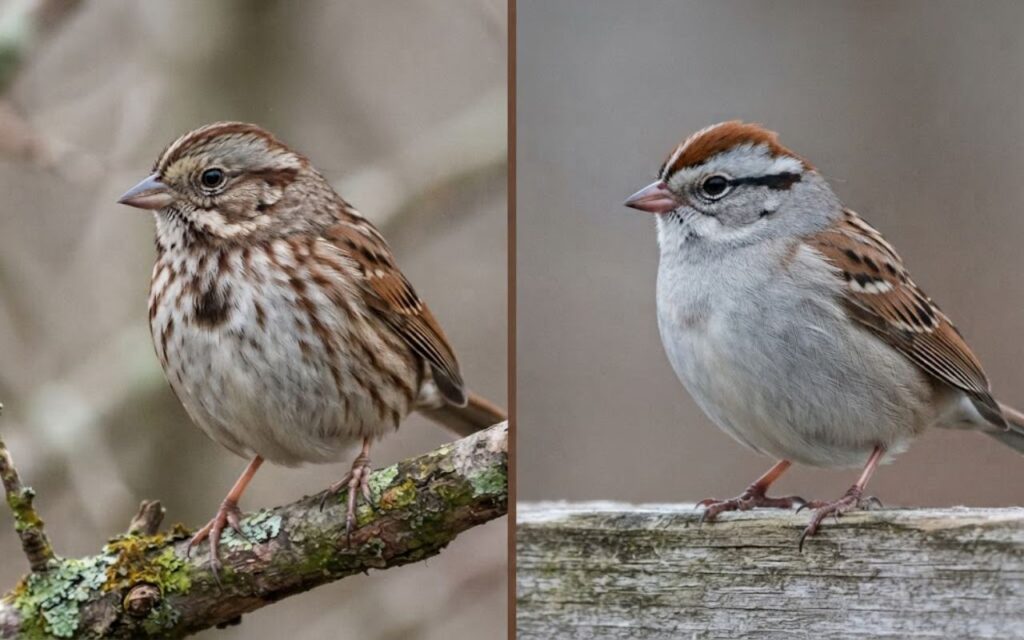
Navigating a reliable song sparrow vs chipping sparrow identification guide can save birders hours of second-guessing in the field and at backyard feeders. While both species share overlapping geographic ranges across North America, their physical dimensions, structural silhouettes, and vocal habits differ noticeably once you know what to look for.
Novice observers often stumble when birds molt into non-breeding plumage or when juvenile markings distort classic field guide illustrations. Understanding these subtle differences ensures you make rapid, accurate identifications in any season or lighting condition.
Quick-Glance Field Summary
Distinguishing between these two common sparrows comes down to assessing chest markings, tail shape, and overall body bulk. Song Sparrows are robust ground foragers with heavily streaked breasts, while Chipping Sparrows are delicate, slim-bodied birds with unstreaked pale undersides during the breeding season.
- Song Sparrow Body Mass: 18 to 26 grams
- Chipping Sparrow Body Mass: 11 to 16 grams
- Song Sparrow Tail Shape: Broad and visibly rounded at the tip
- Chipping Sparrow Tail Shape: Slender with a distinct, shallow fork or notch
- Song Sparrow Chest Markings: Coarse brown streaks converging into a central breast spot
- Chipping Sparrow Chest Markings: Clear, unmarked pearl-gray or buff (adult breeding)
- Song Sparrow Bill Structure: Heavy, conical, and grayish horn in color
- Chipping Sparrow Bill Structure: Fine, sharply pointed, and black (breeding) or dull pink (non-breeding)
Breast Streaking and Crown Plumage Diagnostic Nuances
The most immediate field mark separating breeding adults is the plumage of the breast and crown. An adult Chipping Sparrow features a crisp, bright rufous cap bordered by a sharp white supercilium and a clean black trans-ocular line running directly through the eye to the bill. Its chest is completely clear of streaks, displaying an even, pearl-gray tone that extends down through the belly.
In contrast, the Song Sparrow presents a heavily patterned, coarser facial design with broad gray and reddish-brown stripes across the head. Its crown is split by a faint grayish central stripe, lacking the solid rufous saturation seen on an adult Chipping Sparrow. The underparts are defined by bold, thick brown streaks that run down the flanks and usually merge into a dense central breast spot.
Birders must remain cautious during late summer and autumn when plumage wear and molting blur these lines. Non-breeding Chipping Sparrows lose their solid rusty cap, taking on a dull brown crown streaked with dark charcoal that can mimic other small sparrows. However, even in winter, adult Chipping Sparrows maintain clean, unstreaked breasts, whereas Song Sparrows retain their heavy ventral streaking year-round.
| Field Attribute | Song Sparrow (Melospiza melodia) | Chipping Sparrow (Spizella passerina) | Field Identification Clue |
|---|---|---|---|
| Ventral Patterning | Dense, thick brown vertical streaks that converge into a distinct center chest spot. | Completely smooth, unstreaked pearl-gray underparts with no central markings. | Look at the breast; heavy streaks confirm a Song Sparrow, clear gray confirms a Chipping. |
| Head & Crown Profile | Streaked brown and gray crown with thick, dark brown lateral throat stripes. | Solid, bright rufous-chestnut cap bordered cleanly by a stark white eyebrow stripe. | A bright, solid reddish-brown cap and clean white line above the eye means Chipping. |
| Ocular Stripe | Muted, soft brown eyestripe that diffuses into a gray-brown face patch. | Sharp, crisp black line running horizontally through the eye straight to the beak. | The jet-black eye line is a definitive marker for the Chipping Sparrow. |
Tail Geometry and In-Flight Ballistics
When poor backlighting obscures plumage details, structural geometry and flight dynamics provide definitive clues. Chipping Sparrows are built with long, narrow wings and a proportionately slender, notched tail that shows a visible central indention when folded. Song Sparrows possess a much stockier anatomy, defined by shorter, rounded wings and a broad, paddle-shaped tail.
Their behavior in flight diverges significantly due to these aerodynamic differences. When flushed from dense brush, a Song Sparrow flies with low, pumping tail movements, flicking its broad tail downward and sideways as it weaves through cover. This characteristic pumping motion is an exceptionally reliable field signature that ornithologists use to confirm identification from long distances.
Chipping Sparrows, conversely, maintain a direct, undulating flight trajectory without deliberate tail pumping. Their lightweight frame allows them to lift rapidly into higher tree branches or utility wires without lingering near low ground cover. Paying attention to how the tail moves as the bird departs will clarify your identification before plumage can even be analyzed.
Feeder Substrate Choices and Foraging Mechanics
Backyard feeding stations highlight distinct biomechanical differences between the two species. Song Sparrows are adapted for scratching through dense leaf litter and ground debris, using a synchronized two-footed backward hop to uncover fallen seeds. Chipping Sparrows operate as nimble gleaners, frequently perching on delicate foliage, thin grasses, or wire perches to pluck micro-seeds directly from seed heads.
On birding forums like r/backyardbirds, community members frequently note that Song Sparrows struggle with compact, hanging tube feeders designed for finches. Their larger, bulkier frame requires a stable platform feeder, a broad ground tray, or open terrain beneath shrubs. Chipping Sparrows easily balance on standard narrow feeder perches and readily access high-hanging feeders that deter heavier sparrows.
- Preferred Song Sparrow Feeders: Low platform trays, open hopper stations with wide perches, and ground scatter zones
- Preferred Chipping Sparrow Feeders: Hanging tubular seed dispensers, fine mesh feeders, and small elevated perches
- Song Sparrow Diet Focus: Coarse cracked corn, black oil sunflower kernels, and millet raked from leaf litter
- Chipping Sparrow Diet Focus: Small white proso millet, nyjer seed, and natural grass seeds harvested in the open
These physical feeding tolerances explain why backyard birders rarely see Song Sparrows clinging to high, swinging hardware. If an unknown sparrow consistently clings to a narrow metal perch on a hanging feeder, it is far more likely to be a Chipping Sparrow.
Acoustic Signatures: Mechanical Trills vs Melodic Complexity
Song Sparrow vocalizations are famously elaborate, musical, and structurally dynamic. A typical territorial song begins with two to three clear, sharp notes, followed by an abrupt, buzzy trill, and concludes with a tumbling cascade of assorted chirps. Each individual male commands a personal repertoire of several distinct song types, varying tempo and pitch throughout the day to claim territory.
The Chipping Sparrow sings a completely different, dry, mechanical song that consists of a rapid, continuous trill delivered on a single pitch. This insect-like trill can last anywhere from two to eight seconds, often sounding similar to a Dark-eyed Junco or a Pine Warbler. The mechanical speed is often so tight that individual pulses blend together into a dry rattle.
Their call notes are equally diagnostic when birds are calling from dense undergrowth. Song Sparrows emit a heavy, nasal “chimp” or “tchep” note that carries substantial weight across marshy edges and thickets. Chipping Sparrows produce a very high, thin, metallic “seep” or short “chip” that sounds brittle and sharp by comparison.
Juvenile Molt Confusion and Forum Identification Pitfalls
A frequent identification trap shared across online communities like r/whatsthisbird involves juvenile Chipping Sparrows. In late summer, young Chipping Sparrows leave the nest sporting heavily streaked breasts and drab, brownish faces, causing beginners to misidentify them as Song Sparrows. These youngsters lack the solid rufous cap entirely and display fine, dusky streaking across their pale chest and flanks.
To avoid this mistake, check the overall proportions and the texture of the breast markings. Juvenile Chipping Sparrows feature very fine, needle-like streaks, whereas Song Sparrows of any age feature coarse, broad, blurry streaks that cover a wider area. Furthermore, the juvenile Chipping Sparrow retains a delicate pinkish-buff bill and a noticeably slim, notched tail that rules out a young Song Sparrow.
Another common point of confusion reported by feeder watchers occurs during early spring when Chipping Sparrows transition out of non-breeding plumage. Incomplete molts leave some individuals with patchy, mottled brown crowns that superficially look like the broken crown stripes of a Song Sparrow.
Always double-check the bill color; a Chipping Sparrow developing its breeding condition will show a darkening bill that turns jet black, contrasting sharply with the permanently two-toned gray bill of the Song Sparrow.