
The House Sparrow is the most abundant bird in the world and a successful colonizer of every continent except Antarctica. In North American backyards, it is also the most common reason bluebirds, Tree Swallows, and Purple Martins fail to raise a brood.
If you are serious about supporting native cavity-nesting birds, learning how to deter house sparrows effectively is a requirement, not an option. It requires a systematic approach across three overlapping fronts: what you feed, how you protect nest boxes, and how you seal structures against nesting.
This guide covers every tool available, what the research actually shows about their effectiveness, and the legal framework for removing nests. This is the three-step exclusion protocol that gives native birds the best chance in sparrow-heavy suburban environments
Quick Answer: How do you deter house sparrows from feeders and bluebird houses?
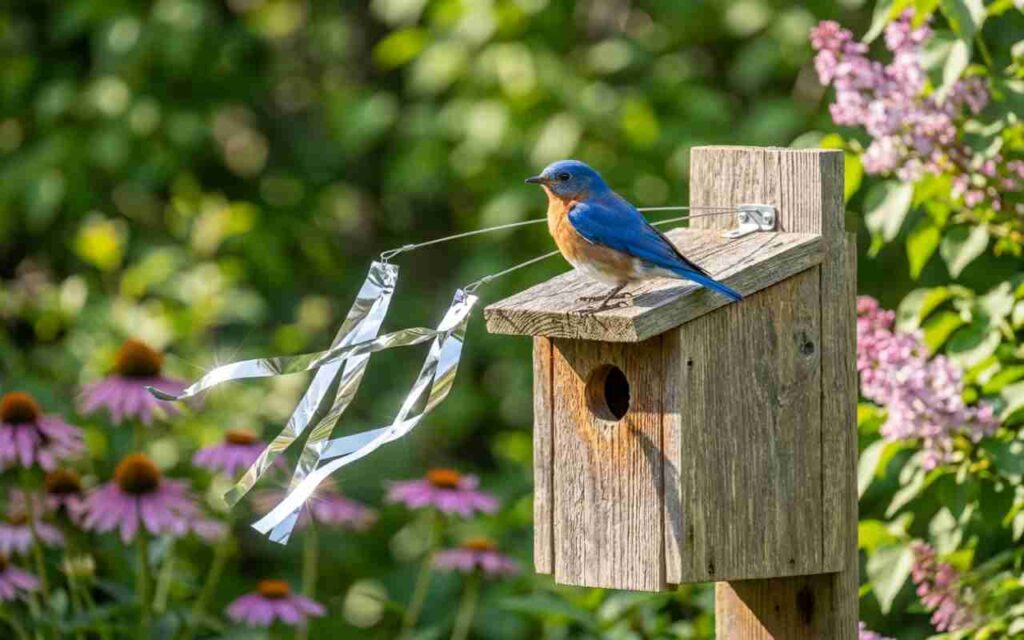
The most effective way to deter House Sparrows is through mechanical exclusion. For bird feeders, install a “Magic Halo” (weighted monofilament lines) and switch to selective seeds like safflower or nyjer. To protect bluebird houses, install “Sparrow Spookers” (Mylar strips) after the first egg is laid and use 1-1/8 inch hole restrictors for smaller species. Because House Sparrows are an invasive species, active nest removal is a legal and effective long-term deterrent.
The Strategy of Exclusion: An Expert Visual Guide
If you prefer to see these methods in action, watch our detailed video overview below. This guide provides a step-by-step breakdown of how to analyze sparrow behavior and implement the mechanical defenses required to protect your sanctuary.
Show Transcript:
0:00
Okay, let’s dive right in. Not long ago, I had a vision to turn my backyard into a paradise for native birds. I installed feeders, added a nest box for eastern bluebirds, and waited for my backyard bird sanctuary to come to life.
0:21
But instead of a peaceful setup, I walked straight into chaos. Within days, I started asking a disturbing question. Was my birdhouse actually a death trap? My attempt at bird conservation quickly turned into something much darker.
0:49
At first, a few small brown birds showed up. Then more and more. They were house sparrows, and they were not just visiting. They were taking over. They mobbed the feeders, chased away native birds, and aggressively claimed the nest box.
1:09
It got worse. They filled the bluebird box with debris and attacked any bird that came near. What was supposed to support backyard birds had turned into a hostile takeover. My dream backyard was now a battleground.
1:27
I needed answers. Research from the Cornell Lab of Ornithology showed this behavior was not random. House sparrows are known for destroying eggs, killing chicks, and attacking adult birds in nest boxes.
1:53
So I rushed out and bought solutions, but I was guessing. My first mistake was a plastic owl decoy. It looked like a perfect predator deterrent, but within 48 hours, sparrows were sitting on it like it was a perch.
2:23
Then came the second mistake. Cheap mixed bird seed. I thought variety would attract more birds. Instead, I created a buffet of millet and cracked corn, which are exactly what sparrows love. I was inviting more pests.
3:04
At this point, I was ready to quit. Instead, I changed my approach. I stopped guessing and started learning from real research and proven bird feeding strategies. That is when everything shifted.
3:34
I discovered data showing nearly 10 percent of bluebird nests are taken over, mostly by house sparrows. This was not just my problem. It is a widespread issue in backyard birding.
4:00
Then I learned their scientific name, Passer domesticus, which means sparrow of the house. That explained everything. They are perfectly adapted to live around homes and nest in structures.
4:28
The biggest surprise was that house sparrows are invasive and not protected under the Migratory Bird Treaty Act. This opened the door to legal and effective control strategies I did not know were possible.
4:56
With real knowledge, I built a three part strategy. Fix my feeders, protect my nest boxes, and secure my home. This was no longer trial and error. It was a system.
5:14
First, I upgraded my feeders. I removed cheap seed and switched to safflower, which sparrows dislike but native birds enjoy. I added nyjer feeders for finches and used weight sensitive feeders that close under heavier birds.
5:38
I also used upside down suet feeders designed for birds like woodpeckers that can cling, but difficult for sparrows to use. This simple change reduced competition immediately.
6:11
Then I found a tool called the magic halo. It is a wire hoop with hanging lines that disrupt sparrow behavior. Research shows a high success rate, and it worked extremely well in my yard.
6:38
Next, I protected the nest box. I installed a sparrow spooker with reflective strips that deter sparrows. Timing is critical. It must be installed only after the first egg is laid and removed after the chicks leave the nest.
7:13
I also modified the nest box design. A deeper floor makes it less attractive to sparrows while still ideal for bluebirds. Small design changes can make a big difference.
7:45
Finally, I secured my house. I sealed vents, gaps, and eaves using wire mesh to eliminate nesting spots. This stopped sparrows from using my home as a nesting site.
8:15
So did it work? Yes, completely. I took back control of my backyard bird habitat. The aggressive flocks disappeared and native birds returned.
8:35
A pair of eastern bluebirds successfully nested and raised a family. Black-capped chickadees visited regularly, and downy woodpeckers used the suet feeder. House finches fed peacefully on safflower seed.
9:03
The biggest change was the sound. The harsh noise of sparrows was replaced by a mix of native bird songs. My backyard finally became the peaceful bird sanctuary I imagined.
9:17
What started as a simple idea turned into a real lesson in backyard birding and bird feeder strategy. By replacing guesswork with science, I transformed my yard.
9:32
If you are dealing with aggressive birds or invasive species at your feeders, the solution is not more effort. It is the right strategy. Your backyard bird paradise is possible.
The Invasive Challenge: Why Deterrence is Necessary
Why House Sparrows Are a Direct Threat to Bluebirds, Tree Swallows, and Purple Martins
House Sparrows are not simply competitors for nesting sites. They are active killers of native cavity-nesting birds. Cornell University’s Birdhouse Network documentation states the pattern directly: in head-to-head competition, House Sparrows readily out-compete native species by evicting other nesting birds, destroying their eggs, killing nestlings, and sometimes killing the incubating female.
Once a male House Sparrow establishes a territory, he remains there year-round and begins defending it early in the season, often preventing later-arriving species such as bluebirds and swallows from nesting at all.
The competitive threat extends beyond individual nest boxes. A study published in Landscape Ecology by Robillard and colleagues (2012) tracked a 400 nest-box system across 40 farms in Southern Quebec over multiple years.
The study found that competition for nesting sites between House Sparrows and Tree Swallows was a documented factor in Tree Swallow population decline, with House Sparrow nest-box occupancy increasing significantly as agricultural intensification increased, directly displacing Tree Swallows that had used the same boxes in prior seasons.
NestWatch research from Cornell Lab, drawing on data from 3,156 bluebird nests, 1,468 Tree Swallow nests, and 412 Purple Martin nests, found that 9.3% of bluebird nest attempts were usurped, predominantly by House Sparrows. Tree Swallows and Purple Martins were usurped at statistically significant levels compared to bluebirds, likely because bluebird boxes receive more active management.
Every unmonitored nest box in sparrow-heavy territory is a potential House Sparrow breeding site and a threat to any native birds that attempt to use it. For a broader overview of House Sparrow biology and behavior in suburban environments, the guide to House Sparrow habits and natural history covers territory establishment, flock dynamics, and seasonal patterns.
Legal Standing: The MBTA Exclusion for Non-Native Species
The legal framework for House Sparrow management is unambiguous at the federal level. The Federal Register’s official list of bird species not protected under the Migratory Bird Treaty Act, published by the U.S. Fish and Wildlife Service in 2020, explicitly states that the House Sparrow (Passer domesticus), belonging to the Passeridae family, is not covered under any of the four migratory bird treaties between the United States and Canada, Mexico, Russia, or Japan, because it belongs to a biological family not included in any of those treaties.
U.S. Fish and Wildlife Service testimony on exotic birds and the MBTA is specific: for almost a century, the Service has condoned the removal of adults, eggs, and nests of European Starlings and House Sparrows from artificial houses and nest boxes erected to benefit species such as bluebirds and Purple Martins. This is active federal endorsement of nest box management, not merely a passive exclusion from protection.
State and local laws may vary and should be checked before proceeding. Some states impose additional restrictions on methods of take even for unprotected species. The federal exclusion from MBTA protection does not override state wildlife laws.
For the ecological context and the broader case for managing invasive bird species in suburban environments, the resource on invasive backyard birds covers both House Sparrows and European Starlings with the full ecological and legal framework.
Deterring Sparrows at the Feeder: The “Magic Halo” Method
The Physics of Fear: How the Magic Halo Exploits House Sparrow Risk Assessment
The Magic Halo is a horizontal wire hoop hung above a bird feeder, from which thin weighted wires or monofilament lines hang downward around the feeder. It was invented and patented by researchers at the University of Nebraska. The device exploits a specific behavioral trait of House Sparrows: an unusually strong aversion to dangling vertical lines near a feeding site, an aversion that most native feeder species do not share.
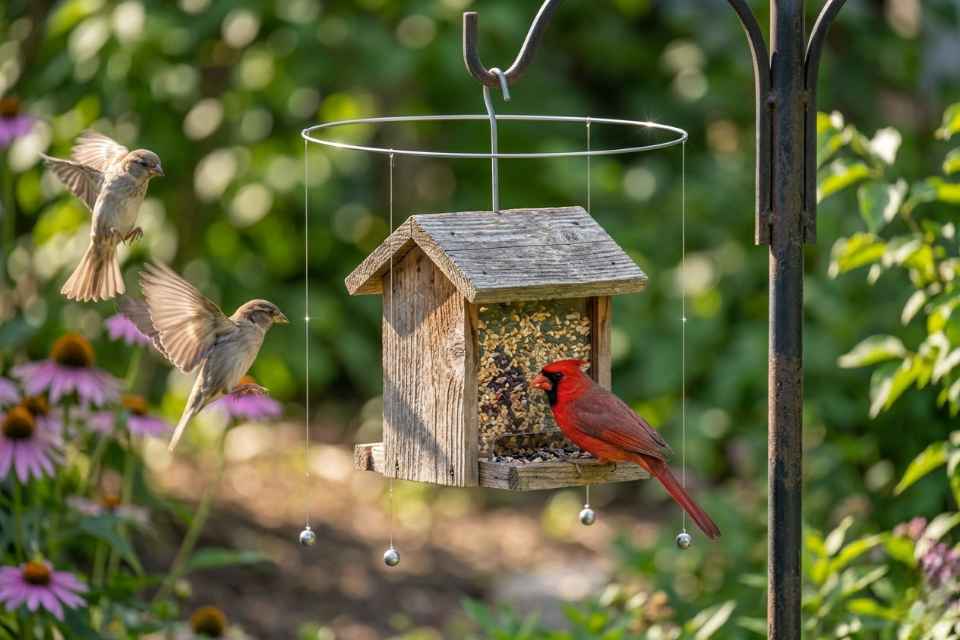
Cornell Lab’s Project FeederWatch blog, reviewing the original University of Nebraska research paper, documents that the hoop device alone (without hanging wires) deterred only House Sparrows and allowed other birds to feed normally. Adding hanging wires increased the repellency to House Sparrows but also modestly affected Blue Jays and occasionally Northern Cardinals.
While the exact neurological reason for this fear is still debated by ornithologists, the field results are undeniable. By suspending weighted lines around the perimeter, you create a psychological “no-fly zone” that allows native species to feed in peace.
The University of Nebraska researchers also found that the wires were not effective in deterring juvenile House Sparrows or breeding females, with breeding females becoming more likely to take risks to care for young. The overall deterrence rate reported across multiple surveys is approximately 85% for adult House Sparrows.
The mechanism is not fully understood, but the most likely explanation involves the House Sparrow’s visual risk assessment: the hanging lines create an unpredictable obstacle that interferes with the sparrow’s ability to assess a clear approach and escape route to and from the feeder.
Most native species with stronger clinging and perching agility appear less sensitive to this visual disruption. Important caveats: juvenile House Sparrows are not deterred and may acclimate adults over time; deterrence declines if feeders are maintained year-round through summer when juvenile populations peak.
Selective Feeding: Eliminating Sparrow Magnet Seeds
The North American Bluebird Society’s House Sparrow control documentation identifies the first passive step in feeder management: eliminate cheap mixed bird seed that contains a high percentage of filler grains such as milo, millet, and cracked corn.
These are among the preferred foods of House Sparrows and serve as a primary attractant that increases local sparrow populations around any feeding station that offers them.
Replacing mixed seed with foods that House Sparrows cannot efficiently process reduces their competitive advantage at feeders. Safflower seed is one of the most effective replacements: it is readily taken by Northern Cardinals, chickadees, and House Finches, but avoided by most House Sparrows and European Starlings.
Nyjer (thistle) seed is attractive primarily to goldfinches and Pine Siskins, species House Sparrows rarely compete with directly. Shelled peanuts and suet attract woodpeckers and nuthatches. None of these foods are primary House Sparrow attractants.
Equipment Upgrades: Clinger-Only and Weight-Sensitive Feeders
Weight-sensitive tube feeders close their feeding ports when a bird heavier than a target threshold lands on the perch ring. House Sparrows, at 27-30 grams, are heavier than goldfinches (12-14 grams) and chickadees (9-14 grams), making properly calibrated weight-sensitive feeders an effective passive exclusion tool for the smallest native species without any management effort beyond initial setup.
Upside-down suet feeders, which require birds to cling below the feeder to access food, are effective at excluding House Sparrows from suet. House Sparrows are not strong clingers and cannot maintain an inverted position long enough to feed reliably.
Woodpeckers and nuthatches, which cling readily in any orientation, are not affected. NestWatch documentation confirms that no truly sparrow-proof design exists for nest boxes, but feeder design exclusion is considerably more effective and achievable.
Protecting Bluebird Houses: Mechanical Exclusion
The Sparrow Spooker: First-Egg Timing and 24/7 Protection
The Sparrow Spooker is a device mounted on the roof of a bluebird or swallow nest box that suspends shiny, fluttering Mylar strips from a horizontal frame positioned above the entrance hole.
The North American Bluebird Society’s House Sparrow control fact sheet describes it as protection on a 24/7 basis for eggs, nestlings, and adults: it is placed on the box after the first native bird egg is laid and removed after fledging to prevent House Sparrows from becoming accustomed to it.
The timing rule is non-negotiable: installing before the first egg risks scaring the native bird away from a box she has not yet committed to. Installing after the first egg uses the bird’s own commitment to the nesting site as the buffer.
Once a female has laid her first egg, she is highly unlikely to abandon the box, and the research indicates no documented cases of bluebirds abandoning a nesting when the Spooker is correctly installed after the first egg is laid.
The Spooker must be removed as soon as nestlings fledge, and the nest must be cleaned out at the same time. Leaving it up between nestings will cause House Sparrows to acclimate to the device, eliminating its effectiveness for the next brood.
This acclimation risk is why the Spooker is deployed in windows, not permanently.
Hole Guard Forensics: Entrance Size Restrictors and PVC Boxes
Entrance hole size is the primary passive structural exclusion tool for nest boxes. The standard bluebird box entrance of 1.5 inches allows both bluebirds and House Sparrows to enter. For chickadees and smaller species, a 1.125-inch (1 and 1/8 inch) entrance hole restrictor blocks House Sparrows while allowing the smaller native species to enter and exit freely.
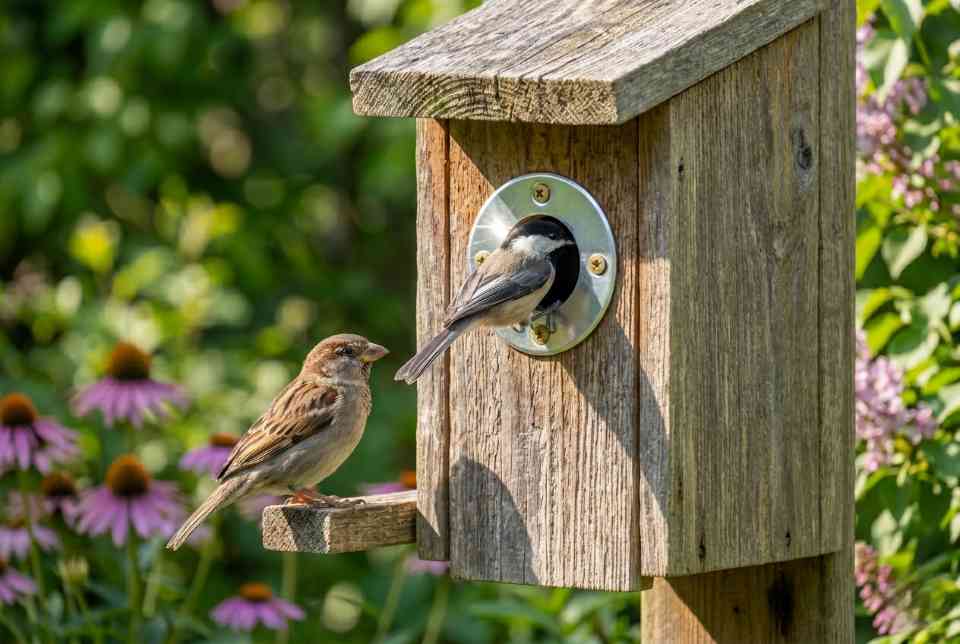
NestWatch documentation confirms that House Sparrows can fit through entrance holes as small as 1.25 inches, so any box designed for bluebirds or swallows cannot be made sparrow-proof through hole size alone.
NestWatch management documentation notes that Gilbertson PVC boxes are often avoided by House Sparrows, and that when PVC boxes are paired with wooden boxes, House Sparrows tend to choose the wooden box.
The mechanism is not fully understood, but the preference for wooden over PVC boxes is consistent enough across monitoring reports that PVC boxes represent a meaningful passive deterrent in situations where active management is not possible.
For guidance on attracting and supporting Eastern Bluebirds in nest boxes, the complete resource on attracting Eastern Bluebirds to your yard covers box placement, monitoring, and sparrow management together.
The Floor-to-Hole Distance: Deepening Nest Boxes to Reduce Sparrow Interest
Increasing the floor-to-entrance-hole distance in a nest box to 6 inches or more makes it harder for House Sparrows to look into the box from the entrance and assess it as a nesting site.
Bluebirds and swallows are comfortable with deeper boxes; House Sparrows tend to prefer shallower cavities that allow more light and visual access from the entrance. This is a passive structural modification that reduces initial sparrow interest during territory establishment, not a guarantee of exclusion once a male has claimed a box.
Box location remains the single most impactful passive factor in sparrow competition. Boxes placed more than 100 meters from buildings, barns, and other structures where House Sparrows congregate see significantly lower sparrow competition.
The Sialis bluebird conservation resource documents that the House Sparrow’s Latin name, Passer domesticus, accurately describes its preference for nesting around human structures, and that boxes in open fields far from buildings are less likely to be claimed by sparrows in the first place.
Preventing Nesting: Structural Deterrence for Homes
Passive Exclusion: Hardware Cloth for Dryer Vents, Eaves, and AC Units
House Sparrows nest in any cavity or crevice they can access in a structure: dryer vents, bathroom exhaust vents, gaps in eaves, spaces behind siding, air conditioning unit housings, and gaps around pipes and ductwork.
The most permanent deterrence is physical exclusion with 1/4-inch hardware cloth (galvanized wire mesh) installed over any opening that does not require regular access.
Dryer vents require a specialized louvered cover that allows air to exhaust while blocking bird entry, since standard hardware cloth will trap lint and create a fire hazard. Commercially made dryer vent bird guards with metal flaps are the appropriate solution. Eave gaps and siding spaces can be sealed with 1/4-inch hardware cloth cut to fit and secured with galvanized staples or screws.
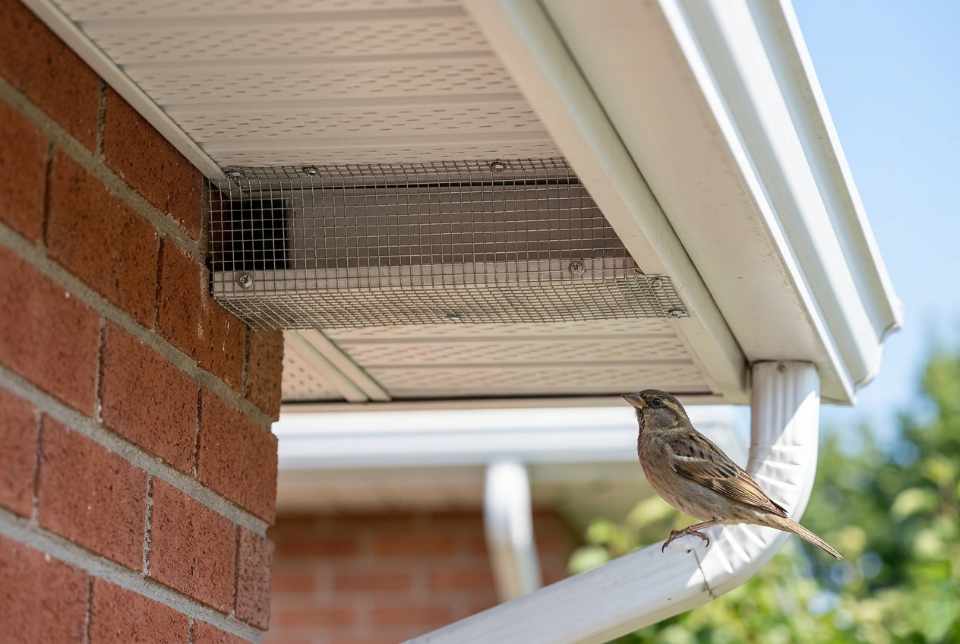
For guidance on how to prevent birds from nesting in vents and structural openings specifically, the resource on how to stop birds from nesting in vents covers the full range of preferred nesting locations and the appropriate exclusion approach for each.
Active Management: The Legality and Timing of Nest Removal
For House Sparrow nests in structures, active nest removal is legal under federal law for this non-native species. Removing nesting material every few days before eggs are laid prevents the pair from completing a nest and establishing the territory attachment that makes later removal more difficult.
NestWatch management documentation notes that if House Sparrow nest material is removed once or twice per week consistently, no young will fledge from the site, though the male will tenaciously defend his chosen location and continue attempting to rebuild.
The most important timing principle is to begin removal before the pair becomes strongly bonded to a site. Once a female has laid a full clutch, she will return repeatedly to a cleared cavity and rebuild faster than if the nest is removed at the early construction stage.
Consistent early-season nest removal from structural sites, combined with hardware cloth exclusion where possible, is more effective than reactive management of established nests.
Acoustic Deterrence: Why Sonic Devices Usually Fail
Sonic and ultrasonic bird deterrent devices marketed for House Sparrow control have a consistent and well-documented failure mode: habituation. Wildlife control training resources document that audible and visual stimulus devices only provide short-term damage reduction, as birds often become acclimated to the devices rapidly.
The guidance is to vary the timing, placement, and selection of devices to extend effectiveness, but the underlying habituation problem is not solved by variation, only delayed.
Ultrasonic devices specifically have no evidence base for effectiveness against any bird species. Birds do not hear in the ultrasonic range and are not affected by ultrasonic sound. Any product marketed as an ultrasonic bird deterrent is ineffective by design, regardless of the species targeted.
Resources that recommend sonic deterrence for House Sparrows are typically recommending short-term suppression as a temporary bridge while physical exclusion is installed, not as a standalone solution.
Behavioral “Scare” Tactics: What Actually Works?
Reflective Tape and Fake Owls: Ineffective After 48 Hours
Plastic owl decoys and reflective flash tape are among the most commonly purchased bird deterrent products and among the least effective against House Sparrows in established territories. Wildlife control training resources document that birds habituate to stationary fake owls rapidly, often within days, and that crows have been observed perching on or adjacent to plastic owl decoys after brief initial avoidance.
Reflective tape creates unpredictable light flashes that may initially startle birds but loses effectiveness as birds learn the pattern is not associated with a real threat. Both products share the same fundamental limitation: they provide a stimulus but no reinforcing consequence.
A House Sparrow that approaches a fake owl, discovers no threat, and feeds successfully has learned that the decoy is safe, and will not be deterred by it again. The window of effectiveness is typically 48 hours to one week.
Visual Disturbance: Kinetic Motion as a Sustained Disruption Tool
Motion-based deterrents that do not have a fixed and learnable pattern are more resistant to habituation than static devices. Wind-driven spinners, rotating reflective pinwheels, and other devices that produce unpredictable movement patterns in variable winds create a more sustained disruption because the stimulus is genuinely variable rather than static and learnable.
The underlying principle is similar to the Magic Halo: the moving device creates uncertainty about approach and escape routes, which is more aversive to House Sparrows than a fixed obstacle they can assess and dismiss. However, even kinetic devices lose effectiveness over time in the presence of a strongly motivated breeding bird.
Motion deterrents are best used during the pre-nesting territory establishment phase, when sparrows have not yet committed to a specific site, rather than after nest building has begun.
For guidance on window marking that protects both deterred birds in flight and native birds at nest boxes, the resource on preventing birds from hitting windows covers the exterior marking approaches relevant to both sparrow deterrence and native bird safety.
The 2026 Deterrence Checklist: A Summary of Success
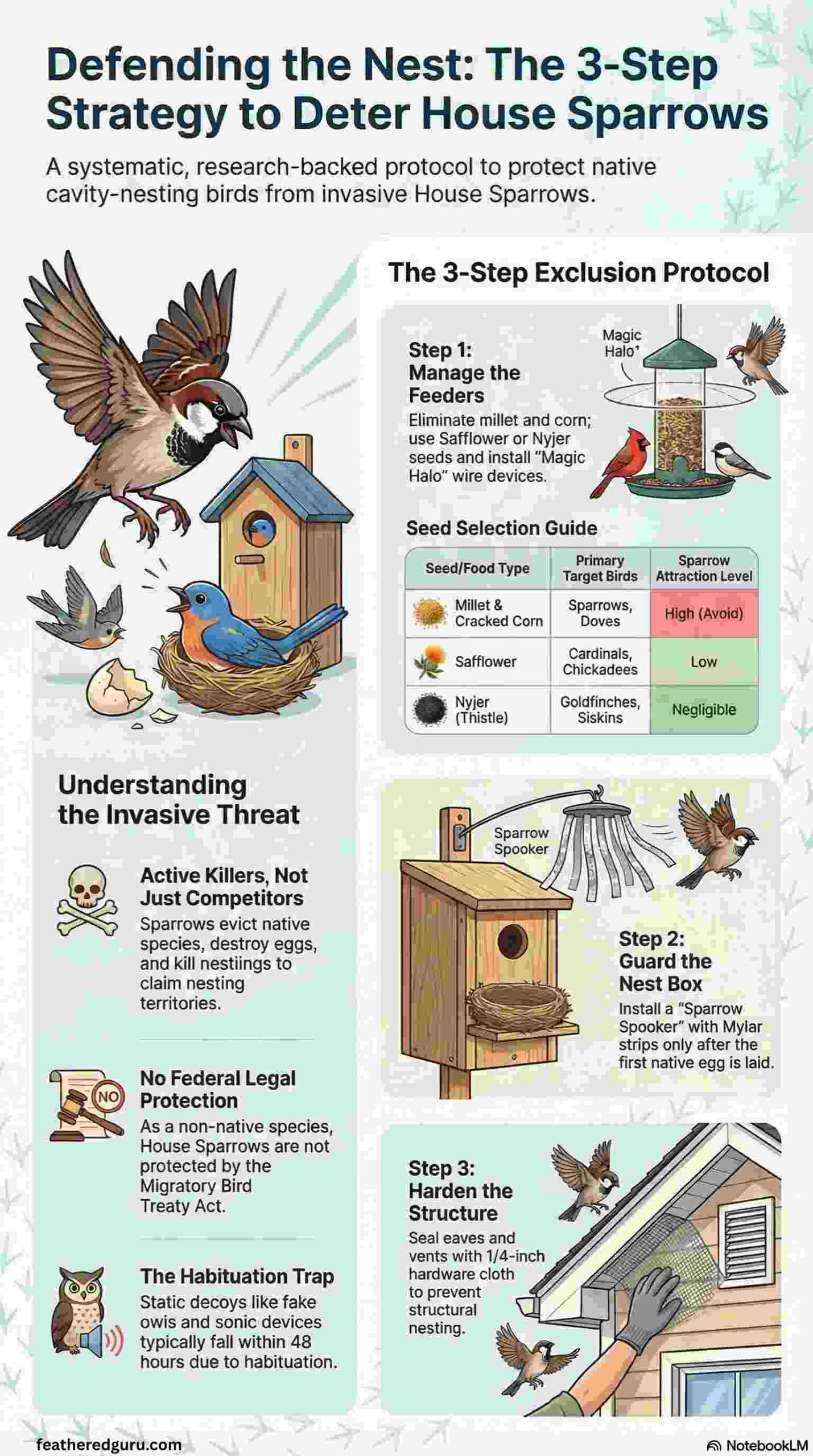
The 3-Step Exclusion Protocol: Selective Feeding, Mechanical Guards, Structural Sealing
Step 1: Selective Feeding. Remove millet, milo, and cracked corn from all feeders immediately. Replace with safflower, nyjer, suet, or shelled peanuts. Install a Magic Halo monofilament device over all hanging feeders. Install weight-sensitive tube feeders for small native species. Accept that juvenile House Sparrows will not be deterred by the halo, and plan to take feeders down between late spring and early fall if juvenile populations are high.
Step 2: Mechanical Guards on Nest Boxes. Install a Sparrow Spooker immediately after the first native bird egg is laid in any bluebird or swallow box. Remove it as soon as the brood fledges and clean the nest at the same time. Monitor boxes every 3 to 5 days during the breeding season and remove any House Sparrow nest material before eggs are laid. Consider Gilbertson PVC boxes as a passive deterrent in high-sparrow areas. Place any new boxes more than 100 meters from buildings.
Step 3: Structural Sealing. Install 1/4-inch hardware cloth over all eave gaps, AC unit openings, and structural voids accessible to sparrows before the nesting season begins. Install louvered metal dryer vent covers over exhaust vents. Remove any House Sparrow nest material from structural sites consistently before egg-laying begins. Do not use sonic or ultrasonic devices as a primary control method: they will provide no meaningful deterrence beyond the first week of use.
These three steps, applied in combination and maintained consistently across the breeding season, represent the most effective non-lethal approach to House Sparrow management currently available.
For the complete picture of House Sparrow natural history and behavior that underlies the management decisions above, the comprehensive resource on House Sparrow habitat and behavior covers the species’ year-round ecology in suburban environments.
The Deterrence Roadmap: Your 2026 Visual Strategy
For a visual synthesis of the mechanical and structural defenses covered in this guide, refer to our Interactive Roadmap below. This infographic maps out the exact tools, placement metrics, and seasonal timing required to secure your feeders and nest boxes in one unified view.
Conclusion: Reclaiming the Sanctuary
Deterring House Sparrows is not a “one-and-done” project, but a commitment to active sanctuary management. By shifting from passive bird feeding to a systematic exclusion strategy, you provide native species like Bluebirds and Tree Swallows with the structural advantage they need to thrive.
Whether you are installing a Magic Halo on your feeders, deploying a Sparrow Spooker on a nest box, or sealing residential eaves with hardware cloth, these interventions work because they exploit the specific behavioral weaknesses of this invasive species.
While the persistence of House Sparrows can be frustrating, the success of your local bird population depends on these deliberate, science-based actions. By following the three-step exclusion protocol and maintaining a consistent monitoring schedule, you move beyond a simple backyard hobby and become a primary defender of North American avian diversity.