
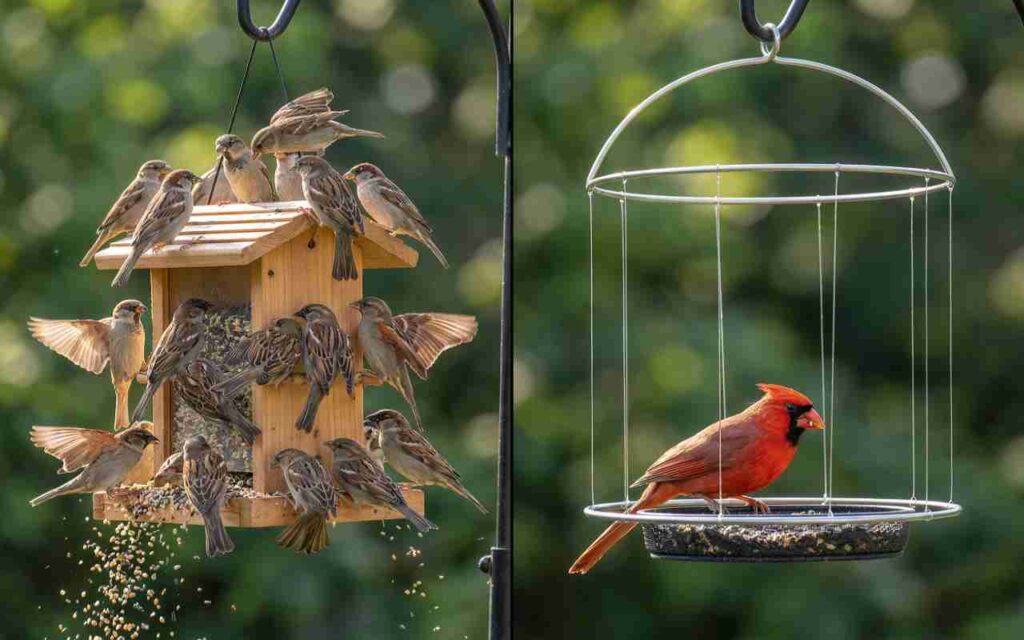
You fill the feeder on Monday morning. By Tuesday afternoon, it is empty. Not because the cardinals and chickadees found a bonanza, but because a flock of 30 House Sparrows discovered it and stayed. They are perched on every port, clustered on the ground below, and watching from the hedges. The birds you actually want to feed have given up and moved on.
This is a classic feeder takeover, and learning how to keep House Sparrows away from feeders is one of the most common frustrations in backyard birding across North America. These birds (Passer domesticus) are among the continent’s most abundant and aggressive visitors. Standard deterrence, like hanging flashy tape or spraying water, almost always fails within days.
Understanding why it fails, and what actually works, is the difference between reclaiming your sanctuary and spending another season watching sparrows drain your seed budget while your target species eat elsewhere.
Quick Answer: The 2026 Feeder Defense Reset
To immediately stop a House Sparrow takeover, implement a two-step reset: switch your primary feeder to safflower seed and install a Magic Halo (weighted monofilament lines). This combination exploits the sparrow’s aversion to bitter shells and vertical obstacles, deterring 86%–95% of adult sparrows while allowing cardinals, finches, and chickadees to feed normally. Clean all ground spillage and remove millet-based mixes to break the flock’s site fidelity within 48–72 hours.
The Science of Exclusion: An Expert Visual Strategy
If you prefer a step-by-step visual breakdown of the “Physics of Fear” and how to properly configure your backyard sanctuary, watch our detailed video guide below. This video maps out exactly how House Sparrows exploit your feeding station, and the precise mechanical and spatial steps required to reclaim it.
Show Transcript:
0:00
So, I had this vision. I put up a bird feeder in my backyard and imagined bright red cardinals, colorful finches, and cheerful chickadees showing up every day. Instead, my feeder turned into an all-day party for one bird only, the house sparrow.
0:08
Have you ever had that happen? You put out great bird seed and one species shows up with a whole flock. My peaceful backyard bird setup quickly became a loud, chaotic sparrow takeover.
0:26
It felt less like a nature retreat and more like a nonstop sparrow convention. I was frustrated, but also curious. Why were house sparrows dominating my feeder?
0:40
What was it about my bird feeding setup that made it so attractive? I had a real house sparrow problem, and I needed to figure out why.
0:53
Every morning it was the same pattern. Sunrise meant sparrows everywhere. They scattered seed, bullied other birds, and completely took over the feeder.
1:04
It was a full monopoly. So I decided to crack the seed code. If I wanted to fix my backyard bird problem, I had to start with the food.
1:12
I grabbed my bag of bird seed, that generic mix, and looked closely. It was packed with tiny pale seeds. That detail turned out to be the key.
1:23
Those seeds were white proso millet, and that was my first big realization. I was not just feeding birds. I was serving house sparrows their favorite food.
1:41
Research confirmed it. House sparrows have a very high preference for millet. They seek it out first and ignore other seeds.
1:54
I was not imagining things. My feeder had become a millet magnet. I was attracting sparrows on purpose without even knowing it.
2:02
Studies show house sparrows actively search for millet because it is their top commercial seed choice. I had created the perfect feeding station for them.
2:10
Then I found an even more surprising fact. By late winter, nearly 90 percent of their diet can come from feeders like mine.
2:22
That changed everything. My bird feeder was not just a snack spot. It was a winter survival station for house sparrows.
2:31
The deeper I looked, the more I realized this was not just about my yard. House sparrow feeding habits are closely tied to humans.
2:44
They are what scientists call a commensal species. That means they benefit from living alongside humans and using our resources.
2:59
House sparrows have adapted perfectly to human environments. You see them everywhere, from outdoor cafes to parking lots, feeding on scraps and insects.
3:16
They are opportunistic feeders, using spilled grain, livestock feed, and urban food sources. This behavior has been documented for over a century.
3:30
Historical studies show that most of their diet has long been tied to human activity. They have been following us and feeding alongside us for generations.
3:48
At this point, I thought I understood them. They were seed eaters that thrived on human food sources. Simple enough.
3:56
But then I found the biggest surprise of all. It completely changed how I looked at house sparrow feeding behavior.
4:03
Adult house sparrows eat mostly seeds and grains. But their nestlings require a completely different diet.
4:12
Baby sparrows depend almost entirely on high protein insects. For the first few days, up to 90 percent of their diet is insects.
4:26
That means adult sparrows switch roles during breeding season. They go from seed eaters to active hunters, collecting insects like caterpillars and beetles.
4:40
This is critical. No matter how much seed is available, if there are not enough insects, their population cannot grow.
4:50
Insects are the limiting factor for reproduction. That is the bottleneck that controls house sparrow population growth.
5:04
Once I understood the full picture, I knew exactly how to fix my feeder problem. The solution was simple. I needed to change the menu.
5:20
I did not need gimmicks or scare tactics. I just needed to stop offering their favorite foods.
5:24
Research showed that house sparrows avoid certain seeds. One of the best options is safflower seed, which has a bitter taste and thick shell.
5:32
Another is niger seed, also called thistle. It is very small and difficult for sparrows to eat with their beak shape.
5:42
So I made three simple changes. First, I removed all millet and cracked corn from my feeders.
5:47
Second, I switched to safflower seed, which attracts cardinals and finches but discourages sparrows.
5:55
Third, I added a separate niger seed feeder to attract goldfinches and other small birds.
6:04
By changing the food, I changed the entire dynamic of my backyard bird feeding setup.
6:12
Now I see their behavior clearly throughout the year. In warmer months, they hunt insects for their young. In winter, they search for high energy seeds to survive.
6:23
That is why they were overwhelming my feeder during cold months. It all made sense once I understood their feeding strategy.
6:29
And the best part is, it worked. The change was immediate and noticeable.
6:36
House sparrows did not disappear completely, but they stopped dominating. My backyard became more balanced and welcoming to other bird species.
6:45
What started as frustration turned into a deeper appreciation. House sparrows are incredibly adaptable and successful birds.
6:52
They are often described as masters of living alongside humans. That idea really stuck with me.
6:59
In the end, the question is not just how to stop house sparrows. It is how much space we are willing to share with them in our backyard bird habitat.
Why House Sparrows Take Over: The Scout and Swarm Dynamic
House sparrows are intensely social foragers with a recruitment system that makes them extraordinarily effective at exploiting reliable food sources. Understanding how that system works is the first step toward disrupting it.
When an individual house sparrow discovers a feeder, it does not simply eat quietly. Research published in Behavioral Ecology and Sociobiology (Springer) found that lone “pioneer” sparrows vocalize with chirrup calls to recruit others to food sources, establishing group foraging rapidly once a site is deemed safe.
The more birds arrive, the more calls are broadcast. Within hours, a single scout bird can anchor an entire flock to your feeding station. Once the flock is established, it self-reinforces. Cornell Lab of Ornithology’s All About Birds documents that house sparrows are highly social, forming crowded feeding flocks with well-developed dominance hierarchies.
Dominant males with larger black throat badges claim the best feeding positions and displace subordinates. This layered social structure means the flock operates with coordinated vigilance: while some birds feed, others watch for danger and broadcast alarm calls.
This is precisely why simple scare tactics fail so quickly. A hawk silhouette or a sudden noise triggers an alarm response and clears the feeder momentarily. But the flock lands in nearby shrubs, watches, and returns within minutes once they confirm the threat is not real.
Repeated false alarms simply habituate the birds. What works instead is restructuring the food environment so that the feeder itself is no longer worth the flock’s attention.
Seed Chemistry: The No-Fly Zone Nutritional Strategy
The Repellent Seed Profile: Safflower and Nyjer
The most durable form of sparrow control starts with what you put in the feeder. House sparrows are generalist granivores with strong preferences for small, thin-shelled seeds like millet, cracked corn, and white proso millet. Shifting away from these toward seeds that sparrows either cannot process efficiently or actively dislike changes the nutritional calculus of your feeding station.
Safflower (Carthamus tinctorius) is the most widely recommended sparrow-discouraging seed for standard feeders. Its thick white shell and slightly bitter flavor make it a reluctant choice for most house sparrows, while cardinals, house finches, chickadees, titmice, and nuthatches readily accept it.
As Cornell Lab of Ornithology’s seed guide notes, house sparrows, European starlings, and squirrels generally avoid safflower, though in some areas where food is scarce, local populations have learned to accept it. This regional variation means safflower works best as part of a layered strategy rather than as a single solution.
Nyjer (also called nyger or thistle seed), a tiny black seed from the African plant Guizotia abyssinica, is a powerful selective tool because its value is tied to feeder design. Nyjer can only be extracted efficiently from feeders with very small mesh openings or narrow ports.
House sparrows have beaks too wide to pull nyjer through standard finch feeder ports, making nyjer-in-finch-feeders one of the cleanest exclusion solutions available. Birds and Blooms magazine confirms that bully birds, including grackles, starlings, and house sparrows, tend to leave thistle seeds alone when served in purpose-built finch feeders.
The Shell-Cracking Lockout: Striped Sunflower
If you are not ready to abandon black oil sunflower entirely, switching to striped sunflower seed provides meaningful friction. Striped sunflower seeds have significantly thicker shells than black oil varieties. House sparrows and blackbirds have considerably more difficulty cracking them than the small-billed finches and titmice that are your target species.
Cornell Lab’s seed guide is direct on this point: if you are inundated with species you would rather not subsidize at your black oil sunflower feeder, switching to striped sunflower is the first thing to try before any other intervention.
The energy cost of processing striped sunflower is high enough relative to the reward that sparrows often abandon these feeders in favor of easier food nearby.
Purging the Millet Magnet
White proso millet is the house sparrow’s favorite seed. It is small, thin-shelled, and easy to consume in large quantities quickly. It also appears in virtually every cheap mixed seed blend sold at grocery stores and big-box retailers, usually labeled as “wild bird food” or “backyard blend.”
Eliminating millet from your feeding station is non-negotiable for serious sparrow management. Check the ingredient list on every bag before purchasing. If millet, cracked corn, or sorghum appear in the first three ingredients, the blend will anchor house sparrow flocks to your yard.
The birds that actually benefit from millet, including native sparrows, juncos, and mourning doves, are all equally attracted to black oil sunflower, so no target species is lost by eliminating millet from elevated feeders.
Mechanical Forensics: The Physics of Feeder Exclusion
The Magic Halo: Placement and Effectiveness
The Magic Halo is the most research-backed mechanical deterrent available for house sparrows at elevated feeders. Originally developed and patented by researchers at the University of Nebraska, the device consists of a 28 to 30-inch diameter wire ring suspended horizontally above the feeder, with optional weighted wires hanging down from the ring to below the feeder’s perch level.
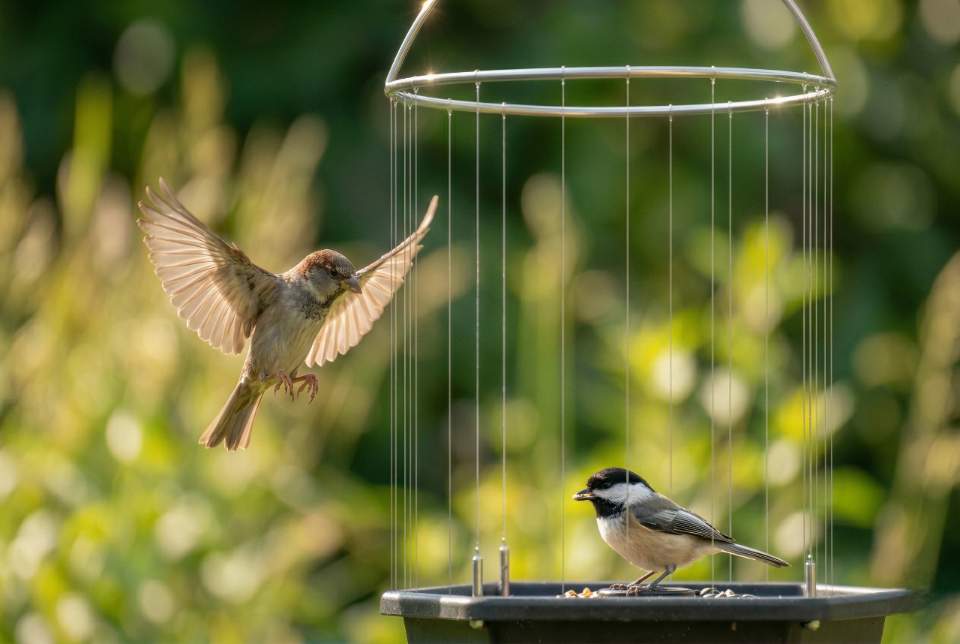
As clearly seen in the comparison above, the Magic Halo functions as a “Passive Shield” because it relies on the specific flight psychology of the target species. The mechanism exploits a behavioral difference between house sparrows and most desirable species.
House sparrows are highly alert to obstacles near food sources because their survival strategy depends on rapid escape from the feeder when threatened. The hanging wires are perceived as a potential hindrance to fast exit.
Project FeederWatch’s analysis of the University of Nebraska research found a significant reduction in house sparrow visits and confirmed that the effect appears to be species-specific: finches, cardinals, and native sparrows are largely unperturbed by the wires.
Effectiveness data from user surveys collected by halo manufacturers and aggregated by Sialis, the bluebird monitoring resource, indicates an 88 to 94% deterrence rate for adult house sparrows in winter and approximately 84% in summer. Summer rates are lower because juvenile sparrows, which have not yet learned predator-avoidance responses, do not recognize the wires as a threat.
The wires should be spaced approximately 12 inches apart and weighted at the bottom so they hang straight. Use hobby wire rather than fishing line: fishing line can entangle incoming birds, which hobby wire will not.
The Upside-Down Suet Strategy
House sparrows are poor clingers. Unlike woodpeckers, nuthatches, and chickadees, which can feed comfortably while hanging in any orientation, sparrows strongly prefer flat surfaces or perches where they can stand upright. Upside-down suet feeders, in which the suet cake is presented from below rather than above, exploit this anatomical limitation directly.
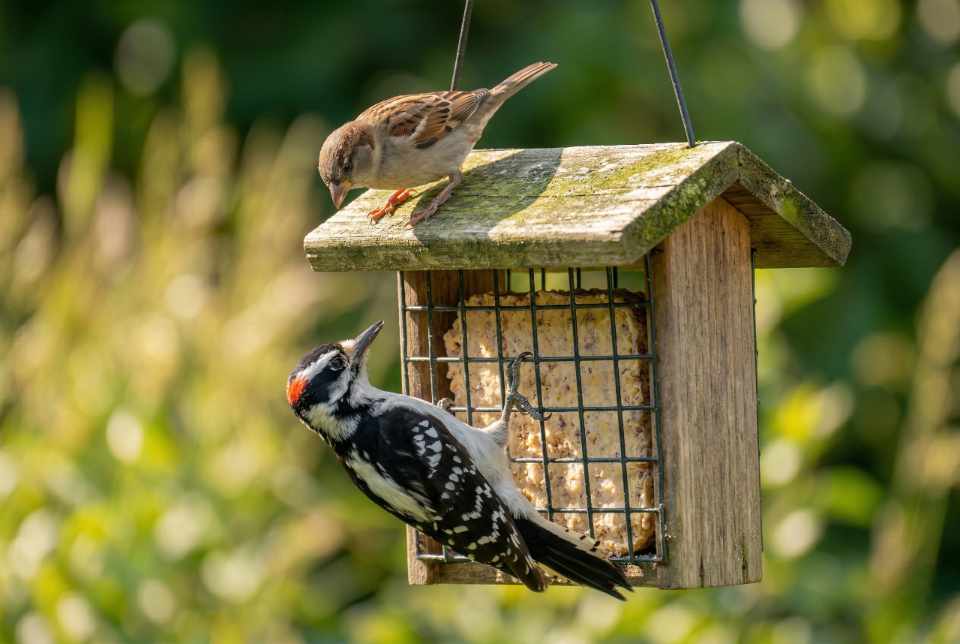
As clearly seen in the comparison above, a standard suet cage with the entry point on the bottom requires birds to cling upside down to feed. Native species like woodpeckers, nuthatches, and chickadees do this effortlessly, while House Sparrows lack the specialized anatomy to sustain it and typically abandon these feeders quickly.
Half-filling the cage rather than stuffing it to the edge makes the food even more inaccessible to any bird that cannot hang below the feeder.
Weight-Sensitive Feeder Calibration
Squirrel-proof feeders that close under excess weight can be calibrated to exclude sparrow flocks as well. A single house sparrow weighs roughly 27 to 30 grams, well below the threshold of most squirrel-exclusion systems. But a cluster of four or five sparrows landing simultaneously can exceed the closure threshold of a feeder set at the low end of its sensitivity range.
Experiment with tightening the spring tension or lowering the weight threshold on adjustable weight-sensitive feeders until the ports close when two or three sparrows attempt to feed simultaneously.
Most chickadees, titmice, and finches visit feeders individually or in pairs rather than in the mass clusters sparrows use, so tighter calibration discriminates against sparrow feeding behavior without significantly affecting target species.
Ground-Zero Hygiene: Stopping the Spillover Effect
The single most overlooked element in feeder sparrow management is what happens on the ground. Even a perfectly optimized elevated feeder creates a ground-level food source through spillage, and that ground buffet is often what keeps a sparrow flock anchored to your yard.
House sparrows are highly comfortable ground foragers. A flock that cannot access your elevated feeder will simply shift to feeding on the spillage below it, maintaining its presence in your yard and continuing to broadcast recruitment calls that draw additional birds. Unless the ground supply is eliminated, the elevated feeder exclusion strategy is only partially effective.
Tray catchers and seed hoops that attach below the feeder to catch falling seed solve this problem by intercepting spillage before it reaches the ground. The caught seed is then available only to birds that can access the tray, which can itself be designed to exclude sparrows. Seed hoops with mesh bottoms allow rain drainage while keeping seed above ground level.
Switching to shelled sunflower hearts eliminates the debris problem at its source. Sunflower hearts generate no shell litter because they have already been processed. Birds that eat them at the feeder produce no waste worth foraging for on the ground.
This is the cleanest solution to the ground buffet problem and has the added benefit of attracting a high volume of target species, including goldfinches, house finches, chickadees, and titmice, that readily eat hearts but who compete poorly against massed sparrow flocks for whole seeds.
Spatial Deterrence: The 30-Foot Placement Rule
The Buffer Zone: Moving Feeders Away from Nesting Cover
Feeder placement relative to nesting and roosting cover is a major determinant of house sparrow pressure that most birders never consider. House sparrows nest and roost in dense hedges, shrubs, vines against buildings, and especially in building eaves and vents near human structures.
A feeder placed within 10 to 15 feet of these cover sites is essentially located inside the sparrow colony’s home range. Displacement requires almost no energy cost for the birds and is therefore almost impossible to achieve.
Moving feeders at least 25 to 30 feet from dense hedges, building eaves, and shrub masses increases the risk exposure of sparrows traveling to the feeder and removes it from the zone of immediate flock awareness.
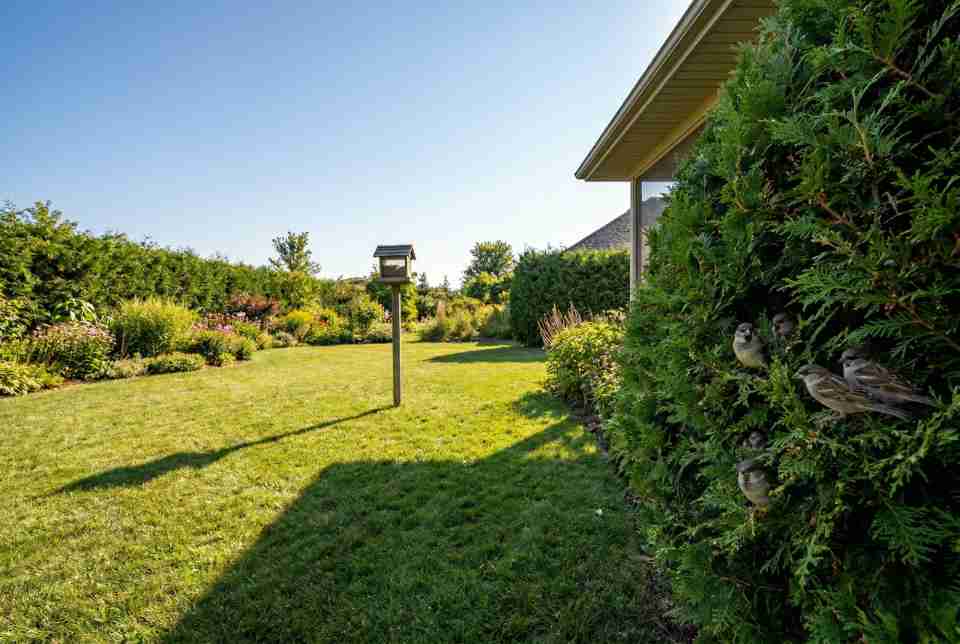
As clearly seen in the spatial blueprint above, birds already nesting or roosting within that cover continuously monitor the area immediately around them. Feeders placed outside that radius require the flock to make a deliberate foraging trip rather than simply dropping from a hedge two feet away.
The Decoy Station: Pulling the Flock Away
One of the most counterintuitive but effective spatial strategies is setting up a dedicated sparrow feeding station at the far end of your yard, at least 80 to 100 feet from your primary feeder, and loading it with exactly the foods sparrows prefer: millet, cracked corn, and cheap mixed seed. This is sometimes called the Robin Hood method, giving cheap food to the sparrows to keep them away from the expensive quality feeder.
The logic is sound: house sparrows establish feeding site fidelity quickly. If the decoy station is discovered first, or is consistently more productive for sparrows, the flock centers on it rather than your primary station.
The decoy should be at ground level or on a low platform, which matches sparrow ground-foraging preferences. Keep it stocked consistently so the flock has no incentive to explore elsewhere.
Our guide to how to deter house sparrows covers the full spatial management protocol including decoy placement geometry.
Troubleshooting: When the Sparrows Still Won’t Leave
If you have implemented seed changes, a halo device, and spillage management and still have persistent house sparrow pressure, you are likely dealing with a super-colony: a large established flock with a deeply embedded site memory for your feeding station.
Super-colonies form when house sparrows have been breeding in or directly adjacent to your yard for multiple generations. These birds have never known a time when your feeder was not a food source.
They are also highly social learners. Juveniles raised within sight of your feeder will continue returning even after adults have been partially deterred, and the juveniles that overcome the halo wires teach that tolerance to others.
The most effective intervention for an established super-colony is a complete feeder blackout. Remove all feeders from the yard for a minimum of 5 to 7 days, ideally 10 to 14. This severs the flock’s learned association between your yard and food.
After the blackout, return a single feeder loaded with safflower or nyjer and fitted with the halo. Reintroduce additional feeders one at a time over the following two weeks, monitoring sparrow response at each stage. Most observers who implement the full blackout reset report dramatically lower sparrow pressure on resumption.
Also examine your nesting infrastructure. Sparrows nesting in your building’s eaves, vents, or dense climbing vines create a permanent feeder audience that no deterrent strategy will fully overcome.
Exclusion of nest sites, by blocking open vents with hardware cloth and removing nest material promptly before incubation begins, is a legal management option for house sparrows, which unlike native species are not protected under the Migratory Bird Treaty Act.
Our guide to house sparrow habits covers the nesting biology and the legal management options in detail.
The 2026 Feeder Defense Checklist
| # | Strategy | Action & Forensic Benefit |
|---|---|---|
| 1 | Dietary Lockout | Remove all millet and cracked corn to eliminate the “Millet Magnet” that triggers the Scout and Swarm dynamic. |
| 2 | Seed Chemistry | Switch to safflower or nyjer to exploit the sparrow’s aversion to bitter shells and wide-beak mechanical limitations. |
| 3 | Mechanical Shield | Install a Magic Halo with hanging weighted wires to create a psychological “No-Fly Zone” for alert sparrows. |
| 4 | Anatomical Barrier | Use Upside-Down suet feeders to physically exclude sparrows, which lack the rear-toe strength for sustained clinging. |
| 5 | Ground Hygiene | Install tray catchers and use shelled sunflower hearts to eliminate the “Ground Buffet” that anchors the flock. |
| 6 | Spatial Buffer | Move feeders 30+ feet from dense cover to remove them from the colony’s immediate home range. |
| 7 | Decoy Strategy | Set a millet-heavy decoy station 80–100 feet away to redirect the flock’s site fidelity to a remote location. |
| 8 | System Reset | Execute a 10-day feeder blackout for super-colonies to sever the flock’s learned association with your yard. |
The Deterrence Roadmap: Your 2026 Visual Strategy
For a visual synthesis of the mechanical, chemical, and spatial defenses covered in this guide, refer to our Interactive Roadmap below. This infographic maps out the exact placement metrics, seed choices, and seasonal timing required to secure your feeders and nest boxes in one unified view.
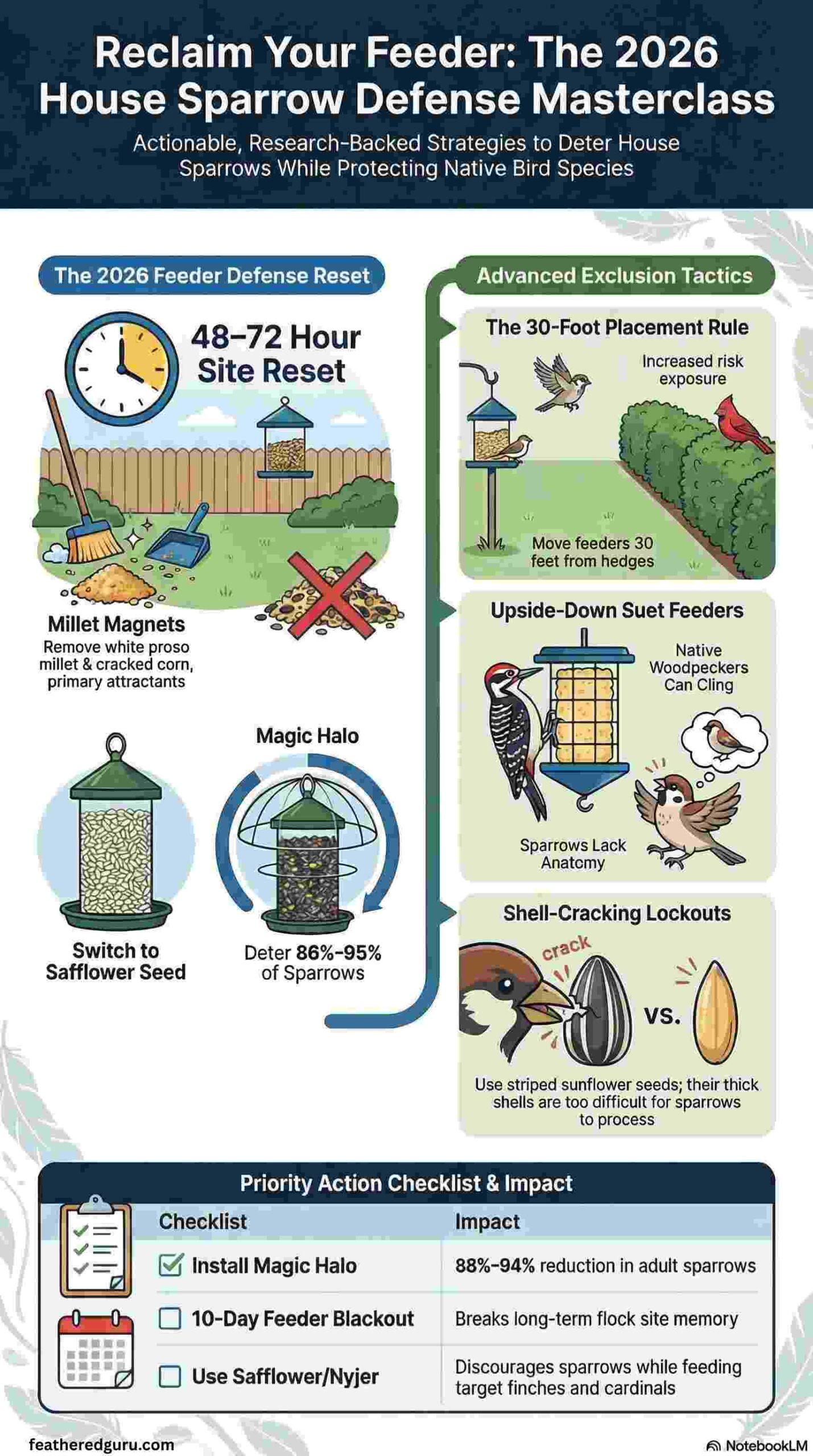
Reclaiming Your Backyard Sanctuary
House sparrow feeder takeovers feel intractable because they involve a species that is behaviorally sophisticated, socially coordinated, and deeply adapted to human environments. Standard scare approaches fail because they address the symptom, the birds at the feeder, rather than the system, the flock’s food economy and spatial territory.
The defense strategy in this guide addresses both. By changing what food is offered, how the feeder is mechanically configured, where ground spillage goes, and where in your yard the feeder sits, you alter the cost-benefit calculation for the sparrow flock as a whole. At some threshold of combined deterrence, your feeder is simply no longer worth the flock’s time and attention compared to the decoy station or another nearby food source.
None of these measures are 100% permanent. House sparrows are adaptive learners. Juveniles raised in your yard will probe your defenses with less caution than adults. The halo’s effectiveness may drift during breeding season. Consistent maintenance of the full strategy, particularly the seed hygiene and spillage management components, is what separates lasting results from temporary relief.
For the full context on what house sparrows eat, how their territorial behavior shapes feeder dynamics across the year, and which native species they most aggressively displace, our guide to house sparrow habits covers the behavioral ecology behind every recommendation in this article.
And if you are managing feeders for specific target species that sparrows are most aggressively crowding out, our guides on how to attract tufted titmice and preventing finches from being bullied cover species-specific feeder design that complements the sparrow exclusion strategy.