
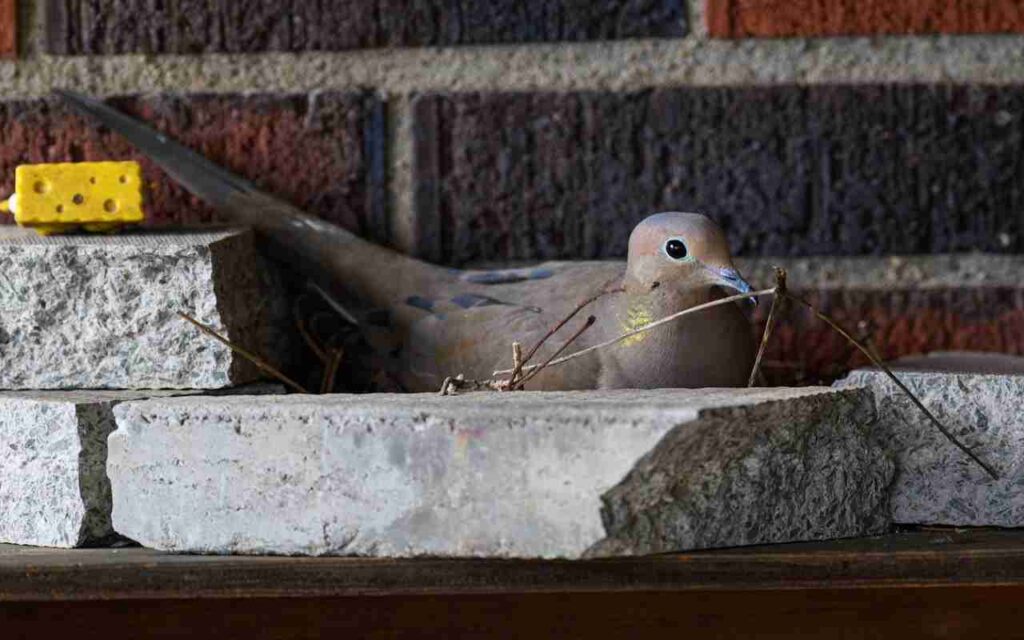
The Mourning Dove is one of the most abundant birds in North America, with a U.S. population estimated at around 350 million. Yet for all their familiarity, mourning dove nesting habits remain widely misunderstood by the very suburban homeowners who host them every spring.
The nest looks careless. The location often seems random. The whole operation appears to be over in days. But every decision the Mourning Dove makes during the nesting cycle is a studied response to predation pressure, wind exposure, and the caloric demands of raising multiple broods in a single season.
Suburban environments have become genuine strongholds for this species. Understanding why, and how to support the birds nesting in your yard, starts with the science behind the choices that look careless but rarely are.
Quick Answer: How do mourning doves nest?
Mourning doves build a flimsy twig platform in 2 to 4 days, typically laying 2 white eggs that fledge in 14 days. Parents share incubation duties: males sit during the day and females at night. In warm climates, they can raise up to 6 broods per year. Note: Active nests are strictly protected under the Migratory Bird Treaty Act and cannot legally be moved or disturbed.
Decoding Suburban Success: A Visual Guide to Mourning Dove Nesting
To help you visualize the sophisticated construction logic and unique reproductive biology of this species, we have included an educational video explainer below. This analysis deconstructs the metabolic math and structural adaptations that allow mourning doves to achieve a 60.9% nesting success rate on artificial substrates.
Show Transcript:
0:00
Have you ever watched mourning doves in your backyard and noticed their nests look… terrible? Loose twigs, flimsy structure, sometimes barely holding together. It almost looks lazy. But what if that messy design is actually a smart survival strategy?
0:16
Mourning dove nests may look poorly built, but there’s a hidden purpose behind them. These birds aren’t trying to create strong, long-lasting nests. Instead, they rely on speed, efficiency, and smart placement to survive and reproduce successfully.
0:28
Take a closer look at a mourning dove nest. It often looks like a random pile of twigs, sometimes so thin you can see through it. At first glance, it seems like bad design. In reality, it’s a deliberate adaptation that helps these birds thrive in both natural and suburban environments.
0:50
This simple platform is the key to why mourning doves are so common across North America. Their nesting strategy focuses on building quickly, working as a team, and choosing locations that maximize survival rates.
1:06
As biologist Vince Croce explains, this isn’t carelessness. It’s a calculated trade-off. Every twig placed in that fragile nest serves a purpose in a larger survival plan focused on speed and reproduction.
1:28
For mourning doves, time is everything. They are not building permanent homes. They build fast, breed quickly, and move on. Their entire nesting strategy is based on rapid reproduction rather than long-term durability.
1:45
The nest-building process is surprisingly efficient. The male gathers twigs one at a time and delivers them, often standing on the female’s back to pass them along. The female then carefully arranges each twig into place, creating a functional nest in just 2 to 4 days.
2:09
The result is a minimalist structure designed to hold two eggs and later two chicks. It’s not meant to be comfortable or sturdy. It’s simply a temporary launchpad for raising young as quickly as possible.
2:24
This focus on speed has a huge payoff. Because they build nests so quickly, mourning doves can raise up to six broods in a single season in warmer climates. That’s more than most native backyard birds.
2:43
If a nest fails due to weather or predators, it’s not a major setback. Mourning doves can rebuild and lay new eggs within days. Their strategy is based on repetition and resilience rather than perfection.
3:00
This fast breeding cycle only works because both parents are highly coordinated. From egg-laying to fledging, the entire process takes about 30 days, making it one of the most efficient reproductive cycles among birds.
3:12
The timeline is rapid. Incubation lasts around two weeks, followed by another two weeks before the chicks, known as squabs, leave the nest. Everything happens quickly to maximize survival.
3:29
Both parents share responsibilities. The male typically incubates during the day, while the female takes over at night. This constant care keeps the eggs protected and stable.
3:53
Another key advantage is how they feed their young. Mourning doves produce crop milk, a nutrient-rich substance that both parents create. This allows them to raise chicks even when insects and seeds are scarce.
4:13
Crop milk is high in protein and fat, helping chicks grow rapidly. This gives mourning doves the ability to start nesting earlier in the season compared to many other bird species.
4:29
So why do mourning doves often build nests on houses, gutters, or porch lights? It’s not random. They are actively choosing these locations because they offer better survival odds.
4:42
Backyards are a perfect example of what ecologists call edge habitat, where open space meets shelter. These environments provide ideal nesting conditions and easy access to food.
4:50
Studies show that a large percentage of mourning dove nests are found in suburban areas. Human structures provide stability and protection that natural branches sometimes cannot.
5:01
Research has shown that nests built on artificial structures have higher success rates than those in trees. Solid surfaces like ledges and gutters don’t sway in the wind and often provide better protection from predators.
5:26
Buildings also offer cover from rain and make it harder for predators like raccoons or cats to reach the nest. In many cases, your home is actually a safer nesting site than a tree.
5:42
This means we’ve unintentionally created ideal nesting environments for mourning doves. The question is how to coexist without disrupting them.
5:52
The most important rule is to avoid drawing attention to the nest. Predators such as crows and jays watch human behavior and may follow repeated activity to locate nests.
6:06
If you check on a nest, keep it brief and infrequent. Avoid visiting more than once every few days, and limit your time near the nest to reduce risk.
6:23
It’s also important not to interfere. Do not try to fix or reinforce a mourning dove nest. Even if it looks fragile, it is functioning exactly as intended.
6:31
One of the most common mistakes involves baby birds. When a young mourning dove leaves the nest, it often cannot fly well yet and may appear helpless on the ground.
6:35
In most cases, the bird is not abandoned. A parent is usually nearby, continuing to feed and protect it. Intervening can actually reduce its chances of survival.
6:52
The best approach is to leave the bird alone and allow the parents to do their job. вмешoring often does more harm than good.
7:00
The next time you see a messy mourning dove nest in your yard, you’ll understand what it really represents. It’s not poor construction—it’s a highly effective survival strategy.
7:05
What looks like a weakness is actually a strength. Mourning doves succeed because they prioritize speed, efficiency, and adaptability, turning even the simplest nest into a powerful tool for survival.
The Suburban Advantage: Why Doves Choose Artificial Structures
The 60.9% vs 44.2% Success Metric: Man-Made Ledges Outperform Natural Trees
The idea that Mourning Doves nesting on gutters, eaves, and porch ledges are making a poor choice is not supported by the research. The data shows the opposite.
A study published in the Proceedings of the Iowa Academy of Science by Gary Nelson (1976) tracked 293 nesting attempts across both artificial and natural nest sites in central Minnesota. Of 69 attempts in artificial nests, 60.9% were successful. Of 224 attempts in natural nests, only 44.2% succeeded. The difference was statistically significant.
The artificial nest advantage came primarily from reduced predator access and improved structural stability. A flat ledge 10 feet above a porch is far harder for raccoons, snakes, and corvids to access than a horizontal branch in a shrub at the same height.
Edge Habitat Preference: Where Doves Choose to Nest
The suburban preference makes biological sense when viewed through the lens of habitat edge research. A study published in the Journal of Field Ornithology by Drobney, Schulz, Sheriff, and Fuemmeler (1998) radio-tracked 59 breeding doves across central Missouri and found that 81.9% of all 83 monitored nests were located in edge habitats rather than continuous woodland or open field interiors.
Suburban yards are essentially engineered edge habitat: the transition zone between a structure, landscaping, and open sky that Mourning Doves select for repeatedly. This is not a species tolerating human environments. It is a species for which human-modified landscapes often represent optimal nesting conditions.
Substrate Selection: Gutters, Eaves, and the Porch Ledge Phenomenon
Cornell Lab of Ornithology’s Mourning Dove life history account documents that the species will nest on gutters, eaves, and abandoned equipment, entirely unbothered by nesting close to humans. This is not opportunism. It is a deliberate evaluation of structural stability and predator exposure.
In urban and suburban environments, doves also use window ledges, air conditioning units, hanging flower pots, and the flat tops of outdoor light fixtures. Any horizontal surface with a slight lip to prevent nest drift, placed at moderate height with partial overhead cover, fits the template they are looking for.
The porch ledge is particularly attractive because the overhang above it provides rain protection, human activity below deters ground predators, and the structure itself does not sway in wind the way a tree branch does.
The Information Gain: Stable Platforms, Not Lazy Building
Mourning Doves are often described as poor nest builders. The nest is flimsy, loosely constructed, and so thin that eggs are sometimes visible through the base from below. This description is accurate but the interpretation is wrong.
The flimsy construction is a deliberate strategy for a species that raises multiple broods per season. Time spent on elaborate nest construction is time not spent on the next clutch. The speed of the build is the feature, not the flaw.
And on a stable artificial platform, the structural shortcomings of the nest matter far less. The twig platform that would blow off a thin pine branch in a summer storm sits perfectly still on a gutter bracket or ledge. The platform is not compensating for bad construction. It is upgrading the substrate the construction sits on.
Behavioral Forensics: The 4-Day “Flimsy” Nest Build
The Construction Logic: One Twig at a Time
Cornell Lab’s life history account documents the nest construction process precisely: over 2 to 4 days, the male carries twigs to the female, passing them to her while standing on her back. The female weaves them into a nest about 8 inches across.
The male brings one twig at a time. Each delivery is accompanied by a ritual of caresses, soft cooing, and mutual preening documented in Flathead Audubon Society’s behavioral observations of the species. The female then weaves each stem into the platform one by one while remaining at the nest site.
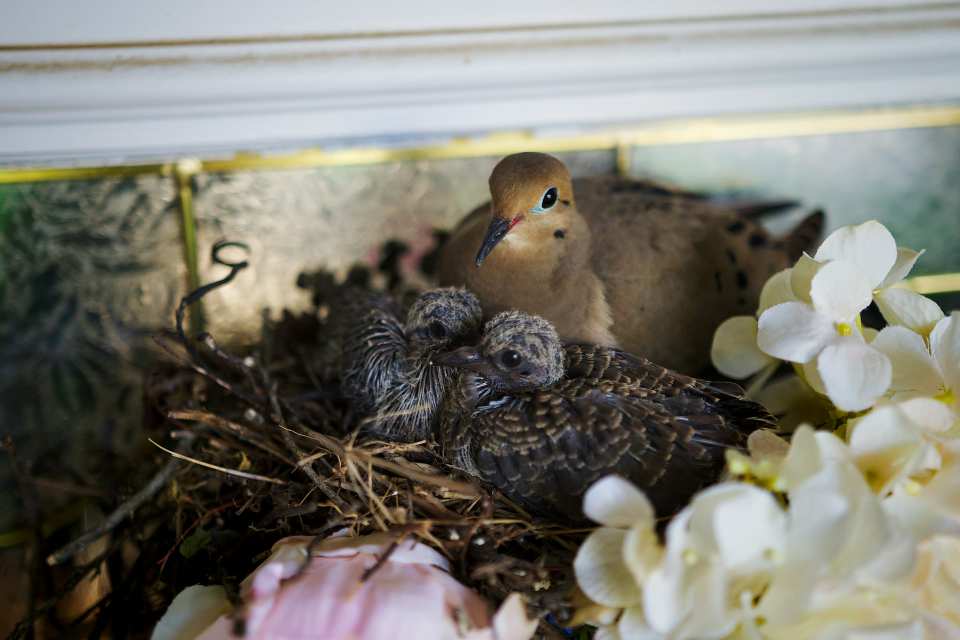
The nest is unlined because the eggs do not require insulation. One parent sits on the nest at all times during incubation, maintaining egg temperature through body contact rather than a thick insulating cup. The absence of lining is a consequence of continuous parental presence, not an oversight.
Because the nest is always occupied by one parent during incubation, the white, unspeckled eggs do not require camouflage. Most birds lay cryptically colored eggs specifically to reduce predator detection during periods when the nest is left unattended.
The Mourning Dove’s white eggs are a direct reflection of the pair’s commitment to never leaving the nest uncovered, a behavioral adaptation that compensates for the nest’s structural simplicity.
Renesting Speed: A New Clutch Within Days of Fledging
Audubon Society’s documented facts on Mourning Doves confirm that in warm climates a pair can raise as many as six broods in a single year. This extraordinary pace is made possible by the overlap built into their reproductive cycle.
The female begins preparing for the next brood at roughly the 12-day mark of the current nestling period, while the male continues feeding the current squabs. By the time the fledglings leave, egg-laying for the next clutch can begin within days.
Mourning Doves sometimes reuse the same nest for multiple consecutive broods, according to Cornell Lab. A nest that survived one cycle on a stable ledge may host two, three, or more clutches across a single season without being rebuilt.
The 30-Day Lifecycle: From Egg to Fledge
The Incubation Shift: Father Daytime, Mother Overnight
Both parents share incubation duties across the full 14-day incubation period. But the schedule is not random. Wikipedia’s Mourning Dove article, citing the ornithological literature, states that both sexes incubate, the male from morning to afternoon, and the female the rest of the day and at night.
Colorado Parks and Wildlife’s Mourning Dove species account confirms this pattern: males usually incubate during the day, females at night. Because one parent is always present, the eggs remain at stable temperature and are never exposed to ground or aerial predators unattended.
The changeover between shifts is accompanied by the mutual nibbling and preening documented in behavioral accounts of the species. The bonded pair grasps bills and bobs heads in unison during these handoffs, maintaining the pair bond throughout the nesting cycle.
Crop Milk Delivery: The High-Protein Diet That Drives Rapid Growth
Mourning Dove squabs hatch helpless and featherless, covered in sparse yellowish-brown down, unable to thermoregulate or lift their heads. They weigh approximately 5 grams at hatching.
Audubon’s documented facts describe the first food as crop milk, a nutrient-rich substance produced by cells lining the crop of both parents. As described by field observers at Eliza Howell Nature Walk, crop milk is a semi-solid substance resembling cottage cheese. It is high in both protein and fat and provides everything the squabs need for initial growth without requiring the parents to switch to insect foraging. Both male and female produce it.
The squab sticks its head into the open mouth of a parent and consumes the crop milk directly from the crop, a feeding method unique to the pigeon and dove family among common backyard birds.
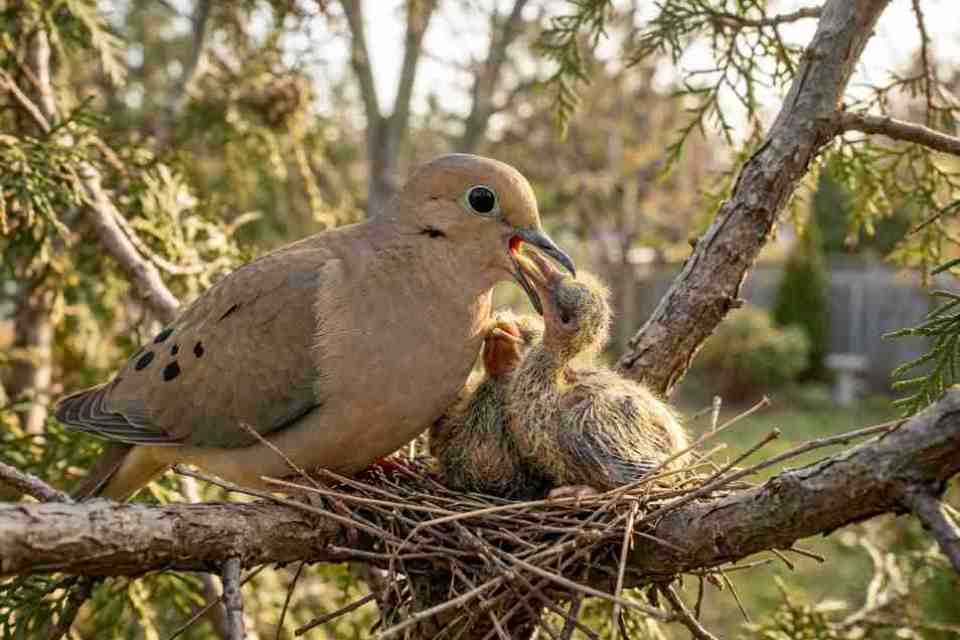
Colorado Parks and Wildlife documents the result: squabs increase in weight 14 times by 15 days of age. Crop milk is gradually replaced by regurgitated seeds after the first 3 to 4 days, and by the time of fledging at 14 to 15 days, the squabs eat broadly the same diet as their parents.
That 14-fold weight gain in 15 days is one of the fastest growth rates documented for any altricial bird species in North America, driven entirely by the fat and protein density of crop milk during the critical first week.
The guide to feeding birds through the winter season covers supplemental food options that support doves during the colder months when natural seed availability drops.
Suburban Sanctuary Infrastructure: Protecting the Brood
The 2×4 Safety Grid: Preventing Parental Panic-Strikes at Windows
A Mourning Dove flushing from a nest on a ledge near a window is traveling at full speed within two wingbeats. If the departure path passes a reflective glass surface, the risk of a fatal strike is real and cumulative across a nesting season of multiple broods.
The American Bird Conservancy’s recommended standard for window marking is gaps no larger than 2 inches vertically and 4 inches horizontally across the exterior glass surface. UV-reflective film, adhesive dot-pattern tape, and scored window film all work if applied at this density to the outside of the glass.
Interior treatments do not work. The reflective surface a bird sees is the exterior glass face, and a decal on the inside does not interrupt that reflection. For a comprehensive guide to window strike prevention techniques and product options, the resource on preventing birds from hitting windows covers the full range of exterior solutions verified by ornithological research.
The Gutter Guard Dilemma: Legal Obligations Under the Migratory Bird Treaty Act
Finding a Mourning Dove nest in a gutter is a common suburban situation, and the response is governed by federal law. U.S. Fish and Wildlife Service guidance on bird nest protection is unambiguous: under the Migratory Bird Treaty Act, it is illegal to destroy a nest that has eggs or chicks in it, or young birds still dependent on the nest for survival.
The practical implication is that a nest with eggs or live squabs in your gutter cannot legally be removed without a permit from U.S. Fish and Wildlife Service. Permits are rarely granted for residential situations. The legal path is to wait for the nest to become fully inactive, meaning no eggs, no chicks, and no longer in active use, before clearing it.
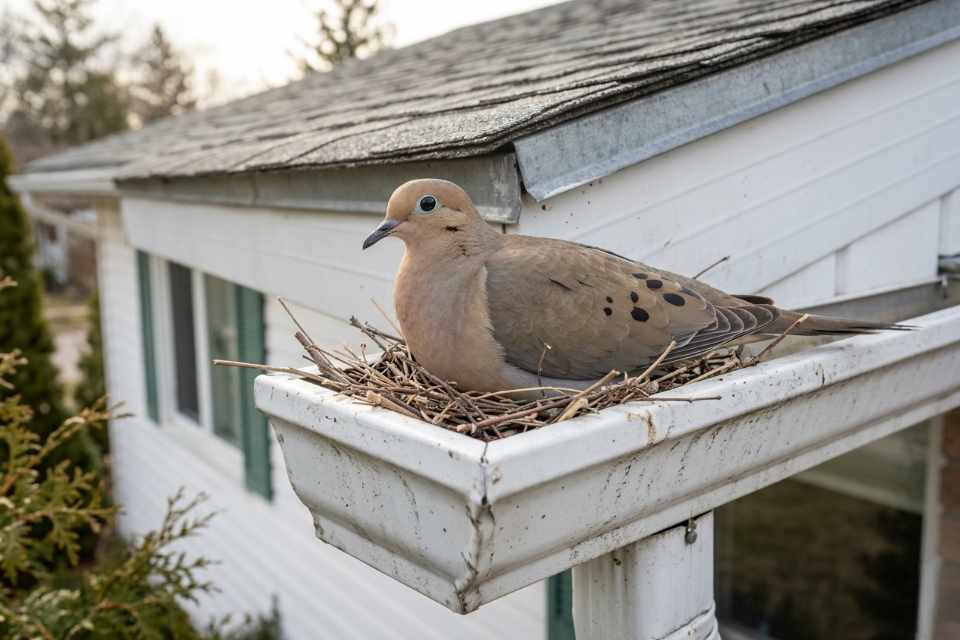
Given that the fledging period is only 14 to 15 days and renesting can occur multiple times per season, this waiting period is usually shorter than homeowners expect. Gutter guards installed during the non-nesting season prevent the situation from recurring without any legal risk.
If a gutter nest is genuinely causing drainage problems, the correct approach is to contact a licensed wildlife rehabilitator or your state wildlife agency for guidance. Attempting to relocate an active nest without a permit, even with good intentions, constitutes a federal violation with penalties up to six months in prison and a $15,000 fine under the MBTA.
Platform Support: Installing a Nesting Cone for High-Wind Areas
The science behind this is direct. A graduate thesis published through Utah State University Digital Commons by Paul Meyers (1994) found that nest density in shrubby habitat was strongly correlated with the density of available perch sites, and that plots where artificial perch sites were installed saw nest density increase between years while adjacent control plots without perch additions stayed the same. The difference was statistically significant. Doves use perch availability as a cue for evaluating nesting habitat quality.
Cornell Lab’s overview of the Mourning Dove recommends installing a nesting cone to attract breeding pairs, noting it should go up well before breeding season begins. A nesting cone is a simple wire mesh or wooden platform mounted to a tree, post, or structure that provides the stable horizontal surface doves select for.
The cone shape helps retain the loose twig nest that doves build, preventing the platform from sliding off in wind. Placement should be at moderate height (8 to 15 feet), with some overhead cover from a branch or eave, and clear of dense vegetation at the base that would give predators concealed approach routes.
A successfully positioned nesting cone converts a yard from one that doves pass through into one with an established nesting territory. Because doves return to successful sites across multiple seasons, a cone used in one year is likely to be used in subsequent years without any additional management.
For complete guidance on attracting and supporting Mourning Doves in your yard, the resource on attracting Mourning Doves to your backyard covers food, water, and habitat decisions that support resident pairs.
Managing Predator Dynamics in Human-Modified Habitats
The Cat Buffer: Ground-Level Nesting and the Indoor-Only Standard
Mourning Doves occasionally nest on the ground, particularly in the western United States, and this ground-nesting behavior brings them into direct conflict with free-roaming domestic cats. Research published in Wildlife Biology documented that predation rates on ground nests (60.0%) were significantly higher than on elevated nests (31.5%), underlining the risk.
Cornell Lab’s overview states this directly under dove management advice: keep cats inside. Doves that spend significant time on the ground foraging and occasionally nesting are particularly vulnerable. A free-roaming cat does not need to be a skilled hunter to represent a lethal threat to a ground-nesting dove or a newly fledged squab that has not yet developed full flight capability.
The indoor-only standard within 100 feet of a known nest site is not excessive. Fledgling Mourning Doves spend several days on or near the ground after leaving the nest, fed by the male parent, before they develop the flight speed to escape a charging cat reliably. This is the window of highest vulnerability.
For seasonal guidance on keeping hummingbirds, doves, and other yard birds safe from common hazards, the resource on keeping backyard birds safe from predators covers the full range of threats and solutions.
Corvid Deterrence: Protecting Visible Nests from Blue Jays and Crows
Wikipedia’s Mourning Dove account lists corvids explicitly among the primary nest predators during the nesting period, alongside grackles, housecats, and rat snakes. Blue Jays and Crows are visually acute, intelligent, and persistent. A thin twig platform offering no visual concealment of the eggs is an easy target once discovered.
The most effective deterrence strategies focus on making the approach difficult rather than the nest invisible. Positioning nesting platforms or cones under an eave, beneath a porch overhang, or against a wall limits the angles from which a corvid can land and approach the nest. Open-air positioning in the middle of a tree, with clear sight lines from multiple directions, is the configuration most likely to result in corvid predation.
Corvid-specific deterrents including reflective tape, predator decoys, and motion-sensitive water jets can reduce corvid activity in the immediate area of a nest during the nesting period. These measures are most effective when combined with structural placement that already limits corvid access, rather than used as the sole deterrent on an exposed nest site.
It is also worth noting that corvid predation pressure peaks during the period when the nest is most visible. Once squabs are 8 to 10 days old and their feathers are developing, the noise they make when begging for food can actually draw corvid attention. Keeping foot traffic and human noise near the nest to a minimum during this window reduces the likelihood that nearby jays or crows investigate and locate the squabs.
The Success Checklist: A 2026 Suburban Summary
Monitoring Protocol: How to Check a Nest Without Causing Premature Fledging
The greatest single cause of suburban Mourning Dove nest failure is well-intentioned human disturbance. A squab that flees the nest before day 12 to 14 in response to perceived threat is not ready to survive independently and will almost certainly die.
This is directly supported by peer-reviewed research. Westmoreland and Best (1985), published in The Auk via Oxford Academic, compared 51 disturbed nests checked at 3-day intervals (adults flushed each visit) against 50 undisturbed nests monitored from a distance without flushing.
Disturbed nests had significantly lower daily survival probabilities across both incubation and nestling stages, with the effect most pronounced during incubation. The mechanism was predator attraction: flushed adults leaving the nest exposed drew predators that would not otherwise have located it.
The correct monitoring approach is passive and distant. A brief visual check from at least 10 feet away, using binoculars if available, once every two to three days is sufficient to track nest status without triggering a flush response. Avoid checking during the first 48 hours after hatching, when squabs are most vulnerable to temperature shock if a parent is startled off the nest.
If a squab is found on the ground before day 14 with no visible injury, the correct response is to leave it in place. The male parent will continue feeding a grounded fledgling for up to two weeks after it leaves the nest. Removing it to “rescue” it interrupts that feeding relationship and causes the harm it is intended to prevent.
For fall window-strike prevention as doves and other yard birds begin their seasonal movements, the guide to preventing window strikes in fall covers both the timing of peak collision risk and the exterior marking approaches that most effectively reduce it across the season.
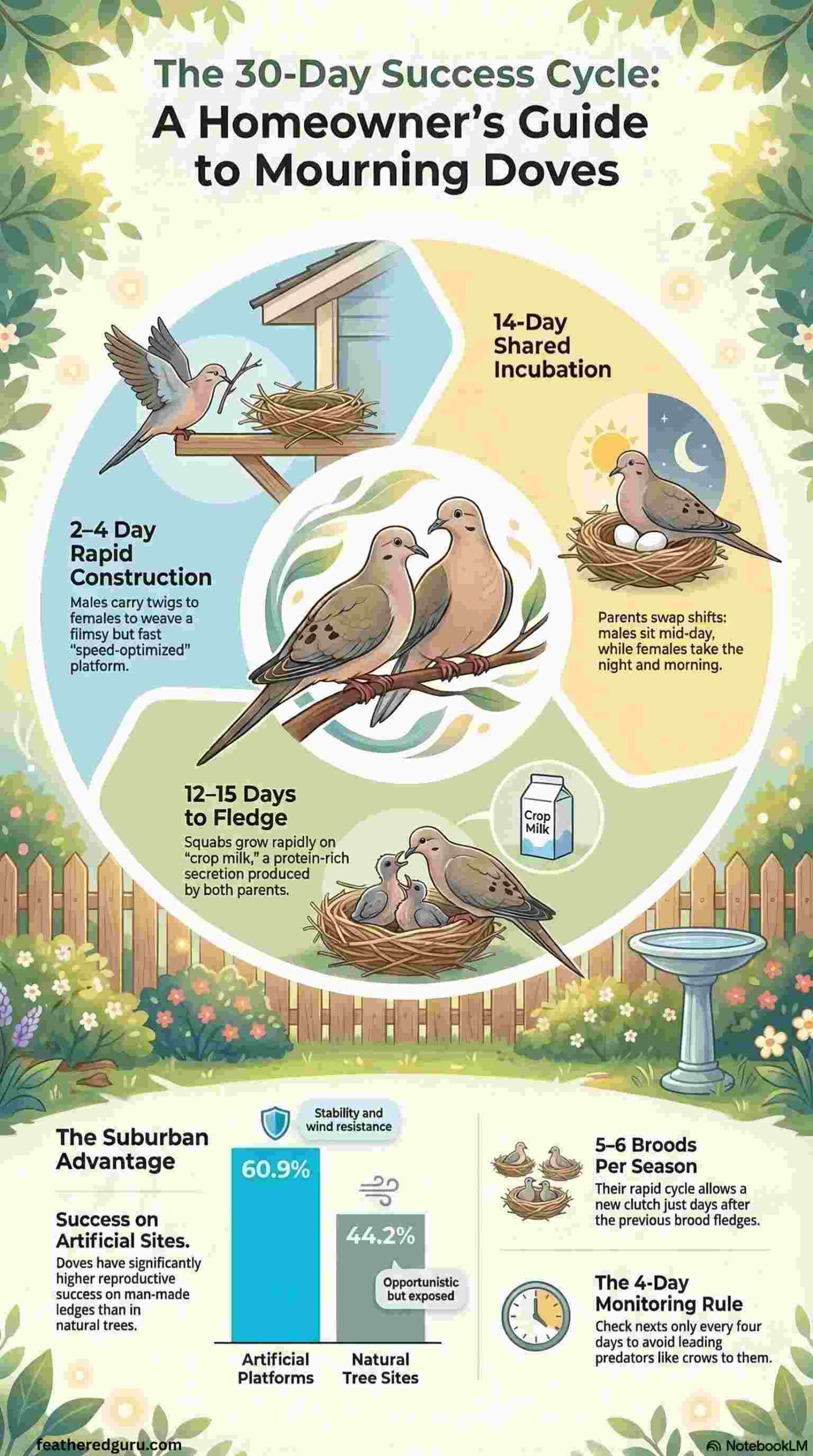
Visualizing the 30-Day Cycle: The Suburban Success Infographic
To help you quickly synthesize the 60.9% artificial ledge success rate and the 14-day metabolic surge, we have created the suburban nesting infographic below. This visual guide deconstructs the high-performance lifecycle that allows mourning doves to thrive in our backyards across multiple broods.
Conclusion: Success Through Suburban Stewardship
The success of the mourning dove in human modified landscapes is no accident. By choosing artificial substrates like gutters, eaves, and ledges, these birds achieve a 60.9% nesting success rate which is significantly higher than their counterparts in natural woodland settings. What looks like a flimsy or lazy nest is, in reality, a masterclass in efficiency that allows a single pair to raise up to six broods in a single year.
As a suburban sanctuary steward, your role is to support this unique biological rhythm. By providing stable nesting platforms, securing your windows with a 2×4 safety grid, and respecting the legal protections of the Migratory Bird Treaty Act, you turn your yard into a high performance habitat. Whether they are utilizing a porch light or a rain gutter, these birds are not merely surviving in our neighborhoods; they are thriving because of the deliberate choices they make and the infrastructure we provide.