
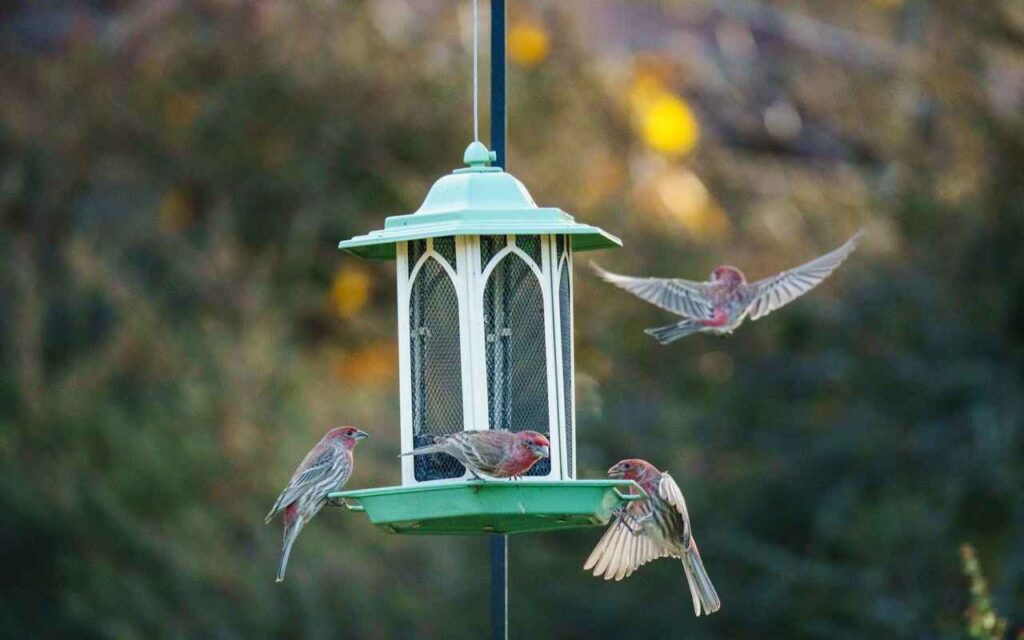
Most backyard birders think they just need more feeders to stop bullies, but preventing finches from being bullied requires a strategic approach. Research shows that larger birds like starlings and grackles don’t just eat the food; they physically block flight paths, creating “exclusion zones” that deter smaller finches regardless of seed abundance.
This guide moves beyond basic advice to provide a technical, three-tier defense system based on bird weight, beak shape, and feeding mechanics. By the end of this resource, you will know exactly how to “calibrate” your backyard to favor finches while making it physically impossible for larger birds to feed 🙂.
Visual Guide: Strategic Ways to Prevent Finches From Being Bullied
Stopping aggressive birds requires more than just extra seed; it requires a tactical approach to your backyard layout and feeder settings. Review the expert breakdown below for a step-by-step visual guide on how to calibrate your feeders to favor finches while making it physically impossible for larger birds to feed:
Show Transcript:
0:00
Have you ever set up a bird feeder, excited to see your backyard finches, only to have larger, aggressive birds chase them away? It’s frustrating! But the solution isn’t more feeders—it’s smarter strategies. This guide will show you how to defend your finches and create a backyard finch sanctuary.
0:21
Feeder dominance isn’t just about food—it’s about territory. Bigger birds establish exclusion zones, physically blocking smaller finches from accessing feeders. They create aerial blockades, preventing your tiny finches from getting a bite. To reclaim your feeders, we need a structured plan: understand the problem, know your “enemy,” and deploy a three-tier defense system.
0:59
First, bust the myth: adding more feeders doesn’t always help. More feeders can attract even larger flocks, essentially advertising your yard as a high-value bird feeding spot. The key isn’t quantity—it’s strategic feeder placement.
1:42
Now, let’s meet the culprits. European Starlings, those iridescent invaders, overwhelm feeders in huge flocks. Common grackles, with their blue-purple heads, team up with other blackbirds to dominate seed sources. And tiny house sparrows use bill sweeping to waste seed and harass smaller birds like finches.
2:22
Size matters. A single grackle can weigh almost 10 times a goldfinch—creating a natural pecking order where small finches avoid conflict. Understanding this physical challenge is crucial for designing finch-friendly feeders.
2:43
Tier One: Mechanical Exclusion. Use physics to favor nimble finches. Caged feeders with 1.5-inch openings allow finches to enter while blocking larger birds like Starlings and grackles. Weight-activated feeders set around 2.5 ounces let small birds feed safely, while heavier bullies trigger closure of seed ports.
3:38
Leverage finches’ biology. Their acrobatic feet allow them to cling and feed upside down. Feeders without traditional perches or designed for inverted feeding create puzzles larger, clumsier birds cannot solve. This gives your finches an advantage at the feeder.
4:04
Tier Two: Dietary Defense. Change the menu to repel bullies. Safflower seed is disliked by Starlings and grackles but adored by finches and cardinals. Avoid cheap millet mixes that attract house sparrows. Niger seed is perfect for finches’ slender bills but frustrating for larger, clumsy birds. Using selective seeds reduces competition and supports a healthy winter finch diet.
5:02
Tier Three: Spatial Strategy. Smarter feeder placement can transform your yard. Use a “sacrifice feeder” with cheap seeds like cracked corn in the open to attract bullies, while hiding finch-specific feeders 30+ feet away near bushes or behind structures. This creates a hidden finch sanctuary that bullies overlook.
5:38
For persistent invasions, implement a 48-hour feeder blackout. Removing all feeders disrupts bully routines and forces them to seek new territory. This “reset” helps finches reclaim the yard.
6:00
How do you know if your strategy works? The true measure is finch behavior. Relaxed, confident finches eating calmly indicate your backyard bird sanctuary is succeeding. They shift from stressed, jumpy visitors to calm, confident feeders.
6:45
Recap of the Three-Tier Defense System:
- Mechanical defenses: Caged feeders, weight sensors, perch removal.
- Dietary defenses: Switch to safflower and niger seeds.
- Spatial defenses: Decoy feeders, tactical blackouts, and smart feeder placement.
7:13
Layering these strategies creates a reinforcing system that prevents bullies from dominating your feeders. Now your finch fortress is complete, and the fun begins—watching your backyard finches thrive, relaxed and stress-free.
The Bully Bird Hierarchy: Who is Displacing Your Finches?
The Aggressor Profile: Identifying European Starlings, Common Grackles, and House Sparrows
European starlings (Sturnus vulgaris) represent non-native aggressive competitors introduced to North America in the 1890s. According to documentation from Wild Birds Unlimited, European starlings are iridescent black with speckles, with beaks that are dark in winter and yellow in summer. Their preferred diet consists primarily of insects and berries, but when these prove hard to find, they turn to feeders instead, often arriving in large flocks that dominate resources.
Common grackles (Quiscalus quiscula) show purple-blue sheen to their heads and black beaks. According to Cornell Lab of Ornithology research, they frequently mix with other blackbirds, cowbirds, and starlings to form massive mixed-species flocks that can number in the thousands or even millions of individuals. The social feeding behavior amplifies their impact, as entire flocks descend on feeding stations simultaneously.
House sparrows (Passer domesticus), another introduced species, compete aggressively with native finches despite similar size. Their bill-sweeping feeding behavior sends seeds flying to the ground, wasting substantial quantities while preventing other birds from accessing feeders. The aggressive territorial behavior includes harassment of smaller finches attempting to feed.
Physical Displacement: Why Larger Birds Block Flight Paths
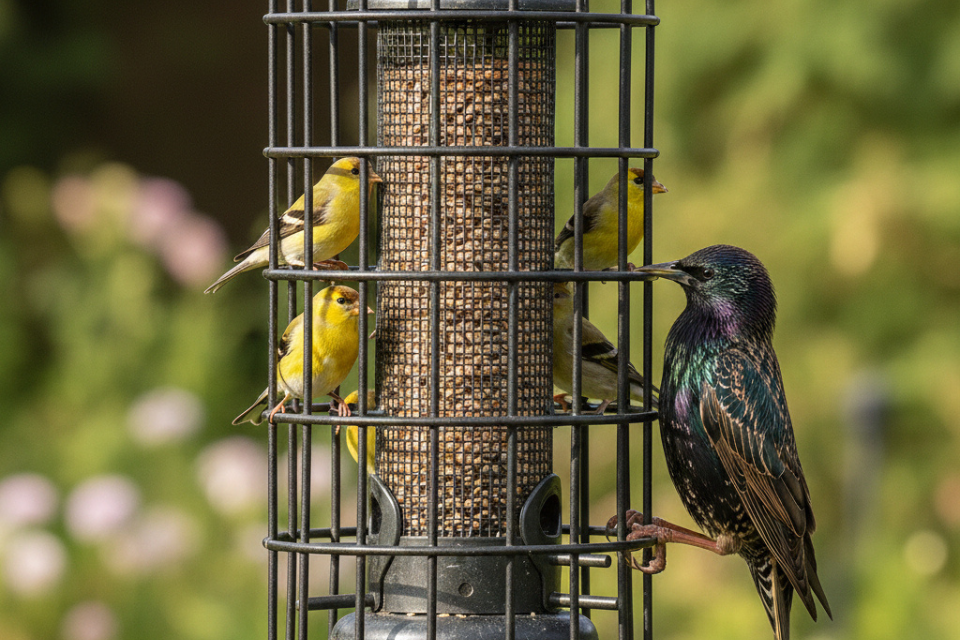
Physical displacement operates through multiple mechanisms beyond simple food consumption. Large birds positioned at feeders create aerial blockades that smaller finches cannot navigate around. The territorial spacing requirements mean a single grackle occupies sufficient feeder space to exclude 3-4 goldfinches. According to research from bird behavior experts, when annoying flocks of starlings appear at suet feeders, woodpeckers tend to stay away, demonstrating how the visual presence of large predatory-appearing birds triggers avoidance responses in smaller species evolved to escape potential threats.
According to research on weight disparities, grackles weigh 3.9 ounces while cardinals weigh 1.5 ounces. Goldfinches and other small finches weigh 0.4-0.6 ounces, creating weight differentials of 6-10 times between bully species and target finches. These size differences translate to dominance hierarchies where smaller birds yield feeding opportunities to larger species regardless of actual aggression levels.
The flight path blocking extends beyond the immediate feeder vicinity. Large birds perched on surrounding branches create gauntlets finches must navigate to reach feeders. The energy expenditure and predation risk associated with running this gauntlet often exceeds the caloric value of seeds obtained, driving finches to abandon feeding stations despite food availability.
The Resource Guarding Myth: Why More Feeders Attract More Bullies
Adding multiple feeders without strategic placement paradoxically intensifies bully bird problems rather than solving them. Each additional feeder creates new visual targets attracting passing flocks. The increased food availability supports larger bully populations, allowing more individuals to establish territories in your yard. The expanded feeding infrastructure signals abundant resources to roaming flocks, advertising your property as premium feeding habitat.
The correct approach involves strategic feeder distribution rather than simple multiplication. Position finch-specific feeders distant from general-purpose stations to create spatial separation between finch and bully feeding zones. Use architectural barriers (buildings, dense shrubs, garage structures) to create visual separation preventing bully birds from discovering finch feeders while scanning from elevated perches.
Mechanical Exclusion: The Physics of Feeding
The 1.5-Inch Rule: Physical Barrier for Larger Birds
According to Wild Birds Unlimited cage feeder specifications, cages utilizing 1.5-inch openings allow smaller birds to feed while excluding European starlings, common grackles, and eastern gray squirrels. This precise dimension represents the critical threshold based on body width and skeletal measurements of target species. The 1.5-inch spacing accommodates goldfinches (body width approximately 1.3 inches), house finches (1.4 inches), and chickadees (1.2 inches) while excluding starlings (body width 2.0-2.3 inches), grackles (2.5-2.8 inches), and blue jays (2.8-3.2 inches).
The physics involves more than simple width restrictions. Birds must navigate through cage openings while maintaining flight control and maneuvering around obstacles. Smaller finches possess aerial agility allowing tight turns and precise positioning. Larger birds require greater clearance and approach angles incompatible with narrow cage spacing. The combination of size restriction plus maneuverability requirements creates effective exclusion of bully species.
Cage depth matters equally. According to feeder design research, placing the feeder portion several inches inside the cage prevents larger birds from reaching seed with their long bills. Starlings and grackles possess bills capable of reaching 2-3 inches into cages, requiring minimum 4-inch distance between cage exterior and seed ports for complete exclusion.
Weight-Sensitive Calibration: The 2.5-Ounce Threshold
Weight-activated feeders utilize spring-loaded mechanisms that close seed ports when birds exceeding preset weight thresholds land on perches. The mechanical advantage involves counterweight systems calibrated to specific mass ranges. Set properly, these feeders allow finches (0.4-0.6 ounces) and chickadees (0.3-0.5 ounces) to feed while automatically excluding grackles (3.9 ounces), blue jays (2.5-3.5 ounces), and even cardinals (1.5 ounces).
The 2.5-ounce threshold represents optimal balance for most applications. This setting permits cardinals while excluding all larger bully species. For finch-exclusive feeding, reduce the threshold to 0.8-1.0 ounces, creating access restricted to goldfinches, purple finches, house finches, pine siskins, and chickadees while excluding even cardinals and titmice.
Calibration requires manual adjustment and testing. Most weight-sensitive feeders include tension screws allowing threshold modification. Start with factory settings and adjust progressively tighter until observing desired species access patterns. Monitor feeding sessions to verify settings exclude bullies without preventing target finches from triggering mechanisms.
The Cling vs. Perch Strategy: Removing Perches Favors Acrobatic Finches
Finches possess zygodactyl foot structure (two toes forward, two backward) providing exceptional grip strength for clinging to vertical surfaces. Goldfinches, siskins, and other small finches feed comfortably while hanging upside-down or clinging to wire mesh feeders. According to research from Birds & Blooms, removing feeder perches or shortening them discourages grackles, as many large birds cannot cling to feeders to eat.
The modification involves either complete perch removal or reduction to nubs extending less than 0.5 inches from feeder tubes. Goldfinches and chickadees land directly on tube feeders, gripping the feeder body with their feet while feeding from ports. Grackles and starlings require substantial perch platforms providing stable footing for their larger body mass and feeding posture.
Nyjer feeders exemplify this design principle. The specialized tube feeders feature tiny feeding ports without perches, requiring birds to cling directly to mesh or metal tube surfaces. Goldfinches excel at this feeding method while grackles and starlings cannot maintain position long enough to extract meaningful seed quantities.
Upside-Down Feeding: Physical Impossibility for Starlings
Upside-down suet feeders exploit anatomical limitations of bully species. The feeders position suet cakes accessible only from beneath a roof structure, requiring birds to hang inverted while feeding. Woodpeckers, chickadees, nuthatches, and finches possess foot structure and musculature supporting sustained upside-down feeding. Starlings and grackles lack this capability.
According to feeder effectiveness research, starlings might obtain small amounts of suet from upside-down feeders but cannot mob and consume entire cakes in hours as they do with conventionally positioned suet. The leg structure and muscle distribution of starlings and grackles evolved for ground foraging and perched feeding rather than inverted hanging, creating physical constraints that feeder design exploits.
The strategy extends beyond suet to seed feeders. Bottom-feeding designs where seed ports face downward create similar upside-down feeding requirements. Chickadees and finches adapt readily while larger bully birds struggle or abandon attempts after brief trials.
The Menu Pivot: Using Taste and Beak Shape as Shield
The Nyjer (Thistle) Advantage: Labor-Intensive for Bullies
Nyjer (Guizotia abyssinica) produces tiny seeds (approximately 1-2mm length) requiring specialized feeding techniques. Goldfinches, siskins, and redpolls possess fine-pointed bills perfectly adapted for extracting and manipulating nyjer seeds. According to research from Birds & Blooms, bully birds like grackles, starlings and blackbirds tend to leave thistle seeds alone, finding them too labor-intensive relative to caloric reward.
The deterrent effect operates through multiple mechanisms. The tiny seed size requires numerous individual feeding actions to obtain meaningful calories. Starling and grackle bills, designed for insect capture and larger seed processing, lack the fine motor control needed for efficient nyjer manipulation. The energy expenditure per calorie obtained exceeds that of alternative food sources, driving bully birds toward easier targets.
Specialized nyjer feeders enhance exclusion through design features. Small feeding ports (2-3mm diameter) accommodate finch bills while frustrating larger birds. Mesh-style tube feeders require birds to extract seeds through tiny openings, a task finches accomplish efficiently while bullies fail. The combination of unfavorable seed size plus feeder design creates effective bully exclusion without mechanical barriers.
Safflower: The Bitter Pill Cardinals and Finches Love
According to research from Birds & Blooms ornithologists, safflower seeds have a somewhat bitter flavor that deters many problem birds. Squirrels, grackles, starlings, and blackbirds actively avoid safflower seeds while cardinals, house finches, purple finches, chickadees, titmice, and grosbeaks consume them readily.
The bitter compounds in safflower seed coatings create taste-based exclusion that bully species find unpalatable. While the exact biochemical mechanisms remain incompletely understood, observational evidence consistently demonstrates that grackles and starlings abandon feeders filled with safflower after brief sampling. The hard white shell provides secondary deterrent, requiring stronger bills and greater processing effort than softer seeds.
Safflower nutritional profile matches sunflower, containing high protein (15% minimum) and fat (35% minimum) supporting finch energy needs. The seeds work in identical feeders as sunflower, requiring no specialized equipment. The straightforward substitution transforms existing feeders into bully-resistant stations without infrastructure investment.
Transition strategy matters for success. According to feeding recommendation research, birds accustomed to sunflower may initially reject pure safflower. Introduce safflower gradually through mixed blends (50% sunflower, 50% safflower), progressively increasing safflower percentage over 2-3 weeks. This acclimation period allows desired species to recognize and accept safflower before complete substitution eliminates familiar sunflower seeds.
The Suet Trap: Hot Pepper Deterrent
Capsaicin-treated suet exploits mammalian vs. avian sensory differences. Birds lack capsaicin receptors, experiencing no burning sensation from hot peppers. Mammals (squirrels, raccoons, bears) possess full capsaicin sensitivity, finding treated suet intensely unpleasant. While primarily targeting mammalian pests, hot pepper suet provides secondary benefits against some bully birds.
Starlings show reduced interest in capsaicin-treated suet compared to standard formulations. The deterrent mechanism may involve learned avoidance after negative experiences or behavioral aversion to unfamiliar food presentations. The effect proves less reliable than cage exclusion or upside-down feeding but provides additional layered defense when combined with other strategies.
Pure suet blocks (fat without additives) deter starlings and grackles more effectively than suet containing seeds, peanuts, or insects. According to feeder management observations, woodpeckers and chickadees accept pure suet readily while starlings show minimal interest except during periods of severe food scarcity. The elimination of attractive add-ins removes the primary draw bringing bully birds to suet feeders.
Zero-Waste Blends: Eliminating the Millet Magnet
Millet attracts house sparrows, cowbirds, and other ground-feeding bully species while providing minimal value for finches and other desirable songbirds. Commercial wild bird mixes often contain 40-60% millet as inexpensive filler. Birds selectively consume preferred seeds (sunflower, safflower) while rejecting millet, which falls to the ground creating mess and attracting pest species.
Zero-waste blends eliminate millet and other filler seeds, containing only species-specific preferred foods. For finch feeding, use pure nyjer, straight safflower, or custom mixes combining black oil sunflower and safflower without millet, milo, wheat, or other fillers. The elimination of ground-feeding attractants simultaneously reduces mess, waste, and bully bird attraction.
The economics favor quality over quantity. While zero-waste blends cost more per pound, the absence of waste means all purchased seed gets consumed by target species. Calculate cost-per-feeding rather than cost-per-pound, recognizing that cheap mixes containing 50% waste actually cost more per bird fed than premium blends offering 100% desired species consumption.
Strategic Backyard Engineering and Layout
The Sacrifice Feeding Station: 30-Foot Decoy Placement
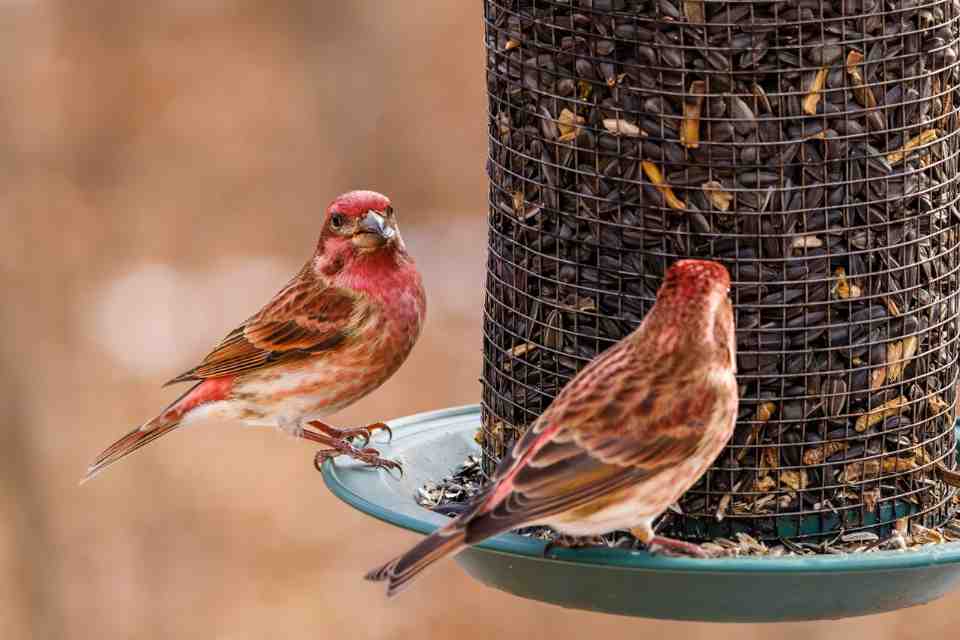
Sacrifice feeders deliberately attract and concentrate bully birds in designated areas distant from finch feeding zones. Position platform feeders filled with inexpensive cracked corn 30+ feet from finch-specific feeders. The separation distance exceeds the territorial radius most birds maintain around active feeding sites, creating distinct feeding territories.
The platform design appeals to ground-feeding preferences of grackles, starlings, and house sparrows while providing less attractive feeding experience for finches preferring tube or hopper feeders. Fill sacrifice stations with corn, milo, wheat, and other inexpensive grains that bully species consume but finches ignore. The abundant, easily accessible food establishes sacrifice stations as primary feeding locations for bully flocks.
Location selection matters critically. Position sacrifice feeders in open areas visible from distance, advertising their presence to passing flocks. Place finch feeders in sheltered locations near shrubs and trees, making them less visually obvious while providing preferred habitat for finches. The differential visibility steers bully birds toward sacrifice stations while finches discover protected feeding zones through habitat preference.
Baffle Geometry: Torpedo vs. Dome Designs
Baffles prevent aerial approaches to hanging feeders, forcing birds to access feeders from below through narrow openings incompatible with large bird maneuverability. Torpedo baffles (cylindrical designs positioned above feeders) shed approaching birds attempting to land on feeder tops. The smooth curved surface provides no grip, causing sliding failures that discourage repeated attempts.
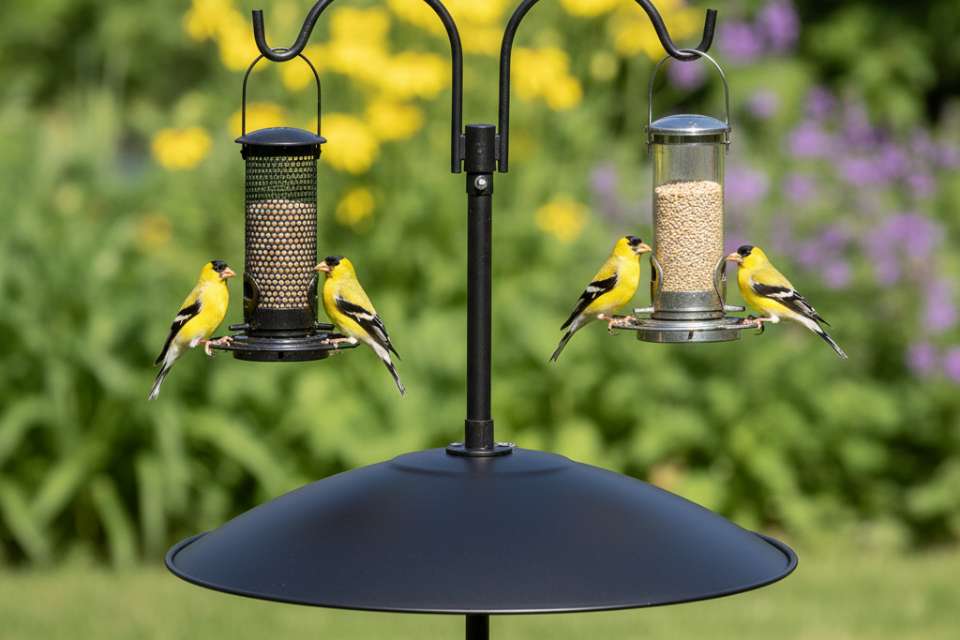
Dome baffles (inverted bowl shapes mounted above feeders) create larger exclusion zones through broader diameter coverage. The 18-24 inch diameter domes prevent birds from bypassing baffles through lateral approaches. The combination of overhead blocking plus peripheral overhang creates aerial no-access zones where approaching birds cannot find landing paths.
Pole-mounted baffles prevent climbing access by mounting below feeders on poles. Torpedo designs positioned 4-5 feet above ground block squirrels and climbing mammals while larger dome designs prevent both climbing and aerial access. The cylindrical smooth metal or plastic surfaces offer no grip for claws, creating impassable barriers for ground-originating approaches.
Visual Deterrents: Strategic Flash Tape Use
Reflective flash tape creates moving visual stimuli that some bully species find aversive. The metallic strips flutter in wind, producing flashing reflections and rustling sounds. Hang 12-18 inch strips near (but not touching) sacrifice feeding stations, creating mild aversive stimulus directing flocks toward unprotected feeders while avoiding protected finch stations.
Selective placement prevents deterring desirable species. Never position flash tape within 15 feet of finch feeders, as the visual stimulus affects all birds non-selectively. Use tape to create subtle directional pressure steering flocks toward sacrifice stations rather than creating hard barriers that might deter all feeding. The goal involves behavioral manipulation rather than complete exclusion.
Habituation limits long-term effectiveness. Bully birds adapt to static deterrents within days to weeks, learning they pose no actual threat. Rotate deterrent locations biweekly, remove them periodically for 3-5 days, and vary deterrent types to maintain novelty preventing complete habituation. The dynamic approach sustains mild aversive pressure without allowing complete adaptation.
Behavioral Reset and Hygiene Protocols
The 48-Hour Blackout: Breaking Scouting Routines
Bully bird flocks establish feeding circuits visiting reliable food sources on predictable schedules. The learned behavior creates daily visitation patterns where flocks arrive at specific times expecting food availability. Breaking these patterns requires temporary resource removal forcing flocks to establish new circuits excluding your property.
Implement blackout periods by removing all feeders for 48 hours when bully populations become unmanageable. The absence forces flocks to identify alternative feeding territories. After 48 hours, reinstall only finch-specific feeders (caged feeders, nyjer feeders, safflower-filled tubes) without platform or hopper feeders that previously attracted bullies. The selective restoration provides resources for finches while maintaining absence of bully-attractive feeding options.
Timing blackouts strategically maximizes effectiveness. Implement during periods when bully flocks would naturally move (late winter through early spring for starlings, fall migration for grackles). The seasonal movement combined with temporary resource removal increases likelihood flocks establish new territories elsewhere rather than returning after blackout ends.
Ground-Level Defense: Mandatory Seed Catchers
Seed catchers (trays positioned below feeders catching dropped seeds) prevent ground accumulation that attracts ground-feeding bully species. Starlings, grackles, and house sparrows frequently feed on ground spillage rather than accessing elevated feeders, making ground seeds the primary attractant bringing them to your yard.
The trays must extend beyond feeder footprint by 12-18 inches in all directions, catching wind-scattered seeds plus those dropped by feeding birds. Empty trays daily during high-use periods, preventing ground seed accumulation that attracts undesired species. Discard spilled seed rather than redistributing to ground, eliminating the resource entirely rather than relocating it.
Screen-bottom trays allowing rain drainage prevent water accumulation that spoils seeds and creates mosquito breeding habitat. The elevated screen position (2-3 inches above tray bottom) provides drainage while catching seeds before ground contact. Regular cleaning prevents mold and bacterial growth that poses health risks to all feeding birds.
Seasonal Tactical Shifts: Spring Nesting Aggression
Spring breeding season (March through June) intensifies territorial aggression as birds establish nesting territories. Bully species become more aggressive toward other birds perceived as territory intruders, increasing displacement pressure on finches attempting to feed. The seasonal aggression peak requires tactical adaptations beyond year-round baseline strategies.
Increase spatial separation between feeders during breeding season, expanding minimum distances from 20 feet to 40+ feet. The greater separation reduces territorial overlap, allowing multiple species to feed simultaneously in distinct territories rather than competing within shared space. Add temporary feeders in peripheral areas providing alternative feeding locations reducing crowding at primary stations.
Reduce feeding volume by filling feeders partially rather than completely. Half-full feeders empty faster, requiring more frequent refilling but reducing food abundance that attracts and supports large bully flocks. The decreased resource availability creates natural limits on bully population densities your yard can support while maintaining adequate food for smaller finch numbers.
Advanced Troubleshooting for Persistent Bullies
Intra-Species Rivalry: When House Finches Bully Goldfinches
House finches sometimes dominate goldfinches despite similar size, creating within-finch-family bullying scenarios unresolved by size-based exclusion methods. The aggression stems from territorial behavior and dominance hierarchies rather than size advantages. Male house finches prove particularly aggressive during breeding season when defending feeding territories near nest sites.
Solution involves feeder multiplication and diversification rather than exclusion. Add multiple feeding stations with varied designs (tube feeders, sock feeders, tray feeders) distributed across property. The abundance and diversity reduces territorial defense effectiveness, as aggressive individuals cannot monopolize all feeding locations simultaneously. Goldfinches discover and use feeders house finches currently ignore or defend less aggressively.
Species-specific preferences provide additional leverage. Goldfinches show stronger preference for nyjer than house finches. Dedicate specific feeders exclusively to nyjer, positioning them in areas house finches visit less frequently. House finches favor sunflower and safflower, allowing strategic food distribution separating species through dietary preferences rather than physical exclusion.
The Squirrel-Bully Alliance: Preventing Mammal-Bird Teaming
Squirrels create feeding opportunities for bully birds through spillage and feeder damage. A squirrel attacking hopper feeders shakes loose substantial seed quantities falling to ground where ground-feeding bully species consume it. The symbiotic relationship means controlling squirrels simultaneously reduces bully bird attraction.
Weight-sensitive feeders exclude both squirrels (typical eastern gray squirrel weighs 16-24 ounces) and large bully birds through single mechanism. The 2.5-ounce threshold excludes grackles while the upper weight limit (typically 5-6 ounces maximum trigger weight) excludes squirrels. The dual exclusion addresses both mammalian and avian feeding problems simultaneously.
Pole baffles positioned 4-5 feet above ground prevent squirrel access to pole-mounted feeders. The smooth metal cylinder or cone shapes provide no grip for climbing claws. The 18-24 inch vertical dimension exceeds maximum squirrel leap height from ground, creating impassable barriers. With squirrel access eliminated, ground spillage decreases dramatically, removing the primary attractant for ground-feeding bully birds.
Common Mistakes: Why Filling Feeders to the Top Hurts Defense
Completely full feeders create several problems undermining bully exclusion efforts. The abundant visible food advertises feeding station to passing flocks, increasing discovery rates. The extended time between refills allows seed aging and deterioration, reducing palatability for desired species while remaining acceptable to less discriminating bully birds. The weight of full seed loads may prevent weight-sensitive mechanisms from functioning properly, allowing heavier birds to feed despite intended exclusion.
Fill feeders to 50-70% capacity rather than completely full. The partial filling requires more frequent refilling but maintains fresher seed that finches prefer. The reduced visual food abundance makes feeders less obvious to passing flocks. Weight-sensitive mechanisms function reliably with lighter seed loads, maintaining consistent exclusion of heavy birds.
Frequent small refills beat infrequent large refills for multiple reasons. Fresh seed attracts finches more effectively than aged seed. Regular yard presence during refilling creates mild disturbance that some bully species avoid. The opportunity to observe feeding patterns during refilling visits provides information for strategy adjustments, revealing which techniques work and which require modification.
Summary: Your Three-Tier Defense for Preventing Finch Bullying
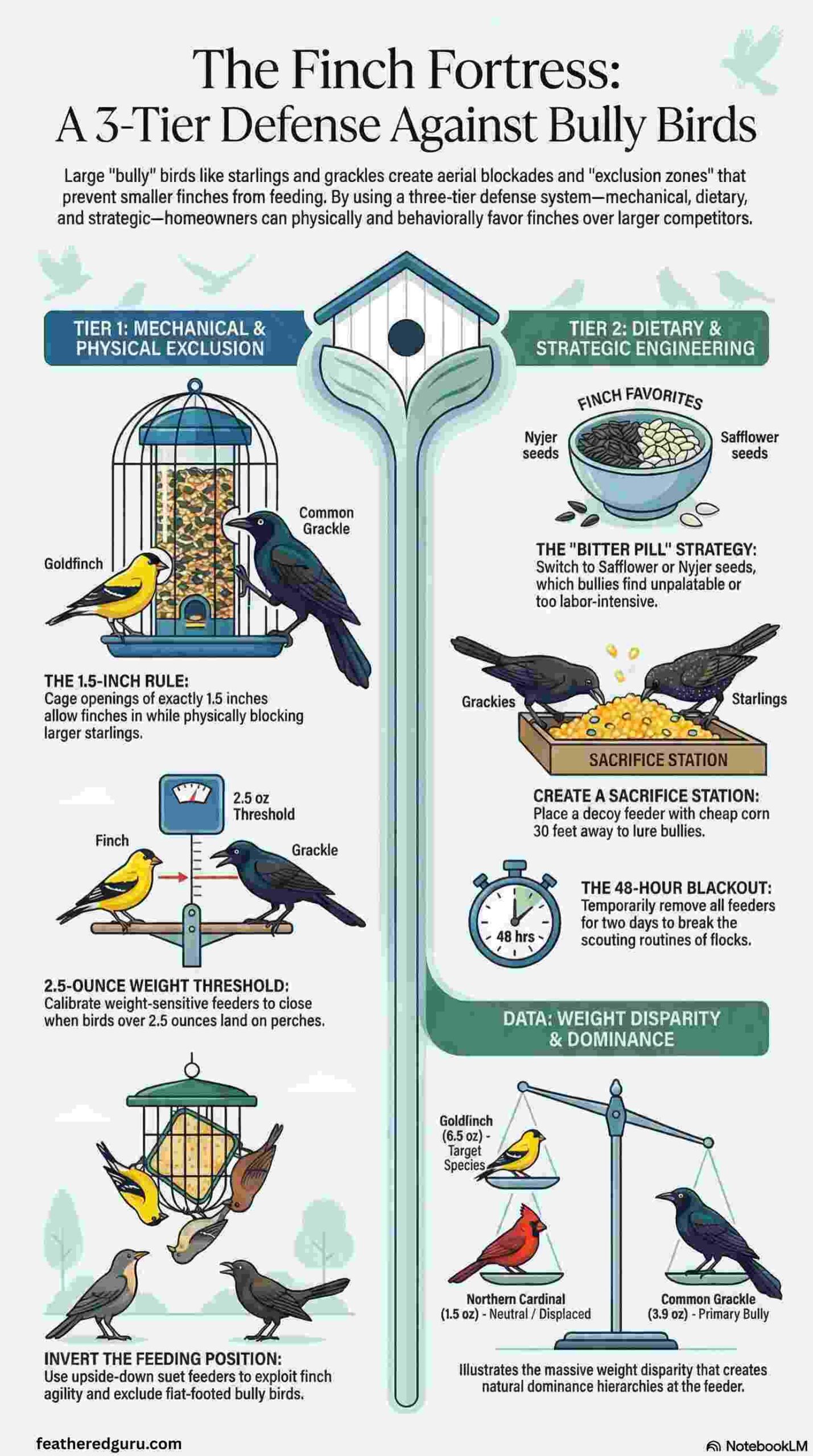
Successfully “calibrating” your backyard requires a layered approach that targets bird weight, beak shape, and spatial layout simultaneously. Use this final visual checklist to ensure your defense system is fully optimized to protect your finches before you begin monitoring your results:
Conclusion: Implementing Your Three-Tier Defense System
Effective finch protection from bully birds requires integrated strategies operating at mechanical, dietary, and spatial levels simultaneously. Mechanical exclusion through 1.5-inch cage spacing, weight-sensitive feeders calibrated to 2.5-ounce thresholds, and upside-down feeder designs create physical barriers preventing bully access. Dietary manipulation through nyjer, safflower, and specialized seed blends eliminates food sources that bully species prefer. Strategic layout featuring sacrifice feeding stations, proper baffle installation, and spatial separation creates environment favorable to finches while directing bully birds toward designated areas.
The three-tier system succeeds where single-strategy approaches fail through redundancy and reinforcement. Bully birds that bypass one defense encounter another. The cumulative effect of multiple barriers proves far more effective than any single technique alone. A grackle might eventually figure out a caged feeder but encounters safflower it refuses to eat. A starling that tolerates safflower cannot navigate the 1.5-inch cage spacing. The layered defense creates multiple failure points preventing bully birds from establishing dominance.
Implementation requires patience and iteration. Expect 2-3 weeks for strategies to show full effect as bully birds learn feeders no longer provide easy meals and finches discover protected feeding opportunities. Monitor feeding patterns daily, documenting which species visit which feeders at what times. Use observations to refine cage spacing, adjust weight sensitivities, and reposition feeders for optimal results. The data-driven approach identifies what works in your specific situation rather than relying on generic advice that may not apply to your local bird populations.
Success metrics extend beyond simple bully absence. Measure finch visitation frequency, feeding duration, and apparent comfort levels (relaxed vs. nervous feeding behavior). Healthy finch populations spend extended periods at feeders, feeding calmly without constant vigilance. Bully-dominated yards show brief, anxious finch visits with frequent flight responses to perceived threats. The transition from nervous, brief visits to relaxed, extended feeding sessions indicates successful implementation of protection strategies.
For additional information on attracting and supporting finch populations, explore guides on attracting finches to your yard, understanding finch winter diets, and creating finch-friendly native plant habitats. Learning about finch identification and nesting behavior provides broader context for understanding finch needs that extends beyond feeding to encompass complete habitat requirements supporting year-round finch populations.