
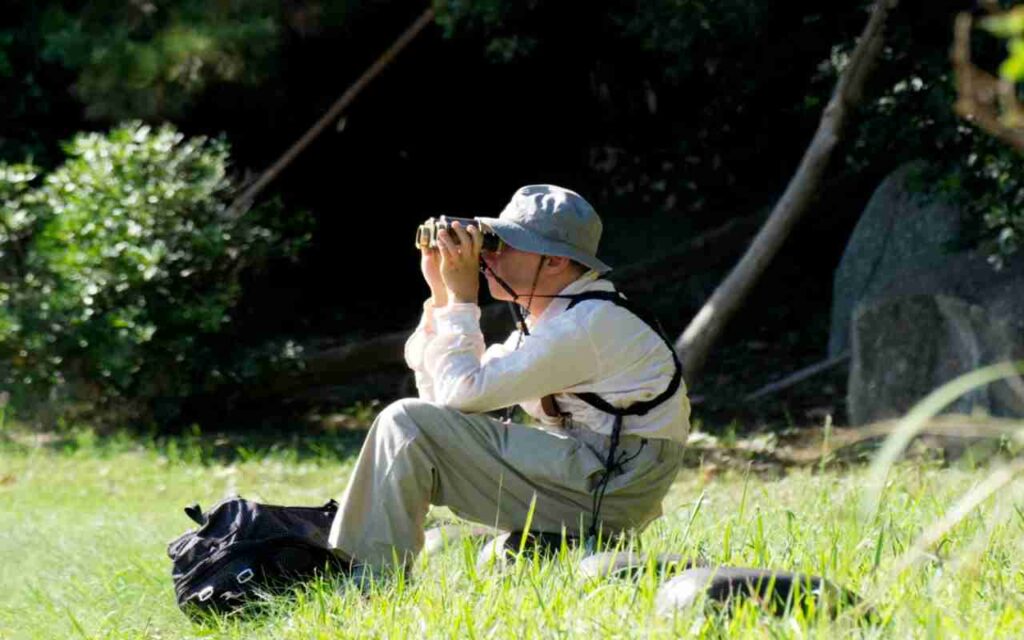
If you’ve ever tried summer birding in July and come home with blurry photos, mystery calls you couldn’t track down, and frustration from missing birds hidden in plain sight, you’ve discovered summer’s Hard Mode of birdwatching. High-noon sun washes out plumage colors, dense foliage forms green walls where birds vanish, heat sends songbirds into semi-dormancy around 2 PM, and atmospheric distortion turns distant observations into shimmering mirages.
This guide tackles five summer observation challenges using field-tested techniques, including polarized lenses to cut sun glare, reading internal canopy movement, finding active birds during the midday lull, and getting low to eliminate heat haze. These methods work with summer’s physics, helping you spot warblers, finches, and other summer residents more reliably 🙂.
- Early morning, 30 min before sunrise to 9:00 AM, is peak activity.
- Morning activity comes from feeding nestlings, singing, and defending territory.
- Midday activity drops due to heat, predators, and satiety.
- Water and shade attract birds during midday inactivity.
- Late afternoon and early evening show a smaller activity peak.
- Hummingbirds, raptors, and waterbirds often stay active midday.
- Extreme heat limits activity to dawn and dusk hours.
- Early summer is peak breeding; mid-summer has fledglings; late summer is dispersal.
- Adjust timing by temperature, weather, and species for best results.
Solutions for Mastering Summer Birding
Watch this video for a visual breakdown of all five challenges and their solutions:
Show Transcript:
0:00 – Introduction: Summer Birding Challenges
Ever have one of those summer birdwatching days? You step outside on a warm morning, binoculars ready, and… crickets. The sun is shining, the trees are full, but it feels like every bird has vanished. This is a common frustration for backyard birders.
But here’s the secret: the birds are right there, hiding in plain sight. Let’s decode the disappearing summer birds and learn to spot warblers, finches, and other summer residents even in mid-July.
0:44 – Summer Birding Hard Mode
Summer birding is tricky. High sun, dense foliage, and heat combine to make spotting birds a challenge. Think of it like “summer birding hard mode.” Once you understand the rules and secrets, you can succeed. Today, we’ll tackle every challenge.
1:06 – Challenge 1: Light and Color
High noon sun can wash out vibrant bird colors. Birds like Indigo Buntings or Blue Jays may look dull because of structural color—microscopic prisms in their feathers that scatter light. In harsh overhead sun, the color disappears, similar to a diamond losing its sparkle in bad lighting.
1:53 – Solving Light Challenges
To reveal true plumage colors:
- Understand the problem: high sun scatters light.
- Adjust your angle: put the sun at your side or back, viewing the bird’s shadow side.
- Use polarized sunglasses: they cut horizontal glare and enhance color visibility.
2:36 – Challenge 2: Dense Foliage (The Green Wall)
Summer foliage is at its thickest, creating a dense green wall where birds hide. Birds retreat deep inside branches, 3–4 feet from the edges, to stay cool and shaded.
3:23 – Seeing Through the Green Wall
- Start with your ears: cup them to locate faint calls.
- Make gentle sounds to pique curiosity.
- Watch for movement: even a subtle leaf rustle can reveal hidden birds.
3:50 – Challenge 3: Timing and Temperature
Birds avoid wasting energy in the midday heat. To find them:
- Seek thermal refuges: shady ravines, damp springs, north-facing slopes.
- Observe crepuscular windows: sunrise and sunset are peak activity times.
- Understand behavioral torpor: midday naps help birds conserve energy. Adjust your schedule to match theirs.
4:50 – Building Your Summer Birding Toolkit
Combine light, foliage, and timing strategies with tactical gear:
- Pre-treat clothing with permethrin to repel insects.
- Let binoculars acclimate in shaded areas to prevent fogging.
- Avoid heat haze by crouching 2–3 feet lower to see under shimmering air.
5:23 – Strategic Gear Checklist
- Wide-brimmed hat with dark underbrim for glare reduction
- Polarized sunglasses (amber or brown lenses for contrast)
- Hydration pack to stay alert and sharp
- Light, breathable, treated clothing
6:25 – Key Takeaway: Adapt to Summer Birds
Summer birds don’t disappear—they adapt. By adjusting your tactics, timing, and gear, you can decode light, see through dense foliage, and master the heat. Summer birding is no longer “hard mode”—it’s just a game with different rules.
6:56 – Conclusion: Ready to Spot More Birds?
Now that you know the rules, are you ready to go out and win? Use these strategies to see more birds, take better photos, and enjoy summer birdwatching like never before.
Challenge 1: The Color Washout & Sun Glare Problem
The Physics of Plumage Bleaching
High-noon sun doesn’t just make birding uncomfortable; it fundamentally alters how you perceive plumage. When direct sunlight strikes feathers at angles above 60 degrees, the light scatters across the barbule structure instead of reflecting true colors back to your eye. This phenomenon, similar to how a diamond loses fire in direct overhead light, washes out the diagnostic field marks you rely on for identification.
According to researchers studying avian coloration, different wavelengths of light interact uniquely with feather microstructures. The problem intensifies with structural colors like those in bluebirds and indigo buntings, where the color you see depends entirely on viewing angle. A study published in the Journal of Experimental Biology found that thermoregulatory responses in desert birds demonstrate how environmental conditions affect bird physiology and behavior. Add horizontal light reflection from water, sand, or light-colored buildings, and you create a glare environment where even common species become identification puzzles.
The severity varies by habitat. Coastal birders face reflected glare from water surfaces. Desert observers battle sand reflection. Even woodland birders encounter problems when sunlight bounces off pale tree bark or light-colored substrate.
The Solution: Shadow-Side Viewing & Polarized Optics
Professional wildlife photographers learned this decades ago: position yourself so birds appear against their shadow side. The rule is simple. If the sun is at 12 o’clock, move to view birds from the 3 o’clock or 9 o’clock position. This 90-degree offset minimizes glare while maintaining adequate illumination for color perception.
Polarized lenses provide the technical solution to horizontal light reflection. These lenses contain a chemical filter aligned vertically, blocking horizontally reflected light while allowing vertical light through. According to optical research from the University of São Paulo, polarized lenses reduce eye strain and improve visibility by filtering the disruptive effects of glare.
The American Academy of Ophthalmology explains that polarized sunglasses drastically cut glare and help observers see details more clearly. For birders specifically, polarized lenses reduce the reflected glare from water and sand that plague coastal and wetland observations. Field testing by experienced birders shows that polarized lenses enable observation of birds near the sun that would otherwise be difficult to view without significant eye strain.
Implementation Strategy:
Choose polarized sunglasses with dark under-brims on wide-brimmed hats. The combination blocks overhead glare while the polarized lenses handle horizontal reflection. Amber or brown-tinted polarized lenses often provide superior contrast enhancement compared to gray lenses, though individual preference varies.
For the best color accuracy, remove sunglasses when viewing through binoculars, as the interaction between polarized lenses and coated optics can occasionally create color shifts. However, many modern binoculars with phase-correction coatings work well with polarized glasses.
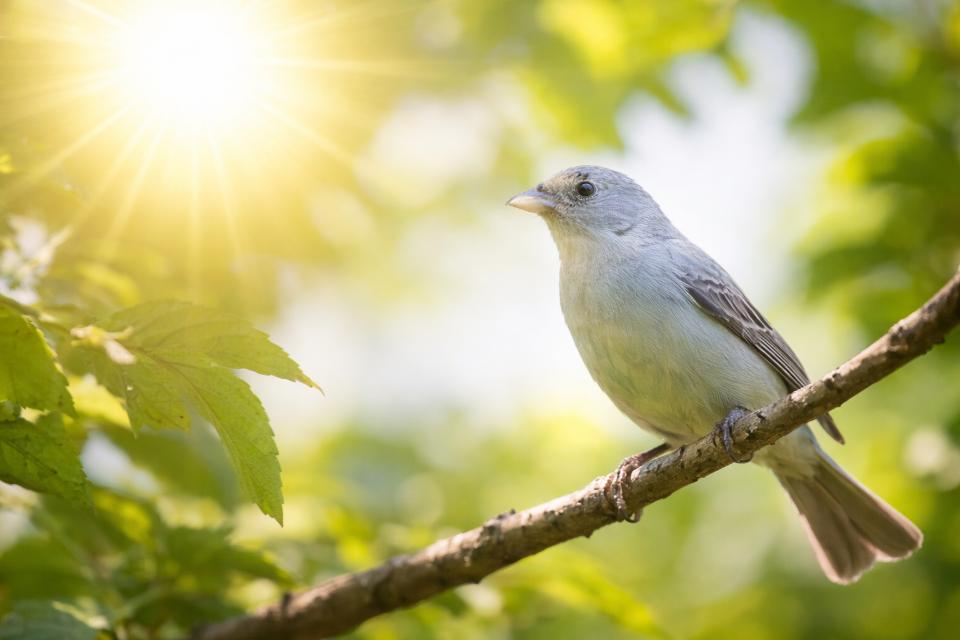
Challenge 2: The Green Wall (Dense Foliage)
Why You Can’t See Summer Birds
The same leafy canopy that provides cooling shade creates an impenetrable visual barrier. By midsummer, deciduous trees reach maximum leaf density, with individual leaves overlapping in layers that block 85-90% of light penetration to the forest floor. Birds you could easily observe in April become invisible shapes flitting through green curtains.
Compounding this challenge is a behavioral shift most birders don’t recognize: according to research on bird thermoregulation, many songbirds modify their behavior during extreme heat by moving into shaded interior canopy areas. They don’t perch on outer branches where you’re looking; they retreat 3-4 feet inward to the shaded interior where temperatures run several degrees cooler.
This creates a frustrating paradox. You hear birds constantly (summer is peak territorial and nesting season) but you rarely see them. The foliage problem isn’t actually about leaves. It’s about looking in the wrong place.
The Solution: Ear-Birding & Internal Canopy Movement
Technique 1: Ear-Birding for Precise Location
Develop the ability to locate birds by sound before attempting visual observation. This isn’t about species identification through calls (though that helps). It’s about using sound to pinpoint a bird’s exact position within dense foliage.
Cup your hands behind your ears to amplify directional sound. Close your eyes and rotate slowly until the call reaches maximum volume. This technique can locate a bird’s position within a 3-foot radius, giving you a specific zone to watch rather than scanning randomly through leaves.
Technique 2: Pishing to Trigger Movement
Pishing (making a repeated “pish-pish-pish” or squeaking sound) triggers a curiosity response in many songbirds. The sound mimics alarm calls that draw birds closer to investigate potential threats. In dense foliage, pishing can bring birds from the interior canopy to positions where you can observe them.
Use pishing sparingly and stop if birds show stress behaviors like agitated calling or dive-bombing. The technique works best early morning or late afternoon when birds are naturally more active.
Expert Secret: Watch for Internal Canopy Movement
Here’s what field researchers discovered: during peak heat hours, most songbirds position themselves in the interior 3 feet of tree canopies, not on the outer branches visible from the ground. This shaded zone provides temperatures 5-10 degrees cooler than exposed branches.
Instead of scanning the outer leaves, watch for movement within the canopy interior. Look for:
- Subtle shifts in leaf position within shaded areas
- Rhythmic movement suggesting breathing or feeding
- Leaf disturbance without wind explanation
- Small gaps in foliage where interior birds might be visible
Focus on the transition zone between full shade and dappled light. Birds often position themselves to maintain visual awareness while staying cool, creating opportunities for observation through canopy gaps.
Challenge 3: The Midday Lull & Estivation
The 2 PM Disappearing Act
Around 2 PM on summer days, bird activity plummets dramatically. This isn’t random timing. Research on avian estivation reveals that birds use torpor strategies during high ambient temperatures to reduce thermoregulatory energy expenditure. According to a study published in the Journal of Comparative Physiology, aestivation in birds represents a physiological response to heat where they enter a state of reduced metabolic activity.
According to research from the Smithsonian’s National Zoo, many birds incorporate siestas into their summer routine, limiting exposure to heat by taking power naps when the sun is strongest. This behavioral pattern, documented across multiple species, represents an energy conservation strategy similar to how hummingbirds enter torpor at night. Add mosquitoes, fogged optics, and the fact that songbirds vocalize 70% less during peak heat, and you understand why many birders simply stay inside during summer afternoons.
Field observations by the U.S. Fish and Wildlife Service confirm that species including cedar waxwings, double-crested cormorants, owls, and mourning doves commonly rest during the hottest times of the day, using behaviors like gular fluttering to dissipate heat without additional movement that would generate metabolic warmth.
The Solution: Target Thermal Refugia
While most birds reduce activity during peak heat, not all locations experience the same temperatures. Microclimate variation creates thermal refugia where temperatures remain 5-8 degrees cooler than surrounding areas, allowing birds to maintain activity levels 3-4 hours longer than in exposed locations.
But summer birding isn’t about working harder. It’s about understanding how birds behave during extreme heat and adapting your strategy accordingly. Birds don’t disappear; they modify their behavior in predictable ways based on thermoregulation needs.
Cold-Water Seeps & Springs:
Areas where groundwater emerges create localized cooling effects. Spring-fed streams, seeps along hillsides, and artesian flows maintain cooler air temperatures in the immediate vicinity. Birds concentrate in these zones during midday heat, both for drinking and for the cooler ambient temperatures.
Look for:
- Moss-covered areas indicating constant moisture
- Vegetation that appears greener than surrounding areas
- North-facing slopes where seeps commonly emerge
- Canyon bottoms with permanent water flow
Microclimate Hotspots:
Certain landscape features create natural air conditioning:
- North-facing slopes receiving minimal direct sun
- Deep ravines where cool air settles
- Dense conifer stands with continuous shade
- Areas near large water bodies where evaporative cooling moderates temperature
- Limestone outcrops with cave-like overhangs
Research on how birds respond to extreme weather, published by NASA Earthdata, found that temperature had a bigger impact than precipitation on bird distribution over short timeframes. Birds actively select cooler microclimates during heat exposure, concentrating in areas that provide thermal relief.
Crepuscular Activity Windows:
Rather than abandoning midday birding entirely, shift your timing to crepuscular periods (the hour before sunrise and the hour after sunset). These windows offer cooler temperatures plus peak bird activity as species emerge from midday torpor to feed intensively before nightfall.
Evening activity often exceeds morning activity in summer because birds need to replenish energy after hours of heat stress and minimal feeding. According to research on bird behavior, many species show increased foraging during late afternoon and early evening hours, making these prime observation windows for summer birding.
Challenge 4: Environmental Irritants (Mosquitoes & Optic Fog)
The Double Threat: Biting Insects & Equipment Failure
Summer birding means sharing habitat with mosquitoes, biting flies, and ticks. Beyond the obvious discomfort, insects create observation problems by forcing constant movement, preventing the stillness essential for detecting bird activity.
Meanwhile, a separate technical challenge plagues summer birders: optic fog. Moving from air-conditioned vehicles or homes into humid summer heat causes instant condensation on binocular lenses, rendering them useless for critical minutes during prime observation windows.
The Solution: Strategic Repellent Use & Temperature Buffering
Mosquito Management:
Permethrin Treatment: Pre-treat clothing with permethrin spray 48 hours before field outings. Unlike DEET-based repellents applied to skin, permethrin bonds to fabric fibers and remains effective through multiple washes. The compound kills mosquitoes and ticks on contact while providing protection that lasts 6 weeks or 6 washes.
Apply permethrin outdoors, treating shirts, pants, hats, and even boots. Allow 24-48 hours for complete drying before wearing. This creates a protective barrier that remains effective even in heavy sweat conditions where skin-applied repellents fail.
Thermacell Devices: These portable units create a 15-foot protection zone by heating a pad saturated with allethrin, a synthetic copy of a natural repellent found in chrysanthemum flowers. Unlike spray repellents, Thermacell doesn’t require skin application and doesn’t create the oily feeling that causes discomfort in heat.
The devices work best in low-wind conditions and require about 15 minutes to establish the protection zone. Place the unit upwind from your observation position for maximum effectiveness.
Expert Secret: The Garage Buffering Trick
Here’s a solution developed by wildlife photographers dealing with the same problem: buffer your optics temperature before going into the field.
The fog problem occurs because cold glass surfaces from air-conditioned environments immediately collect moisture when exposed to warm, humid air. The temperature differential causes instant condensation. The solution isn’t heating your optics; it’s gradually equalizing temperature.
Implementation:
- 30-45 minutes before leaving, place binoculars and camera equipment in your garage or an outdoor storage area
- This intermediate temperature zone allows equipment to warm gradually without exposure to full humidity
- Your garage typically runs 10-15 degrees warmer than your air-conditioned house but cooler than outdoor temperatures
- By the time you head into the field, your optics have reached ambient temperature without condensation
This technique eliminates the foggy lens problem that costs crucial observation time when you arrive at prime locations.
Alternative method: Keep a microfiber cloth in a sealed bag with silica gel packets. The super-dry cloth can absorb initial condensation faster than standard lens cloths, though the buffering method remains superior.
Challenge 5: Heat Haze (Atmospheric Distortion)
Why Long-Range Views Shimmer
On hot summer days, distant birds appear to waver and blur even though your optics are perfectly focused. This phenomenon, called heat haze or atmospheric distortion, results from temperature gradients in the air between you and your subject.
According to photographers specializing in wildlife observation, heat haze occurs when light passes through layers of air with different temperatures. As surfaces like asphalt, sand, or bare soil heat up, they create rising currents of warm air that mix with cooler air above. Light bends unpredictably as it passes through these temperature layers, creating the shimmering effect that degrades image clarity.
Research on atmospheric distortion shows that the problem intensifies with:
- Increased distance between observer and subject
- Telephoto magnification (long lenses amplify the effect)
- Proximity to heated surfaces
- Temperature differentials between air layers
Wildlife photographers report that heat haze is particularly severe when viewing low over water, sand, or asphalt, where the first few feet of air above the surface experiences the most dramatic temperature mixing.
The Solution: Get Low to the Ground
Physics provides a counterintuitive solution: the lowest position offers the clearest views. Here’s why:
Heat haze concentration follows a vertical gradient. The most turbulent air (where temperature differences are greatest) occurs in the first 1-3 feet above heated surfaces. This layer contains the most dramatic temperature mixing and therefore the worst distortion.
However, when you position yourself low to the ground, you’re viewing through this disturbed layer at a very shallow angle. Instead of looking through 50 feet of turbulent air when standing, a prone position means you’re only viewing through 3-5 feet of that worst zone before your line of sight rises into more stable air.
Implementation Strategy:
- Use ground pods, bean bags, or prone shooting positions
- Seated positions work better than standing when viewing distant subjects
- Avoid viewing over asphalt roads and parking lots when possible
- Target subjects at higher elevations when practical (birds in flight, elevated perches)
- Prioritize morning and evening hours when surface temperatures are lower
Wildlife photographers working with extreme telephoto lenses report that positioning just 2 feet lower can transform an unusably soft image into acceptable sharpness. The technique works because you’re minimizing the amount of thermally disturbed air between you and your subject.
Additional Mitigation:
- Shoot earlier in the day before surfaces reach peak temperatures
- Choose observation positions over water or grass rather than asphalt or sand
- Understand that some atmospheric distortion is inevitable in summer conditions
- Accept that heat haze may limit effective observation range to 30-40 meters on the hottest days
Research on heat distortion in photography confirms that atmospheric conditions during peak summer heat can significantly degrade long-range clarity, but strategic positioning and timing minimize these effects.

Summer Birding Gear Guide
Optical Modifications for Summer Conditions
Wide-Brimmed Hats with Dark Under-Brims:
Standard baseball caps provide inadequate sun protection for birding. Choose hats with 3-4 inch brims that shade your face and prevent peripheral light from reaching your eyes. The critical feature most birders miss: a dark-colored under-brim.
Light-colored hat undersides reflect sunlight upward into your face, creating glare even in shaded conditions. Dark gray or black under-brims absorb this reflected light, dramatically improving visual comfort during extended observations.
Polarized Sunglasses Optimized for Bird Observation:
Choose amber or brown-tinted polarized lenses over gray. According to optical research, amber tints provide superior contrast enhancement while still eliminating glare. Gray lenses block light evenly across the spectrum but offer no contrast improvement.
Wrap-around frame designs prevent light from entering around the sides, further reducing glare exposure. Ensure any polarized glasses are rated for 100% UVA/UVB protection, as prolonged outdoor observation exposes eyes to significant ultraviolet radiation.
Portable Mosquito Repeller Systems:
Beyond personal application repellents, consider establishing a protection zone at fixed observation points. Thermacell backpacker units are lightweight and clip to belts or backpacks, creating a moving 15-foot protection zone. The devices work best when:
- Positioned upwind from your body
- Allowed 10-15 minutes to establish the protection zone
- Used with manufacturer pads and fuel cartridges for reliability
- Operated in low-wind conditions (under 10 mph)
Hydration Systems with Insulated Reservoirs:
Summer birding demands significantly more water intake than spring or fall outings. Hydration bladders with insulated sleeves keep water cool for 4-6 hours and allow hands-free drinking without interrupting observations. Target minimum intake of 16-24 ounces per hour during active birding in temperatures above 85°F.
Clothing Strategies for Summer Field Work
Light-colored, loose-fitting clothing in synthetic fabrics designed for moisture-wicking outperforms cotton in summer heat. Modern hiking shirts with built-in ventilation panels and UPF sun protection provide cooling while preventing sunburn during extended observation periods.
Pre-treated permethrin clothing creates a tick and mosquito barrier that remains effective through multiple washes, eliminating the need for repeated spray applications. Many outdoor retailers now offer permethrin-treated clothing as a standard option.
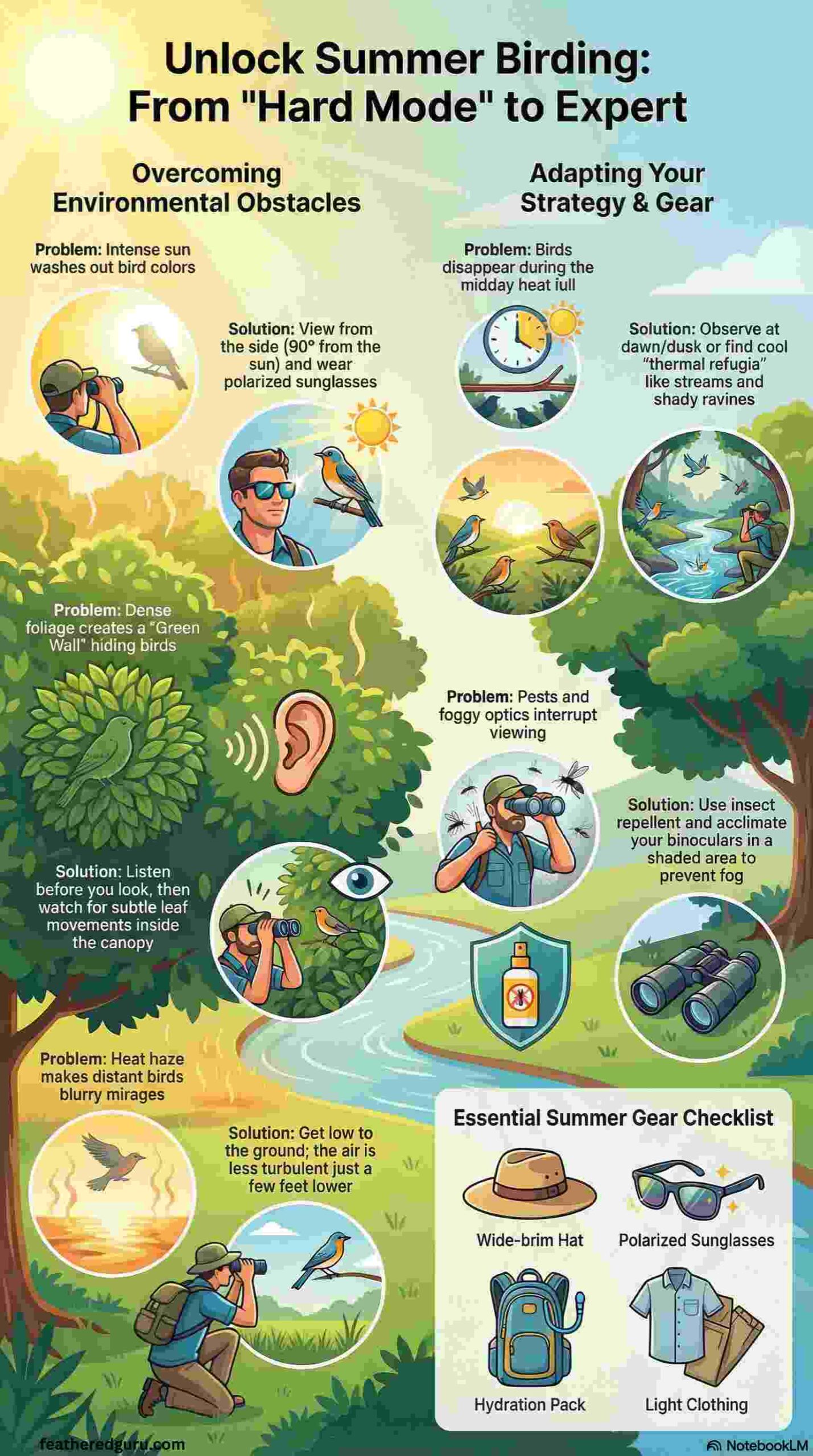
Quick Reference Guide: Summer Birding
Need a quick reference? Save or print this infographic for easy access to the top tips:
Conclusion: Summer as Strategic Opportunity
Summer birding rewards those who understand bird thermoregulation and adapt their techniques accordingly. The challenges (sun glare, dense foliage, heat-induced torpor, insects, and atmospheric distortion) have specific solutions rooted in ornithological research and field-tested observation strategies.
The key insight: summer birds don’t disappear; they modify their behavior in predictable ways. By targeting thermal refugia during midday, using internal canopy movement to locate birds in dense foliage, and understanding how heat affects both bird behavior and atmospheric optics, you transform summer from the frustrating “hard mode” into a season of strategic advantage.
Most birders abandon summer observation, creating an opportunity for those who adapt. Nesting behavior provides observation opportunities unavailable in other seasons. Fledgling activity peaks in July and August. Certain species become more visible as they defend territories and provision young, making summer an excellent time to observe songbird family groups and feeding behaviors focused on insects.
The difference between successful summer birding and frustration comes down to working with summer’s physics rather than against it. Use polarized optics to cut glare. Position yourself low to minimize heat haze. Target the thermal refugia where birds remain active during midday heat. And critically, adjust your expectations to match avian behavioral patterns rather than forcing birds to fit your spring-season observation habits.
Understanding how to keep birds cool during heat waves naturally leads to the next logical question: how can you support birds through summer’s most extreme temperatures? The techniques for helping birds thermoregulate in your backyard complement these observation strategies, creating a comprehensive approach to summer bird stewardship.
For more information on providing water sources, shade structures, and other cooling resources that help birds survive heat waves, explore our comprehensive guide on keeping birds hydrated during summer and learn about creating bird-friendly habitats that provide thermal relief during extreme heat.