
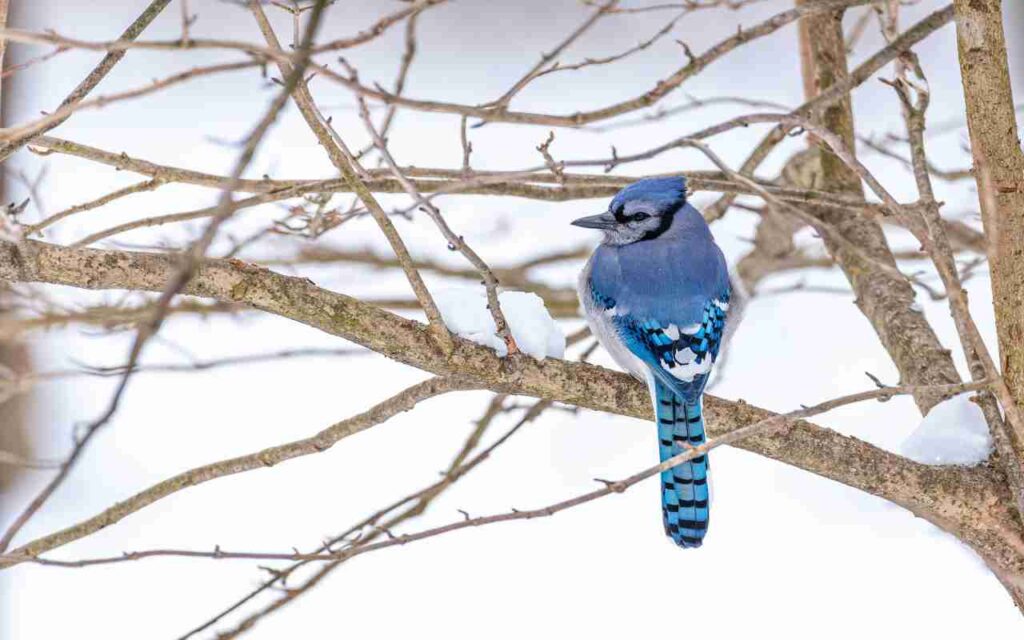
Migration gets most of the attention with its epic seasonal journeys, but some of the most interesting birds are the ones that stick around when winter hits. If you have ever found yourself wondering what birds stay in winter, a flash of red from a cardinal in the snow or a bold chickadee at your feeder offers the answer. These tough, year-round residents handle freezing temperatures, deep snow, and limited food with a set of survival tricks that are just as impressive as long-distance migration.
Learning which birds remain through winter and why they choose to stay reveals a lot about how birds adapt to their environment. This guide pulls together research on winter bird residency, covering which species stay put, how they survive cold weather, how winter bird populations vary by region, and practical ways you can support them when conditions are toughest. 🙂
- Many birds stay year-round instead of migrating south.
- Cardinals, chickadees, and nuthatches are common residents.
- Woodpeckers, jays, and titmice often remain through winter.
- Which birds stay depends heavily on region and climate.
- Some species partially migrate while others stay put.
- Resident birds rely on food caching to survive winter.
- Winter diets shift from insects to seeds and berries.
- Evergreens and tree cavities provide key cold shelter.
- Climate change is shifting winter bird ranges north.
- Feeders, water, and shelter greatly improve survival.
What Birds Stay in Winter (Video Explainer)
Some backyard birds stick around all winter instead of migrating south. This quick video explainer shows which birds stay put, how they handle cold weather, and why feeders, water, and shelter matter most during winter.
Show Transcript:
0:00
Okay, so when winter hits, we all know the story. Birds fly south. But what about the ones that don’t? The ones that just stay? Those are nature’s ultimate survivors. Today, we’re diving into the science of how they manage to thrive when everything turns cold and white.
0:20
You’ve seen it, right? It’s snowing, it’s freezing, and there’s a tiny bird all puffed up just hanging in there. You have to wonder, how in the world do they do that? That is exactly what we’re exploring today.
0:35
First, let’s meet the stars of this story. The birds that face winter head-on and say, “I’m staying.” Migration gets all the attention with epic continent-spanning journeys, but these resident birds play a totally different game. They are the year-round locals. Their strategy isn’t about escaping the cold. It’s about toughing it out.
0:57
Seeing a brilliant red cardinal against the snow isn’t just a pretty picture. It’s a symbol of a complex survival machine. It tells us there’s an amazing biological drama unfolding right outside your window.
1:22
Choosing to stay is not simple. For these birds, the decision to go or stay is a high-stakes gamble. It’s an evolutionary bet where the consequences are life or death. For many species, it’s not an all-or-nothing choice. Some birds in the same species migrate, while others stay. This is called partial migration.
1:48
A study of European blackbirds shows the migrants had a sixteen percent better chance of surviving winter. That’s huge. But the residents who survive hit the jackpot. They get first choice of the best nesting sites in spring, giving their young a big head start. It’s the ultimate risk and reward.
2:16
So, how do they pull it off? That’s where the mind-blowing biology comes in. Let’s focus on one bird you probably know: the black-capped chickadee. Don’t let its small, cheerful appearance fool you. This little bird is one of the toughest survivalists on the planet.
2:47
Chickadees cache thousands of seeds to get through winter. To remember every hiding spot, they literally rewire their brains every fall. Old neurons die, new ones grow, giving their memory a massive upgrade for the winter.
3:00
At night, to save energy, they go into regulated hypothermia. They intentionally drop their body temperature, saving ten to fifteen percent of energy every night. For a tiny bird in freezing temperatures, that margin can mean the difference between life and death.
3:24
It’s not just chickadees. All resident birds have survival tricks. Cardinals switch from insects to cracking seeds. Different species form mixed flocks, like a neighborhood watch, to improve foraging and spotting predators. They find microhabitats, such as dense evergreens, for shelter. They become experts at managing every second of winter daylight.
3:50
A fun fact: the cardinal, a symbol of winter resilience, is the official state bird of seven US states, more than any other species. This shows how much we admire a true survivor.
4:06
Modern challenges are reshaping winter survival. Climate change is redrawing winter maps and forcing birds to adapt again. EPA data shows that since the 1960s, sixty-one percent of bird species have shifted their winter ranges north.
4:36
This means new neighbors in your backyard. The American robin, once a spring herald, now often stays all winter. Traditional rules for migration are changing in real time.
4:50
Here’s how you can help. You can be part of their survival story. Supporting your local birds boils down to three essentials: high-energy food, fresh water, and shelter.
5:16
High-energy food is key. Black oil sunflower seeds are a favorite. Suet is like a power bar for birds—pure fat they need to generate heat. Your feeder becomes their essential gas station on a cold day.
5:31
Water is often overlooked. When everything freezes, finding liquid water is nearly impossible. Heated birdbaths provide drinking water and keep feathers clean, which helps birds stay insulated and warm.
5:58
The next time you see a tiny bird in the snow, think about what it can teach us. These small survivors show ingenuity, toughness, and determination. They are incredible examples of resilience in a rapidly changing world.
Understanding Bird Residency: Definitions and Patterns
Before identifying specific winter residents, clarifying what constitutes “resident” versus “migratory” status helps frame the discussion.
Resident Birds Defined
According to Smithsonian Gardens research on non-migratory birds, not all birds migrate during the cold winter months. Some stay local, which means they must modify their feeding and living habits. While most flowers, insects, water, and other resources are abundant during spring and summer seasons, they become increasingly harder to find as plants go dormant and water supplies freeze.
Research published in Scientific Reports examining behavioral plasticity in birds found that resident birds show significantly greater behavioral flexibility than migratory species, suggesting that the ability to adapt to varying local conditions represents a key evolutionary advantage supporting year-round residency.
However, the concept of “resident bird” must relate to a very specific region. Many birds considered resident in the continental United States are considered migratory species throughout Canada and Alaska. Likewise, some year-round residents of Florida, Texas, and other southern locales are considered migratory birds elsewhere. This geographic relativity makes discussing residency patterns complex but fascinating.
Partial Migration: The Middle Ground
Research published in PMC examining migration patterns notes that sedentary or resident animals, such as Florida Scrub-Jays, Western Scrub-Jays, or Northern Cardinals, are non-migratory, remaining on the same territories year round. However, short-distance migrants make annual movements spanning some hundreds of kilometers, exemplified by species including Eastern Bluebirds and Red-winged Blackbirds that move shorter regional distances south for winter.
Partial migration, where some individuals within a species migrate while others remain resident, represents particularly interesting biology. A study published in PMC on migration and winter survival found that in partially migratory European blackbird populations, migrant birds had 16% higher probability to survive winter compared to residents, though resident birds benefited from earlier access to prime breeding sites.
This research demonstrates the evolutionary tradeoffs between migration and residency. Residents face higher winter mortality risk but gain breeding advantages, while migrants survive winter better but arrive later to compete for territories.
Common Winter Resident Birds by Region
Which birds remain through winter varies dramatically by geographic location, reflecting regional climate conditions and available food sources.
Northern Regions: Hardy Year-Round Species
In northern states and Canada where winters are severe, only the hardiest species maintain year-round residency.
According to The Nature Conservancy’s Midwest winter birds research, black-capped chickadees remain year-round residents despite extreme cold. These birds eat 20 times more in winter than in summer, requiring constant access to high-energy foods. Every autumn, they allow neurons in their brain with old information to die and replace them with new neurons that let them remember food caches, new social rules to follow in large flocks, and other skills needed for winter.
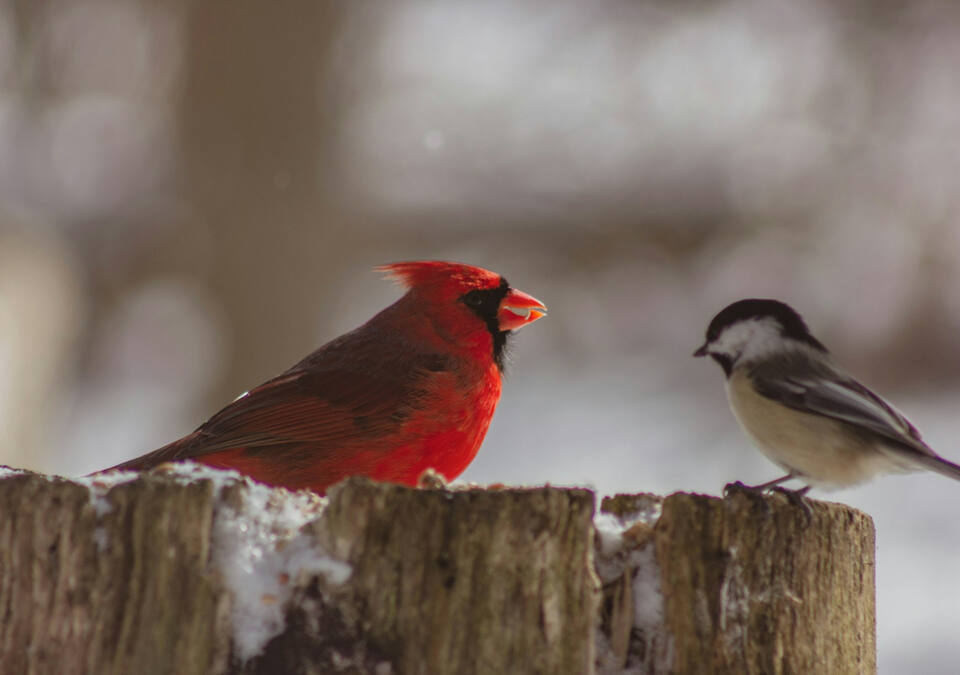
Northern cardinals stand out as one of the most recognizable winter residents across much of North America. Spotting a male’s bright red feathers among the muted landscape of winter provides a highlight of any chilly day. According to Wikipedia’s comprehensive overview, the northern cardinal is the state bird of seven U.S. states, more than any other species: Illinois, Indiana, Kentucky, North Carolina, Ohio, Virginia, and West Virginia.
Tufted titmice represent another common northern winter resident. Related to chickadees, these birds are frequent sights during winter months. A mated pair will remain together in their territory in winter, often with one of their young. They visit feeders preferring sunflower seeds, but also taking peanuts, suet, or other seeds.
White-breasted nuthatches, often spotted clinging vertically to trees, shift from insect hunting in warmer months to seeking meaty seeds in winter. They hop up and down trunks and branches, turning sideways or upside down as they look for food or store seeds.
For comprehensive understanding of winter chickadee survival, explore how chickadees survive the winter.
Temperate Regions: Greater Resident Diversity
Moderate winter zones support higher diversity of year-round residents compared to harsh northern climates.
Downy woodpeckers and other woodpecker species remain year-round across most of their range. These cavity-nesting birds access insect larvae and pupae hidden under bark, providing protein sources unavailable to seed-eating species.
Blue jays, members of the corvid family, show complex movement patterns. While some populations migrate short distances, many remain year-round residents, particularly in areas with reliable food sources like oak forests producing abundant acorns.
Mourning doves exhibit partial migration in northern portions of their range while remaining resident in southern and temperate regions. Their ability to crop milk feed offspring and efficient seed digestion allows them to exploit winter seed resources effectively.
Southern Regions: Expanded Resident Communities
Mild southern winters support the most diverse year-round resident bird communities.
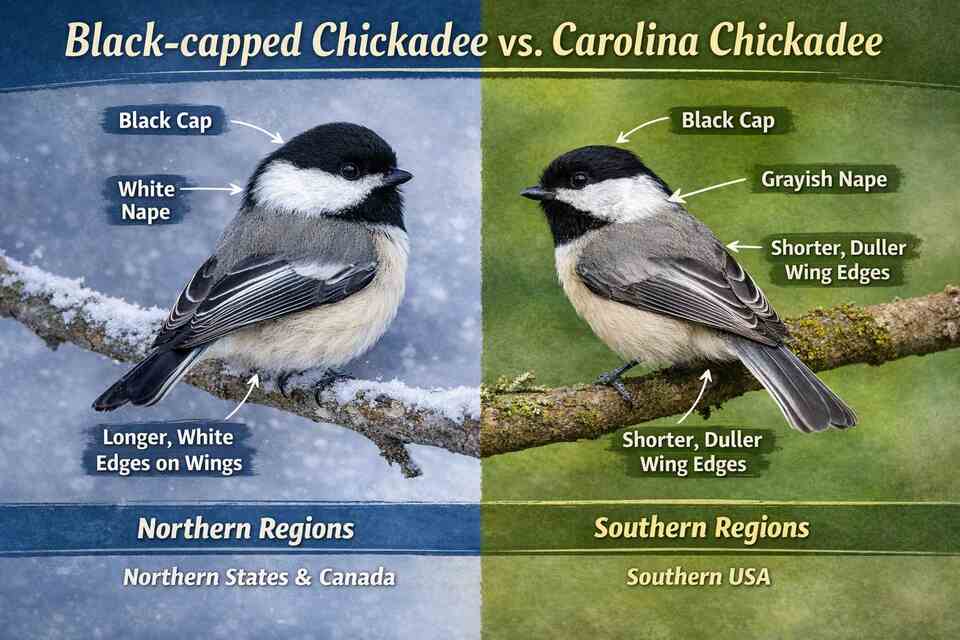
Carolina chickadees replace black-capped chickadees as the common resident chickadee across the Southeast. According to Alabama’s Outdoor Alabama resource, Carolina chickadees can be found in a variety of habitat types including deciduous, mixed, and coniferous forests, as well as woodland clearings and edges, gardens, parks, and residential areas. During winter, they feed in small flocks of 8 to 12 birds and forage in the woodlands with nuthatches, titmice, warblers, kinglets, and other small birds.
Additional southern residents include Carolina wrens, Eastern towhees, and various woodpecker species. The milder climate allows these species to find adequate food and shelter without migrating.
To understand regional bird distributions better, consult guides on common backyard birds and winter bird identification.
Physiological Adaptations for Winter Residency
Resident birds employ remarkable physiological strategies enabling winter survival in challenging conditions.
Metabolic Flexibility
Research published in Ecology and Evolution examining resident versus migratory birds found that resident Great Tits were more capable of initiating egg laying in closer association to variation in early spring conditions than long-distance migrants. This demonstrates that resident birds possess greater physiological flexibility to respond to local environmental cues, an advantage during variable winter conditions.
Black-capped chickadees demonstrate extraordinary metabolic adaptation. They can lower their body temperature during cold winter nights through regulated hypothermia, conserving energy that would otherwise be expended maintaining normal body temperature. This controlled hypothermia can reduce overnight energy expenditure by 10-15%, providing meaningful survival advantages during extended cold periods.
Food Caching Behavior
Many resident species employ sophisticated food caching strategies to survive winter food scarcity. Chickadees, titmice, and nuthatches hide thousands of seeds throughout their territories during fall, then retrieve them during winter when fresh food becomes scarce.
Research published in Current Biology examining genes underlying spatial cognition in food-caching chickadees found that chickadees rely on specialized spatial learning and memory abilities to recover food caches throughout winter. The study identified specific genes and developmental pathways that play key roles in creating variation in spatial cognition, with many candidate genes associated with synaptic plasticity.
Dietary Flexibility
Resident birds must exploit diverse food sources throughout winter as availability fluctuates. Species like Northern Cardinals shift from primarily insect-based summer diets to seed-based winter nutrition. Their strong, conical bills specifically adapt them for cracking seeds, making this dietary shift feasible.
Research on what cardinals eat demonstrates their remarkable dietary flexibility, consuming over 90 different foods including seeds, fruits, and insects depending on seasonal availability.
Behavioral Adaptations for Winter Survival
Beyond physiological changes, resident birds modify behavior dramatically to survive winter conditions.
Flocking Behavior
Many resident species that defend territories during breeding season form mixed-species flocks during winter. These flocks provide multiple survival advantages: improved predator detection through many eyes, reduced individual predation risk through safety in numbers, and enhanced foraging efficiency through information sharing about food locations.
According to research on winter bird communities, in the bird community of the Hun River riparian zone, there were 19 species of resident birds, accounting for 63.3% of the total species. During winter surveys, resident birds were distinguished from migratory birds, with resident species showing different responses to environmental variables than winter visitors.
Mixed flocks typically include a core of chickadees or titmice with associated nuthatches, woodpeckers, and kinglets. The chickadees’ constant vocalizations help maintain flock cohesion while also serving as alarm calls warning of predators.
Microhabitat Selection
Resident birds select specific microhabitats offering thermal protection and food access. Dense evergreen cover provides critical shelter from wind and precipitation while also offering marginally warmer temperatures than exposed locations.
According to the Smithsonian Gardens, providing winter habitat through native plants, evergreens, and shelter structures creates environments where resident birds can survive harsh conditions.
Activity Pattern Shifts
Winter day length constraints force resident birds to compress daily activity into fewer daylight hours. Studies show that winter birds begin foraging earlier after dawn and continue later before dusk compared to summer patterns, maximizing food acquisition during limited light.
Additionally, resident birds reduce non-essential activities during winter, minimizing energy expenditure on territorial defense, singing, and other behaviors that can wait until breeding season.
Climate Change Impacts on Winter Bird Distributions
Shifting climate patterns are measurably altering which birds remain resident through winter in specific regions.
Northward Range Shifts
According to the EPA’s analysis of bird wintering ranges, of the 305 species studied, 186 (61 percent) have shifted their wintering grounds northward since the 1960s, while 82 (27 percent) have shifted southward. Some others have not moved at all.
These shifts reflect birds’ responses to warming winter temperatures. Species can adapt to generally warmer temperatures by changing where they live, such as by not migrating as far south in winter, or by shifting inland as winter temperature extremes grow less severe.
Non-migratory species might shift as well, expanding into newly suitable habitats while moving out of areas that become less suitable. This dynamic redistribution complicates the question of “which birds stay in winter” as the answer increasingly depends on which specific years we examine.
Altered Migration Patterns
Some traditionally migratory species are becoming partial migrants or residents in response to climate warming. American Robins, historically considered migratory across much of their range, now increasingly remain through winter in areas where they previously migrated south.
Similarly, some waterfowl species that historically migrated when northern water bodies froze are finding that milder winters keep some water bodies ice-free, allowing them to remain resident where migration was previously obligatory.
Supporting Resident Birds Through Winter
Understanding which birds remain through winter allows targeted support through appropriate habitat management and supplementation.
Providing Winter Food Sources
Resident birds benefit from diverse food offerings matching their specific dietary requirements. According to the Smithsonian, black oil sunflower seeds, safflower seeds, berries, cracked corn, crushed peanuts, thistle seeds, mealworms, and white milo attract a plethora of birds all winter long.
Suet represents particularly valuable winter nutrition due to its high fat content. However, suet can go rancid, so it should be refrigerated before use, or rendering the suet improves its shelf life.
For comprehensive guidance on winter feeding, explore resources on feeding birds in winter and what seeds to use in winter feeders.
Water Availability
Fresh water becomes critically scarce during winter when natural sources freeze. Providing heated water sources dramatically improves resident bird survival during extended freezes.
Research demonstrates that birds require water for both drinking and bathing, with feather maintenance through bathing proving critical for maintaining insulative properties. For detailed guidance, see resources on attracting birds during winter.
Shelter Provision
Dense evergreen plantings, brush piles, and cavity structures provide essential winter shelter. Birds need sheltered areas to protect themselves from elements and predators, with evergreens providing windbreaks and dense cover.
For specific strategies, consult guides on how to make winter shelter for birds and bird-friendly garden design.
Winter Resident Birds at a Glance
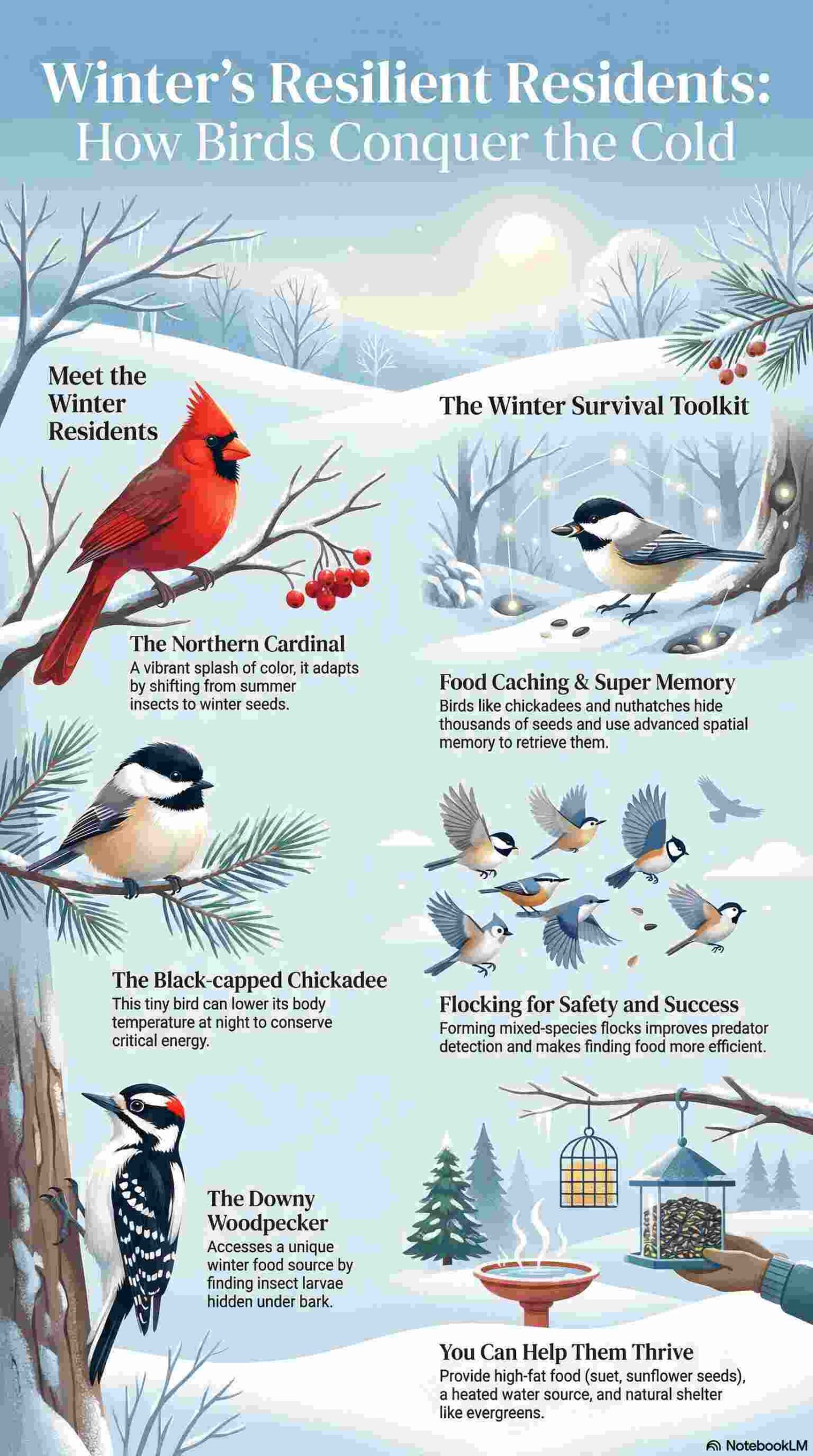
To give you a quick visual overview, this infographic highlights the birds that stay active in winter, where they’re commonly found, and the strategies they use to survive harsh conditions.
Conclusion: Appreciating Winter’s Resident Birds
The birds that remain through winter demonstrate remarkable evolutionary adaptations allowing survival under conditions that drive billions of birds to migrate thousands of miles. From physiological changes like regulated hypothermia to behavioral shifts including food caching and mixed-species flocking, resident birds employ diverse strategies conquering winter’s challenges.
Understanding regional variation in residency patterns, recognizing that climate change continually reshapes these distributions, and implementing evidence-based support through appropriate food, water, and shelter provision allows us to assist these hardy species through winter’s harshest months.
The next time you observe a chickadee at your feeder during a snowstorm or hear a cardinal singing on a frigid January morning, appreciate the sophisticated biological mechanisms enabling these birds to thrive where many species cannot survive. Winter residents represent evolution’s successful solutions to seasonal resource scarcity, and supporting their survival enriches our winter landscapes while contributing to bird conservation.
For comprehensive guidance on creating year-round bird habitat, explore resources on creating bird sanctuaries and complete backyard birding strategies.