
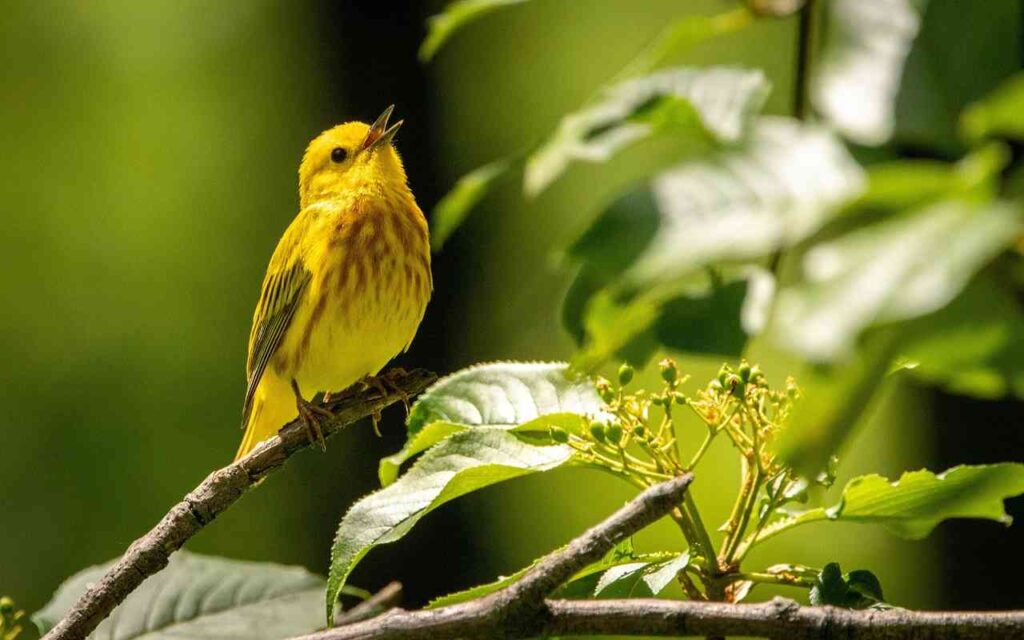
Spring warbler migration is one of North America’s most spectacular natural phenomena, with over 50 species traveling thousands of miles from Central and South American wintering grounds to northern breeding territories. Knowing how to attract migratory warblers in spring helps residential yards provide the key habitat elements that research shows make stopovers successful, rather than letting warblers simply fly over.
This guide is for birders who want to transform their yards into warbler stopover sites during spring migration, not just hope for occasional visitors. Understanding migration ecology, stopover habitat requirements, and timing allows property owners to create conditions that warblers actively seek. This synthesis of ornithological research, stopover ecology studies, and migration timing data provides actionable strategies for attracting spring warblers across North American regions. 🙂
- Warblers select stopover sites based on insect abundance and cover.
- Native trees and shrubs support far more caterpillars than ornamentals.
- Vertical structure (ground to canopy) increases species diversity.
- Dense understory reduces predation risk during refueling.
- Water access improves feather condition and stopover use.
- Pesticides and early spring cleanup reduce available food.
- Most warblers remain 1–3 days before continuing migration.
Watch: How to Attract Migratory Warblers in Spring
Show Transcript:
0:00
Hey everyone. Every single spring, there’s a secret, unbelievable river of color flowing across North America. We’re talking about millions of tiny, jewel-like birds called warblers, and they’re on the move.
0:13
Today, we’re breaking down exactly how you can convince them to make a stop in your own backyard. Let’s figure out how to put out the welcome mat for one of nature’s greatest shows.
0:23
This is the question that drives bird lovers crazy. You see the migration reports and hear about huge waves of birds moving through, but then you look out your window and see nothing.
0:36
It can feel like your yard has some invisible force field around it. But what if I told you it has absolutely nothing to do with luck?
0:44
These birds are true marathoners. We’re talking about creatures that weigh less than a handful of paper clips, flying all the way from Central and South America to the forests of Canada.
0:55
It’s an epic journey, and the amazing part is that it’s happening right over our heads.
1:00
This is what we’re calling the Great Warbler Flyover. It’s the reason most people miss out on this incredible spectacle. But not anymore.
1:08
Today, we’re going to learn how to turn that flyover into a stopover. The secret isn’t crossing your fingers and hoping for the best. It’s grounded in science.
1:17
If you understand what warblers truly need during migration, you can intentionally design a space they can’t resist. It all starts by looking at your yard through their eyes.
1:31
So let’s put on our imaginary warbler wings for a minute. To attract them, we need to understand the pressures and priorities they face in the middle of migration.
1:40
This brings us to a key scientific concept: stopover ecology. This is the crucial point.
1:47
It’s not about finding a forever home. It’s about finding a safe, efficient place to rest and refuel for the next leg of the journey.
1:56
Think of it less like a final destination and more like a critical service station along a highway.
2:02
A breeding habitat is a summer home where a warbler might spend months raising a family. A stopover habitat is a high-stakes pit stop in a race against time.
2:12
They may only be in your yard for a day or two, and their goal is simple: fuel up, stay safe, and move on.
2:22
When a warbler lands, it’s running through a mental checklist. First, it needs to maximize food intake by gorging on insects to rebuild fat reserves.
2:31
Second, it needs protection from predators, which means dense cover from hawks or cats. And third, it needs to do all of this while conserving as much energy as possible.
2:40
The perfect yard satisfies all three needs. So how do we build that perfect pit stop? It really comes down to three core essentials.
2:50
If you get these three things right, you’re well on your way to becoming a warbler hotspot. It all comes down to structure, food, and water.
3:02
More specifically, that means layered vertical structure, native plants that produce food, and a reliable source of clean water. Let’s break each one down.
3:11
First, structure. Different warbler species feed at different heights. The problem is that most suburban yards only have two layers: tall trees and lawn.
3:22
What’s missing is the midstory and understory. These dense shrubs and small trees are where most warblers actually live and find food.
3:32
Next is native plants. And why native? Because native insects evolved to eat native plants. During migration, warblers are almost entirely insect eaters.
3:40
They need thousands of caterpillars to fuel their flight, and those caterpillars only exist on native plants.
3:50
The numbers here are staggering. A single native oak tree can support over 530 species of caterpillars. That’s a nonstop buffet for hungry migrants.
4:02
Compare that to a non-native ornamental tree, which may support only a handful of insect species, if any at all.
4:11
Choosing native trees isn’t a small improvement. It’s the difference between a full buffet and an empty restaurant for a bird on a tight energy budget.
4:26
Finally, water. Warblers need it for drinking and bathing to keep their feathers in flight-ready condition.
4:33
The key is making it feel safe. Use shallow water, add movement with a dripper, and place it near shrubs so birds can dart into cover if needed.
4:46
Now that we know what to do, it’s just as important to know what not to do. Let’s cover four common mistakes that can turn your yard into a warbler-free zone.
4:59
Mistake number one is pesticide use. Even a single mosquito spray can wipe out insect populations for weeks, right when warblers need them most.
5:11
Going pesticide-free during migration is one of the most powerful things you can do.
5:17
Another common mistake is cleaning up too early in spring. That leaf litter on the ground is a pantry full of overwintering insects.
5:24
Removing it too soon is like throwing out all your food right before guests arrive.
5:38
Without that critical three- to ten-foot layer of shrubs and small trees, you’re missing habitat for most warbler species. This is the biggest gap in modern yards.
5:52
And finally, seeds won’t help. Warblers don’t eat sunflower seeds or suet. They’re specialized insect hunters.
6:02
The only way to feed warblers is to grow their food by creating the right habitat.
6:09
So what can you expect if you make these changes? Habitat building isn’t overnight, but the rewards start sooner than you think.
6:21
In the first year, you may see quick visits from common species. As native plants mature, diversity and numbers increase.
6:34
Within five years, your yard can become a reliable, life-saving stopover on the warbler migration highway.
6:43
And this isn’t just about your enjoyment. With natural habitat shrinking, a network of bird-friendly backyards provides a real lifeline.
6:57
So there it is. You now have the scientific blueprint. It’s not about luck. It’s about structure, food, and water.
7:08
The only question left is this: what story will your yard tell next spring? That river of jewels is coming, and your yard can be the oasis they’ve been flying all night to find.
Understanding Warbler Stopover Ecology
Warbler migration operates on tight energy budgets. Research published in The Auk examining stopover habitat use by spring migrant landbirds found that habitat quality has important energetic consequences for en route migrants. Male Wilson’s Warblers gained mass during fall stopover in riparian cottonwoods in New Mexico, but not in more fragmented agricultural or willow habitats, demonstrating that habitat type directly affects refueling success.
The critical concept underlying warbler attraction is stopover site selection. Unlike breeding habitat where warblers occupy territories for weeks or months, stopover sites serve as brief refueling stations. Studies of Wilson’s Warbler stopover ecology documented that Wilson’s Warblers appeared to prefer native willow habitat during spring migration, with variation in stopover patterns predominantly sex-related in spring and age-related in fall. Males appeared at study sites earlier than females and carried higher fat stores.
During stopover, warblers face competing demands: maximizing food intake to build fat reserves while minimizing predation risk and energy expenditure. Properties that provide abundant insects in structurally diverse vegetation with adequate cover meet these requirements more effectively than manicured landscapes.
In my own yard, after establishing dense understory shrubs with native plants, I’ve noticed warblers spending significantly more time foraging rather than quickly passing through, with some individuals returning to the same shrubs multiple mornings during migration waves.
Spring Migration Timing by Warbler Species
Warbler migration occurs in waves rather than as a continuous stream, with different species arriving on predictable schedules. Understanding these patterns allows property owners to prepare habitat before arrival.
Early Arrivals (Late March-Early April)
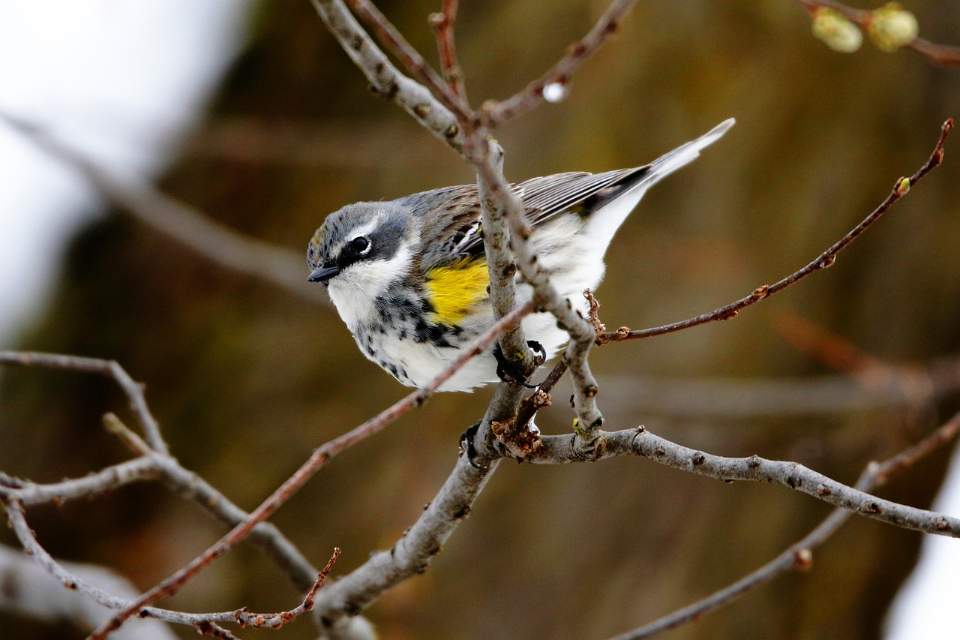
Yellow-rumped Warblers lead the spring migration, arriving in northern states by late March. These hardy warblers can survive on berries when insects are scarce, allowing earlier migration than strictly insectivorous species. They forage from ground level to canopy, investigating diverse microhabitats for emerging insects.
Palm Warblers arrive in early April, preferring areas with low vegetation and open ground where they characteristically bob their tails while foraging. They concentrate along woodland edges, marshes, and fields with scattered shrubs.
Mid-Migration Peak (Late April-Mid May)
The warbler wave peaks from roughly April 25 through May 15 across the mid-Atlantic and Northeast, with timing shifting earlier in southern regions and later in northern regions. This 3-week window brings maximum species diversity.
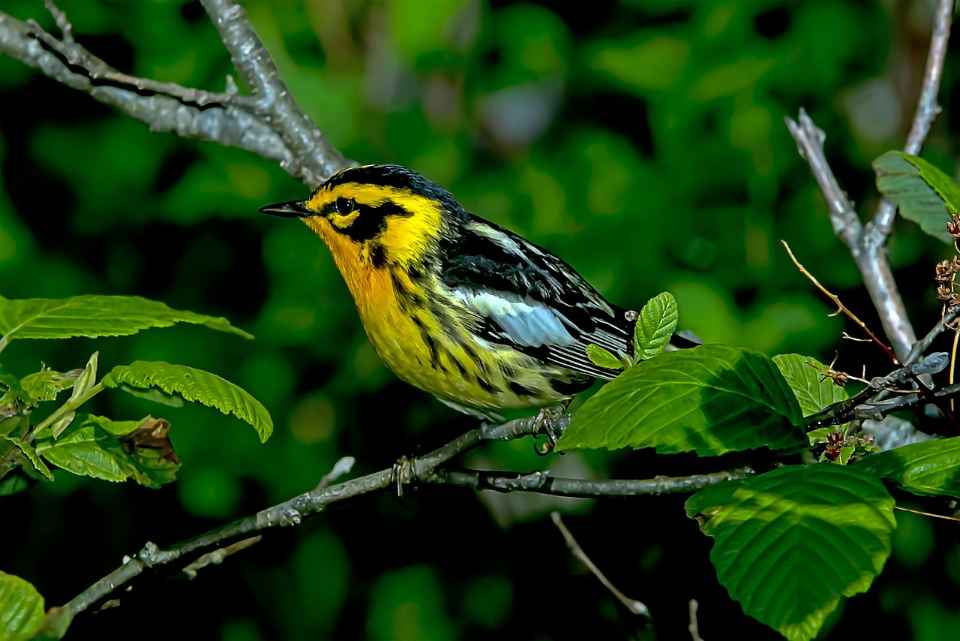
Black-throated Blue Warblers, Black-throated Green Warblers, Magnolia Warblers, Blackburnian Warblers, and American Redstarts dominate this period. Most species pass through in 7-14 days, though individuals may stop over for just 1-3 days if conditions are good.
Tennessee Warblers, Nashville Warblers, and Wilson’s Warblers peak slightly later, typically May 5-20. These species often form mixed-species foraging flocks that move through habitats systematically.
Late Migrants (Mid May-Early June)
Blackpoll Warblers, Bay-breasted Warblers, Canada Warblers, and Mourning Warblers conclude spring migration, arriving mid-May through early June. These late migrants often face fully leafed-out forests, requiring different observation strategies than early arrivals.
For detailed migration timing guidance, see warbler migration patterns.
Essential Habitat Components for Warbler Stopover
Research consistently identifies specific habitat elements that determine whether warblers select stopover sites and successfully refuel.
Vertical Vegetation Structure
Studies examining stopover habitat demonstrated that transient species that breed in mature forests were positively associated with sites presenting large trees and denser vegetation in the understory. Research on warbler habitat associations found that the density of trees larger than 30 cm diameter at breast height was an overall important variable for diverse bird communities, with large-diameter trees essential for providing suitable warbler habitat.
Warblers occupy different foraging zones based on species-specific preferences:
Ground to 3 Feet:
- Ovenbirds, Louisiana Waterthrushes, Northern Waterthrushes
- Dense leaf litter with fallen logs
- Low shrubs providing cover
3 to 10 Feet (Understory):
- Common Yellowthroats, Kentucky Warblers, Hooded Warblers
- Dense shrub layer with tangled branches
- Native flowering shrubs producing insects
10 to 30 Feet (Midstory):
- Black-throated Blue Warblers, Magnolia Warblers, Chestnut-sided Warblers
- Small native trees and large shrubs
- Branch density for gleaning insects
30+ Feet (Canopy):
- Blackburnian Warblers, Cerulean Warblers, Bay-breasted Warblers
- Mature native deciduous trees
- Outer foliage clusters
Creating this layered structure requires intentional plant selection spanning all height zones. Properties with only lawn and mature canopy trees lack the mid-level vegetation where many warbler species concentrate.
Native Plant Dominance
The relationship between native plants and warbler stopover success centers on insect abundance. Warblers are obligate insectivores during migration, requiring thousands of caterpillars and other arthropods to fuel flight.
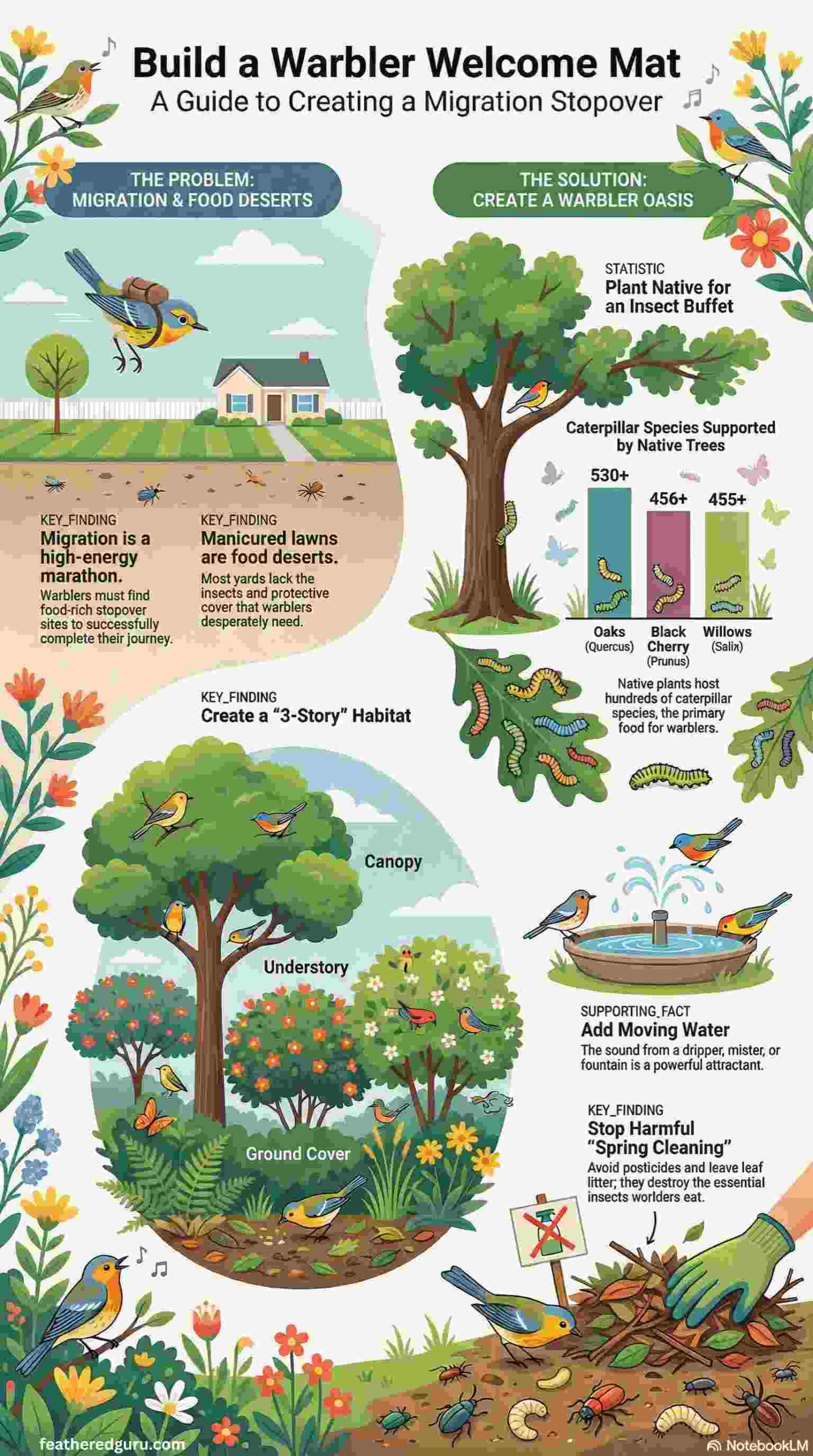
According to research on native plant benefits for birds, native oaks support more than 530 species of butterfly and moth caterpillars, while non-native ornamentals support minimal insect populations. This disparity translates directly to warbler foraging success.
Top Native Trees for Warbler Attraction:
| Tree Species | Caterpillar Species Supported | Primary Warbler Species |
|---|---|---|
| Native Oaks (Quercus) | 530+ species | Cerulean, Blackburnian, Bay-breasted |
| Black Cherry (Prunus serotina) | 456+ species | Yellow-rumped, Tennessee, Nashville |
| Willows (Salix) | 455+ species | Wilson’s, Yellow, American Redstart |
| Birches (Betula) | 413+ species | Black-throated Green, Magnolia |
Top Native Shrubs:
- Serviceberry (Amelanchier): Dense branching, early leaf-out, rich insect populations
- Viburnum species: Layered structure, diverse insect support
- Native roses: Thorny protection, abundant caterpillars
- Elderberry (Sambucus): Early flowers, insect magnet
Water Features
Water availability dramatically affects warbler stopover site selection. Warblers require water for drinking and bathing, with bathing particularly important for maintaining feather condition during migration.
Optimal Water Feature Design:
- Shallow depth (1-2 inches maximum)
- Gradually sloping sides
- Moving water (drippers or fountains) for auditory attraction
- Positioned within 20-30 feet of dense cover
- Elevated or ground-level options
- Clean water maintained every 2-3 days
After installing a solar-powered fountain in my yard, warbler visitation increased noticeably, with birds apparently attracted by the sound of moving water from considerable distances.
Learn more about attracting birds to water features.
Regional Warbler Migration Patterns
Migration timing and species composition vary significantly by geographic region, requiring location-specific strategies.
Eastern and Midwestern Migration
Peak Period: April 25-May 20 Key Species: Black-throated Blue, Magnolia, Blackburnian, Canada, American Redstart Habitat Priorities:
- Mature deciduous forest with dense understory
- Native oak, cherry, maple dominance
- Shrub layer 3-8 feet tall
- Water features in semi-open settings
Eastern regions experience concentrated warbler diversity during the mid-May peak, with 20-30 species possible in prime habitat over a 2-week window.
Southeastern Migration
Peak Period: April 15-May 10
Key Species: Hooded, Kentucky, Worm-eating, Prothonotary (coastal), Swainson’s Habitat Priorities:
- Bottomland hardwoods where available
- Dense understory with cane thickets
- Riparian corridors with willows
- Early leaf-out species
Southeastern stopover sites serve trans-Gulf migrants that crossed the Gulf of Mexico and need immediate refueling. Coastal locations see exceptional diversity during weather-related “fallouts.”
Western Mountain Migration
Peak Period: May 1-May 25 Key Species: Wilson’s, MacGillivray’s, Yellow, Orange-crowned, Townsend’s Habitat Priorities:
- Riparian corridors critical (limited water)
- Willows, cottonwoods, alders
- Dense shrub thickets
- Water features absolutely essential
Western migration concentrates along riparian corridors and mountain valleys, with upland habitats seeing minimal warbler activity.
Great Lakes Migration
Peak Period: May 5-May 25 Key Species: All eastern species, high diversity Habitat Priorities:
- Lakefront concentrations during unfavorable weather
- Mixed deciduous-coniferous forests
- Dense shrub borders
- Multiple water sources
Great Lakes regions serve as major funnels for eastern warbler populations, with locations like Point Pelee and Magee Marsh hosting extraordinary concentrations.
For regional timing details, explore spring migration checklists.
Food Availability: The Critical Factor
Stopover site quality ultimately depends on food availability, and research shows that food availability influences stopover behavior and refueling activity in migrating birds, with birds adjusting their search and foraging based on resource abundance.
Caterpillar Phenology and Warbler Timing
Spring warbler migration synchronizes with caterpillar emergence across temperate forests. Native plant leaf-out triggers caterpillar hatching, creating brief windows of exceptional insect abundance.
Research documents that caterpillar biomass peaks in mid-May across northeastern deciduous forests, coinciding precisely with peak warbler migration. This synchrony evolved over millennia, with warblers timing migration to arrive when food is most abundant.
Properties with predomin antly non-native plants miss this synchrony. Non-native ornamentals leaf out on different schedules and support minimal caterpillar populations even when insects are abundant on nearby natives.
Insect Diversity Beyond Caterpillars
While caterpillars dominate warbler diets, diverse arthropod communities provide supplemental nutrition:
Spiders: High-protein food source, especially important for females building fat for egg production Flying insects: Aerial hawking by American Redstarts, Canada Warblers Aphids: Concentrated on new growth, targeted by Tennessee Warblers Small beetles: Gleaned from bark and foliage Midges and small flies: Important along water features
Native plant communities support all these insect groups simultaneously, creating the diverse food base warblers require.
Common Mistakes That Reduce Warbler Attraction
Mistake 1: Pesticide Use During Migration
Pesticide applications eliminate the insects warblers need to refuel. Even “targeted” mosquito treatments kill beneficial insects including moths, flies, and beetles that warblers consume.
A single pesticide application can reduce insect populations for 2-4 weeks, potentially spanning the entire local warbler migration window. Properties that eliminated pesticides entirely see dramatically higher warbler activity compared to chemically treated neighbors.
Mistake 2: Excessive Spring Cleanup
Removing leaf litter, cutting back perennial stems, and clearing dead branches in March-April eliminates overwintering insects precisely when they’re emerging and when warblers need them most.
Leaf litter harbors thousands of insects per square meter. Warblers like Ovenbirds and Waterthrushes spend hours flipping leaves searching for these insects. Removing leaves eliminates this critical food source.
Mistake 3: Planting Only Canopy Trees Without Understory
Properties with mature trees but no understory vegetation attract only canopy-foraging species like Blackburnian and Cerulean Warblers. The majority of warbler species forage in understory and mid-story vegetation.
Establishing native shrubs 3-10 feet tall beneath existing trees creates habitat for Black-throated Blue, Magnolia, Hooded, and many other warbler species that rarely visit properties with only lawn beneath trees.
Mistake 4: Focusing on Feeders Instead of Habitat
Warblers don’t visit seed feeders and show minimal interest in suet. Attempts to attract warblers through supplemental feeding fail because warblers evolved to forage for live insects on vegetation.
The only “feeding” strategy that works for warblers is creating habitat that produces abundant natural insects through native plant communities.
Mistake 5: Expecting Prolonged Visits
Stopover duration varies by individual warbler condition and habitat quality. In optimal habitat with abundant food, warblers may stop for just 1-2 days before continuing migration. Longer stopovers often indicate marginal habitat where birds struggle to find sufficient food.
Brief visits don’t indicate failure. A warbler that feeds intensively for one day and departs in good condition represents successful stopover, while a bird lingering 5-7 days may be struggling.
Creating Warbler-Friendly Yard Zones
Strategic yard design creates microhabitats matching different warbler species’ preferences.
Zone 1: Dense Understory Thickets
Create impenetrable shrub masses 6-15 feet diameter using:
- Native viburnum species
- Spicebush (Lindera benzoin)
- Native roses (Rosa carolina, R. virginiana)
- Elderberry (Sambucus canadensis)
Plant shrubs 3-4 feet apart, allowing them to grow into dense tangles. These areas attract Common Yellowthroats, Hooded Warblers, and Kentucky Warblers.
Zone 2: Forest Edge Simulation
Transition zones between open areas and dense vegetation concentrate warbler activity. Create edges using:
- Small native trees (serviceberry, redbud, dogwood)
- Taller shrubs (witch hazel, native azaleas)
- Herbaceous layer beneath
This structure attracts Magnolia, Chestnut-sided, and Black-throated Blue Warblers.
Zone 3: Canopy Gaps
Beneath mature trees, create small open gaps (10-15 feet diameter) where sunlight reaches the ground. Plant low-growing native wildflowers and ferns. These gaps attract warbler species that drop to the ground to capture flushed insects.
Zone 4: Water Feature Hub
Position water features where warblers can access them from dense cover within 20 feet. Include:
- Shallow basin at ground level
- Elevated birdbath
- Dripper or mister for sound
- Perching branches 2-6 feet from water
Observation Strategies for Spring Warblers
Attracting warblers means little if you can’t observe them effectively. Warblers move quickly through vegetation, requiring specific observation tactics.
Optimal Viewing Times
- Dawn to 9:00 AM: Peak activity as warblers resume foraging after night migration
- Evening (4:00-6:00 PM): Secondary activity peak before nightfall
- Midday: Minimal warbler activity during hot weather
- Overcast days: Extended morning activity periods
Positioning and Approach
- Observe from inside near windows (warblers habituate to structures)
- Use binoculars 8×42 or 10×42 for adequate light gathering
- Learn common chip notes for detecting warblers in dense foliage
- Move slowly; warblers tolerate quiet observers
- Focus on edges where vegetation transitions occur
Weather and Warbler Activity
Warbler stopover density increases dramatically following:
- Overnight north winds during migration season
- Rain or storms forcing birds to land
- Cold fronts moving through during peak migration
Clear, calm nights with south winds produce minimal stopover as warblers continue migrating rather than landing.
Success Metrics and Expectations
Measuring warbler attraction success requires understanding realistic outcomes.
Year 1 Expectations
If starting with minimal habitat:
- 3-6 warbler species during peak migration
- Brief visits (hours to 1 day)
- Common species only (Yellow-rumped, Palm, Common Yellowthroat)
If moderate habitat exists:
- 8-12 warbler species
- Occasional 2-3 day stopovers
- Mix of common and less common species
Year 2-3 With Habitat Improvements
- 12-18 warbler species annually
- Regular sightings during peak migration
- Some individuals returning to same shrubs daily
- Occasional rare species
Mature Habitat (5+ Years)
- 18-25 warbler species in prime locations
- Consistent activity throughout migration window
- Multiple individuals of most species
- Annual rare species records
For additional spring birding strategies, see spring birdwatching tips.
Quick Reference: Warbler Stopover Infographic
To make it easier to apply these strategies in your yard, check out this visual guide summarizing the key steps to attract migratory warblers in spring.
Conclusion
Attracting migratory warblers during spring migration requires creating functional stopover habitat rather than hoping for chance encounters. The key elements emerge consistently from research: native plant dominance, vertical vegetation structure, abundant insects, and available water. Properties meeting these requirements attract significantly more warbler species and individuals than conventional landscapes.
Implementation doesn’t require perfection or large properties. Even small yards can attract warblers when designed with stopover ecology in mind. Focus on establishing dense understory vegetation using native shrubs, eliminating pesticides completely, and providing reliable water sources.
The reward for this effort extends beyond personal observation satisfaction. As natural stopover habitat continues declining across migration routes, residential properties increasingly determine whether warbler populations successfully complete annual migrations. Every yard converted to warbler-friendly habitat contributes to landscape-scale conservation of species facing mounting challenges throughout their ranges.