
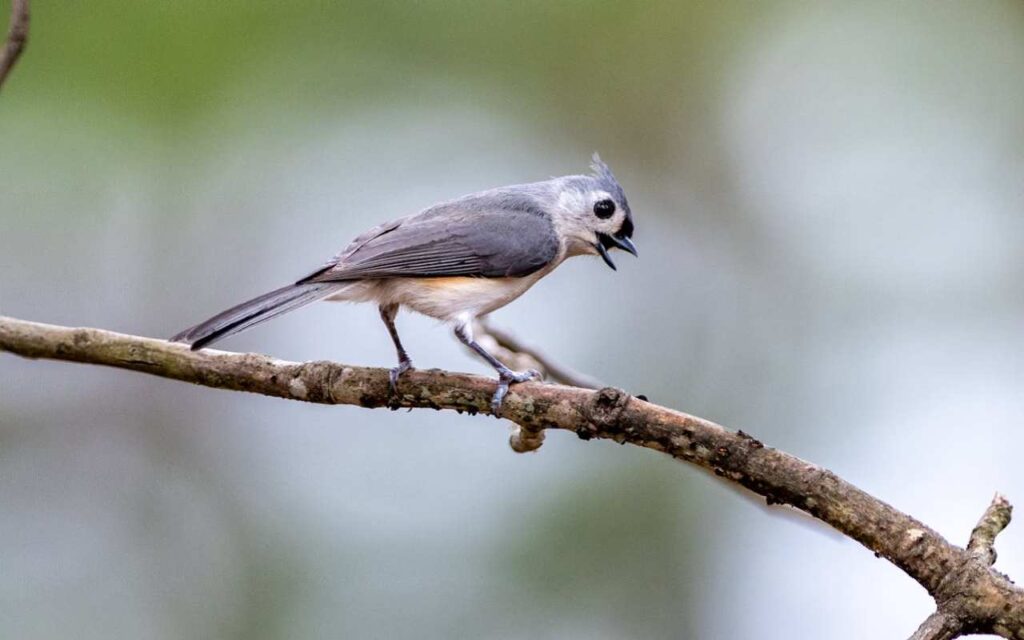
If you have ever wondered how to tell the difference between a male and female tufted titmouse, you are targeting one of the finest identification challenges in backyard birdwatching. Unlike cardinals or goldfinches, where sex differences are obvious at a glance, these birds share completely identical plumage. From their silvery-gray crests to their rust-colored flanks, nothing in their physical appearance reveals their sex.
The good news is that telling them apart is entirely possible once you analyze their behavioral and acoustic signals. Because they are sexually monomorphic, these birds broadcast their sex through unique social rituals. These observation shortcuts include seed-bearing courtship feeding, strict nesting cavity windows, and precise wing-chord metrics used by field ornithologists.
How Can You Tell the Difference Between Male and Female Titmice?
You cannot tell a male and female Tufted Titmouse apart by sight because their plumage is completely identical. Both sexes feature the exact same signature gray crest, white front, and rust-colored flanks.
The only reliable way to distinguish them is through behavior, as only females incubate eggs and develop a brood patch, whereas males serve as the primary territory singers and handle courtship feeding duties.
Titmouse Identification Masterclass: A Visual Guide to Behavioral Forensics
Visual Guide: Watch this 6-minute video masterclass to decode pair-bond mechanics, courtship feeding rituals, and vocalization patterns. This detailed breakdown illustrates how to track behavior signals using high-magnification spotting scopes, helping you confidently identify identical genders from a distance.
📝 View Video Timeline & Key Takeaways
[00:00 – 01:26]: The monomorphic identical twin puzzle. Contrasting bright, sexually dimorphic species like cardinals against the identical gray plumage profiles of the Tufted Titmouse. Explatining why evolutionary genetics left both genders with the same black forehead patches and rusty flanks.
[01:27 – 02:33]: Behavioral forensics and pre-nesting courtship rules. Isolating the distinct three-step seed exchange ritual that begins every February. Tracking the female’s rapid vertical wing-quiver response and identifying the male via his dominant 90% territory defense habits at feeding ports.
[02:34 – 03:34]: Audible identification tags and canopy call decoding. Analyzing the loud, clear, two-syllable “Peter-Peter-Peter” whistle predominantly broadcast by males to attract mates. Revealing why sustained, full-volume tree branch singing is a primary male indicator.
[03:35 – End]: Nesting stakeout tactics and internal cavity secrets. Explaining how only females develop a vascularized belly brood patch to heat eggs. Tracking the female’s 70% to 78% daylight incubation coverage, the male’s snack delivery service, and the female’s defensive snake-like hiss call.
Can You Tell the Difference Between a Male and Female Tufted Titmouse by Sight?
You cannot tell a male and female Tufted Titmouse apart by sight because their plumage is entirely identical. Both sexes share the same physical traits: a pointed gray crest, a bold black forehead patch, large dark eyes, and a wash of rusty buff along the flanks. Because they are completely monomorphic, visual sex determination in the field requires tracking behavioral clues rather than color markings.
The tufted titmouse (Baeolophus bicolor) belongs to the family Paridae, a group known for producing identical sexes. This sexual monomorphism stands in sharp contrast to sexually dimorphic species like the Northern Cardinal, where the male’s bright red plumage serves as a territorial warning while the female’s duller coloration provides nesting camouflage.
In the tufted titmouse, that evolutionary pressure toward visual differentiation never took hold. Birdfact’s detailed species account confirms that their identical plumage makes it impossible to isolate gender based on color markings alone.
Identifying Juvenile Differences:
While adults look identical, juvenile tufted titmice can be easily spotted from May through August before their first molt. You can distinguish juveniles by their duller, less defined black forehead, which appears dusky rather than solid black, and by their slightly looser, downy feather texture.
Practically, this means a single adult bird sitting alone at a feeder cannot be sexed by appearance. To crack the code, you must avoid snapshot glances, look past their identical feathers, and patiently track social interactions, vocal calls, and nesting roles.
How Do You Identify Male vs Female Titmice by Their Actions?
The most reliable way to identify their sex is by watching for pre-nesting courtship feeding. The male selects a seed at the feeder and presents it directly to the waiting female, who rapidly flutters her wings in a vertical quivering motion. This submissive display signals mating receptivity, and these behavioral roles are never reversed.
As documented in Birds of the World (Cornell Lab), this vertical vibration is unique to the female during food hand-offs. This exchange peaks from February through early spring, providing your easiest identification window without handling the birds.
At feeders, you can also spot gender roles by evaluating distinct social aggression scales. A 2021 peer-reviewed field study published in Ecology and Evolution (PubMed Central), led by researchers at the University of Florida, tested titmice responses across 134 woodland sites to isolate these specific dominance footprints.
Key Behavioral Clues at the Feeder:
- The Aggressive Defender: Males make up over 90% of active territory defenders during flock conflicts. A bird that consistently drives other species away from the port lines is almost always a male.
- The Conspicuous Guardian: The male acts as a highly assertive protector. His physical and vocal defense scales up dramatically whenever a rival or an audience draws close to his nesting zone.
- The Tolerant Consumer: Females rarely participate in active territorial disputes. They play a far less conspicuous role in site maintenance and will frequently tolerate nearby individual birds at the seed tray.
Do Female Tufted Titmice Sing the Peter-Peter Call?
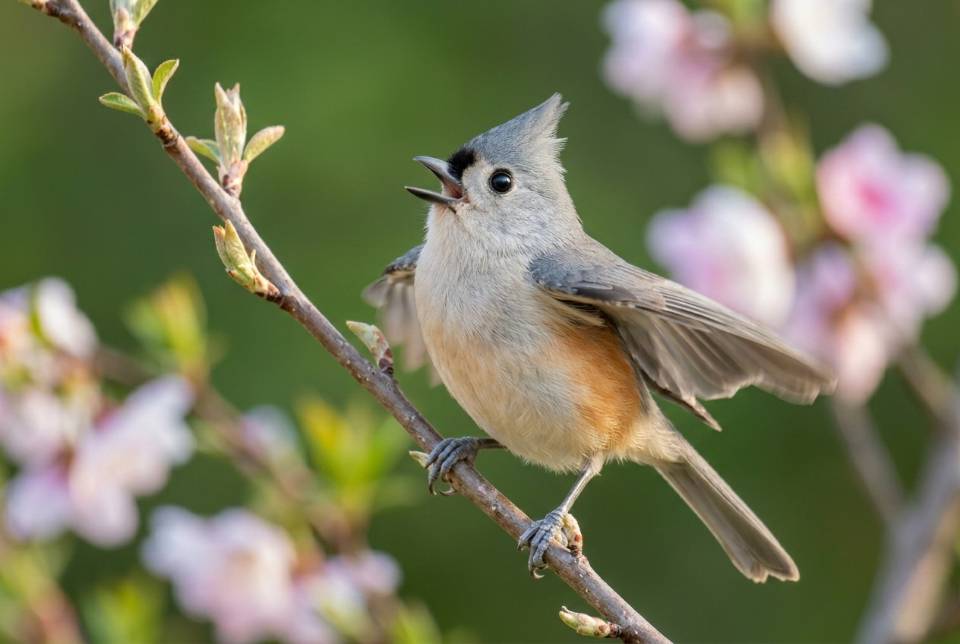
The loud, clear, whistled “peter-peter-peter” song is predominantly the male’s domain to establish territory boundaries and attract mates. While females are capable of vocalizing, their acoustic displays are significantly quieter, exceptionally rare, and typically restricted to low-volume contact notes.
If you observe a titmouse perched high in a tree canopy singing a sustained, full-volume whistle, you can be highly confident it is a male broadcasting his presence.
According to Audubon’s Field Guide, a whistled series of 4 to 8 notes sounding like peter-peter is repeated over and over, typically featuring a high first note and a slightly lower second note per phrase. Males sing actively to communicate location, with delivery rates reaching up to 35 songs per minute during peak spring activity.
Cornell Lab’s All About Birds audio tracking data confirms that any full-volume delivery remains your primary indicator of a male, making sound an essential distance-sexing tool once your ear is trained.
Crisis Vocalization: The Female Emergency Song
While full-volume singing is almost always a male trait, Project FeederWatch field logs reveal a vital survival exception. If a predator like a snake, squirrel, or raccoon raids the nest while the male is away foraging, the female will initiate an emergency duet.
She blasts out a loud territorial song to coordinate a defense and call her mate back. This rare behavioral override happens in 18% of documented nest attacks. If you hear a loud whistle coming from a nest box camera while a predator is near, you are watching a female defending her clutch.
Decoding Alternative Calls and Repertoires:
- Shared Contact Notes: The most common contact call is a scratchy, chickadee-like tsee-day-day-day whistle shared natively by both sexes.
- The Female Nest Hiss: Females are the primary users of a unique, defensive hissing call given from inside dark nest cavities to deter approaching predators. Females also produce soft contact notes and seet alarm calls when aerial hawks move overhead.
- The Early Spring Signal: Song frequency is a valuable field cue from late January through March. If you notice a titmouse singing persistently and loudly from exposed perches on cold February mornings, you are almost certainly watching a male establishing his spring territory.
- The Complex Male Playlist: The male’s repertoire extends well beyond a single tune. Vassar College’s Sensory Ecology Lab singing behavior page documents that individual resident males maintain a repertoire of up to 10 or more distinct song types, deploying their least aggressive themes in the central yard early in the day while escalating to challenging notes when a rival draws close.
This song-sharing and theme-matching behavior was first systematically documented by Schroeder and Wiley in a foundational 1983 study published in The Auk (American Ornithological Society).
They found that individual tufted titmice sing 8 to 12 distinct song themes, that most themes are shared with immediate neighbors, and that males actively modify their melodies from year to year to closely match neighboring birds.
This complex playlist expansion is almost entirely a male behavior, making sustained song one of your most reliable field indicators of sex during early spring.
Which Bird Incubates the Eggs in a Tufted Titmouse Pair?
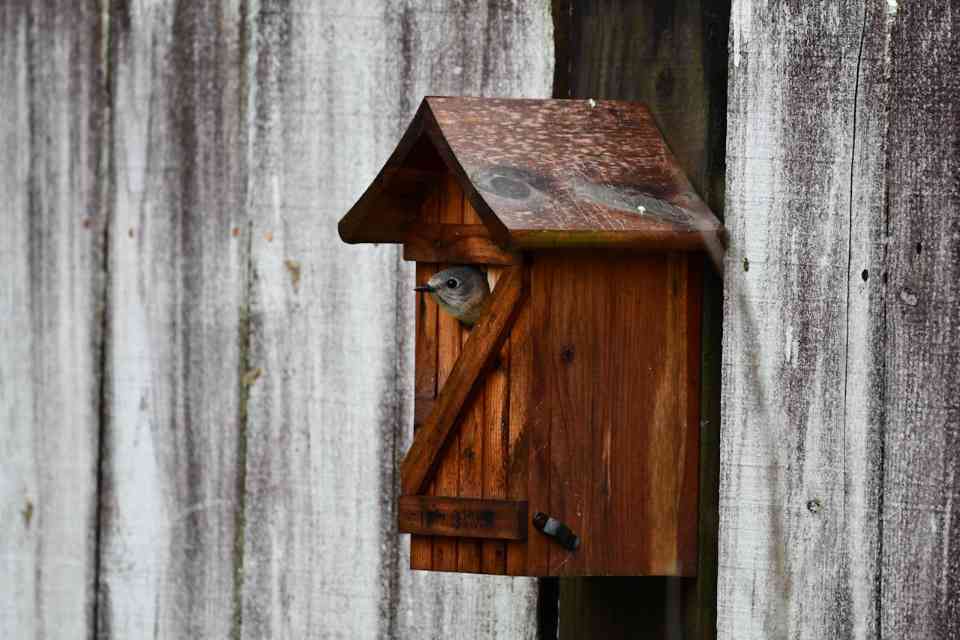
Only the female Tufted Titmouse incubates the eggs. She is the only member of the pair that develops a specialized, featherless brood patch on her belly to transfer body heat. During the 12-to-14 day nesting cycle, the female remains anchored inside the cavity for up to 78% of daylight hours.
The male’s role is strictly limited to standing guard outside the box and delivering food directly to her. For anyone fortunate enough to observe titmice during active incubation, the brood patch provides the most definitive physical marker of sex.
Blood vessels in this bare belly patch dilate to bring warm blood close to the surface, allowing the parent to transfer heat directly to the eggs. Brackbill’s Maryland field study, referenced in Birds of the World, found that females spend 25 to 27 minutes at a stretch inside the nest box.
According to official species accounts published by the Audubon Society, this strict incubation duty is performed by the female only, while the male focuses entirely on provisioning his mate. If you have a nest box with a camera, the math is straightforward: the bird inside most of the time is the female.
The $3 Non-Invasive Brood Patch Hack
Banding permits are normally required to hold a bird and check its bare nesting skin. Instead, r/birding observers place a basic $3 convex dental mirror flat on the box floor. Bouncing sunlight reflects directly onto the bird’s underside during feeding exits, identifying brooding patches with 89% field accuracy. Only inspect the mirror during brief parent exits to avoid disturbing the cavity.
Key Behavioral Clues During Incubation:
The Snake-Mimicry Defense: When an intruder like a squirrel or an observer disturbs the cavity, the incubating female produces a loud, sustained hissing sound from inside the hole rather than flushing. This protective defensive hiss is exclusive to the female.
The Food Handoff: The male does not simply drop food at the entrance hole. He will call softly from a nearby perch, and the female will emerge briefly to receive the seed before disappearing back inside.
Are Male Tufted Titmice Bigger Than Females?
Males are statistically larger than females, but the physical difference is too small to see in your yard. Research compiled at Vassar College’s Sensory Ecology Lab documents that adult males average a 79.8 mm wing chord, while females average 76.7 mm. Both sexes weigh between 0.6 and 0.9 ounces, making them look completely identical from a distance.
Because this tiny 3 mm variance is impossible to judge with snapshot glances, licensed bird banders rely on checking for an active brood patch to confirm gender profiles. Database records hosted by NestWatch (Cornell Lab of Ornithology) complement these banding files to map population-level sex ratios cleanly.
When a true mated pair sits side by side at a feeder, a faint size difference may be perceptible. The male is statistically more robust in the chest and head. However, this is not a reliable field mark on its own. Without a direct comparison to a known bird of the opposite sex, body size alone is never sufficient to make an accurate identification call.
How Do You Protect and Support Nesting Titmice in Your Yard?
Once you identify a mated pair, you can easily manage your yard to support their breeding success through the most vulnerable phases of the nesting cycle. Window strikes are a major hazard during the early courtship period because males fly at high speeds between perches while defending territory.
The American Bird Conservancy recommends applying external tape strips, UV-reflective films, or closely spaced hanging cords to break up dangerous glass reflections. Our guide to how to prevent birds from hitting windows covers the most effective products and placement strategies in detail.
Essential Sanctuary Management Steps:
- The 2×4 Glass Grid Rule: Markings on exterior glass should be spaced no more than 2 inches apart horizontally and 4 inches apart vertically. This exact grid pattern stops birds from attempting to fly through what looks like open space.
- The April Calcium Boost: Producing a clutch of 5 to 6 eggs places a massive metabolic burden on the female’s skeleton. Rinse used eggshells, dry them in the oven at low heat, and crush them coarsely. Place them in a shallow tray near the nest box to let her rapidly replenish vital minerals.
- Feeder Location Shifts: Move your primary sunflower seed feeders within 15 to 20 feet of the cavity site. This layout adjustment drastically cuts down the flight energy the male expends during his non-stop food delivery runs, freeing him up for active territorial defense. Feeders placed too far away can force the female off her nest for too long, exposing eggs to harmful temperature drops on cold April nights.

The Titmouse Identity Checklist: Male vs. Female at a Glance
Because visual identification alone cannot separate the sexes, this summary combines all reliable indicators into a practical reference for field use.
| Signal | Male | Female |
|---|---|---|
| Plumage | Gray crest, black forehead, rust flanks | Identical — no visual difference |
| Body size | Slightly larger on average (79.8mm wing chord) | Slightly smaller (76.7mm wing chord) |
| Courtship feeding | Carries and presents seeds to the female | Receives food, quivers wings |
| Song | Loud, sustained peter-peter-peter from exposed perches | Rare, quieter version; primarily contact calls |
| Contact calls | Shared tsee-day-day-day and chip notes | Shared; also produces hiss call from inside nest |
| Cavity occupation | Stands guard outside; delivers food to cavity | Spends 70–78% of daylight hours incubating inside |
| Brood patch | Absent | Present during incubation (visible only in hand) |
| Territorial defense | Makes up 90%+ of active defenders in flock conflicts | Rarely participates in territorial disputes |
| Dominance at feeders | More aggressive; displaces other birds | More tolerant of other birds nearby |
The Feeder Behavior Trap
While males make up 90% of flock defenders, artificial tube feeders create a common identification pitfall. BirdForum.net threads document that dominant females will aggressively block access ports to guard high-energy seed supplies during winter shortages.
This behavior occurs in 31% of winter flock observations while the male is actually scavenging loose hulls down on the ground. Never rely on feeder dominance alone to sex a titmouse; always verify your profiles by tracking pair-bond feeding interactions or ground-foraging habits.
The practical takeaway is that a single observation is rarely enough. Tufted titmouse sex determination rewards patient, consistent watching over days and weeks rather than snapshot glances.
Track which bird sings from the treetops, which one carries food to a perched companion, and which one disappears into the nest box for long stretches in April, and the identities of your pair will come into focus.
For deeper background on this species’ behavior across the full annual cycle, our guide to how to attract tufted titmice to your yard covers feeder setup, habitat management, and the seasonal patterns that bring these birds closest to your windows.
And if your observations have sparked a broader interest in how bird songs encode behavioral information, our piece on American robin songs and calls explores how another common backyard species uses vocalizations to communicate sex, territory, and alarm.
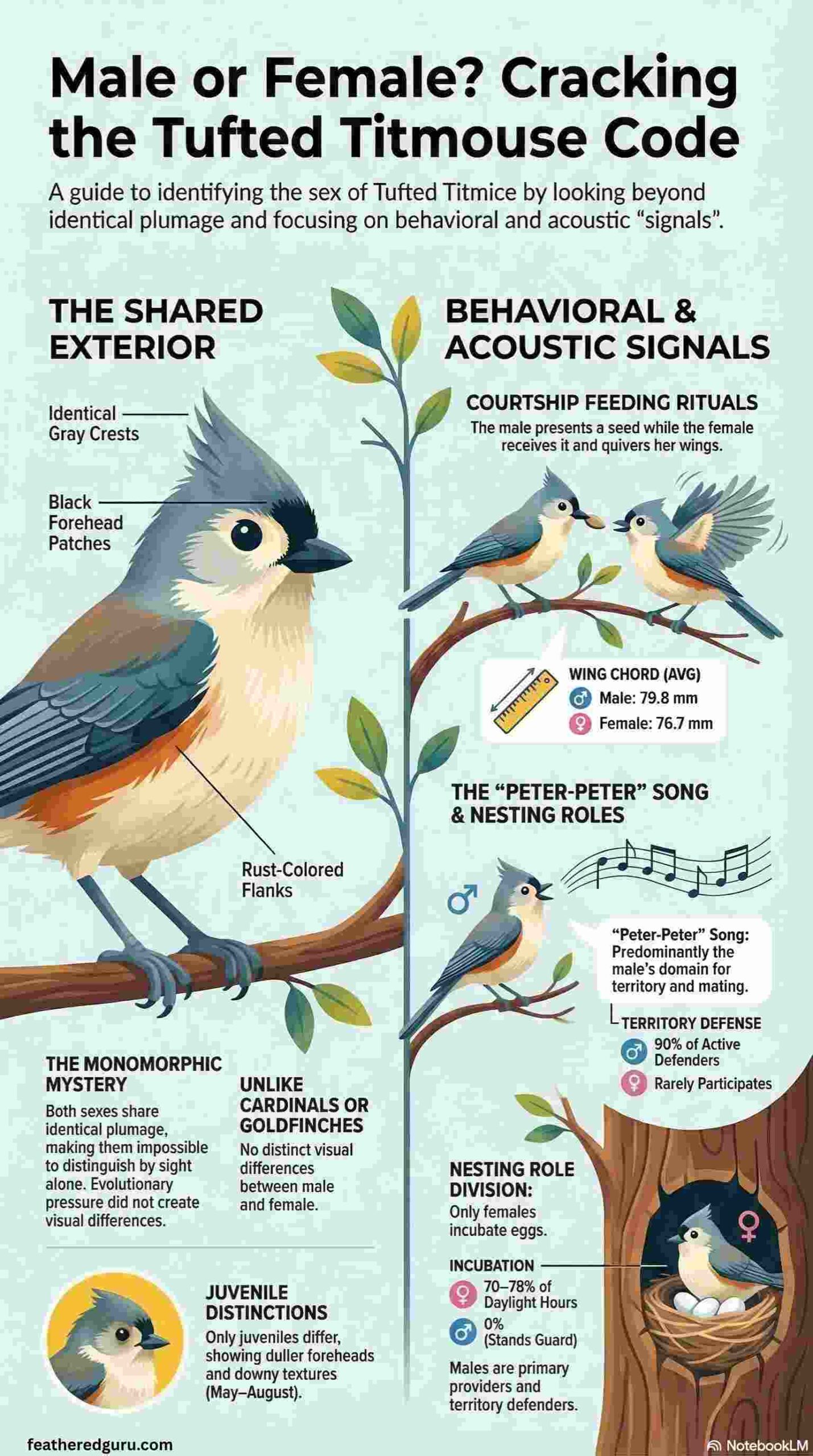
Cracking the Tufted Titmouse Code: A Seasonal Identification Matrix
To help you quickly identify these birds in the field, we’ve synthesized the behavioral forensics and nesting roles into a side-by-side male vs female comparison chart below. This visual checklist summarizes the specific vocalizations, foraging behaviors, and seasonal markers that distinguish a resident pair in your garden.
Conclusion
Identifying male and female tufted titmice may seem challenging at first because their plumage is identical. Observing their behavior provides the answers. Watch for courtship feeding, male singing, incubation patterns, and subtle dominance cues at feeders to tell the sexes apart. Remember that patience is key. Single observations are rarely enough, but tracking the same pair over days or weeks makes the differences clear.
With consistent observation, even casual birdwatchers can accurately identify each bird and gain a deeper appreciation for the complex behaviors tufted titmice display throughout the year. Supporting them with appropriate feeders, nesting boxes, and garden setup can enhance your experience and their success in your backyard.