

The mourning dove is a common backyard visitor across North America. While they are highly visible, many birders wonder exactly what mourning doves eat and why their biology is so specialized. With a population of 350 million, their unique anatomy and massive crop storage are precisely tuned to a single food source, seeds.
Understanding their specialized diet and how the digestive system is built around it gives birders a sharper, more effective toolkit for sanctuary design. This guide covers the full picture, from the biomechanics of the crop-and-carry foraging system to the crop milk fed to nestlings, from the grit requirements that most gardeners overlook to the seasonal calcium demands of breeding females.
What is the Best Food for Mourning Doves?
The absolute best food for mourning doves is white proso millet, supplemented heavily by safflower seeds and black oil sunflower seeds to meet their strict 99% seed-based diet.
To support their digestion, provide 60 to 100 pieces of coarse grit daily, and scatter the mix directly onto low platform feeders or bare ground patches to match their natural ground-foraging habits.
Video Explainer for Mourning Dove Crop and Carry Foraging Biology
This animated whiteboard walkthrough illustrates the precise digestive mechanics, metabolic math, and unique suction drinking behaviors of these ground-feeding birds. Reviewing these visual steps allows property owners to optimize ground foraging stations and winter caloric density safely without increasing predator pressures.
Are Mourning Doves Granivores? Understanding Their 99% Seed Diet
Yes, mourning doves are obligate granivores. Unlike omnivorous birds that switch food sources, their entire digestive anatomy, foraging behavior, and energy economy are strictly organized around seed consumption. This specialization is rare even among other seed-eating species, making them true seed specialists.
According to Cornell Lab of Ornithology’s All About Birds, seeds make up 99% of a mourning dove’s diet, including cultivated grains and peanuts as well as wild grasses, weeds, herbs and occasionally berries. The remaining 1% consists primarily of snails, which are incidentally consumed and likely provide a calcium supplement rather than representing a deliberate dietary shift.
Unlike robins that switch heavily to insects in summer, or chickadees that depend on caterpillars to feed nestlings, the mourning dove maintains its seed-dominant diet across all seasons and life stages. Even nestlings receive a seed-derived product rather than insects. The bird’s beak, digestive tract, and foraging behavior are all optimized for a single food type.
This specialization comes with a metabolic cost. Cornell Lab’s species overview documents that mourning doves eat roughly 12 to 20 percent of their body weight per day, averaging approximately 71 calories for a typical 4-to-6-ounce bird. That percentage rises to its peak in September and October, when birds are fattening ahead of migration and the metabolic demands of thermoregulation begin to increase.
Their ground-foraging technique is also distinctive. Unlike chickens or sparrows that scratch the soil with their feet to expose buried seeds, mourning doves use a peck-and-sweep motion, picking seeds from the surface of bare or sparsely vegetated ground. They are physically incapable of digging.
This makes them entirely dependent on exposed seed surfaces, which is why bare ground patches and low platform feeders are far more effective for doves than tube feeders or hanging seed cylinders.
The Top Power Seeds for Your Feeding Station
Not all seeds are equal to a mourning dove. Decades of preference research, including controlled cafeteria-style feeding trials with captive birds, has established a clear hierarchy of preferred foods.
White proso millet is the undisputed favorite. Research summarized by Birds of the World (Cornell Lab), drawing on work by LeBlanc and Otis (1998) and Hayslette and Mirarchi (2001), found that captive mourning doves foraged selectively on white proso millet, dove proso millet, and browntop millet, and generally preferred cultivated crop seeds over non-agricultural seeds across all seasons.
White proso millet’s small size, thin coat, and high carbohydrate content make it easy to process in volume.
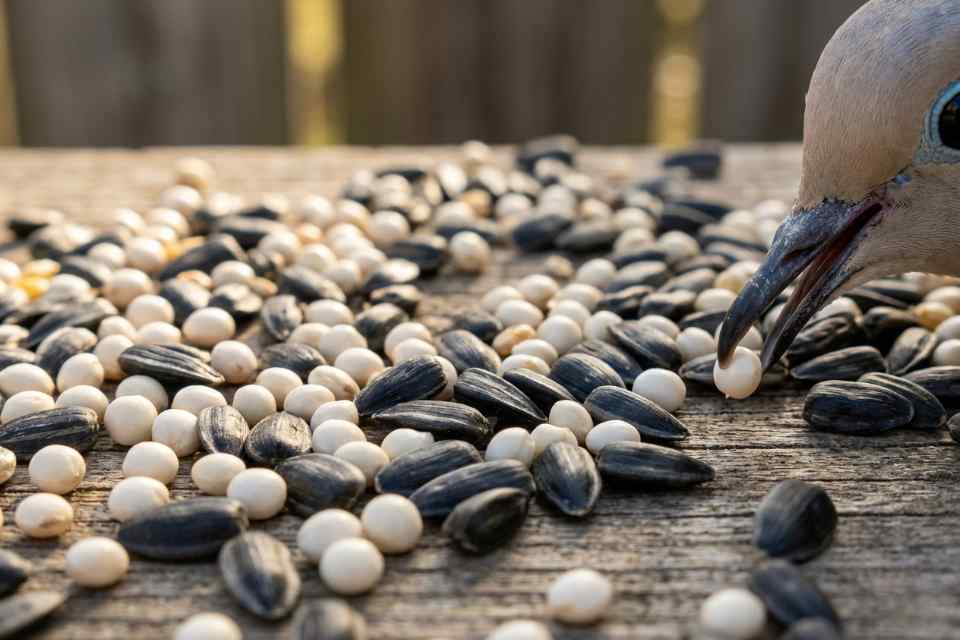
Black oil sunflower seeds rank high for energy density. Their fat content, roughly 28% by weight, and thin shells make them efficient to process. Safflower seeds are also eagerly taken and have the practical advantage of being strongly disliked by European Starlings and House Sparrows, making them a useful option for reducing feeder competition.
Cracked corn is a staple at ground feeding stations and along roadsides near agricultural areas. The broken pieces are small enough for the dove’s bill and easy to swallow whole for crop storage. Whole corn kernels are too large for efficient intake. Wheat, grain sorghum (milo), and other agricultural grains round out the preferred list.
As the University of Missouri Extension documents, the mourning dove’s diet draws from more than 300 documented food items, with crop seeds such as corn, sorghum, millets, wheat, sunflowers, soybeans, and buckwheat representing the core agricultural staples.
Milo and millet are often dismissed as filler seeds in mixed bags, but for mourning doves specifically they are premium items. If you are buying mixed seed primarily to attract doves, look for blends where millet and milo make up the majority of the content rather than sunflower-dominant mixes optimized for other species.
How Do Mourning Doves Forage for Seeds?
Mourning doves forage by using a “crop-and-carry” strategy, rapidly pecking seeds from the surface of the ground to fill their specialized storage pouch. Unlike many other birds that linger at a feeder, doves gorge themselves as quickly as possible and then leave to digest in a safer, elevated location. This behavioral sequence explains why doves spend very little time at the feeder itself, even if they visit it repeatedly throughout the day.
The crop is an enlarged section of the esophagus that functions as a holding chamber for food. Mourning doves have a bilobed crop, meaning it expands in two chambers rather than one.
According to Cornell Lab’s All About Birds, the record for seeds stored in a single mourning dove crop is 17,200 bluegrass seeds, a figure from a 1939 field study by Rosene that has not been surpassed in the published literature.

The logic of this strategy is predator avoidance. The ground is the most dangerous place in a dove’s environment. Open ground beneath a feeder is especially dangerous because the location is known, fixed, and frequented by Sharp-shinned Hawks and Cooper’s Hawks, both of which learn feeder locations and patrol them.
By spending the minimum time necessary to fill the crop and then moving to a sheltered perch for digestion, the dove converts what would be an extended foraging session at a dangerous site into a series of brief, rapid visits.
Once in the crop, seeds are softened by moisture and gradually passed to the gizzard for mechanical processing. The gizzard is a powerfully muscular organ that grinds seeds against itself and against swallowed grit particles.
According to Oklahoma State University Extension’s mourning dove fact sheet, it is estimated that doves require 60 to 100 pieces of grit daily to replace particles that are worn down in the gizzard.
This is why you will often see mourning doves pecking at gravel driveways, sandy soil edges, and roadside gravel rather than bare grass: they are not looking for food in those spots but for the grinding media that makes digestion possible.
Backyard gardens with all surfaces paved or heavily mulched present a grit access problem for doves. A shallow tray of coarse sand or a small area of exposed gravel near the feeding station provides the grit substrate doves need and can meaningfully improve their digestive efficiency.
Two distinct foraging windows dominate the mourning dove’s daily schedule: a concentrated session in the early morning, shortly after sunrise, and a second session in the late afternoon before roost. These windows correspond to the lowest predator activity periods and the highest metabolic demand for a bird that has spent the night fasting.
A feeder that is full and accessible at first light provides the most critical resource of the dove’s day. Feeders that empty by midday and are not refilled until the following morning miss both peak demand windows.
Mourning doves are also notably loyal to established foraging locations. Field research has documented individual doves returning to the same patch of bare ground or low platform feeder for months or even years.
Once a dove has mapped your feeding station as a reliable food source, it will return consistently as long as the food supply remains predictable. Consistency of supply is therefore as important as the quality of what you offer.
What is Crop Milk? How Doves Feed Their Young
The most surprising fact about mourning dove diet biology is not what the adults eat but what they feed their young, and how they produce it. For the first several days of a nestling’s life, the dove’s otherwise seed-exclusive diet gives way to a substance that has no equivalent in the diets of most other backyard birds.
Crop milk, also called pigeon milk, is a thick, protein-rich secretion produced by the epithelial lining of the adult crop during the brooding period. Both parents produce it, stimulated by the same hormonal signal, elevated prolactin, that triggers lactation in mammals. The output resembles cottage cheese in consistency and is regurgitated directly into the nestling’s open bill.
As Birds and Blooms magazine documents, crop milk is rich in protein and fat and feeds nestlings exclusively for the first few days of life, with the diet beginning to transition to seeds by day four. By day 14, the nestlings are nearly fledged and functioning on a seed-only diet. This is an exceptionally rapid weaning timeline compared to other altricial bird species of similar size.
The nutritional composition of crop milk has been documented to include proteins, fats, and immune-modulating compounds not found in seeds. This early nutritional package supports the dove’s remarkable growth rate: chicks go from hatchling to near-fledgling in two weeks, a pace that demands a highly concentrated early diet that seeds alone could not support.
For backyard observers, this has a practical implication. During the nesting season, the adults are producing both crop milk and foraging heavily for seeds to sustain themselves. Consistent, high-quality seed availability close to nesting sites reduces the time adults spend away from the nest during the critical first days of nestling life.
How Do Mourning Doves Drink Water? The Suction Advantage
The mourning dove drinks water differently from almost every other backyard bird, and this behavioral distinction reflects a deeper physiological adaptation to arid and semi-arid environments.
Most birds sip water and tilt their heads back, using gravity to move each mouthful down the esophagus. Mourning doves submerge their bill and suck continuously, drawing water up like a straw without tilting.
This mechanism allows them to drink far more rapidly and with less exposure time at the water source, reducing the predation risk that accompanies any visit to open water.
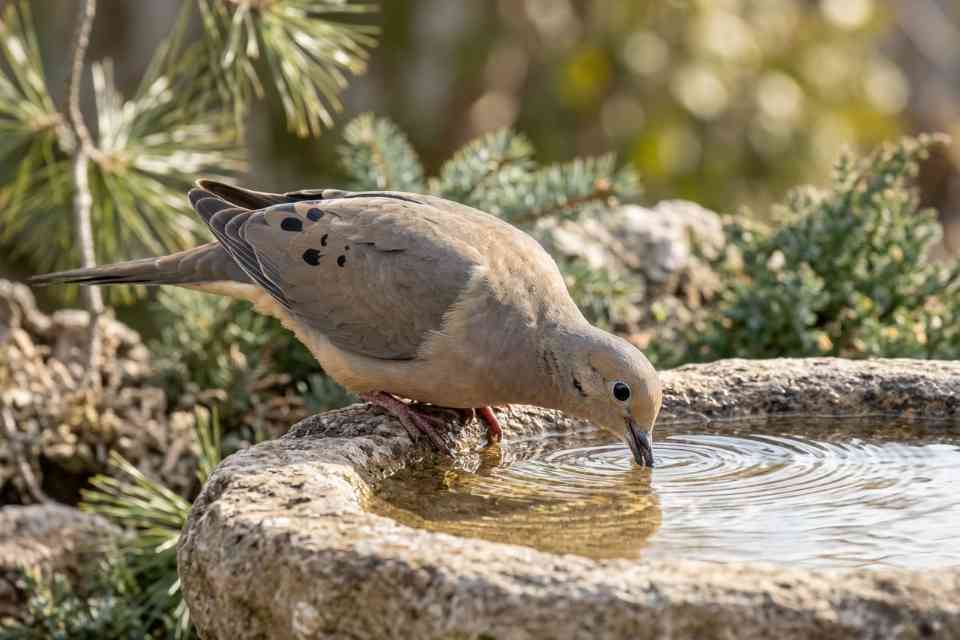
Cornell Lab notes that this adaptation has additional advantages in dry environments: mourning doves can drink brackish spring water at up to nearly half the salinity of seawater without becoming dehydrated, a tolerance that allows them to exploit water sources unavailable to most other birds in arid regions.
Salt and mineral access plays a role in dove diet that is often overlooked at backyard feeding stations. The Oklahoma State University Extension fact sheet on mourning doves notes that salt is theorized to be an important component of the dove diet and is thought to be necessary for proper egg viability.
The exact mechanism is not fully characterized, but field observations have recorded doves seeking out salt licks, mineral deposits, and crushed oyster shell during the breeding season.
Providing a shallow calcium station near your feeding area, using crushed clean eggshells or crushed oyster shell, addresses both the calcium needs of egg-laying females and the mineral requirements that salt-seeking behavior suggests.
This is a low-cost, high-impact addition to any dove-focused feeding station during spring and summer.
Managing Mourning Dove Feeding Station Infrastructure
The mourning dove’s ground-foraging anatomy and predator-avoidance behavior together dictate a feeding station design that differs significantly from what works for most other backyard birds.
Platform feeders and direct ground scatter are the correct formats. Mourning doves cannot cling to hanging tube feeders and have difficulty maintaining balance on narrow perch bars.
A wide, open platform feeder set at 6 to 12 inches off the ground, or seeds scattered directly on bare or lightly vegetated ground, matches the bird’s natural foraging posture. Our guide to How to Attract Mourning Doves to Your Backyard covers feeder selection and scatter placement in detail.
Window strikes are a significant hazard for mourning doves specifically because of their fast, direct flight pattern. Unlike many songbirds that dart and maneuver, doves fly in straight lines at high speed, and a window reflection that appears to be open air becomes a lethal obstacle.
The American Bird Conservancy’s 2×4 rule applies here: external markings on glass spaced no more than 2 inches horizontally and 4 inches vertically create a visual barrier birds will not attempt to fly through. Our guide to how to prevent birds from hitting windows covers the most effective products for each window type.
Predator management matters more for doves than for most feeder birds because doves spend so much time on or near the ground. Cats are the primary threat during active foraging sessions. Dense brush within 10 to 15 feet of a ground feeding area also creates hawk ambush cover.
Position feeding areas in open space with clear sightlines in all directions, and keep brush piles and dense shrub edges at a distance that gives doves time to detect and evade a hawk approach. Our guide to how to protect baby birds from predators covers the broader principles of predator-safe yard design.
Water access is best provided in a shallow dish at ground level or slightly elevated, with no more than 1 to 2 inches of water depth. The sucking drinking technique requires a surface the dove can reach with its bill submerged; deep basins work poorly. Change water daily to prevent contamination from the seeds and droppings that doves inevitably deposit near water sources.
What Do Mourning Doves Eat in the Winter?
During the winter, mourning doves prioritize high-fat seeds like black oil sunflower and safflower to meet the increased metabolic demands of cold weather.
While the mourning dove’s diet remains seed-focused year-round, the specific seeds available, the energy density required, and the mineral demands of the bird shift significantly across the annual cycle. Aligning your feeding station with these seasonal shifts makes your yard more productive for doves at every time of year.
In winter, the dietary priority shifts decisively toward caloric density. Natural seed sources are at their most depleted, temperatures demand higher metabolic output, and doves in northern areas concentrate around the most reliable food sources.
High-fat offerings, including black oil sunflower, safflower, and suet-based products for the other species sharing the station, provide the energy density doves need to maintain body condition through cold nights.
Our guide on Feeding Birds in Winter covers the full winter feeding calendar. And our article on What Bird Seed to Use in Winter Feeders compares the nutritional profiles of the most common winter options.
In spring and early summer, the priority shifts to calcium and mineral support for breeding females. A female mourning dove may produce up to six clutches per season in warm climates, each clutch containing two eggs.
Producing eggshells at that rate places a sustained demand on calcium reserves that the seed diet alone cannot fully meet. Placing a shallow dish of crushed rinsed eggshells or crushed oyster shell near the feeding station from March through July gives breeding females a readily accessible calcium supplement.
Midsummer brings a spike in natural seed abundance from grasses and weeds, and feeder visitation often drops as doves shift to wild foraging. This is normal and expected.
Maintaining a small supply of white millet and cracked corn through summer keeps the feeding station registered in the birds’ foraging map, so they return reliably as natural sources become less abundant in late summer and fall.
For a complete look at how the mourning dove’s social behavior, pair bonding, and nesting cycle interact with its diet across the year, our piece on why mourning doves coo covers the communication side of this species’ remarkable annual rhythm.
And if you are managing a yard for multiple ground-feeding species simultaneously, our guide to common backyard birds provides species-by-species feeding profiles that help you design a station serving the widest possible community.
The 2026 Mourning Dove Feeding & Safety Checklist
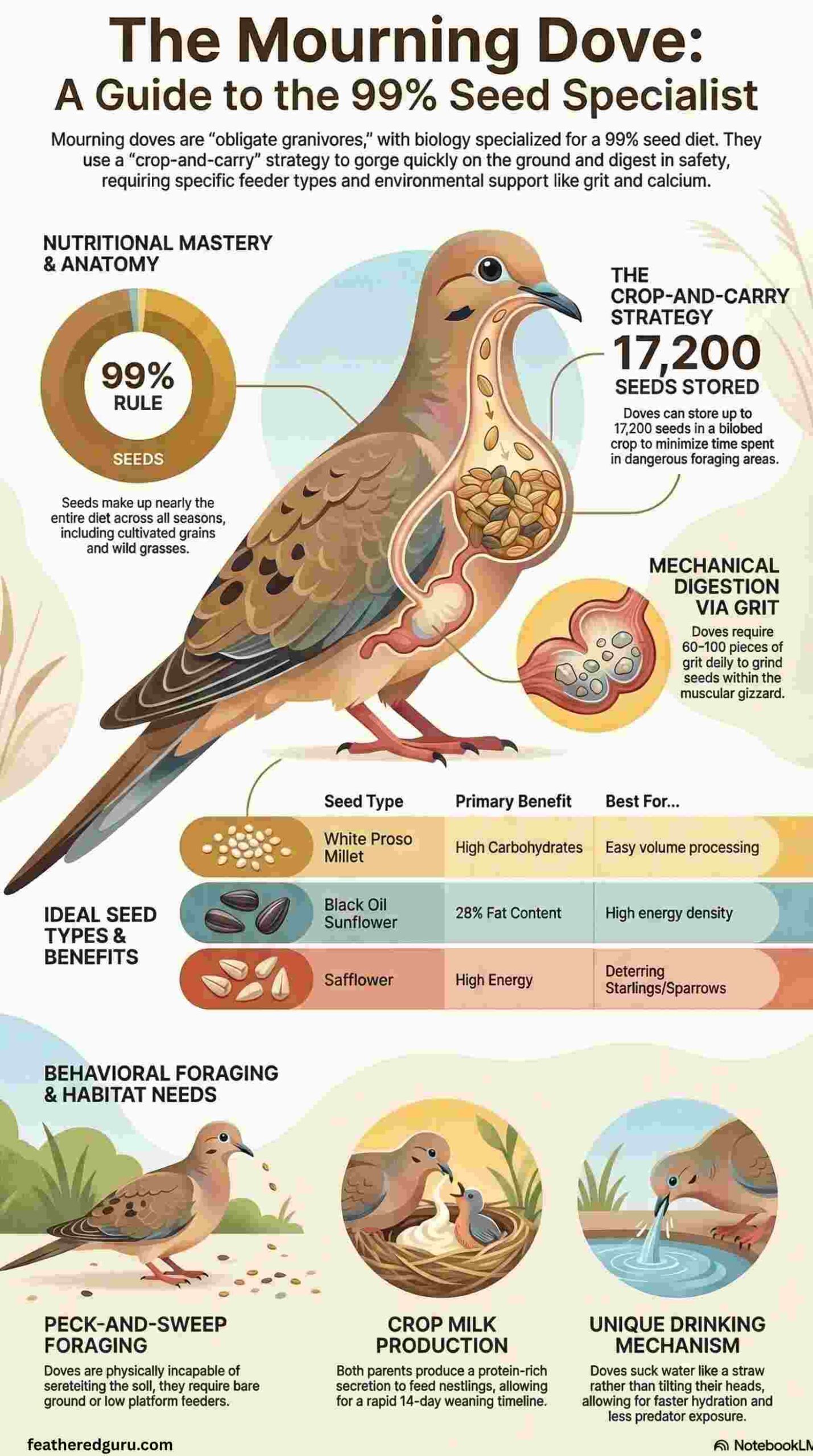
To synthesize the technical requirements of metabolic support and sanctuary safety, we have created the mourning dove feeding checklist below. This visual guide summarizes the 17,200-seed crop storage strategy, the 100-piece daily grit requirement, and the essential 2×4 window safety standards needed to sustain a healthy resident population year-round.
Frequently Asked Questions About Mourning Dove Diet
What is the best bird seed for mourning doves?
White proso millet is the undisputed favorite due to its small size and high carbohydrate content. They also enjoy black oil sunflower seeds and safflower.
Do mourning doves eat insects or worms?
No, mourning doves are 99% granivorous (seed-eaters). Unlike many other backyard birds, they maintain a seed-dominant diet even during the summer months.
Why do mourning doves eat gravel or sand?
Doves need 60 to 100 pieces of grit daily. They use these small stones in their gizzard to mechanically grind down the hard shells of the seeds they eat.
Can mourning doves eat whole corn kernels?
No, whole corn is typically too large for a mourning dove’s bill. It is better to offer cracked corn, which they can easily swallow and store in their crop.
Summary of Mourning Dove Behavioral and Nutritional Needs
Supporting these ground-feeding visitors relies heavily on the open accessibility of your backyard feeding layout rather than offering a complex menu. Because these birds are almost exclusively granivorous and physically incapable of scratching for buried food, their survival depends on the predictable availability of surface-scattered grains like white proso millet and safflower.
Providing a consistent supply of these high-energy grains alongside daily grit helps satisfy the unique biological requirements of a species engineered for rapid foraging. Securing your glass windows with a defensive safety grid protects these fast-flying visitors from accidental collision impacts while they navigate toward your open property borders.
Whether they are utilizing their specialized drinking techniques at your water basins or filling their expansive crops for a quiet digestion session, your property becomes a vital sanctuary along their continental migratory routes. Designing your landscape for these resilient birds delivers the exact structural and nutritional safety required to sustain a highly specialized avian success story.