
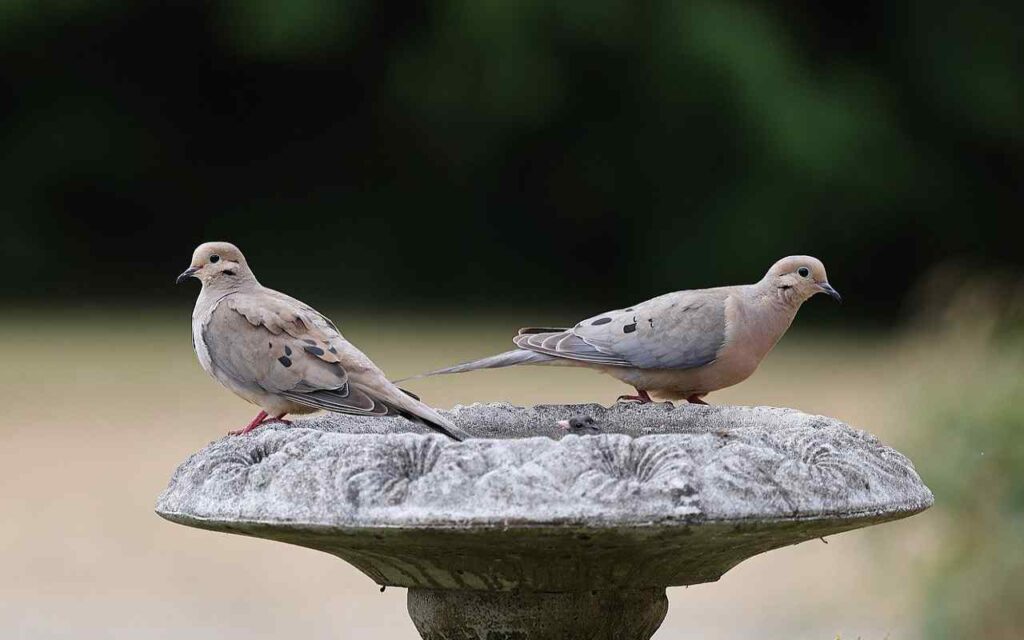
The Mourning Dove is one of the most familiar birds in North America. It visits nearly every suburban yard, sits on every telephone wire, and fills every quiet morning with its unmistakable, mournful coo. And yet, most people who watch them every single day still don’t know how to identify male vs female mourning doves reliably.
The physical differences between a resident pair are incredibly real, but they are also highly subtle, context-dependent, and almost entirely invisible in poor backyard lighting. To confidently separate the sexes, you must look past simple snapshot glances and learn how to decode their three specific facial color zones and their strict daily behavioral schedules
How Do You Tell the Difference Between Male and Female Mourning Doves?
To identify male vs female mourning doves, look for the bluish-grey crown and pinkish-iridescent neck patches found only on males. Females feature a tan or brownish crown with a muted beige breast, while males typically lead three-dove chase formations and sit on the nest from morning to mid-afternoon.
Male vs Female Mourning Doves: Visual Video Guide
To help you visualize the subtle physical differences and unique behavioral clocks of this species, I have included an educational video breakdown below. This analysis deconstructs the structural physics of the male’s iridescence and the precise timing of the ten-to-four nest shift.
📝 View Video Timeline & Key Takeaways
[00:00 – 02:16]: Introduction to mourning dove monomorphism and identification challenges. Understanding how lighting alters our perception of these birds, why it is critical to focus on targeted zones instead of the entire body, and how to scan the head crown, neck, and breast regions.
[02:17 – 03:44]: Close-up physical profiling of the three primary gender markers. Dissecting the male’s bluish-gray crown, rosy-tinted chest, and physics-based neck iridescence against the female’s muted tan features, alongside a detailed breakdown of structural color variations.
[03:45 – 05:21]: Deciphering behavioral gender maps during overcast conditions or long-distance tracking. Analyzing the strict social hierarchy behind the three-dove chase formation, identifying territorial cooing calls, and tracking physical displays like wing-clapping takeoffs.
[05:22 – End]: Utilizing the midday nest clock rule for instant identification. Breaking down the strict parental incubation schedules that run from morning to mid-afternoon, building a fast mental checklist for yard scans, and spotting atypical scale textures on juvenile variants.
The Monomorphic Challenge: Why Doves Look Identical at First Glance
The “Monomorphic” Problem: Why It Causes 90% of Backyard ID Errors
Ornithologists use the word “monomorphic” to describe species where males and females look essentially the same. The Mourning Dove is classified as nearly monomorphic, meaning the sex differences exist but are degree differences, not categorical ones.
Wikipedia’s Mourning Dove account, citing the ornithological literature, confirms this directly: females are similar in appearance to males but with more brown coloring overall and are slightly smaller. There is no single field mark that unambiguously signals one sex. Every identification relies on a combination of color zone assessment, light conditions, and behavioral context.
This is why most backyard observers get it wrong. They look at a single dove in average light, see the overall gray-brown plumage shared by both sexes, and either guess randomly or assume all doves look identical. The correct approach is to assess three specific zones in good direct light, then confirm with behavioral cues whenever possible.
Structural vs. Pigment Color: Why the Male’s Pink Is Not a Dyed Feather
The male Mourning Dove’s iridescent neck patch is not produced by pigment the way a Robin’s red breast is. It is a structural color, produced by physics rather than chemistry.
Research published in Zoology by Shawkey, D’Alba, Wozny, Eliason, Koop, and Jia (2011) at the University of Akron used transmission electron microscopy and thin-film optical modeling to determine exactly how the color is produced. The study found that the iridescence is created by thin-film interference from a single layer of keratin, approximately 35 nanometers thick, surrounding the edge of the feather barbules, beneath which lies a layer of air and melanosomes.
There is no pink dye in the feather. The barbules reflect certain wavelengths of light constructively, producing the pink-violet shimmer that appears only when light strikes the feather at the correct angle. This is the same physics that produces the colors in a soap bubble or an oil slick.
The Role of Iridescence in Mate Selection: Why It Disappears in Shade
The Shawkey 2011 study found something remarkable about the male’s iridescent patch: after experimental wetting and drying, iridescent feather color changed hue, became more chromatic, and increased in overall reflectance by almost 50%. The mechanism was a twisting of colored barbules that exposed more of their surface area for reflection.
This has a direct identification implication. Because the iridescence is angle-dependent and requires direct light to produce the constructive interference that creates the visible color, a male dove in full shade will show almost no iridescence at all. The neck patch that blazes pink in morning sun becomes a dull matte beige in shadow.
This is why backyard observers so often conclude that two doves look identical: they are viewing the birds in diffuse or overcast light. In direct sunlight, the sex difference in Zone 2 becomes genuinely obvious. All three color zone assessments below assume good direct light conditions.
Visual ID: The Three “Tell-Tale” Color Zones
Zone 1: The Crown and Nape
This is the most reliable single field mark for sex identification in the Mourning Dove, and the one that holds up in the widest range of lighting conditions.
The adult male has a distinctly bluish-grey crown. Wikipedia’s Mourning Dove account states this explicitly: adult males possess a distinctly bluish-grey colored crown, which females lack. The blue-grey color is present across the top and back of the head and extends onto the nape, giving the male’s head a cleaner, cooler appearance than the female’s.
The adult female’s crown and nape are uniformly brownish-tan, matching the warm brown tones of her back and wings. There is no blue or grey in the female’s head coloration. Seen side by side in good light, the difference is clear. Seen individually in average suburban yard conditions, the blue-grey of the male is subtle but present once you know to look for it.
Zone 2: The Iridescent Neck Patch
Wikipedia documents that the adult male has bright purple-pink patches on the neck sides, and that the iridescent feather patches on the neck above the shoulders are nearly absent in females but can be quite vivid on males.
In direct sunlight, the male’s neck patch shimmers between pink, violet, and rose depending on the angle of view. It is located on the sides of the neck just above the shoulder, not on the throat. It can appear to pulse in color as the bird moves its head.
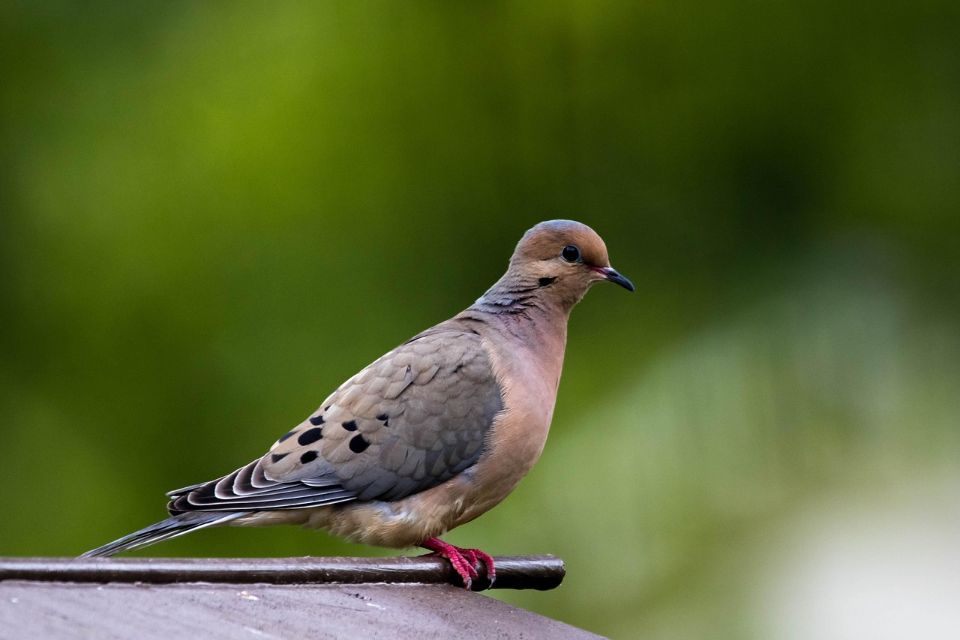
The female’s neck in the same location shows muted, matte beige with little to no iridescence. Some females show the faintest hint of a neck patch in optimal light, but it never approaches the vivid shimmer of a fully adult male in breeding condition.
Remember the shade caveat from Section 1: in diffuse light or full shade, even a male’s neck patch may appear dull. Always assess Zone 2 in direct sunlight for a reliable read.
Zone 3: The Breast and Throat
The male’s breast has a rosy-peach wash that extends down from the throat, described across multiple field accounts as a light pink coloring reaching the breast. It is a warm, faintly rosy tone layered over the underlying gray-brown, most visible on the upper breast in full light.
The female’s breast and throat are a consistent buff-tan with no rosy wash. The underparts are generally described as browner and duller overall, matching the uniformly warmer brown of her entire plumage.
Zone 3 is the least reliable of the three zones assessed individually because lighting angle strongly affects how much pink appears on a male’s breast. It is most useful as a confirming cue when Zones 1 and 2 have already given a tentative identification.
How Can You Tell a Male from a Female Mourning Dove? The Action Cues
The Three-Dove Chase: Identifying Lead, Middle, and Trailer
During breeding season, one of the most reliably interpretable behaviors in all of suburban birdwatching plays out in the sky above Mourning Dove territories.
Cornell Lab of Ornithology’s Mourning Dove species overview documents it precisely: during the breeding season, you might see three Mourning Doves flying in tight formation, one after another. This is a form of social display. Typically the bird in the lead is the male of a mated pair. The second bird is an unmated male chasing his rival from the area where he hopes to nest. The third is the female of the mated pair, which seems to go along for the ride.
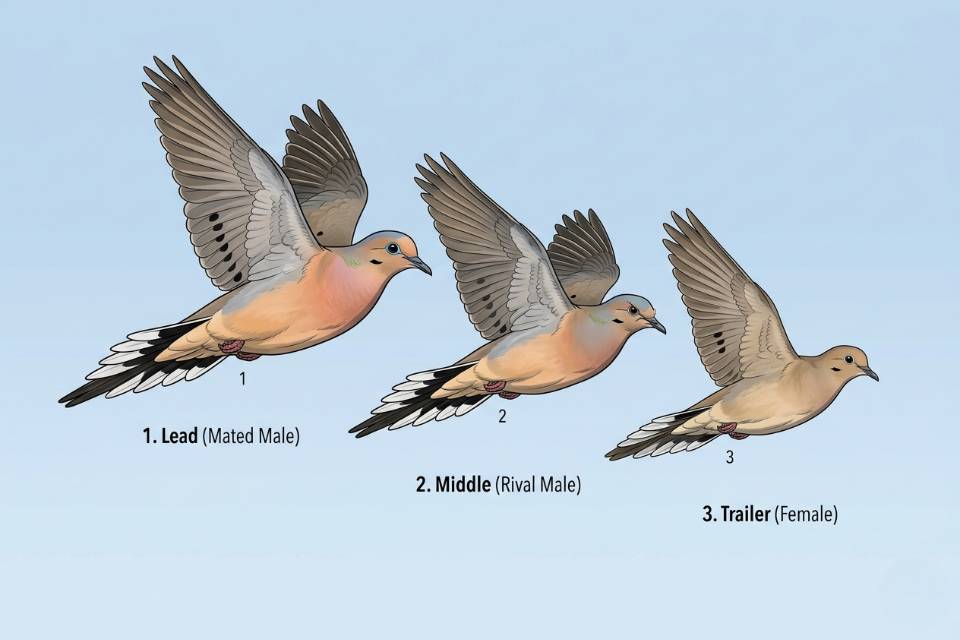
Position 1 in the three-dove chase: mated male. Position 2: rival unmated male. Position 3: female. When you see this formation, you are observing a complete social unit with sex roles immediately readable from position alone, no color assessment required.
The “10-to-4” Nest Shift: A Dove on a Nest at Noon Is the Male
The Birds of the World (Cornell Lab of Ornithology) account for the Mourning (Zenaida macroura) documents a precise incubation shift schedule: the male typically incubates from mid-morning until late afternoon, while the female takes over for the remainder of the 24-hour period and sits through the night.
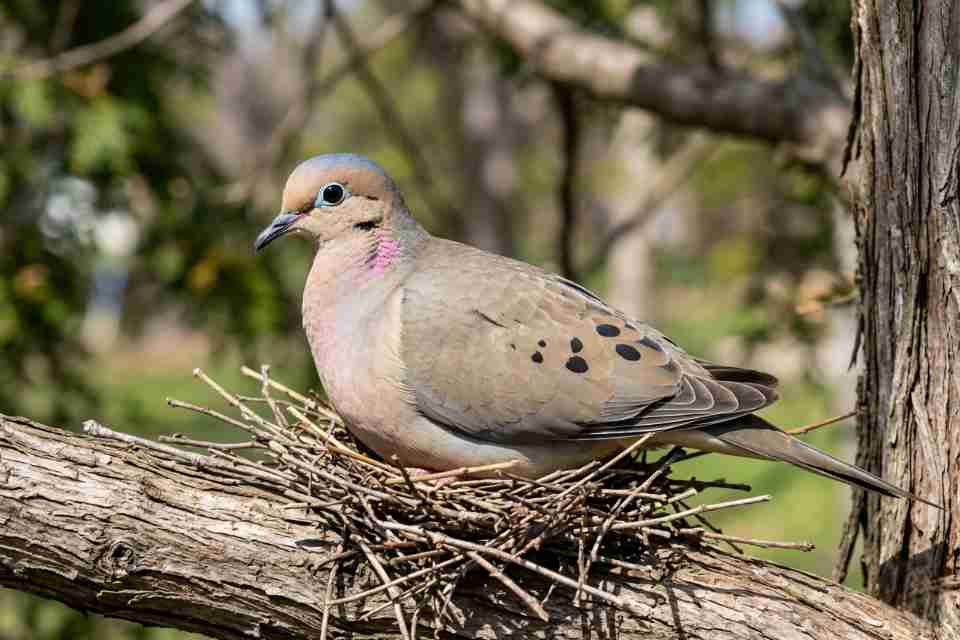
In practice this means that a dove sitting on a nest during the middle of the day is almost certainly the male. The switch typically happens in the late afternoon when the female returns to relieve him. A dove on a nest at dawn is almost certainly the female, still completing her overnight shift.
This is the single situation in which Mourning Dove sex identification approaches 100% certainty without any color assessment at all. If you have a nest visible from a window, checking it at noon tells you which bird you are looking at.
Tail-Fanning, Bowing, and the Advertising Display: Male-Only Behaviors
Audubon Society’s Mourning Dove field guide documents the male’s courtship sequence in full: in courtship, the male Mourning Dove flies up with noisy wingbeats and then goes into a long circular glide, wings fully spread and slightly bowed down. On the ground, the male approaches the female stiffly, his chest puffed out, bowing and giving an emphatic cooing song.
The puffed chest, bowing walk, and emphatic close-range coo are male-only displays never performed by females in a courtship context. A dove puffing its chest and walking stiffly toward another dove is a male. A dove sitting quietly while another approaches with puffed chest is almost certainly a female.
The display flight itself, a noisy ascent followed by a long circular glide with wings bowed down, is also exclusively male behavior. If you see a dove rising from a perch and spiraling back in a slow wide arc, you are watching a male advertising his territory.
A dove flushing rapidly from a nest toward a nearby window creates a real collision risk; the resource on preventing birds from hitting windows covers the exterior marking solutions that interrupt that flight path safely.
For a deeper look at the coo calls and what they communicate, the guide to why Mourning Doves coo covers the full vocal repertoire and social function of each call type.
How to Tell Female and Male Mourning Doves Apart by Sound
The Perch Coo vs. Nest Coo: Only Males Sing from Exposed High Perches
Flathead Audubon Society’s Mourning Dove species account documents the acoustic sex difference precisely: a male marks his territory and proclaims his intent with his recognizable, plaintive coo, perching with neck arched in an effort to make a perfect performance to entice his future mate. The female responds with a thinner and more variable song.
The advertising coo, the classic mournful call that gives the species its name, is performed almost exclusively by unpaired or newly paired males from exposed, elevated perches: wires, rooftop edges, dead branches, fence posts. The male perches prominently, arches his neck, and delivers the full-volume coo repeatedly with every visible muscle engaged in the effort.
Female Mourning Doves do vocalize, but more quietly and variably. If you hear the full carrying mournful coo coming from a prominent exposed perch, the bird producing it is almost certainly male. This acoustic-behavioral combination is one of the most reliable sex-identification tools available, particularly in situations where visual assessment of color zones is not possible.
Wing Whistle Logistics: Both Sexes, Not Just Males
Wikipedia’s Mourning Dove account states that the wings make an unusual whistling sound upon take-off and landing, describing it as a form of sonation, meaning a sound produced by a body part other than the vocal cords.
This wing whistle is produced by the modified outer primary feathers of both sexes and is not a reliable sex identification cue. Both male and female Mourning Doves whistle on take-off. The sound functions as an alarm cue for nearby birds rather than as a sex-specific signal.
The wing whistle is sometimes incorrectly cited online as a male-only behavior. It is not. A dove that whistles when flushed from the ground could be either sex. Do not use wing whistle presence or absence as a sex identification cue.
The Seasonal “Color Surge”: Breeding Season ID
Breeding Season and Plumage: When Males Are Easiest to Identify
The male Mourning Dove’s color differences are most pronounced during the breeding season. Longer day length triggers hormonal changes that affect feather condition, behavior frequency, and the overall brightness of the iridescent neck patch.
Cornell Lab’s life history account for the Mourning Dove notes that day length stimulates the hormones responsible for the physical changes that prepare birds for breeding, and that in some species these hormonal changes directly affect plumage brightness and display behavior frequency. In Mourning Doves, the practical result is that the male’s Zone 1 crown blue and Zone 2 iridescence are at their most visible from March through August.
Outside of breeding season, from October through February, the same male may show noticeably less vivid coloring as his hormone levels drop and feather wear accumulates. A male assessed in January may look considerably more similar to a female than the same bird would in April. Behavioral cues from Sections 3 and 4 remain reliable year-round even when color cues are reduced.
The Juvenile “Third Gender”: Avoiding the Fledgling Misidentification
Wikipedia’s Mourning Dove account is explicit: juvenile birds have a scaly appearance and are generally darker. The scaly pattern comes from pale feather edges on the wing coverts and body feathers, giving fledglings a scaled or spotted look entirely unlike the smooth plumage of adults of either sex.
Young birds of both sexes show this scaly appearance and lack the diagnostic color features of adult males. A juvenile Mourning Dove has no blue-grey crown, no iridescent neck patch, and no rosy breast wash. It looks, if anything, like a particularly brown and spotted female.
Misidentifying a juvenile as a female is extremely common and understandable. The reliable distinguishing feature of a juvenile is the scaly patterning of the wing coverts and the slightly darker, more spotted overall appearance.
Adult females are smooth-plumaged. If the bird looks scaly or spotted across the wing, do not attempt sex identification at all: it is a juvenile and does not yet show adult sex-specific plumage.
Aberrant plumage flukes represent a rare visual trap that can completely derail a standard gender scan. Community scientists on Project FeederWatch have tracked solitary wild doves displaying a striking, asymmetric white forked tail rather than the smooth, tapered grey-brown fan typical of the species.
Ornithologists classify this anomaly as localized leucism, a genetic glitch that shuts down melanin production in specific feather follicles. Because pure white feathers lack the structural reinforcement provided by dark melanin pigments, they suffer from accelerated mechanical wear and easily split along the central shaft.
When tracking visitors at your station, remember that structural genetic flukes can create a bizarre silhouette, but they do not alter the underlying color zones used to confirm an adult male or female.
For guidance on identifying and supporting fledgling doves found on the ground, the guide to caring for a fledgling bird covers what to do and what not to do when a young dove is found outside the nest.
Gender ID Summary: The 2026 Checklist
The 5-Second Scan: Quick-Reference Side-by-Side Comparison
When you have a dove in view in good direct light, work through these five checkpoints in order. Each confirmed observation builds confidence. No single cue is definitive on its own except the nest timing rule.
Step 1 – Crown color: Blue-grey crown pointing to male. Uniformly brownish-tan crown pointing to female. This is your most reliable starting point in most lighting conditions.
Step 2 – Neck patch in direct light: Iridescent pink-violet shimmer on the neck sides pointing to male. Matte beige with little or no shimmer pointing to female. Only assess this in direct sunlight.
Step 3 – Breast tone: Rosy-peach wash on the upper breast pointing to male. Consistent buff-tan with no rosy wash pointing to female. Use as a confirming cue only.
Step 4 – Behavior: Perch cooing from an exposed position, display flight, bowing approach, puffed-chest walk all point to male. Quiet observation while another dove approaches with puffed chest pointing to female. Three-dove chase position 1 or 2 pointing to male, position 3 pointing to female.
Step 5 – Nest timing: Bird on a known nest between approximately 10am and 4pm is almost certainly the male. Bird on a known nest at dawn or overnight is almost certainly the female. This is the most reliable single identification in field conditions.
If the bird shows scaly, spotted wing coverts: stop. It is a juvenile. Do not attempt sex identification.
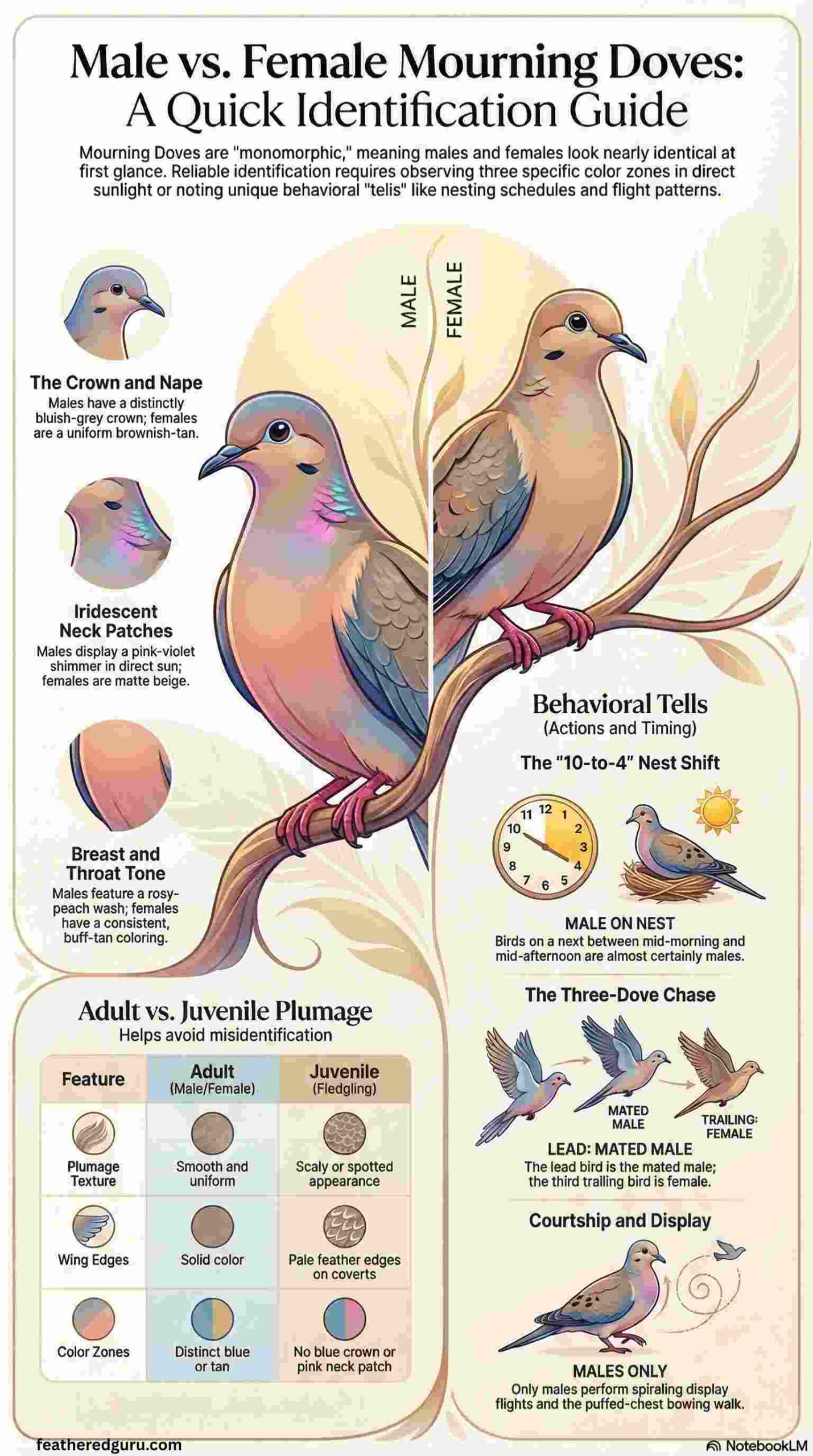
Visualizing the Male vs. Female Profile: The Comparison Infographic
To synthesize the three primary color zones and the four distinct behavioral tells, we have created the Mourning Dove ID Infographic below. This visual checklist provides a side-by-side reference for the bluish-grey crown, the pink-violet neck shimmer, and the specific “three-dove” chase formations.
For those who want to attract and support Mourning Dove pairs in their yard across the full nesting season, the comprehensive guide to Mourning Dove nesting habits in suburban environments covers nest site preferences, the full 30-day lifecycle, and the legal framework for handling nests found in gutters and drainage systems.
For the full range of food, water, and habitat options that bring Mourning Doves into consistent residency in a suburban yard, the guide to attracting Mourning Doves to your backyard covers feeder placement, ground feeding setup, and the native plant selections that make a yard attractive to resident pairs across multiple seasons.
The DIY Wire Nesting Cone Support
Structural nesting support offers a practical way to safeguard local breeding pairs from their own poor building habits. Backyard communities frequently discuss the species’ notoriously flimsy architectural skills, noting instances where pairs attempt to lay eggs on a few loose twigs tossed into rain gutters.
To bypass this environmental risk, hobbyists build DIY wire nesting baskets using basic quarter-inch metal hardware cloth molded into a shallow, five-inch cone. Securely fastening this rigid mesh nest support inside a secure, shaded tree fork 6 to 10 feet off the ground provides an instant, wind-resistant structural framework.
When a dove pair arrives, they will line the artificial wire base with their own twigs, creating a highly stable, predator-baffled sanctuary that keeps the clutch safe from severe spring storm washouts.
The Winter “Shovel Trick” Foraging Hack
Anatomical foraging limits create a critical survival hurdle for winter yard flocks. Real-world emergency tracking threads on Nextdoor highlight a stark behavioral vulnerability: unlike heavy-footed native sparrows, mourning doves are physically incapable of scratching or digging through heavy snow and ice crusts to reach food.
Because their leg structure is evolved purely for walking rather than earth-clearing, a thick winter blanket can lock doves out of their primary food supply entirely. To solve this crisis, backyard innovators utilize the “Shovel Trick”—clearing a dedicated 3×3 foot patch of open ground directly down to the bare soil after a storm.
Scattering high-fat white millet or cracked corn across this exposed earth accommodates their ground-picking mechanics perfectly, turning a dangerous winter freeze into a highly accessible feeding zone.
Conclusion: Mastering the Subtle Science of Dove ID
Identifying male versus female mourning doves is a lesson in both biological physics and behavioral observation. Because the species is essentially monomorphic, successful identification relies on moving beyond a surface-level glance and assessing the structural color of the bluish-grey crown and the pink-violet neck shimmer in direct sunlight. These markers are the result of precise evolutionary engineering, specifically a 335-nanometer keratin layer designed for high-performance mate signaling.
While visual cues can be subtle, the behavioral “clocks” of the species provide the definitive answer. By mastering the “10-to-4” nest shift and recognizing the lead position in a three-dove chase, you move from guesswork to scientific certainty. Whether you are observing a rosy-peach wash on a morning visitor or tracking a daytime incubator, understanding these nuances turns a common backyard sight into a masterclass in avian residency and suburban stewardship.