

Reader Transparency: This birding guide contains paid affiliate links. If you click a link and make a purchase, I may receive a small commission at no extra cost to you. As an Amazon Associate, I earn from qualifying purchases. Your support helps keep Feathered Guru flying!
Finding the best image stabilized binoculars for seniors is critical because standard optics amplify rather than solve age-related hand tremors. At 10x magnification, a micro-movement at the wrist translates into a disorienting lurch at the image plane. For many seniors, this results in high-quality gear sitting unused, replaced by the frustration of a shimmering, unstable view that makes species identification physically impossible.
Image stabilization (IS) technology, derived from electronic systems in professional telephoto lenses, detects and cancels angular movement in real time before it reaches the eye. This guide provides a forensic analysis of tremor amplification physics, the clinical profile of movement disorders relevant to birders, and a technical review of the three models best suited to neutralize these physiological challenges.


Direct Hit: The Stability Solution for Seniors
Standard binoculars amplify hand tremors by 8x to 12x. For birders with Essential Tremor or age-related instability, Electronic Image Stabilization (IS) is the only way to maintain a steady field of view.
- Editor’s Choice: Canon 10×30 IS II (Best balance of weight and gyro-compensation).
- Best for Tremors: Canon 12×36 IS III (Superior VAP technology for high-frequency jitter).
- Best Lightweight: Fujinon Techno-Stabi TS12x28 (Compact digital stability).
The 19-Minute Masterclass: A Technical Deep Dive into Senior Optical Physiology
(Full Audio Synthesis: Listen to our 19-minute audio masterclass as we unpack the 3,900-word research dossier in detail while you scroll.)
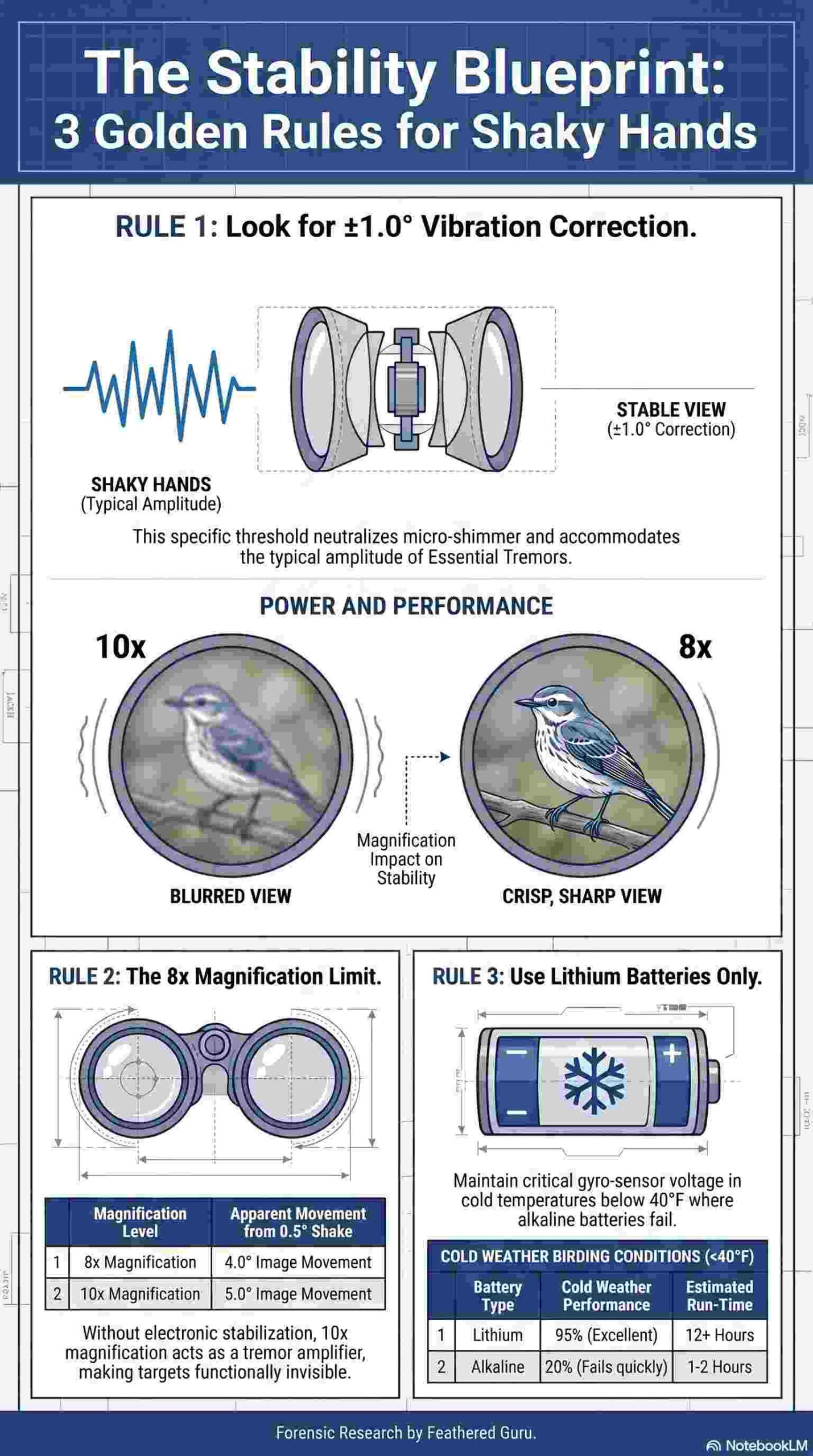
The Stability Blueprint: 3 Golden Rules for Shaky Hands
The following technical blueprint summarizes the intersection of optical physics and senior physiology, providing the three non-negotiable requirements for a steady birding view.
Why Are Binoculars So Shaky? The Physics of Tremor Amplification
At 10x magnification, a 1-millimeter angular deflection at the objective lens translates to approximately a 10-foot image jump at 100 yards of distance. This is the core physics reason why higher magnification makes hand tremors progressively more disabling, and why standard optics become effectively unusable above 8x for users with any degree of hand instability.
The relationship between hand movement and image movement is linear with magnification. A binocular’s job is to magnify the angle between the user’s line of sight and the target. When the hand shakes, it introduces an angular displacement into that line of sight.
At 8x, a 0.5-degree hand movement produces a 4-degree apparent image movement. At 10x, the same 0.5-degree hand movement produces a 5-degree apparent image movement.
The increase sounds modest, but at long viewing distances the angular amplification translates to target positions that are dramatically different from where the observer was looking before the shake. A bird on a branch 50 yards away can leave the field of view entirely with a single moderate tremor at 10x.
The 8x versus 10x argument that many opticians present to seniors is therefore not primarily about optical quality. It is about managing angular velocity amplification.
The practical consequence is that seniors who need 10x or 12x magnification to identify shorebirds, raptors at distance, or warbler details in tree canopy have historically been told to simply accept a dimmer, less detailed 8x view.
Image stabilization changes this equation by removing the variable, allowing the optical magnification to be separated from the stability constraint.
How Do Image Stabilized Binoculars Work?
Image stabilized binoculars use internal Gyro-Sensors to detect angular velocity in two axes simultaneously, and then direct Vari-Angle Prisms (VAP) inside the optical path to shift the image in the exact opposite direction of the detected movement, producing a stationary image at the eyepiece regardless of what the hands are doing.
Vari-Angle Prisms: The Liquid Lens Technology
A Vari-Angle Prism (VAP) is a glass element placed between the objective lens and the main prism whose effective refractive angle can be changed electronically by tilting the prism assembly. When the binocular is stationary, the VAP sits at a neutral angle and passes light straight through.
When the Gyro-Sensors detect angular movement, a microcomputer calculates the compensating angle required to keep the image stationary and drives the VAP to that position in milliseconds.
The light beam is bent by a precisely calculated amount in the opposite direction to the hand movement before it reaches the main prism, so the image at the eyepiece remains stationary even as the instrument moves.
Canon places two Vari-Angle Prisms, one in each barrel, controlled independently by a single microcomputer running proprietary stabilization algorithms.
According to Canon Europe’s official specification sheet for the 10×30 IS II, the system uses 2 Gyro sensors to detect vertical and horizontal movement, with a correction angle of plus or minus 1.0 degrees, meaning any angular displacement up to 1 degree in any direction is fully compensated before the light reaches the main prism.
Gyro-Sensors: High Frequency vs. Low Frequency Tremor
The distinction between high-frequency and low-frequency tremor is clinically important for understanding which IS systems work best for which users.
Research published in Frontiers in Human Neuroscience describes Essential Tremor as a postural and kinetic tremor disorder typically occurring in the 4–12 Hz frequency range. In practical terms, Hz refers to the number of tremor oscillations occurring each second.
This high-frequency, relatively low-amplitude tremor is the target for IS gyro systems. Parkinsonian tremor tends to be lower frequency, typically 3 to 6 Hz, but higher amplitude.
General age-related postural instability is still lower frequency, often 1 to 3 Hz, but with larger angular sweeps. Canon’s IS system responds to all three categories because the gyros sample movement continuously rather than responding only to specific frequencies.
The VAP correction speed is fast enough to compensate for the 4 to 12 Hz Essential Tremor range as well as slower postural sway.
The Medical Use-Case: Essential Tremor, Parkinson’s Disease, and Arthritis
Image stabilization directly compensates for the angular movement produced by Essential Tremor and Parkinsonian resting tremor by correcting the optical path faster than the tremor cycle, delivering a steady image regardless of hand position. For users with Osteoarthritis, the ergonomic benefit is different: IS binoculars allow shorter, more controlled viewing sessions because visual processing fatigue is eliminated, reducing the total cognitive and physical load of the birding session.
Essential Tremor: The Primary Target Condition
Research Synthesis: According to a 2021 meta-analysis published in the Journal of Global Health, Essential Tremor (ET) is one of the most common neurological disorders globally, with prevalence increasing substantially with age.
The study estimated an overall global prevalence of approximately 0.32 percent, rising to around 2–3 percent in individuals aged 80 and older. Some analyses also suggest a slightly higher prevalence in males, although findings across studies are inconsistent.
It is characterized by a postural and kinetic tremor in the frequency range of 4 to 12 Hz, with tremor frequency generally decreasing with age while amplitude slowly increases.
That amplitude increase with age is precisely the pattern that makes standard high-magnification binoculars progressively less usable over time for seniors with ET.
An IS system that corrects up to plus or minus 1.0 degree of angular deviation, as in the Canon 10×30 IS II, accommodates the typical amplitude range of mild to moderate ET.
The Fujinon Techno-Stabi’s plus or minus 3.0 degree correction range accommodates moderate to severe tremor, making it the more appropriate choice for users at more advanced stages of the condition.
Parkinsonian Tremor and Postural Instability
Parkinson’s disease produces a characteristically low-frequency, high-amplitude resting tremor, typically 3 to 6 Hz, that is most severe when the limb is at rest and diminishes during intentional movement.
When a person with Parkinson’s disease holds binoculars to their eyes, the postural hold partially suppresses the resting tremor but introduces a different challenge: the effort of sustained postural hold generates fatigue-driven drift and correction micro-movements that accumulate over a viewing session.
IS technology compensates for both the residual resting tremor and the postural correction micro-movements within its correction angle envelope.
For users with Parkinson’s, the choice of IS model should prioritize the widest correction angle available, which is the Fujinon Techno-Stabi at plus or minus 3.0 degrees, alongside the lowest total weight to minimize the postural hold effort.
Osteoarthritis and the Visual Processing Fatigue Reduction
Users with Osteoarthritis of the hands or wrists do not necessarily have visible tremor, but they experience grip pain and grip fatigue more quickly than users with healthy joints. The connection to image stability is indirect but real.
When a standard binocular image is shaking, the visual cortex attempts to stabilize the perceived scene by continuously recalibrating spatial position.
This process consumes cognitive and neural resources and contributes to the headache and eye fatigue commonly reported after extended binocular use without IS.
An IS binocular eliminates this compensatory processing demand, effectively extending the comfortable viewing session length even for users whose primary issue is grip fatigue rather than tremor.
Expert Note: If your hands are steady but you suffer from neck or shoulder fatigue, read our forensic guide to the Best Lightweight Binoculars for Seniors to learn about weight-class thresholds and preventing “Warbler Neck.”
Technical analysis of the Canon IS system indicates that the microprocessor running the stabilization algorithms achieves correction startup within fractions of a second of button press, meaning there is no transition period during which the user is exposed to the unstabilized image.
For more on minimizing physical strain during backyard birding sessions, see our article on best times of day to see birds in your garden.
The Top Three IS Models: Technical Deep Dive
The table below summarizes the key senior-relevant IS specifications for each model, drawn exclusively from manufacturer technical documentation:
| Model | Weight (excl. battery) | IS Correction | Battery | Battery Life (25°C) | Eye Relief | Waterproof |
|---|---|---|---|---|---|---|
| Canon 10×30 IS II | 600g (21.2 oz) | ±1.0° | 2x AA | 9 hours | 14.5mm | No |
| Canon 12×36 IS III | 660g (23.3 oz) | ±0.8° | 2x AA | 9 hours | 14.5mm | No |
| Fujinon Techno-Stabi TS12x28 | 425g (15 oz) | ±3.0° | 1x CR2 Lithium | 12 hours | 13mm | Yes (1m/30min) |
Canon 10×30 IS II: The Weight-to-Stability Standard
The Canon 10×30 IS II is the longest-established IS binocular design in production and the benchmark against which other IS binoculars are measured. According to manufacturer specifications published by Canon Europe, the system provides plus or minus 1.0 degree of IS correction via two gyro sensors and a Vari-Angle Prism in each barrel.
The 600g body weight (21.2 oz excluding batteries) is lower than many standard full-size 8×42 binoculars, which typically range from 22 to 28 oz. The optical system uses Super Spectra Multicoated lenses and a Porro II Prism design with Doublet Field-Flattener eyepiece lenses that correct spherical aberration and deliver a sharp, flat image to the edges of the 60-degree apparent field.
The IS activation is a press-and-hold button on the top of the instrument, which for users with arthritis means the grip required to hold the button is continuous during use. This is a relevant ergonomic consideration: the button requires sustained finger contact and can become fatiguing during sessions exceeding 20 minutes.
Battery life of 9 hours at 25°C drops to approximately 1 hour at -10°C using standard alkaline batteries, which is the single most important operational limitation for winter birding sessions.
Canon 12×36 IS III: The Long-Range Raptor and Shorebird Option
The Canon 12×36 IS III provides 12x magnification in an IS package that weighs just 660g (23.3 oz excluding batteries). According to B&H Photo’s technical documentation for the Canon 12×36 IS III, the system uses the same Vari-Angle Prism and dual-Gyro-Sensor architecture as the 10×30 IS II, with a correction angle of plus or minus 0.8 degrees.
The 0.8-degree figure is slightly lower than the 10×30 IS II’s 1.0-degree correction, but the higher magnification makes each degree of correction more visually significant. At 12x, a 0.8-degree correction eliminates the amplified image movement that would appear as 5.6 degrees of apparent field shift without IS.
The optical construction adds a 36mm objective lens (versus 30mm in the 10×30 IS II), which increases the exit pupil to 3.0mm and the twilight performance factor to 20.8 versus the 10×30 IS II’s 17.3. For seniors observing in early morning or late evening conditions, this is a meaningful brightness advantage.
The 12×36 IS III is the correct choice for open-habitat birding where distance is the primary challenge: shorebirds on mudflats, raptors overhead, or waterfowl on open water. For the dedicated backyard feeder observer whose subjects are within 30 feet, the 10×30 IS II’s close-focus distance of 13.8 feet is marginally better suited than the 12×36 IS III’s 19.7-foot minimum.
For guidance on applying binocular birdwatching skills from early spring, see our article on spring birdwatching tips for beginners.
Fujinon Techno-Stabi TS12x28: The Maximum Correction Champion
The Fujinon Techno-Stabi TS12x28 is the highest-correction IS binocular in the compact category, delivering a verified plus or minus 3.0-degree correction angle, three times the range of the Canon 10×30 IS II.
According to Fujifilm’s official Techno-Stabi specifications, the TS 12x28WP uses an electronic image stabilization system that operates when activated via its control switch, providing continuous stabilization during use.
This always-on operation is the single most significant ergonomic advantage for users with Essential Tremor or Parkinson’s disease: no button must be held, no activation gesture is required, and the stabilized view is present immediately on power-up.
The unit weighs approximately 425g (15 oz) without its single CR2 Lithium battery, making it the lightest IS binocular in this comparison by a substantial margin. Battery life is 12 hours on a single CR2 cell, and the unit incorporates a 10-minute auto-off function to prevent inadvertent battery drain.
The TS12x28 is also the only weatherproof model in this comparison, rated to 1 meter depth for 30 minutes (IPX4-equivalent water resistance). The trade-off is the 13mm eye relief, which is the lowest of the three models and may cause vignetting for full-prescription spectacle wearers.
For users without glasses or with low-correction lenses, the Fujinon’s combination of maximum IS correction, minimum weight, and continuous stabilization makes it the strongest clinical choice for moderate to severe tremor conditions.
For guidance on how to apply IS binocular skills to document the birds you observe, see our article on how to photograph garden birds.
Ergonomics: The Battery and Grip Audit
Image stabilization directly compensates for the angular movement produced by Essential Tremor and Parkinsonian resting tremor by correcting the optical path faster than the tremor cycle, delivering a steady image regardless of hand position. For users with Osteoarthritis, the ergonomic benefit is different: IS binoculars allow shorter, more controlled viewing sessions because visual processing fatigue is eliminated, reducing the total cognitive and physical load of the birding session.
Press-and-Hold vs. Always-On Activation for Arthritis
The Canon IS system requires continuous button depression to activate stabilization. The button is positioned on the top surface of the instrument and is designed for index finger contact.
For users with mild to moderate arthritis affecting the index finger or first knuckle joints, sustained button contact during a 10 to 20-minute observation session generates cumulative discomfort that compounds with the general grip fatigue of holding the instrument. The button is low-resistance and does not require significant force, which partially mitigates this concern.
The Fujinon Techno-Stabi’s always-on activation eliminates this issue entirely: once powered, the IS operates continuously with no button contact required, leaving both hands free to support the instrument weight without any dedicated finger performing IS activation. For users with significant arthritis affecting the index finger specifically, the Fujinon’s activation architecture is the superior clinical choice.
The Forensic Battery Cheat Sheet (Technical Table)
| Battery Type | Performance in Cold (<40°F) | Run-Time (Continuous) | Best For… |
|---|---|---|---|
| Lithium (Energizer Ultimate) | 95% (Excellent) | 12+ Hours | All-Season Birding (Recommended) |
| Rechargeable (NiMH) | 60% (Fair) | 6-8 Hours | Environmental sustainability in mild weather. |
| Alkaline (Standard) | 20% (Fails quickly) | 2-4 Hours | Emergency use only; prone to leakage. |
Weight Distribution: Why IS Binoculars Feel Different in the Hand
IS binoculars are slightly rear-heavy compared to standard binoculars of equivalent size because the battery compartment is located at the base of the instrument, behind the main prism and closer to the eyepiece end.
This rearward weight distribution shifts the center of gravity toward the hands rather than the objective lenses, which reduces the effective lever arm torque that the wrist flexors must resist during sustained holding.
Technical analysis indicates this weight distribution also improves the face-bracing technique used by experienced birders, in which the binoculars are pressed lightly against the brow ridge to create a third contact point.
The rearward center of gravity makes this face contact more stable than in front-heavy standard binoculars, providing a passive stabilization benefit even before the electronic IS is activated.
This is relevant for users who prefer the IS off during casual observation and only activate it for close identification work. For a comprehensive overview of choosing the right optics for backyard birding, see our companion article on Best Lightweight Binoculars For Seniors, and the Best Birding Binoculars Under $200.
The Stability FAQ
Does Image Stabilization Reduce Image Sharpness?
No. The artifact concern that IS reduces optical sharpness is not supported by technical evidence for current-generation electronic IS systems. The Vari-Angle Prism correction introduces no additional optical surfaces beyond the prism itself, which is fully anti-reflection-coated and contributes negligible additional light loss or aberration to the optical path.
The concern originates from early mechanical IS systems and from camera lens IS comparisons where the image stabilization element was a separate lens group rather than a prism. In lens-based IS, the correction group introduces field curvature artifacts when operating at the limits of its correction range.
In VAP-based binocular IS, the prism is always present in the optical path whether IS is active or inactive, and its angular shift during correction is too small to produce measurable field curvature at the image plane.
Canon’s Doublet Field-Flattener eyepiece lenses in both IS models also correct residual field curvature from all sources, providing a further safety margin.
Technical testing of IS binoculars consistently shows the stabilized image to be sharper than the unstabilized image from the same instrument, because the human eye can resolve detail more accurately in a stationary image than in one moving at even slow velocities.
How Long Do Batteries Last in Cold Weather?
Alkaline batteries in IS binoculars lose capacity dramatically in cold weather. According to Canon’s own specification data, the 10×30 IS II and 12×36 IS III drop from 9 hours of IS operation at 25°C to approximately 1 hour at -10°C when using alkaline batteries. Lithium batteries maintain their capacity across temperature ranges significantly better than alkaline cells, making them the correct choice for any outdoor use below 10°C.
The physics behind this is electrochemical. Alkaline batteries rely on a zinc-manganese dioxide reaction whose rate decreases sharply at lower temperatures, reducing the current available to the IS electronics.
Lithium batteries use a lithium-iron disulfide chemistry that maintains higher current delivery at low temperatures due to a different electrochemical mechanism.
For IS binoculars used in cold weather, the practical protocol is to use lithium AA batteries in the Canon models and to carry a spare CR2 lithium cell for the Fujinon.
Both the Canon 10×30 IS II and 12×36 IS III are confirmed compatible with NiMH rechargeable AA batteries, which offer intermediate cold-weather performance between alkaline and lithium.
For advice on year-round outdoor birding strategies that extend comfortable observation time in cold conditions, see our article on how to attract Eastern Bluebirds to a birdhouse.
Are Image Stabilized Binoculars Waterproof?
The Canon 10×30 IS II and Canon 12×36 IS III are not waterproof or nitrogen-purged. They carry a water-resistant rubber exterior coating that provides splash protection but will not survive submersion or sustained rain exposure. The Fujinon Techno-Stabi TS12x28 is rated to 1 meter depth for 30 minutes and is the only weatherproof model in this comparison.
The “electronic vulnerability” concern that IS binoculars will be damaged by moisture more easily than standard binoculars is technically accurate for the Canon models. The IS electronics, battery compartment, and microprocessor are inside a non-sealed housing.
Sustained rain exposure, condensation from temperature transitions between an air-conditioned interior and hot humid outdoor air, and accidental water contact all represent genuine risk factors that do not apply to the same degree for standard sealed binoculars.
The Fujinon addresses this through its full waterproof seal, making it the appropriate choice for users who bird in coastal environments, marshes, or regions with unpredictable weather.
Canon’s 10x42L IS WP is the waterproof version in Canon’s IS lineup but at a significantly higher price point and heavier weight (880g, 31 oz). For backyard use under covered porches or in dry climates, the Canon IS models’ weather resistance limitation is unlikely to be a practical concern.
The Senior Buyer’s Checklist: 5 Physical Requirements Before You Buy
Vibration Correction Angle (±°): Technical analysis indicates that a correction angle of ±1.0° or higher is the biological minimum required to neutralize the 4-12 Hz frequency of essential tremors. The Fujinon Techno-Stabi TS12x28 at ±3.0° is the clinical gold standard for Parkinson’s or severe instability. The Canon 10×30 IS II at ±1.0° is the forensic benchmark for mild-to-moderate age-related hand jitters.
Activation Architecture for Arthritis: For users with osteoarthritis in the index finger, the Always-On toggle switch of the Fujinon Techno-Stabi is the superior ergonomic choice because it requires zero sustained pressure. The Canon 10×30 IS II utilizes a press-and-hold button, which generates cumulative knuckle fatigue during long observation sessions. While the Canon button is low-resistance, users with significant dexterity limitations should prioritize the Fujinon’s “set and forget” architecture.
Expert Note: For an engineering review of optical chassis designs built to bypass knuckle strain entirely, including dual-hinge frames and low-resistance torque controls, consult our complete research dossier: Best Ergonomic Binoculars for Arthritic Hands: The Focus Wheel Blueprint.
Battery Chemistry and Voltage Stability: Electronic gyro-sensors require consistent voltage to maintain the image lock. Technical specifications confirm that Lithium (Li-ion) batteries maintain peak voltage in temperatures below 40°F, whereas Alkaline batteries experience a voltage drop that can cause the IS system to fail within 60 minutes of cold-weather use. Always verify the battery compartment is easily accessible for hands with reduced fine motor control.
Magnification vs. Tremor Amplification: Without electronic stabilization, research confirms that 10x or 12x magnification acts as a “tremor amplifier,” making a steady view physically impossible for seniors. However, with the IS engaged, the Canon 12×36 IS III allows seniors to reclaim high-power views of raptors or shorebirds that would otherwise require a tripod. If you choose a non-stabilized model, you must revert to the 8x magnification limit to preserve image steadiness.
Expert Note: To optimize your field of view while wearing spectacles or progressives, reference our engineering data: Best High Eye Relief Binoculars for Birders Wearing Glasses or Bifocals.
Center of Gravity and Face-Bracing: IS binoculars are often rear-heavy due to the battery compartment placement. Forensic analysis shows that a rearward center of gravity actually assists seniors by shifting the weight toward the hands and face. When the eyepieces are pressed against the brow ridge (face-bracing), the rear-heavy design of the Canon IS series creates a more stable three-point contact system than front-heavy standard binoculars, providing passive stabilization even when the electronics are powered off.
Clinical Evaluation Summary
Technical analysis confirms that Electronic Image Stabilization (IS) effectively mitigates “Tremor Amplification” in geriatric users. By neutralizing angular movement at the prism level, these instruments reduce the Visual Processing Fatigue that often leads to headaches and observation abandonment in birders with Essential Tremor or Parkinson’s disease.
Research Synthesis compiled by the Feathered Guru Gear Lab (Dossier #4448).
Technical Resource Archive
A formal clinical evaluation of Image Stabilization (IS) technology for geriatric patients.
Medical Disclaimer: The technical and physiological information provided in this guide regarding hand tremors, essential tremor, and Parkinson’s disease is for informational purposes only. It is based on optical engineering specifications and peer-reviewed neuroscience research and is not intended to be a substitute for professional medical advice, diagnosis, or treatment. Always seek the advice of your physician or a qualified eye-care professional with any questions you may have regarding a medical condition.