
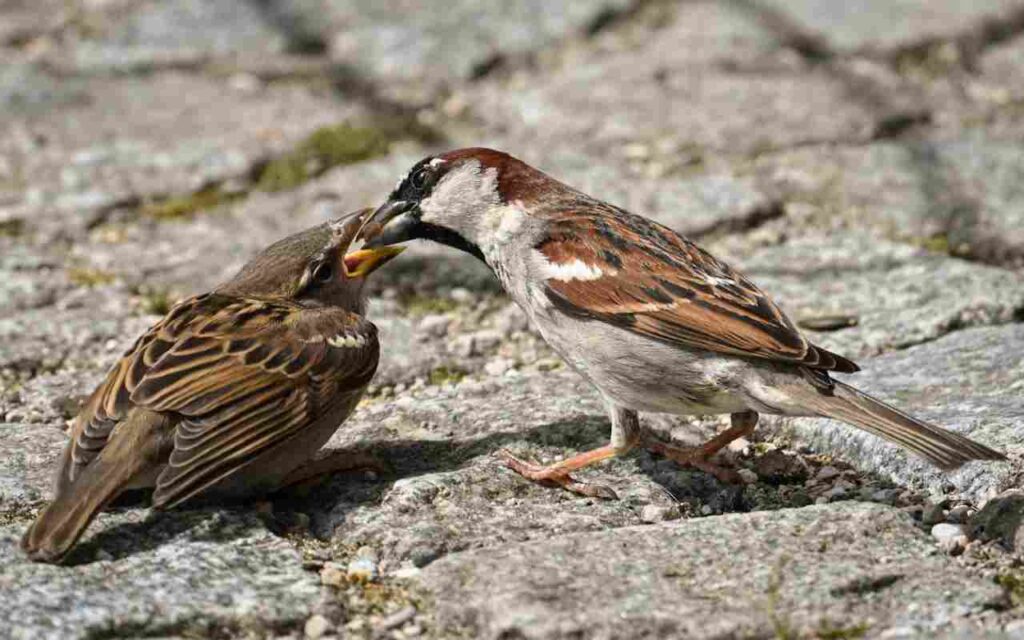
The House Sparrow is one of the most familiar birds in the world. It visits feeders in every season, nests in every building cavity it can find, and calls from rooftops in nearly every city and town across North America.
And yet, even experienced birders often struggle to distinguish a House Sparrow juvenile vs an adult female at a distance. Determining whether you are looking at a young bird, an adult female, or a first-year male requires a specific set of visual markers. The differences are real, documented, and consistent once you know what to look for.
This guide covers every reliable identification cue across all three plumage stages: the yellow gape and fluffy feathers of the juvenile, the buffy eyebrow and plain underparts of the adult female, and the black bib and chestnut nape of the adult male.
Quick Answer: How do you tell a juvenile House Sparrow from an adult?
To identify a juvenile House Sparrow, look for a fleshy yellow gape at the bill corners and fluffy, loose plumage. While adult females have a prominent buff eyebrow and plain gray-brown underparts, adult males are distinguished by a bold black bib and chestnut nape. First-year “teen” males often display a “shadow bib,” which is a pale, washed-out version of the adult black throat. At feeders, juveniles are easily spotted by their unique behavior of shivering drooped wings while begging for food.
Juvenile vs. Adult: A Visual Identification Masterclass
If you want to see the “shadow bib” and juvenile begging behaviors in motion, watch our expert video guide below. This visual breakdown maps out the subtle plumage shifts and behavioral cues you need to accurately age House Sparrows in the field.
📝 View Video Timeline & Key Takeaways
[00:00 – 02:56]: Identifying the juvenile gape flange and plumage features. Evading the anonymous flock blur requires targeting the explicit morphological smoking gun of the fledgling *Passer domesticus*: the bright yellow gape flange located at the corner of the mouth. This soft tissue target sits alongside a pale straw-colored bill, fluffier contour feathers, and frantic wing-shivering feeding behavior.
[02:57 – 04:07]: Decoding cryptic female supercilium and breast markers. To differentiate adult females from juvenile lookalikes, field observers must check the cranial profile for a broad, buff-colored supercilium stripe. This distinctive eyebrow marking operates next to a completely plain, unstreaked dingy gray-brown pectoral region to lock in a foolproof diagnosis.
[04:08 – 05:51]: Deciphering the male black bib status badge and hierarchy. The male throat patch behaves as a visual badge of social dominance within flock hierarchies. Young first-year males exhibit a faint shadow wash, standard adults carry a solid medium-sized bib, and dominant older individuals display a massive, dark throat patch paired with a dark gray crown cap and rich chestnut post-ocular scaling.
[05:52 – End]: The 3-second diagnostic triage order of operations. Implementing a systematic three-step mental triage process (Gape, Bib, Brow) to evaluate backyard flocks instantly. Running through this rapid physical mark progression isolates age structures, identifies watchful nesting mothers, and unlocks hidden population dynamics at the feeding station.
The Identification Challenge: Why Age and Gender Matter
The “LBJ” Problem: Why Juveniles and Females Cause the Most Confusion
Birdwatchers use the shorthand “LBJ” (Little Brown Job) for small, brown, streaked birds that resist quick identification. For House Sparrows, the juvenile and adult female are the two most common sources of this confusion, because both lack the adult male’s distinctive black bib and chestnut plumage that makes him immediately recognizable.
Cornell Lab of Ornithology’s House Sparrow identification account states the challenge directly: juveniles look similar to females. This single fact is the root of most backyard ID errors involving this species. The observer sees a plain, buffy-brown bird and identifies it as a female, when it may in fact be a juvenile of either sex, or even a first-year male that has not yet developed a visible bib.
The practical difficulty of sexing juveniles in the field is not just a beginner’s problem. Research published in The Wilson Journal of Ornithology by Mock and Schwagmeyer (2010), which tracked 100 broods of House Sparrows across a multi-year color-banding study at the University of Oklahoma, found that brood reduction occurred in 42% of 1,000 multi-chick nesting families, with surviving nestlings receiving significant food bonuses from parents after the loss of a broodmate.
The study confirms that juvenile House Sparrows from these broods enter the local population as post-fledging birds whose sex is not externally distinguishable from females until post-juvenile molt is complete, typically by November of their first year.
The solution is a structured three-stage approach: check for juvenile markers first (gape, plumage texture), then assess sex-specific female or male features, and use behavioral cues to confirm when plumage is ambiguous. Working through these stages in order produces reliable identifications far more consistently than trying to match a bird to a general impression of its overall color.
The Three-Stage Lifecycle: Fledgling, Immature, and Breeding Adult
Wikipedia’s House Sparrow account, citing the ornithological literature, lays out the plumage progression clearly. Young birds leave the nest with juvenile plumage: bills light yellow to straw, plumage loose and fluffy with broader buff feather edges, and in males, markings that are paler and far less distinct than the adult version. By the first breeding season, young birds generally appear indistinguishable from other adults, though they may still show paler coloring during their first year.
This means the window for identifying a bird by its juvenile plumage is relatively narrow. A House Sparrow that fledged in May may be largely indistinguishable from an adult female by September of the same year. Catching the juvenile-specific markers requires observing birds in late spring and early summer, when newly fledged birds are most numerous and their distinguishing features most pronounced.
Juvenile vs Adult House Sparrow: The Yellow Gape Test
The Gape Flange: The 100% Smoking Gun for a Juvenile
When comparing a juvenile vs adult house sparrow, the fleshy yellow gape at the base of the bill is the first thing to check. The single most reliable field mark for a recently fledged bird of any small passerine species is the gape flange: the fleshy, often brightly colored soft tissue at the corners of the bill. The yellow gape is specifically documented in ornithological field materials as typical of a recently fledged bird.
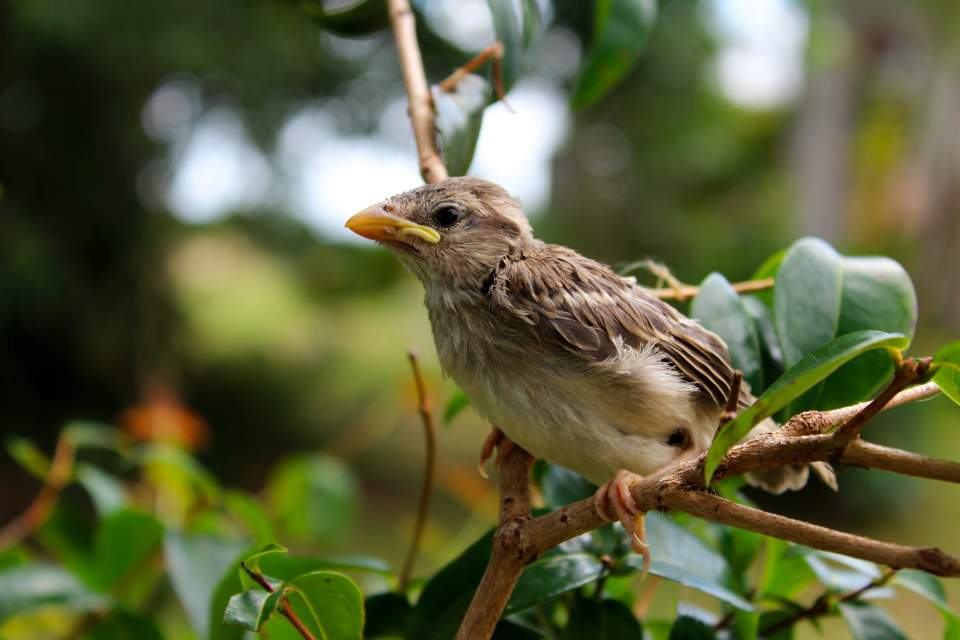
The gape functions as a feeding trigger for parents. Merry Lea Nature Banding Station’s guide to sparrow aging explains that nestlings’ mouths are bright yellow on the inside and at the corners of the bill, which acts as a feeding trigger for parents, and that as the young continue to grow and leave the nest, this yellow fades.
A fledgling that has just left the nest shows prominent yellow at the bill corners; a fledgling several weeks out of the nest shows just a trace of swelling at the corner.
The evolutionary function of this coloration is well-documented in the scientific literature. Research published in The Wilson Journal of Ornithology (2013) used digital photography to quantify the carotenoid-based coloration of rictal flanges in passerine species including House Sparrows.
The study found that yellow flange tissue was most saturated nearest the gape itself, indicating higher carotenoid deposition there than in more lateral regions of the tissue. The researchers concluded that this within-flange color patterning may have evolved specifically in the context of visual communication between offspring and parents.
A complementary study published in Animal Behaviour by Dugas (2009) manipulated flange color in free-living House Sparrow nestlings in Norman, Oklahoma. When provisioning young, parents showed a strong preference for nestlings whose mouth flanges had been painted to match the bright carotenoid-rich colors associated with higher condition, over nestlings with pale mouth colors typical of smaller, weaker offspring.
The effect was driven primarily by a strong female parent bias. This research confirms that the yellow gape is not simply a developmental artifact but an active quality signal that influences how parents allocate food resources among competing nestlings.
No adult House Sparrow, regardless of sex or season, shows this fleshy yellow gape. It is age-specific and temporary. If you see it, the bird is a juvenile, no further identification needed to confirm that age stage.
Bill Color Shifts: From Yellow-Straw to Dusky Adult
Beyond the gape flange, the bill color itself shifts as the juvenile matures into adult plumage. Ornithological literature documents that bills of young birds are light yellow to straw, paler than the female’s brownish-grey bill. The adult male’s bill shifts from yellowish in the nonbreeding season to dark or blackish as the breeding season approaches.
This gives a useful secondary age cue when the gape flange is no longer visible: a bird with a very pale, straw-colored bill but no other adult male markings is likely a young bird still completing its first molt. Adult females show a consistent brownish-grey bill darker than the juvenile’s straw. Adult females show a consistent brownish-grey bill that is mostly pale but darker on top.
Plumage Texture: Fluffy vs. Sleek
Ornithological documentation confirms that juveniles have broader buff feather edges and tend to have looser, scruffier plumage than adults. This textural difference is visible in good field conditions: a juvenile at close range looks slightly ruffled or fluffy compared to the smooth, compact plumage of an adult female of the same age.
The biological reason is straightforward: when young birds grow their first set of feathers all at once, those feathers are thinner and fluffier than the feathers they will grow later in life. Adults grow fewer feathers at a time and each one is sturdier and less fluffy. The looser texture is a consequence of rapid simultaneous feather growth, not poor condition.
This textural cue is most useful at close range, at a well-lit feeder, when the bird can be compared to adult females in the same flock. A side-by-side comparison often reveals the juvenile’s slightly puffier, more loosely structured plumage even after the gape flange has faded.
The Adult Female: Master of Muted Tones
The Supercilium: The Primary ID Marker for the Adult Female
The adult female House Sparrow’s most useful and reliable field mark is the buff-colored supercilium: a prominent eyebrow stripe running from the base of the bill back over and behind the eye. Field documentation consistently notes that females are plain buffy-brown overall, with the broad buffy eyebrow stripe listed as one of the most useful distinguishing features.
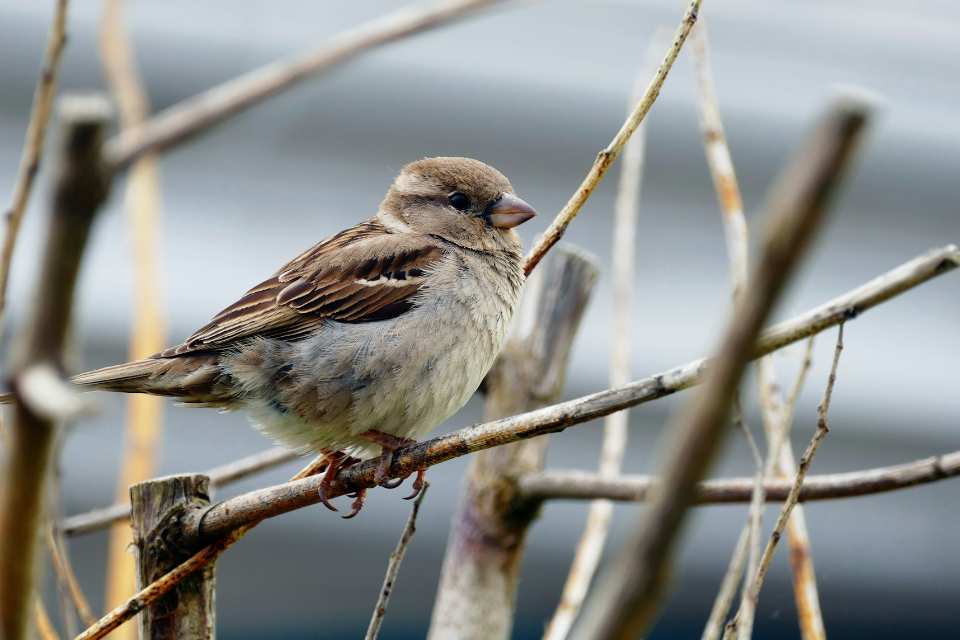
The supercilium is useful for two reasons: it distinguishes the adult female from the juvenile (whose supercilium is paler and less clearly defined in juvenile plumage), and it distinguishes her from the most commonly confused species.
Field comparison guides note that female House Finches have heavily streaked underparts and lack the female House Sparrow’s broad buffy eyebrow stripe, making the supercilium the fastest way to rule out the most common confusion species at a mixed feeder.
The supercilium is present year-round and is not affected by season or breeding condition. It is the most stable and reliable single field mark for the adult female across all lighting conditions.
Breast Patterns: Unstreaked Dingy Gray-Brown Underparts
Field documentation describes the adult female’s underparts precisely: plain buffy-brown overall with dingy gray-brown underparts. The key word is “plain.” The female House Sparrow lacks the heavy brown streaking on the breast that characterizes House Finches and many native sparrows.
This unstreaked underpart pattern is a useful negative identification cue: if the bird’s breast is clearly and heavily streaked with dark brown, it is not an adult female House Sparrow. The female’s breast is uniformly dingy, pale gray-brown without distinct streaking, giving the underparts a washed-out appearance compared to the more heavily patterned native sparrow species she might otherwise be confused with.
Wikipedia’s account confirms the absence of black markings or grey crown in the female, noting that her underparts are pale grey-brown and that she has a distinct pale supercilium. The combination of the prominent buff eyebrow and the plain unstreaked underparts together provides a reliable female identification package that holds across seasons.
For more on the habits and year-round behavior of House Sparrows in suburban environments, the guide to House Sparrow habits and natural history covers territory behavior, flock dynamics, and seasonal patterns in detail.
The Nape Difference: No Chestnut, Confirming Female
The adult female House Sparrow’s nape is uniformly brown, lacking the rich chestnut-brown color that flanks the adult male’s grey crown on the sides of his head. Ornithological accounts confirm that the female has no black markings or grey crown, with her upperparts and head being brown with darker streaks around the mantle.
When assessing a plain brown sparrow from above or behind, the nape color provides a useful confirming cue. Adult males show a warm reddish-brown on the nape that is visible from most angles. The female’s nape is a uniform dull brown with no reddish or chestnut tones.
First-year males may show only faint, washed-out chestnut on the nape, which is one reason identifying the immature ‘shadow bib’ is handled as its own specific identification challenge.
The Adult Male: Decoding the Black Bib
The “Badge”: How Bib Size Relates to Age and Dominance
The adult male House Sparrow’s black throat patch is the most studied plumage ornament in small passerine birds. It has been referred to in ornithological literature as a “badge of status” since Møller (1987) first documented an association between bib size and dominance in male-male aggressive encounters.
A meta-analysis published in Behavioral Ecology by Nakagawa, Ockendon, Gillespie, Hatchwell, and Burke (2007) assessed six well-studied correlates of bib size across the published research. The study found that the relationship between fighting ability and bib size was strong and robust, and that the relationship between age and bib size was moderate and robust.
Bib size does reliably increase with age, even if its link to moment-to-moment dominance is more complicated than originally believed.
Cornell Lab of Ornithology’s House Sparrow species overview frames this for the field observer clearly: males with larger patches of black tend to be older and dominant over males with less black. At a feeder, bib size gives you a reliable read on relative age: the bird with the largest, darkest, most clearly defined bib is almost certainly the oldest male in the group.
Chestnut and Grey: The Nape and Crown of the Adult Male
Beyond the bib, the adult male shows two additional distinctive head features that are absent in both females and juveniles. Ornithological accounts describe the male’s head pattern in detail: a dark grey crown from the top of the bill to the back, with chestnut brown flanking the crown on the sides of the head.
In field conditions this translates to a distinctive two-tone head: grey on top from bill to nape, warm reddish-brown on the sides. The grey crown is most clearly visible when the bird is seen from above or in profile. The chestnut flanking is visible from almost any angle in good light and is one of the quickest sex-specific field marks available for this species.
Documentation confirms that the male’s bib becomes darker black as the breeding season approaches, and that nonbreeding males have a yellowish bill and reduced black on the breast. This seasonal variation in bib intensity is worth knowing: a male photographed in November may show a noticeably paler, smaller-looking bib than the same individual in April, even though he is the same age and dominance rank.
The Immature Male: Identifying the “Shadow Bib” of the First-Year Bird
The first-year male House Sparrow presents the most challenging identification scenario for this species. Ornithological literature states that immature males have paler versions of the adult male’s markings, which can be very indistinct in fresh plumage, and that by their first breeding season, young birds generally are indistinguishable from other adults, though they may still be paler during their first year.
In the field, the first-year male shows what might be called a “shadow bib”: a greyish or pale brownish wash on the throat in the location where the adult black bib will eventually develop. It is present but clearly not the fully saturated black of an older adult. The chestnut nape may also be present but washed out, appearing more buff-brown than the vivid reddish-brown of a mature male.
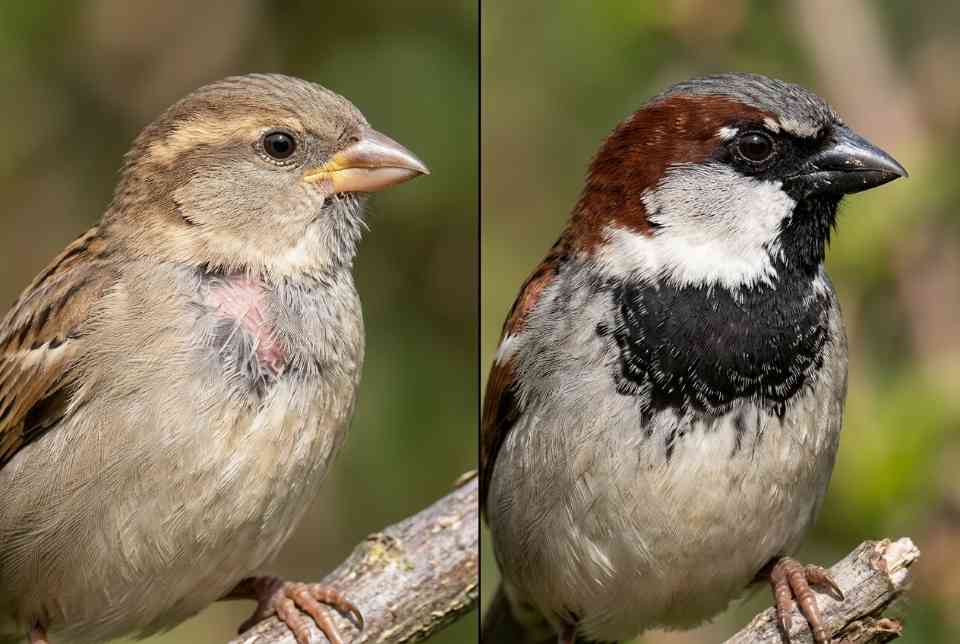
The first-year male is most reliably identified by the combination of a suggestion of dark coloring on the throat (ruling out adult female) and noticeably paler, less saturated markings than older males in the same flock. Comparing the bird to the most heavily marked male present at the same feeder is the most practical approach in field conditions.
For a comparison of House Sparrows against other commonly confused small brown birds at feeders, the guide to identifying male and female finches covers the key distinction points for the species most often mixed up with House Sparrows.
Side-by-Side Field Guide: Juvenile vs. Female vs. Male
Quick-Reference Comparison: Bill, Throat, Eye Stripe, and Crown
Bill color: Juvenile shows light yellow to straw, paler than the female’s bill. Adult female shows brownish-grey, darker on top. Nonbreeding adult male shows yellowish. Breeding adult male shows dark blackish.
Throat pattern: Juvenile shows no black, throat tends grayish in males and whitish in females (though juveniles cannot be reliably sexed by this criterion alone, per ornithological literature). Adult female shows no black markings at all. First-year male shows pale greyish wash suggesting a future bib. Adult male shows bold black bib, larger and darker in older individuals and in breeding season.
Eye stripe / supercilium: Juvenile shows paler and less defined supercilia than adult female, per ornithological literature. Adult female shows prominent buff-colored eyebrow stripe. Adult male shows small white stripe between lores and crown, flanked by black, a different pattern entirely from the female’s broad buff eyebrow.
Crown: Juvenile shows brownish, no distinct pattern. Adult female shows plain brown crown, no grey. Adult male shows clean dark grey crown from bill to nape. First-year male shows grey crown beginning to develop but often paler than fully adult males.
Nape: Juvenile shows dull brown. Adult female shows uniform brown, no chestnut. Adult male shows vivid chestnut-brown flanking the grey crown. First-year male shows chestnut present but noticeably duller and less saturated.
For a complete guide to House Sparrow natural history, territorial behavior, and nesting habits in suburban environments, the comprehensive resource on attracting House Sparrows to your garden covers food, nesting site preferences, and the behaviors that make this species one of the most studied small birds in ornithological research.
Behavioral Tells: Wing Shivering and Begging at the Feeder
When plumage cues are ambiguous, behavior provides a reliable age indicator. Birds of the World’s House Sparrow behavioral account documents the wing-drooping and shivering posture used by begging young: crouching, wings drooped and shivered, and head drawn back. This is used by begging young birds when soliciting food from a parent.
At a feeder, a juvenile that spots a parent will crouch, droop both wings, shiver them rapidly, open the bill, and call persistently until fed. The shivering wing posture is distinctive and immediately visible: the bird looks like it is vibrating or trembling with lowered wings on either side of its body. No adult House Sparrow, male or female, performs this posture in a feeding context.
Cornell Lab’s House Sparrow life history account describes the adult dominance displays for comparison: aggravated adult birds crouch with the body horizontal, shove the head forward and partially spread and roll forward the wings, with the tail erect. This adult threat posture is directional and forward-focused, entirely different from the juvenile’s generalized, symmetrical wing-shivering beg.
Once you have seen both displays, they are unmistakable in field conditions. For context on how House Sparrows interact with other common backyard species at mixed feeding stations, the resource on common backyard birds covers flock dynamics and feeder competition across the most frequently encountered species.
The 2026 Identification Checklist
The 3-Second Scan: Gape, Then Bib, Then Brow
When a House Sparrow lands at your feeder, work through the following three checkpoints in order. The sequence is designed to rule out each age-sex class as quickly as possible with the most reliable single field mark for each stage.
Step 1 – Check for gape (yellow corners of bill): If yellow fleshy gape is visible at the bill corners, stop. The bird is a juvenile, confirmed regardless of any other feature. Note wing-shivering behavior as confirmation if the gape is faded but still slightly swollen.
Step 2 – Check for bib (black on throat): If no gape is visible, look at the throat. Bold, clearly saturated black points to adult male, with bib size giving a read on relative age. Pale greyish wash on the throat with no clear black points to first-year male. No dark markings at all on the throat rules out adult male and first-year male.
Step 3 – Check for broad buff brow (supercilium): If no bib and no gape, look for the prominent buff eyebrow stripe. A well-defined, broad buff supercilium confirms adult female. A faint or poorly defined supercilium on a plain bird suggests late-stage juvenile still completing its first molt.
This three-step sequence (Gape, Bib, Brow) handles the vast majority of House Sparrow identification scenarios at a suburban feeder in under three seconds. Behavioral confirmation through wing-shivering resolves the remaining ambiguous cases.
For guidance on the invasive status of House Sparrows in North America, their interactions with native cavity-nesting species, and how to manage their presence in a backyard designed to support native wildlife, the resource on invasive backyard birds covers the ecological context alongside the practical management options available to homeowners.
The House Sparrow Identification Matrix: A Quick Reference Guide
For a high-level visual summary of the plumage shifts and “visual forensics” covered in this guide, refer to our ID Roadmap below. This infographic provides a side-by-side comparison of the yellow gape, shadow bib, and wing-shivering behaviors that distinguish juveniles from adults at a glance.
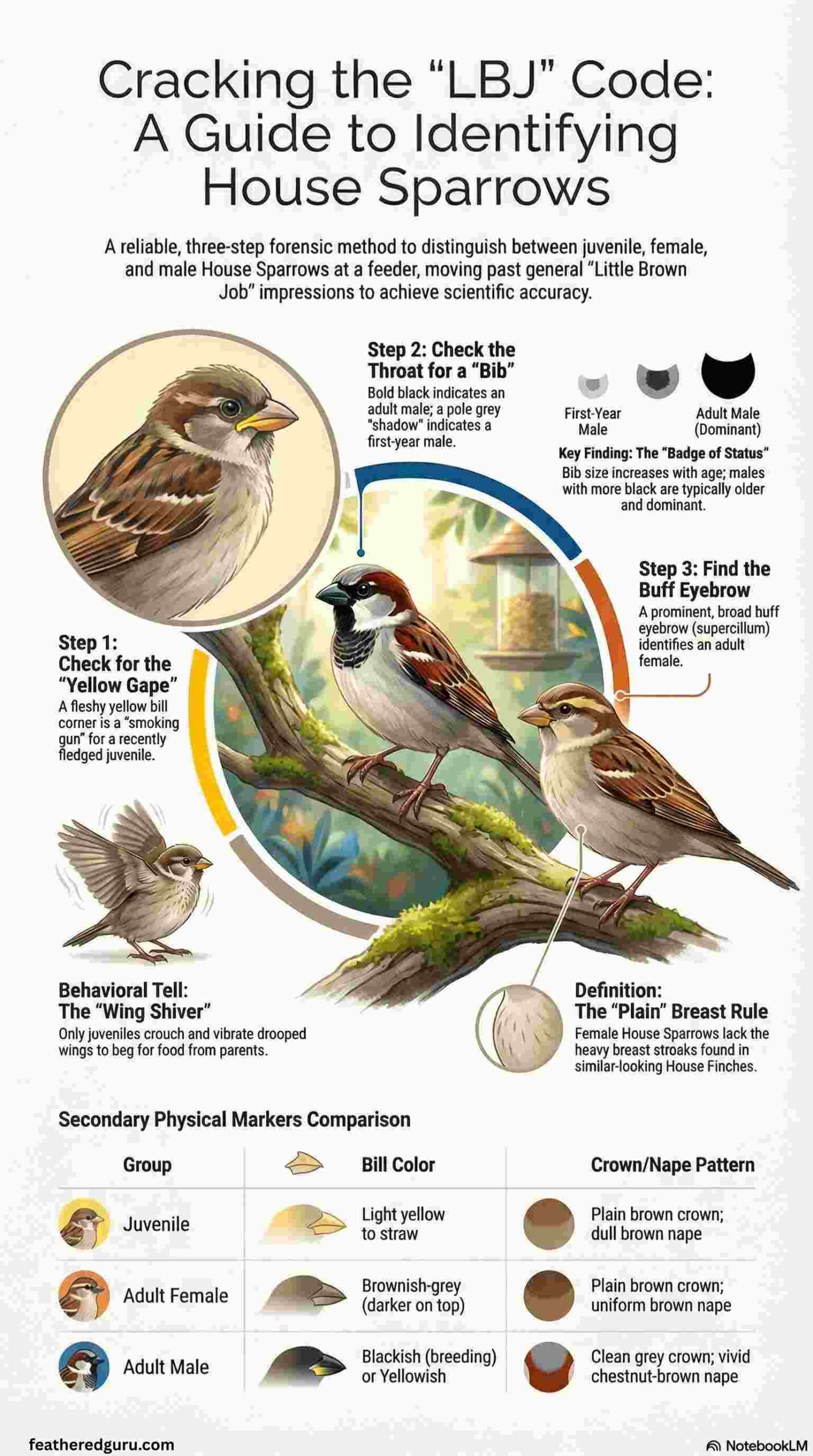
Your House Sparrow Identification Summary
Accurately identifying a House Sparrow juvenile vs adult is more than an academic exercise; it is the first step toward understanding the complex flock dynamics in your own backyard. While the “Little Brown Job” label suggests a confusing sea of identical birds, the reality is a consistent mosaic of biological markers. By looking for the yellow gape of the fledgling, the buff supercilium of the female, or the shadow bib of the developing male, you can age and sex almost any individual with confidence.
As you observe these birds through the seasons, the subtle shifts from fluffy juvenile plumage to the sleek, “badge-of-status” bibs of dominant males will become unmistakable. By applying this systematic, forensic approach, you move beyond guesswork and join the ranks of expert birders who see the fine details that others miss. Your backyard is no longer filled with “just sparrows”—it is a visible record of a successful avian lifecycle in motion.