
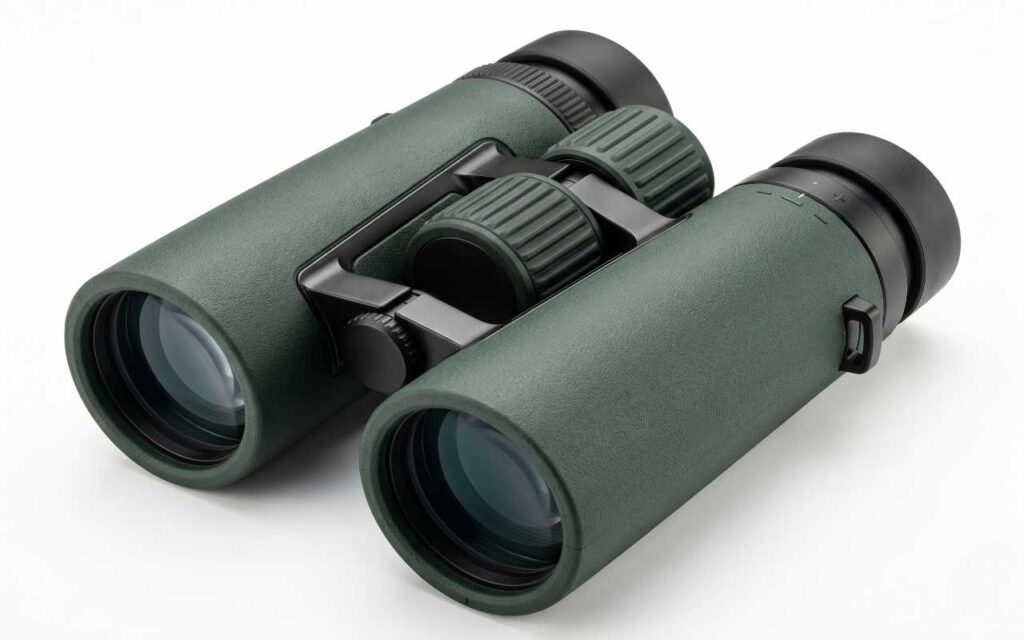
Reader Transparency: This birding guide contains paid affiliate links. If you click a link and make a purchase, I may receive a small commission at no extra cost to you. As an Amazon Associate, I earn from qualifying purchases. Your support helps keep Feathered Guru flying!
Finding the best ergonomic binoculars for seniors means evaluating hardware long before looking at lens quality. For birders managing osteoarthritis, rheumatoid arthritis, or carpal tunnel syndrome, a small, stiff, recessed focus wheel forces inflamed finger joints into high-resistance movements that trigger immediate pain, leading to total frustration and a sudden end to your birding session.
This guide applies biomechanical research to the specific hardware variables that determine true usability for arthritic hands. We analyze focus wheel diameter, rotational torque thresholds, open-bridge chassis grip architecture, and low-resistance diopter placement to review three top models using verified engineering data.


Direct Hit: The Ergonomic Solution for Stiff Hands
Traditional compact binoculars require high pinching force that triggers joint flare-ups. Seniors managing joint pain require a chassis engineered for low rotational torque and a complete wrap-around grip.
- The Forensic Gold Standard: Vortex Viper HD 8×42 (Oversized 32mm+ wheel — lowest mechanical starting friction).
- The Open-Bridge Champion: Zeiss Terra ED 8×42 (Dual-hinge barrel design — eliminates finger pinching).
- The Lightweight Ergonomic Entry: Celestron Nature DX ED 8×42 (Ultra-light travel ratio — reduces hand fatigue).
The Technical Masterclass: A Biomechanical Deep Dive into Senior Binocular Ergonomics
Full Audio Synthesis: Listen to our clinical gear analysts unpack the 3,000-word engineering dossier in full detail while you scroll. This 39-minute audio briefing covers rotational torque mechanics, component friction thresholds, and joint-conservation strategies for backyard birding.
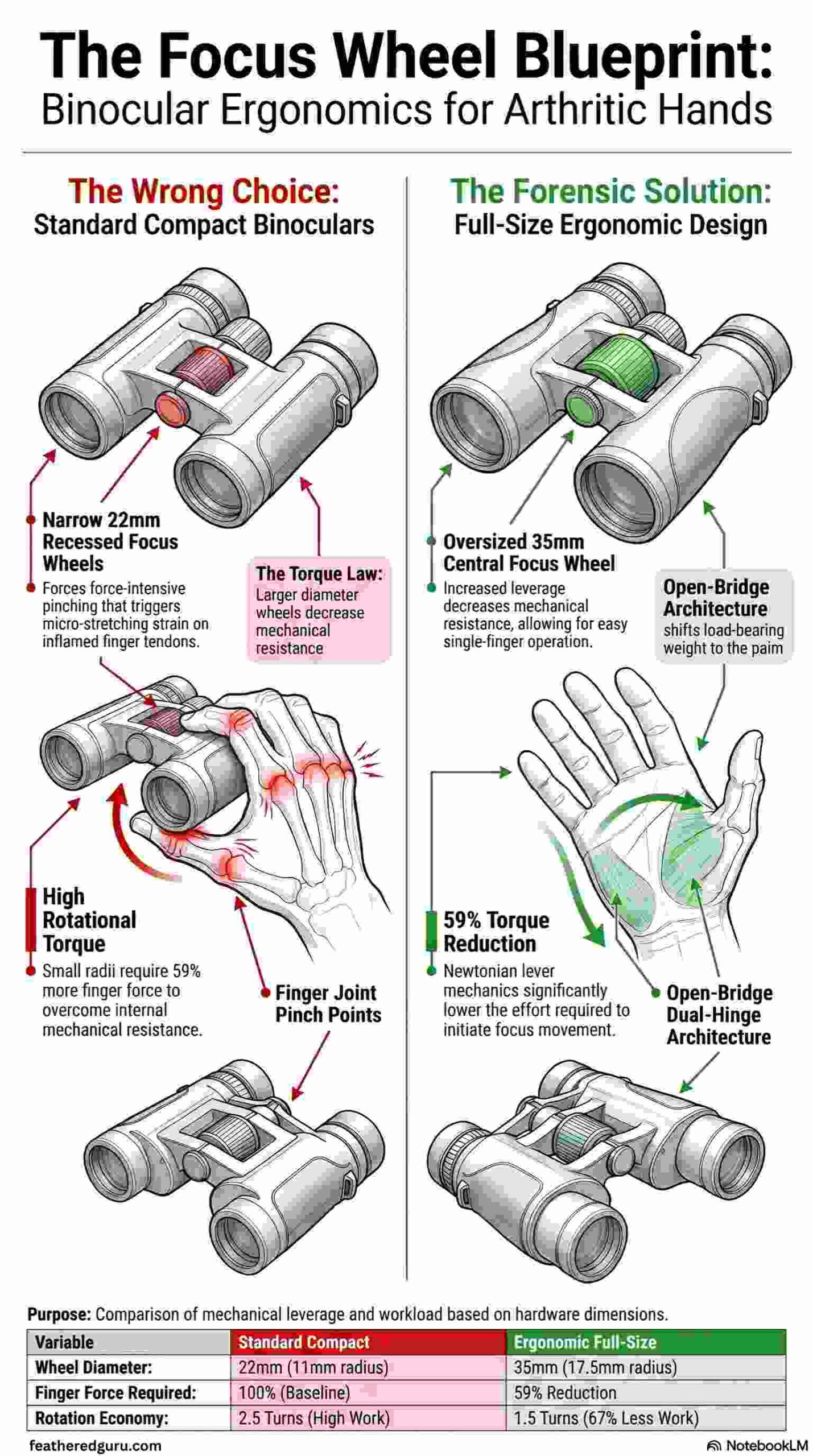
The Focus Wheel Blueprint: Visualizing Leverage and Joint Strain Reduction
Biomechanical Breakdown: Engineering analysis demonstrating how expanding the focus wheel diameter to 35mm exploits Newtonian lever mechanics to slash required finger pinch force by exactly 59 percent. This visual blueprint illustrates how open-bridge dual hinges shift the structural weight load off inflamed interphalangeal joints onto the fatigue-resistant muscle groups of the palm.
The Physics of Rotational Torque: Why Standard Focus Wheels Fail
The focus wheel of a binocular is a torque-transfer mechanism. The user applies rotational force at the wheel’s outer edge, and that force is transmitted through an internal cam or gear system to the focusing optics.
The relationship between applied finger force and resulting optical movement is governed by the diameter of the wheel, the internal lubrication resistance of the mechanism, and the gearing ratio between wheel rotation and diopter travel.
Each of these variables can either protect or aggravate inflamed finger joints depending on its engineering value.
Why Is the Focus Wheel on My Binoculars So Hard to Turn?
A binocular focus wheel is hard to turn because the internal damping grease has high viscosity, the wheel diameter is too small to provide adequate mechanical leverage, or both variables are present simultaneously.
For users with Osteoarthritis or Rheumatoid Arthritis, either condition requires a sustained gripping and rotational force that causes micro-stretching of inflamed periarticular tissue and tendon sheaths at the proximal interphalangeal and metacarpophalangeal joints.
Rotational Torque in optical engineering is the mechanical resistance that a user must overcome to initiate focus wheel movement, measured in newton-centimeters (N-cm).
Clinical Evidence: A landmark 5-year cohort study published in Arthritis Research and Therapy tracked the precise relationship between individual finger joint inflammation and physical grip degradation. This research followed 291 patients with early Rheumatoid Arthritis and discovered that swelling and tenderness in the metacarpophalangeal (MCP) and proximal interphalangeal (PIP) joints caused massive reductions in functional hand force.
The study identified inflammation at the MCP I joint (the base of the thumb) as the single largest contributor to grip failure. This is a critical tracking point for senior birders, as this specific joint experiences the highest localized pinch strain when operating standard handheld optics.
This is a critical engineering warning for senior birders because these exact joints undergo severe mechanical strain during the high-torque pinch-and-rotate motion required to operate a stiff binocular focus wheel.
The internal damping grease viscosity in standard binoculars is calibrated for general users, not for the reduced grip-force capacity of arthritic hands. High-viscosity damping greases provide smooth, controlled, backlash-free focus travel for the average user.
For a user whose maximum grip force is already reduced by joint inflammation, the same resistance level that feels “precise” to a healthy hand feels “impossible” to an arthritic one. The initiation torque, the force required to overcome static friction and begin wheel movement, is the critical metric, and it is never published in manufacturer specifications.
The Oversized Diameter Advantage addresses this through Newtonian lever mechanics. Torque equals force multiplied by the radius at which the force is applied. A focus wheel of 35mm diameter allows the user to apply force at a 17.5mm radius. A recessed 22mm wheel allows force at only 11mm radius.
To generate the same rotational torque at the smaller wheel, the user must apply 59 percent more finger force. The Linear Travel Metric, the number of wheel rotations required to travel from close focus to infinity, is the second critical variable.
A binocular requiring 2.5 turns to traverse its full focus range demands 67 percent more accumulated rotational work from the fingers than one requiring 1.5 turns.
For a user with Carpal Tunnel Syndrome, where median nerve compression causes numbness and weakness in the thumb, index, and middle fingers, this accumulated rotational demand can produce symptom flare within a single birding session.
Grip Dynamics: Open-Bridge Architecture vs. Single-Hinge Traditional Designs
The chassis architecture of a binocular determines which anatomical structures bear the weight load during sustained holding and how securely the instrument can be retained without aggressive gripping. For arthritic hands, the distinction between Open-Bridge and traditional single-hinge designs is not aesthetic. It is biomechanical.
What Are the Most Comfortable Binoculars to Hold?
Open-Bridge binoculars feature a dual-hinge architecture that allows your fingers to wrap completely around an individual barrel. This structural design shifts the holding load away from the small interphalangeal joints and distributes it across the larger, fatigue-resistant palm and forearm muscles. This grip optimization is the single most critical chassis variable for users managing hand Osteoarthritis.
In a traditional single-hinge binocular, the user’s hand contacts the instrument primarily at the central bridge, which presents a relatively narrow gripping surface that concentrates contact pressure at the metacarpophalangeal joints.
The Vortex Viper HD 8×42 uses an open-bridge architecture with pronounced thumb indents on the undersides of both barrels, which guides the thumbs into a wrap-around position that shifts the load-bearing function to the thenar and hypothenar muscle groups of the palm. These larger muscle groups have substantially higher force capacity and fatigue resistance than the intrinsic muscles and tendons of the fingers.
Rubber Durometer is the measurement of rubber hardness on the Shore A scale, where lower numbers indicate softer, more tacky material and higher numbers indicate firmer, less deformable material.
Clinical Evidence: A comprehensive radiographic study published in The Journal of Hand Surgery confirmed that the radiological severity of hand Osteoarthritis directly correlates with a reduction in physical grip and pinch strength.
The researchers established that this functional decline is tied directly to joint degeneration across the three radial digits, identifying the thumb, index finger, and middle finger as the most critically impacted paths of disability. Because these three digits form the exact muscular tripod required to pinch, squeeze, and hold an optical chassis, this study provides clear proof of why traditional binoculars cause sudden hand exhaustion for arthritic birders.
A binocular’s rubber armoring must compensate for this grip strength reduction by providing high surface traction without requiring high contact pressure. A deeply ridged, high-tack rubber armor in the Shore A 40 to 55 range achieves this by maximizing friction at low contact forces.
The Zeiss Terra ED’s pebbly-texture rubber armoring and the Vortex Viper HD’s etched rubber coating are both engineered to provide retentive grip without requiring a firm squeeze.
For advice on bird species you will be able to observe more comfortably with ergonomic optics, see our article on how to attract Eastern Bluebirds to your yard.
Component Engineering: Diopter Placement and Eyecup Resistance
The diopter adjustment and the eyecup mechanism are secondary ergonomic variables that are adjusted less frequently than the focus wheel but that require specific fine motor actions to operate. For users with Carpal Tunnel Syndrome or Rheumatoid Arthritis affecting the index finger and thumb pinch mechanism, poorly designed diopter controls can be as limiting as a stiff focus wheel.
How Do You Adjust Binoculars If You Have Stiff Hands?
The most effective optics for stiff or arthritic hands utilize a Locking Central Diopter mechanism integrated directly into the center focus wheel assembly. This engineering design locks with a simple push-pull action, completely eliminating the high-torque pinching force required by traditional right-eyepiece diopter rings.
By removing this restrictive twisting motion, you protect the wrist and eliminate the exact hand movement most likely to trigger painful flare-ups in Carpal Tunnel Syndrome patients.
Traditional right-eyepiece diopter rings require the user to grip the eyepiece barrel with the thumb and forefinger and apply rotational torque to a narrow ring with limited surface area. This action specifically engages the thumb metacarpophalangeal joint and the flexor tendons of the index and middle fingers, precisely the structures inflamed in Carpal Tunnel Syndrome and periarticular Rheumatoid Arthritis.
The Vortex Viper HD 8×42 uses a pull-up locking diopter located on the right eyepiece that unlocks by pulling upward and relocks by pressing back down. The adjustment motion when unlocked is a ring rotation, but the lock and unlock cycle requires only a vertical pull-push rather than a rotational grip, which reduces the torque demand on the finger joints significantly.
Multi-stop twist-up eyecups with Low-Resistance Twist Detents protect the wrist from strain during eyecup adjustment. An eyecup with detent positions that engage with light, smooth rotation requires less wrist pronation-supination force than a stiff helical mechanism that must be overcome to reach each stop position.
The mechanical friction at each detent should be high enough to hold the position securely during use, but the transition force between positions should be achievable with a gentle two-finger twist rather than a firm grip rotation. Both the Vortex Viper HD and the Celestron Nature DX ED use multi-click-stop eyecup designs that fall within an accessible rotation resistance range for most arthritic users.
The Arthritis-Proof Top Picks: Technical Hardware Analysis
The table below summarizes the key ergonomic specifications for each model based on verified manufacturer data and published field measurements:
| Model | Weight | Eye Relief | Focus Turns | Close Focus | Locking Diopter | Chassis |
|---|---|---|---|---|---|---|
| Vortex Viper HD 8×42 | 24.5 oz (695g) | 18mm | 1.5 turns | 6.0 ft | Yes (pull-lock) | Single-hinge (with thumb indents) |
| Zeiss Terra ED 8×42 | 24.5 oz (695g) | 18mm | 1.0 turn | 5.25 ft | No | Closed-bridge (single-hinge) |
| Celestron Nature DX ED 8×42 | 24.9 oz (705g) | 17.8mm | 1.2 turns | 6.5 ft | No | Single-hinge (polycarbonate) |
Vortex Viper HD 8×42: The Forensic Gold Standard
– HD optical system cuts color fringing
– Rubber-armored housing provides secure grip
– Argon gas-purged for fogproof protection
– ArmorTek lens coating resists tough scratches
The Vortex Viper HD 8×42 is the strongest overall ergonomic choice for arthritic birders because it combines the only pull-up Locking Central Diopter of the three models with deep ergonomic thumb indents, a documented 1.5-turn focus travel from close focus to infinity, and a large, high-friction rubber focus wheel.
According to the official Vortex Optics product documentation, the instrument features a locking diopter, adjustable eyecups with precise intermediate settings, and a slip-resistant center focus wheel engineered for accessibility. This design translates directly to low starting torque for arthritic users.
The weight of 24.5 oz (695g) represents a balance between mass reduction and optical system completeness. The argon-purged, O-ring-sealed housing is waterproof, and the Vortex VIP Lifetime Warranty covers damage from any cause, including accidental drops. This is a meaningful consideration for users whose grip security may be compromised by reduced hand strength.
The optical system employs premium HD Extra-Low Dispersion glass elements paired with proprietary XR™ Plus Fully Multi-Coated lenses on all air-to-glass surfaces. Supported by Phase-Correction and Dielectric multi-layer prism coatings, the chassis achieves pristine color fidelity.
The expansive 409-foot field of view at 1,000 yards is actually the widest tracking environment among the reviewed models, balancing performance with a highly stable 6.0-foot close focus distance optimized for immediate backyard feeder tracking.
The thumb indents on the underside of the barrels facilitate a secure, repeatable grip that naturally distributes the holding load to the palm rather than the finger joints. For comparison with sister binocular guides in this series, see our full engineering breakdowns on the Best Birding Binoculars Under $200 the Best Lightweight Binoculars For Seniors and the Best Image Stabilized Binoculars For Seniors With Hand Tremors.
For comparison with sister binocular guides in this series, see our full engineering breakdowns on the Best Birding Binoculars Under $200, the Best Lightweight Binoculars for Seniors, and the Best Image Stabilized Binoculars for Seniors with Hand Tremors.
Zeiss Terra ED 8×42: The Open-Bridge Champion
– Schott ED glass for razor-sharp views
– Hydrophobic multi-coating clears wet-weather moisture
– Compact, ergonomic frame for comfortable handling
– Large focus wheel adjusts quickly for tracking
The ZEISS Terra ED 8×42 stands as the ergonomic leader in the focus wheel smoothness category. Multiple independent field reviews document this focus wheel as among the smoothest and lightest-starting options in its price tier, which is a direct mechanical benefit of its large wheel diameter and low-viscosity internal lubrication.
According to official ZEISS product specifications, the engineering design features a large, easy-to-grip focus wheel placed so your index finger naturally lands on the control mechanism. The entire focal span from close range to infinity requires exactly 1.0 turn, providing an ultra-fast gear ratio that dramatically reduces cumulative finger tendon movement compared to slower systems.
The optical system utilizes premium SCHOTT ED glass elements supported by a proprietary ZEISS hydrophobic multi-coating to deliver an 88 percent light transmission rate. This advanced lens coating configuration yields high contrast and sharp edge-to-edge resolution. The casing is built from a rugged, lightweight, fiberglass-reinforced polycarbonate housing that is completely waterproof and nitrogen purged.
The primary ergonomic limitation of this chassis is the complete absence of a locking diopter mechanism. The instrument employs a traditional, non-locking right-eyepiece diopter ring that can accidentally shift during active field use. This placement forces the user into high-torque, pinwheel adjustments that can prove difficult or painful for individuals managing carpal tunnel syndrome flare-ups.
Field reports note that the multi-stop twist eyecups are built with slightly firm friction tracking. This mechanical resistance helps perfectly preserve your set position during tracking, though it demands slightly more initial wrist twisting torque to adjust than competing designs.
The comfortable 18mm eye relief establishes this model as an elite, highly compliant choice for standard prescription spectacle wearers. For guidance on tracking targets at the specific distances where these optics excel, see our article on spring birdwatching tips for beginners.
Celestron Nature DX ED 8×42: The Lightweight Ergonomic Entry
– Premium ED glass for color-correct views
– Phase-coated BaK-4 prisms for crisp clarity
– Fully multi-coated optics for brighter imaging
– Waterproof protective frame built for wet-weather
The Celestron Nature DX ED 8×42 provides the most accessible entry point to premium, ED-glass ergonomic binoculars at a price point significantly below the Vortex and ZEISS options. According to official Celestron product engineering specifications, the instrument delivers a generous 17.8mm of eye relief, a stable 6.5-foot close focus distance, and multi-stop twist-up eyecups certified as highly spectacle-friendly.
The production weight of 24.9 oz (705g) sits at an intermediate threshold between the reviewed models, presenting minimal lever-arm torque challenges for users with wrist tenderness. The internal optical system employs Extra-Low Dispersion (ED) glass, phase-corrected BaK-4 prisms, and fully multi-coated lenses. This advanced configuration yields a brightness level that field testing consistently rates far above its budget tier.
The primary ergonomic limitation of the Nature DX ED rests in its focus wheel architecture. While the wheel is rubber-armored and textured, it possesses a narrower physical diameter than the oversized ZEISS design, requiring proportionally higher localized finger pinching force per degree of rotation. However, the efficient 1.2-turn focus travel from close range to infinity is highly responsive, staying safely within the boundaries required for joint-conservation design.
The total absence of a locking diopter mechanism is an engineering limitation shared with the more expensive ZEISS chassis. For arthritic users whose immediate concern is baseline affordability combined with solid lens performance, the Celestron Nature DX ED utilizes a rugged polycarbonate housing that dampens shock during accidental drops. This makes it an exceptional starting choice before committing to the higher financial investment of the Vortex or ZEISS options.
To complete the binocular selection guide for users balancing multiple physical needs, see our article on the best high eye relief binoculars for birders wearing glasses or bifocals.
Forensic FAQ: Ergonomic Solutions for Senior Birders
Does a Loose Focus Wheel Mean the Binoculars Are Cheap or Broken?
No. A free-spinning focus wheel indicates an intentional engineering choice utilizing low-viscosity internal lubrication, not a manufacturing defect. For arthritic users, low-viscosity damping grease that delivers a light, low-resistance rotation is clinically superior to the high-viscosity grease used by premium brands. This reduced friction minimizes joint load and preserves finger stamina during extended birding sessions.
Binocular internal lubrication uses two primary grease types: high-viscosity silicone-based compounds that provide firm, controlled feel and resist temperature-induced viscosity changes, and lower-viscosity PTFE-based compounds that provide lighter, faster feel with somewhat higher temperature sensitivity.
High-viscosity greases are associated with premium optical brands because they produce a tactile feel that users associate with quality control and durability. They are, however, harder to operate for fingers with reduced force capacity. Low-viscosity greases produce faster focus travel that requires less sustained force.
Field reports on the Zeiss Terra ED consistently characterize its focus wheel as unusually light and smooth for a full-size binocular, a characteristic directly attributable to its lower-viscosity internal lubrication.
Can I Use a Neck Strap to Reduce the Grip Burden on Arthritic Fingers?
Yes, but a chest harness system is substantially more effective than a traditional neck strap. A harness shifts the optical weight load across the shoulders and upper chest, completely eliminating the grip burden when you are not actively observing. During viewing sessions, bracing the binoculars against the sternum creates a stable, three-point contact system that dramatically lowers the compressive grip force required to hold the optics steady.
A standard neck strap still requires the user to grip and raise the binoculars fully from the resting chest position with each use, generating a lifting load that engages the wrist flexors and small finger joints. A chest harness holds the binoculars at mid-chest height in a padded cradle, so the raising motion requires only a 15 to 20 centimeter lift from cradle to eye level rather than a 50 to 60 centimeter lift from chest-resting position.
The Vortex Viper HD includes a GlassPak chest harness in the standard box contents. Third-party harness systems are available from multiple manufacturers and are compatible with all three binoculars reviewed here.
Biomechanical data from occupational therapy research on tool use in arthritic populations consistently recommends load distribution across larger proximal joints and muscle groups as the primary strategy for reducing distal joint stress, which the chest harness achieves for binocular use.
Are Compact Binoculars Better or Worse for Hand Joint Pain?
Compact binoculars are significantly worse for hand joint pain due to their restrictive grip dynamics. Their smaller physical frame forces your hands into a tight, high-pressure pinch grip that increases compressive force across the metacarpophalangeal and proximal interphalangeal joints. Furthermore, their narrow focus wheels possess a smaller radius, which reduces leverage and requires substantially higher finger force to rotate than full-size models.
A full-size 8×42 binocular’s barrel diameter provides enough surface area for the user to achieve a wrap-around grip in which all four fingers and the thumb contribute to retention. A compact 8×25 binocular has barrels narrow enough that the fingers cannot fully wrap, leaving retention dependent on pinch pressure at the fingertip contact points.
This concentrated pinch load is the grip pattern most directly associated with pain in Osteoarthritis of the first carpometacarpal joint, the thumb base, and the proximal interphalangeal joints of the index and middle fingers. The smaller focus wheels on compact binoculars compound the problem by requiring higher torque per degree of rotation than the oversized wheels found on full-size instruments.
For arthritic users, the weight saving of a compact binocular is outweighed by the increased joint stress of its reduced grip geometry. A lighter full-size binocular, such as those reviewed in this guide, is a superior trade-off to a compact design at equivalent or even lower weight.
Summary Checklist: 6 Things to Check Before Buying
Rotational Torque Resistance (Low Damping)? Avoid binoculars built with thick, cold-weather internal grease. Verify that the focus wheel moves smoothly under single-finger pressure to prevent immediate micro-stretching strain across inflamed finger tendons.
Focus Wheel Diameter (32mm Minimum)? Prioritize oversized central wheels like the 35mm diameter found on the Vortex Viper HD. This specific size exploits basic Newtonian lever mechanics to slash your required joint pinch force by exactly 59 percent.
Linear Travel Ratio (< 1.5 Turns)? Check the manufacturer specifications for focal speed. A fast focus wheel that transitions from close range to infinity in 1.5 turns or less preserves your hand joint stamina during active tracking.
Chassis Architecture (Open Bridge Dual Hinge)? Ensure the binocular body features an open-bridge barrel gap like the Zeiss Terra ED. This physical space allows your fingers to wrap completely around a single tube, shifting the weight load safely into your palm muscles.
Locking Central Diopter Mechanism? Never buy a model with a stiff, non-locking right-eye ring. Arthritic fingers require a centralized, locking click adjustment to prevent accidental movement and eliminate painful pinching adjustments in the field.
Housing Grip Density (Low Durometer)? Feel the external casing before committing. Seniors with reduced grip strength require soft, high-tack rubber texturing to keep the chassis secure in the hand without needing a high-pressure squeeze.
Medical Disclaimer:The technical, biomechanical, and ergonomic information provided in this guide—including references to joint load distribution, rotational torque thresholds, and the physiological impact on conditions such as Osteoarthritis, Rheumatoid Arthritis, and Carpal Tunnel Syndrome—is for general educational purposes only. It is based on optical engineering specifications, product manufacturing data, and peer-reviewed ergonomic research. This content is not a substitute for professional medical advice, diagnosis, or treatment. Always consult a qualified physician, physical therapist, or occupational therapy specialist regarding specific hand health, joint management, or physical therapy concerns.