
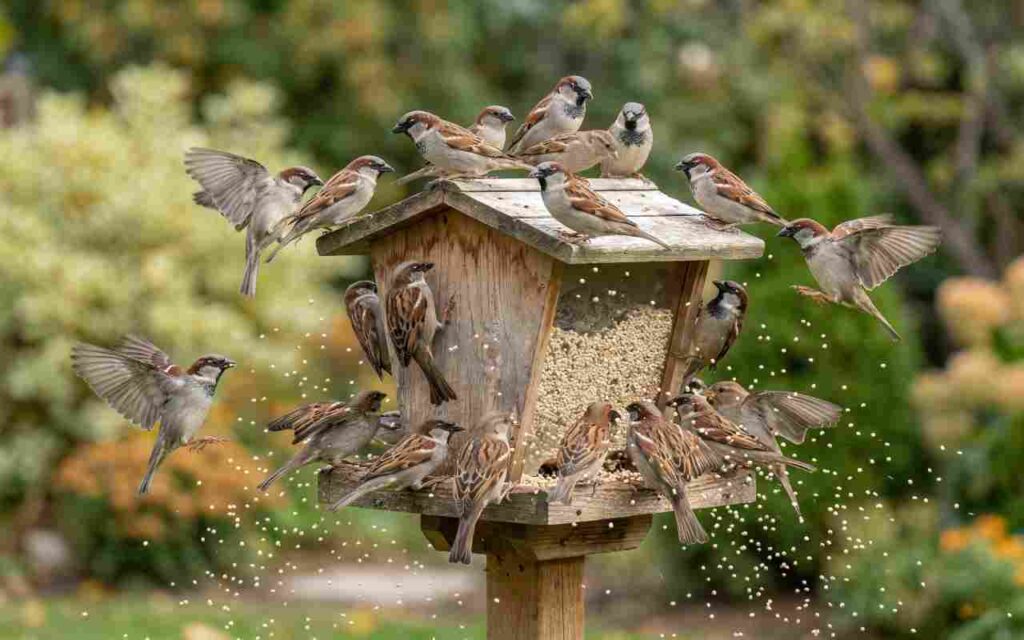
House Sparrows (Passer domesticus) are arguably the most successful wild bird on the planet. Introduced from Europe to Brooklyn in 1851, they spread across the continent within 50 years and now occupy virtually every human-inhabited landscape from coastal cities to high-altitude farm towns. Their colonization story is not a story of brute force. It is a story of diet.
The house sparrow’s beak is the key. Unlike the slender, pointed bills of insect-eating warblers or the curved bills of fruit-eating orioles, the house sparrow’s thick, conical bill evolved for one primary purpose: cracking and processing seeds. It is a generalist bill shaped to exploit the enormous variety of grains, weed seeds, and crop residues that human agriculture produces in virtually unlimited quantities.
Understanding what house sparrows eat, where they find it, how their diet changes across the seasons, and which foods they actually avoid is essential knowledge for any backyard birder. Whether your goal is to support them, redirect them, or understand why they dominate your feeding station, this guide covers the full picture.
Quick Answer: What do House Sparrows eat?
House Sparrows are opportunistic granivores that primarily eat grains and seeds, specifically white proso millet, cracked corn, and sunflower hearts. In the wild, they forage for weed seeds like ragweed and crabgrass but shift to a high protein diet of 90 percent insects including caterpillars and beetles during the breeding season to ensure rapid growth for their nestlings.
The Science of Survival: An Expert Nutritional Deep Dive
If you prefer a visual breakdown of how the House Sparrow’s unique physiology allows it to exploit both backyard feeders and wild landscapes, watch our detailed educational video below. This explainer maps out the metabolic shifts and “Generalist Beak” mechanics that make this species the ultimate opportunistic eater.
Show Transcript:
0:00
So, I had this vision. I put up a beautiful bird feeder in my backyard, imagining bright red cardinals, cheerful finches, and cute little chickadees. But instead, my feeder turned into an all-day takeover by one bird only, the house sparrow.
0:16
Have you ever had this happen? You put out great bird seed, and one species shows up with a huge flock. My peaceful backyard quickly turned into a loud, chaotic sparrow gathering. I had a serious house sparrow problem and needed to figure out why.
0:49
Every day it was the same pattern. From sunrise to sunset, sparrows dominated the feeder, scattering seed and chasing away other birds. It became a complete monopoly at my bird feeder.
1:07
So I decided to solve the mystery by starting with the most obvious factor, the food. What exactly were house sparrows eating that made my feeder so attractive?
1:19
I looked closely at my bird seed mix and noticed it was packed with small, pale seeds. That observation turned into my first big realization. I was serving their favorite food.
1:41
After digging deeper, I found that white proso millet is a top preferred seed for house sparrows. Those tiny pale seeds in my mix were exactly what they were targeting. I was not just feeding them, I was attracting them.
2:02
Research confirmed it. House sparrows seek out millet first and treat it as a primary food source. My feeder had become a millet magnet, drawing in large flocks from the surrounding area.
2:22
Then I learned something even more important. By late winter, up to 90 percent of a house sparrow’s diet can come from feeders. That means my bird feeder was not just a snack. It was a critical winter survival station.
2:40
The more I researched, the more I realized this was not just about my backyard. House sparrows have a long history of living alongside humans and feeding on our resources.
2:55
I came across the term commensal, which describes animals that benefit from living near humans. House sparrows are one of the best examples. They thrive on human environments, from backyard feeders to farms and city streets.
3:15
Once I understood that, I started noticing their behavior everywhere. They feed on crumbs, spilled grain, insects, and scraps. They are highly adaptable birds that take advantage of any available food source.
3:32
Even historical research shows this pattern. Studies found that a large portion of their diet has always come from human-related sources like livestock feed and cereal grains.
3:50
At this point, I thought I understood everything. House sparrows eat seeds and rely on human environments. But then I discovered something that completely changed my perspective.
4:03
The biggest surprise was their diet during breeding season. Adult house sparrows eat seeds, but their nestlings require a high-protein diet made almost entirely of insects.
4:19
For the first few days of life, baby sparrows eat up to 90 percent insects. This forces the parents to shift from seed eating to active hunting for protein-rich prey like caterpillars and beetles.
4:40
This revealed a critical insight. No matter how much seed is available, sparrow populations depend on insect availability to raise their young. Insects are the limiting factor for their growth.
5:04
With this full picture in mind, I realized the solution to my backyard problem was simple. I did not need scare tactics or complicated deterrents. I just needed to change the food.
5:24
Research showed that certain seeds are much less attractive to house sparrows. One of the best options is safflower seed, which has a thick shell and bitter taste that sparrows tend to avoid.
5:37
Another option is niger seed, also called thistle. These tiny seeds are ideal for finches but difficult for house sparrows to eat due to their beak shape.
5:47
So I put a plan into action. First, I removed all millet and cracked corn from my feeder. Second, I replaced it with safflower seed to attract cardinals and finches. Third, I added a separate feeder filled with niger seed to bring in goldfinches.
6:11
This simple change completely shifted the balance at my bird feeders. By adjusting the menu, I changed which birds were attracted to my yard.
6:26
I also started to see seasonal patterns more clearly. In spring and summer, sparrows focus on insects for their young. In fall and winter, they depend heavily on seeds for energy.
6:40
That explained why they were so aggressive at my feeder during colder months. They were relying on it for survival.
6:52
After making these changes, the results were clear. House sparrows no longer dominated the feeder. They still visited occasionally, but they no longer controlled the space.
7:04
My backyard became more balanced, with a wider variety of birds returning. Finches, chickadees, and cardinals were finally able to feed without constant competition.
7:18
What started as frustration turned into a better understanding of bird feeding and backyard bird behavior. House sparrows are not just pests. They are highly adaptable birds that have evolved to live alongside humans.
7:34
In the end, the real question is not how to eliminate them completely. It is how to manage your bird feeders so you can support native birds while limiting dominance by aggressive species.
What Do House Sparrows Eat at Bird Feeders?
What is the Best Bird Seed for House Sparrows?
White proso millet is the single most preferred commercial bird seed for House Sparrows. At a feeder stocked with multiple seed types, they will consistently find and target the millet first due to its small size and high carbohydrate content.
A controlled preference study published in Bird Study (Taylor & Francis) offered free-ranging house sparrows a choice between proso millet and ten species of native prairie forbs and grasses. The sparrows preferred millet over every native seed offered and largely rejected seeds from three of the five forb species tested. The researchers noted that millet’s high carbohydrate content, thin shell, and small size make it exceptionally easy to process in large quantities.
This preference is why millet-heavy mixed seed bags trigger feeder takeovers. The sparrows are not there for the sunflower seeds or the milo. They are there for the millet, and the flock-recruitment behavior that follows a scout’s discovery of a reliable millet source is what fills your feeder with 30 birds before noon.
Cornell Lab of Ornithology’s All About Birds confirms that house sparrows readily eat millet, milo, and sunflower seeds at feeders, with millet consistently topping the preference rankings in field observations across North America.
Do House Sparrows Eat Suet in Winter?
House sparrows have adapted to suet feeders faster than most birders expect. Suet, rendered animal fat often mixed with seeds, peanuts, or corn, provides concentrated calories that become especially valuable when ambient temperatures drop.
The energy demands of a house sparrow rise from approximately 20 kilocalories per day in summer to around 28 kilocalories per day in winter, according to seasonal energetics data compiled in Birds of the World (Cornell Lab). That 40% increase in caloric demand drives sparrows toward high-fat foods.
Standard cage suet feeders, especially those presenting the suet from the bottom, are less attractive to sparrows because they struggle to cling in the inverted position required to feed. Standard cage suet is, however, readily consumed when presented horizontally or at an angle accessible from a perch.
Scraps, Grains, and Commensal Feeding
The term “commensal” describes an organism that benefits from an association with another species without harming it. House sparrows are the textbook commensal bird. They have lived alongside human agriculture for thousands of years and evolved behavioral flexibility to exploit virtually any food source humans produce or discard.
In urban environments, house sparrows scavenge bread crumbs at outdoor cafes, pick insects off car grilles in parking lots, and congregate at fast-food restaurant dumpsters. In rural settings, they feed on livestock grain spilled from troughs, waste seed in animal dung, and crop residue left in harvested fields.
This behavioral breadth is a direct product of their opportunistic diet biology, not a learned urban adaptation but a species-level trait that predates urbanization by millennia.
What Do House Sparrows Eat in the Wild?
What Seeds Do House Sparrows Find in Nature?
Before feeders, house sparrows fed on whatever seeds the landscape provided. A landmark analysis of stomach contents from 4,848 adult house sparrows collected across multiple U.S. states between 1879 and 1925, summarized in Birds of the World, found the diet to consist of approximately 60% livestock feed grains, 18% cereals from fields or storage, 17% weed seeds, and just 4% insects.
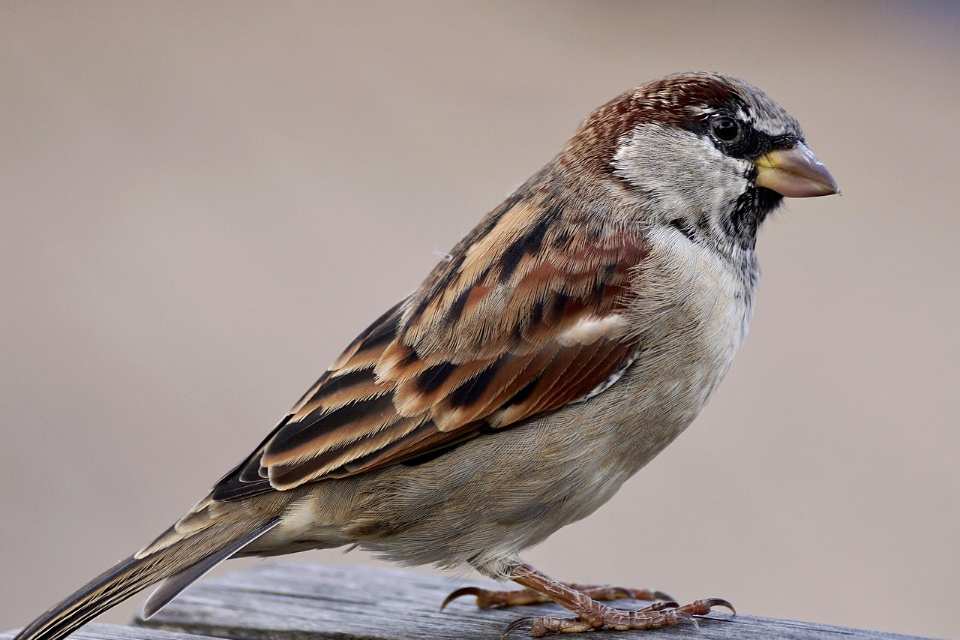
The weed seed component is more diverse than most people realize. Ragweed (Ambrosia), crabgrass (Digitaria), bristlegrass (Setaria), and knotweed (Polygonum) are among the most commonly identified wild seed species in house sparrow stomach analyses. These are precisely the weed species that dominate disturbed ground, roadside edges, and fallow agricultural fields, all of which are core house sparrow habitat.
Urban birds eat more commercial birdseed and weed seed than their rural counterparts, while rural birds eat more waste cereal grain from fields and animal dung.
A paired study by Gavett and Wakeley published in The Condor (Oxford Academic) found that these habitat-driven diet differences were measurable in blood chemistry: urban sparrows showed significantly elevated plasma cholesterol and blood urea nitrogen levels consistent with a higher fat and protein diet, while rural birds had elevated uric acid levels reflecting greater reliance on plant protein from cereal grain.
Both populations, however, maintain the same fundamental preference hierarchy: processed agricultural grain first, then weed seed, then insects.
Agricultural Impact: Crops They Target
House sparrows have been classified as agricultural pests in every country where they have been introduced, and the classification is not arbitrary. Their preference for cultivated cereal grains, including corn, oats, wheat, and sorghum, means they are most abundant in and around the crops they damage.
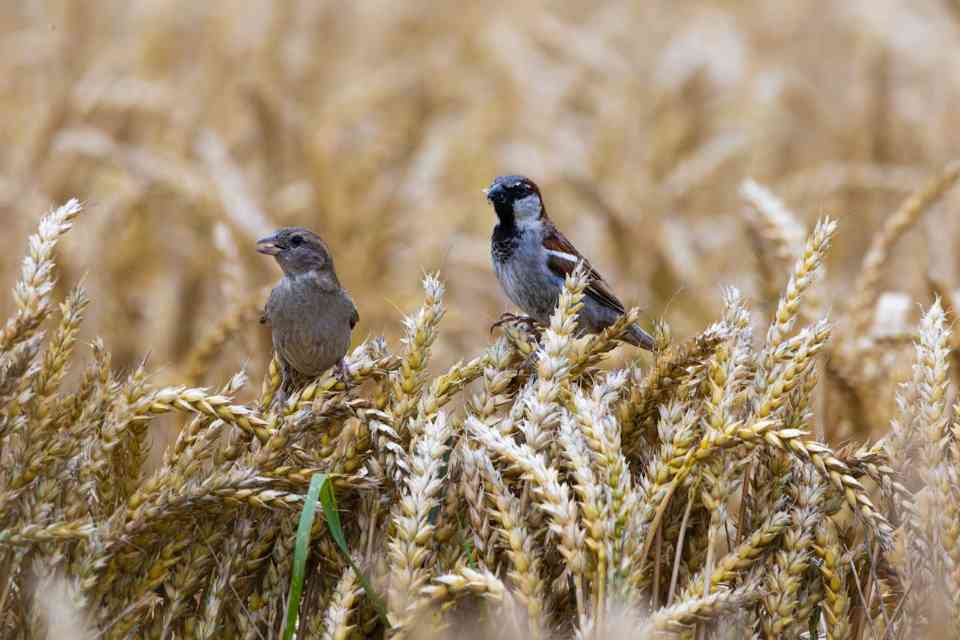
Field studies document that the grain component of the adult house sparrow diet varies seasonally, reaching its peak of approximately 88% in February when weed seeds are scarce and wild invertebrates are unavailable, and its low of approximately 59% in September when both weed seeds and insects are abundant.
The flexibility of this proportion reflects the opportunistic nature of the bird: it will eat whatever maximizes caloric return for foraging effort at any given time of year.
What Do Baby House Sparrows Eat?
How Much Protein Do Baby Sparrows Need?
Baby house sparrows eat a diet consisting almost exclusively of insects and other invertebrates. While adult house sparrows are primarily seed-eaters, this diet undergoes a complete reversal during the nestling period. For the first three days after hatching, parents must provide high-protein prey like beetles, caterpillars, and flies to meet the demands of rapid skeletal and muscular growth.
A controlled study of nestling diet composition published in Bird Study (Taylor & Francis, 2012) analyzed 206 faecal sac samples from 106 nestlings across 31 broods. The nestlings were fed primarily on beetles (mainly Scarabaeidae) and dipteran flies (mainly muscids and tipulids), with the animal component of the diet remaining constant in total mass even as the plant component increased with nestling age. The study concluded that animal protein, particularly arthropods, is directly linked to nestling body condition and breeding success.
Grasshoppers and crickets are among the most important nestling foods in agricultural areas. Caterpillars, aphids, weevils, and ants are also frequently delivered. Parents make 15 to 20 feeding visits per hour during peak nestling growth, and the total insect load delivered over a 14-day nestling period can reach several thousand individual prey items per brood.
Urban Protein: Finding Insects in the City
Urban house sparrows face a different protein-sourcing challenge than their rural counterparts. Dense pavement, managed lawns, and ornamental plantings support far fewer grasshoppers and beetles than agricultural fields.
Urban breeding pairs have documented adaptations to this constraint. They forage for aphids on ornamental roses and garden plants, glean insects from car grilles and windowsills, follow lawn mowers to catch disturbed moths and fly larvae, and have been observed working rough bark of mature trees for overwintering insects.
At night, they take insects attracted to streetlights and building illumination, a behavior documented in the ornithological literature but unfamiliar to most backyard observers. This behavioral flexibility is part of what allows urban populations to sustain breeding success despite reduced natural insect availability.
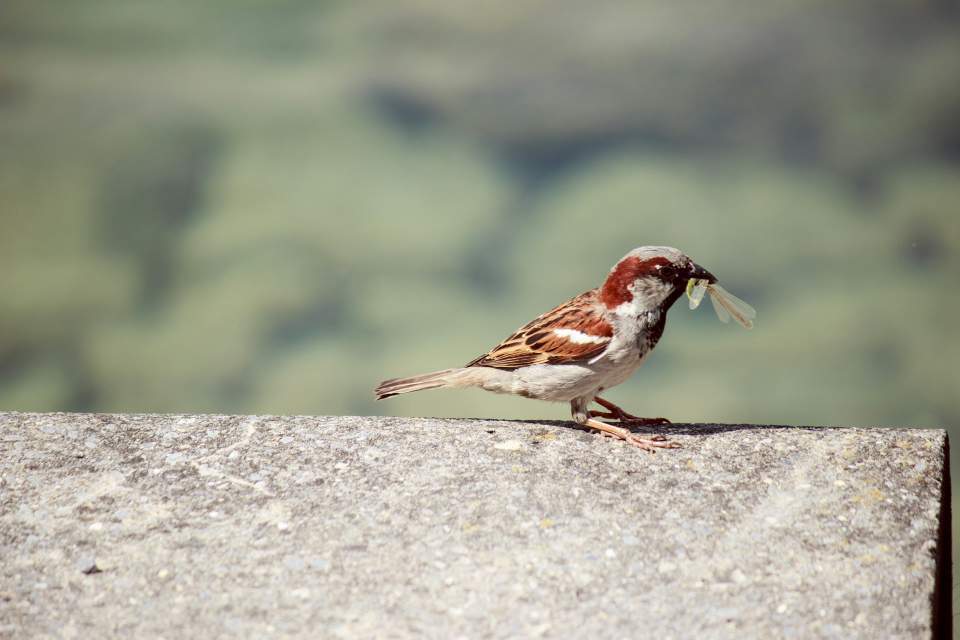
The decline of insect populations in many suburban environments is considered one of the leading causes of house sparrow population decline in Europe and parts of the eastern United States. Where breeding adults cannot find sufficient invertebrate prey to provision nestlings adequately, breeding productivity drops even when adult seed food is abundant.
This relationship was confirmed experimentally by Peach, Sheehan, and Kirby in a garden-based field trial published in Bird Study (Taylor & Francis, 2014): providing supplementary mealworms to urban nesting pairs increased clutch size and chick survival, boosting overall fledgling production by 55%. The study confirmed that it is specifically the invertebrate supply during the nestling window, not the adult seed supply, that limits reproductive output in suburban populations.
What Do House Sparrows Eat in the Winter?
In the winter, House Sparrows eat a diet consisting of nearly 90 percent grains and commercial bird seeds as wild insects and weed seeds become unavailable.
The house sparrow’s annual diet cycle is driven by the same environmental pressures that shape every temperate-zone granivore: the availability of insects collapses in autumn, weed seed reaches peak abundance in late summer before declining through winter, and the caloric cost of thermoregulation rises sharply as temperatures fall.
By October, insects have largely disappeared from the sparrow’s diet. Weed seeds, which peaked at 41% of the diet in October according to the Birds of the World seasonal breakdown, begin declining as standing seed heads are consumed or buried by snow. By February, grain and commercial feed represent nearly 90% of the adult diet.
This is the period when house sparrows hit backyard feeders hardest. A flock that visited your station occasionally in summer is now dependent on it as a primary food source. They also seek out livestock barns, grain storage facilities, and heated human structures during extreme cold, which is why house sparrows are found nesting in building eaves and vents year-round. The nest cavity is not just a breeding site; it is also a thermal refuge that reduces overnight energy expenditure.
High-fat foods, including black oil sunflower, suet-based mixes, and peanut products, are what winter sparrows most benefit from energetically. Their caloric efficiency per gram of food consumed is highest with fat-dense items, which is why sparrows will displace chickadees and nuthatches from suet feeders during cold snaps even though their clinging ability is weaker.
What Seeds Do House Sparrows Dislike?
Do House Sparrows Eat Safflower Seeds?
Safflower (Carthamus tinctorius) is the most reliably unattractive feeder seed for house sparrows under most conditions. Its thick white shell requires more cracking effort than millet or cracked corn, and its flesh contains compounds with a slightly bitter flavor that most sparrows initially reject.
The rejection is not absolute. In areas with large, established sparrow populations and limited alternative food sources, local birds sometimes learn to accept safflower over time. This regional variation means safflower works best as a component of a multi-layer deterrence strategy rather than as a standalone solution.
Cardinals, house finches, chickadees, and titmice all accept safflower readily, making it an effective selective tool for feeders in areas with moderate sparrow pressure.
Why Can’t House Sparrows Eat Nyjer Seed?
Nyjer seed (Guizotia abyssinica), also marketed as thistle or nyger, is tiny, needle-like, and highly oil-rich. American Goldfinches, Pine Siskins, and other small-billed finches can extract it efficiently from feeders with narrow mesh openings or small ports.
House sparrows have considerably wider bills than goldfinches and cannot manipulate nyjer efficiently through the small openings in dedicated finch feeders. The mechanical exclusion is the key, not a flavor preference.
House sparrows are generally indifferent to nyjer itself, but the beak-to-port geometry of a proper nyjer feeder keeps them off with near-100% effectiveness. For feeder managers dealing with persistent sparrow pressure, a nyjer feeder loaded with nyjer seed provides a dedicated goldfinch feeding station with essentially no sparrow competition.
For a full strategy using these dietary dislikes as part of a comprehensive feeder defense system, our guide to how to deter house sparrows from feeders covers seed selection, mechanical exclusion, and the spatial management that makes the difference between temporary relief and lasting results.
Seeds Ranked by House Sparrow Preference
| Seed Type | Sparrow Preference | Shell Difficulty | Target Species Also Attracted |
|---|---|---|---|
| White Proso Millet | Very High ★★★★★ | Very Easy | Doves, juncos, native sparrows |
| Cracked Corn | Very High ★★★★★ | Very Easy | Jays, doves, waterfowl |
| Black Oil Sunflower | High ★★★★ | Easy | Cardinals, chickadees, finches, nuthatches |
| Bread / Scraps | High ★★★★ | None | Pigeons, starlings, crows |
| Milo / Sorghum | Moderate ★★★ | Easy | Doves, towhees |
| Striped Sunflower | Low ★★ | Hard | Cardinals, jays, larger finches |
| Safflower | Low ★★ | Hard + Bitter | Cardinals, house finches, chickadees, titmice |
| Nyjer (Thistle) | Very Low ★ | Beak-size barrier | Goldfinches, siskins, redpolls |
| Peanuts in Shell | Very Low ★ | Very Hard | Jays, woodpeckers, nuthatches |
The House Sparrow Nutritional Life Cycle
The dietary shift from nestling to adult in the house sparrow is one of the most dramatic food transitions in North American bird biology. Understanding it as a continuous arc, rather than two separate phases, reveals why the bird is so successful across environments of vastly different insect and seed availability.
Days 1 to 3 (Nestling): Almost entirely invertebrate. Beetles, fly larvae, grasshoppers, caterpillars, and aphids delivered by both parents. Protein forms approximately 90% of caloric intake. The gut microbiome is dominated by bacteria adapted to protein digestion.
Days 4 to 15 (Late Nestling): Gradual introduction of plant material as the gizzard matures and the gut microbiome shifts. By day 15, seeds represent the majority of the diet, though insect delivery continues at lower rates. Fledging typically occurs at day 14 to 17.
Spring and Summer (Breeding Adult): Seeds form the bulk of the adult diet, but insect consumption rises to approximately 10% of total intake by June. Both males and females actively hunt arthropods during this window. The insect supply directly determines breeding productivity: pairs in insect-poor environments have lower fledgling success than those in insect-rich habitats.
Autumn (Pre-Winter Adult): Weed seed consumption peaks as standing weed patches dry and ripen. Insect intake declines rapidly after September. The bird is building fat reserves for the metabolic demands of winter.
Winter (Adult): Grain and commercial feed dominate at up to 88% of the diet. High-fat foods like suet supplement carbohydrate grain intake. Energy expenditure rises and the bird is dependent on reliable food sources at fixed locations, which is precisely why winter is the period of highest feeder pressure.
Understanding the Opportunistic Eater
The house sparrow’s dietary breadth is not a weakness or a sign of poor nutritional discrimination. It is the mechanism of its global success. A bird that can survive on livestock grain in Iowa, weed seeds in Patagonia, restaurant scraps in Tokyo, and commercial birdseed in suburban Montreal has unlocked a dietary niche that no predator pressure, no habitat change, and no human management has yet been able to close.
For backyard birders, this creates a practical challenge: the same flexibility that makes house sparrows ecologically fascinating makes them feeder management problems. They will learn new food sources, adapt to new feeder designs, and recruit others to productive sites faster than almost any other species.
The best approach to managing house sparrows at feeders is not to treat them as an enemy but to understand their food preferences precisely enough to design a feeding station that serves your target species without offering the specific food signals that trigger sparrow flock formation.
Our guide to how to keep house sparrows away from feeders translates this diet biology into practical feeder management, and our article on house sparrow habits covers the full behavioral ecology behind their territorial and social behavior at the feeding station.
For a closer look at how age affects both appearance and diet in this species, our guide on juvenile vs adult house sparrow identification covers the plumage and behavioral differences between first-year and mature birds.
And if you want to know which feeder birds are most commonly displaced by sparrow pressure, our guide to preventing finches from being bullied at feeders covers species-specific solutions for your most vulnerable backyard visitors.
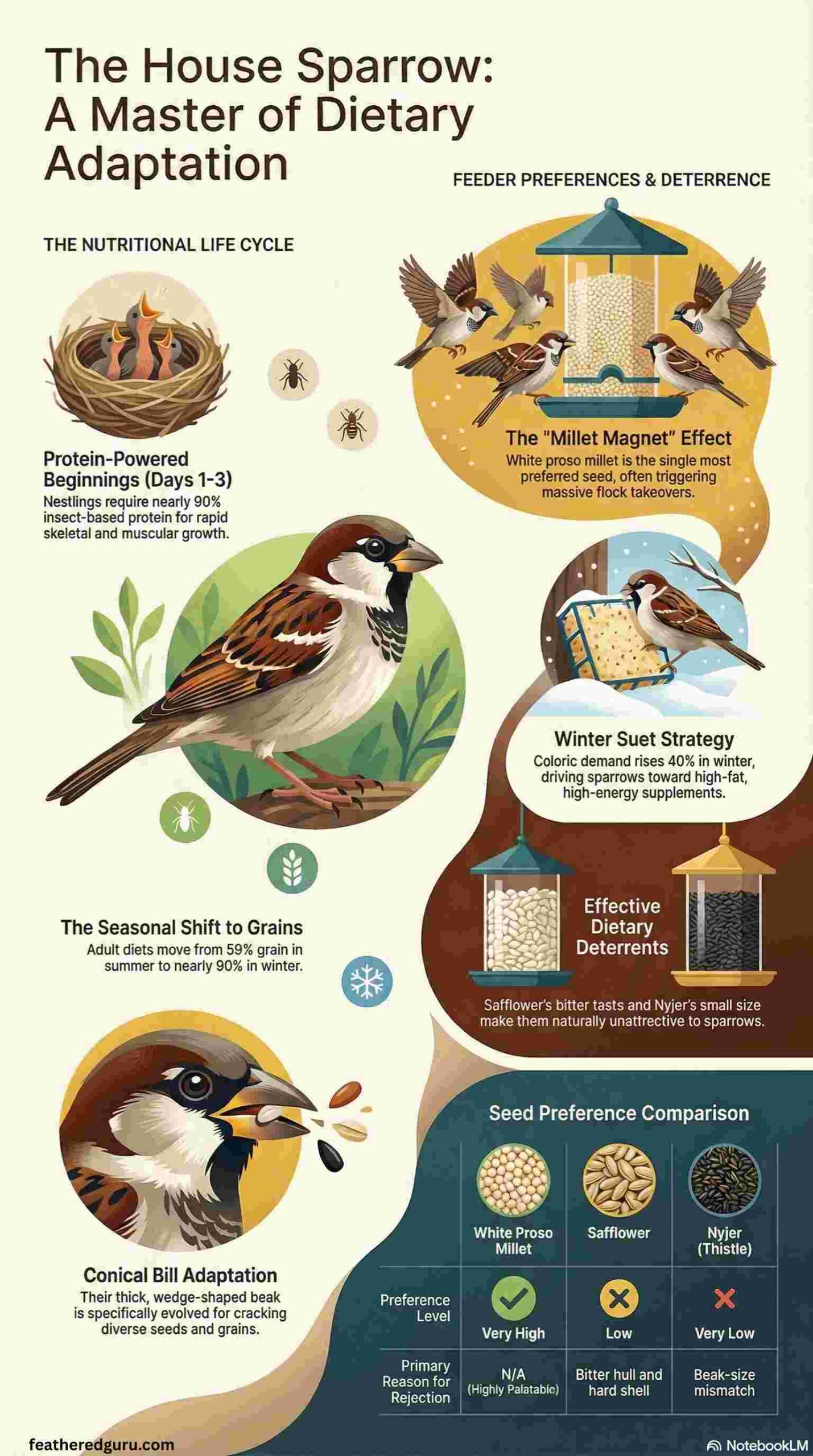
The Foraging Roadmap: A Seasonal Nutritional Lifecycle
For a visual synthesis of the dramatic dietary shifts covered in this guide, from the high-protein demands of nestlings to the starch-heavy survival strategy of wintering adults, refer to our interactive infographic below. This roadmap maps out the exact metabolic requirements and food preferences of the House Sparrow across every stage of its annual cycle.
Frequently Asked Questions About House Sparrow Diet
Do house sparrows eat bread?
House sparrows will scavenge bread and kitchen scraps, but these items lack the essential protein and minerals found in their natural diet of seeds and insects.
Will house sparrows eat from the ground?
Yes, house sparrows are primarily ground-foragers. While they will visit raised feeders, they are most comfortable pecking for spilled seeds and grains on the surface of the ground.
What is the best way to stop house sparrows from eating all the bird seed?
The most effective way is to switch to safflower seed or Nyjer seed. House sparrows find the bitter taste of safflower unattractive and are physically unable to eat tiny Nyjer seeds from finch feeders.
Do house sparrows eat sunflower seeds in the shell?
Yes, house sparrows can crack the shells of black oil sunflower seeds, but they much prefer sunflower hearts and chips because they are easier and faster to consume.
Conclusion: Understanding the Opportunistic Eater
The global success of the House Sparrow is not a product of luck; it is a direct result of their dietary flexibility. From scavenging urban car grilles for protein to exploiting the high-carbohydrate “Millet Magnet” at backyard feeders, they have mastered every human-inhabited landscape on Earth. As we have seen, their nutritional needs are a shifting arc—moving from a nearly 90% insect diet as nestlings to an 88% grain dependency during the metabolic stresses of winter.
For the backyard birder, understanding this diet biology is the key to a peaceful sanctuary. By recognizing their intense preference for white proso millet and their mechanical inability to process nyjer seed, you can design a feeding station that serves your target species without triggering a sparrow flock takeover. The House Sparrow is an evolutionary master of the “human niche,” and only by understanding what they eat can we decide how much of our own backyard we are willing to share.