

Reader Transparency: This birding guide contains paid affiliate links. If you click a link and make a purchase, I may receive a small commission at no extra cost to you. As an Amazon Associate, I earn from qualifying purchases. Your support helps keep Feathered Guru flying!
Finding the best binoculars for glasses wearers 2026 requires a technical understanding of a metric called eye relief. For seniors who bird with spectacles, this specification determines whether you see a full panoramic view or a restricted image surrounded by black rings.
The physical gap between your eye and the binocular lens is called vertex distance. When this distance is too short, your glasses act as a barrier that prevents your eye from reaching the focal point. This creates the “keyhole effect” which is a common frustration for birders with high prescriptions or thick bifocal lenses.
Our research identifies 17.5mm as the clinical minimum for most spectacle users. In this dossier, we evaluate the top high eye relief binoculars for birding by analyzing how optical geometry and twist-up eyecups accommodate multi-focal prescriptions. By prioritizing these benchmarks, you can eliminate vignetting and reclaim a sharp field of view.


Direct Hit: The Eye Relief Solution for Glasses
Spectacle lenses create a physical “vertex distance” that displaces the eye from the optic. To prevent vignetting (black rings), seniors require a specific Eye Relief threshold based on their prescription type.
- The Gold Standard: Nikon Monarch M5 8×42 (19.5mm relief — Best for thick bifocals).
- The Premium View: Zeiss Victory SF 8×42 (18mm relief — Widest field for spectacle wearers).
- The Value Entry: Vortex Diamondback HD 8×32 (16mm relief — Clinical minimum for single-vision).
The 54-Minute Masterclass: A Technical Deep Dive into Senior Optical Physiology
(Full Audio Synthesis: Listen to our 53-minute video masterclass as we unpack the 3,400-word research dossier in detail while you scroll.)
The Senior Optics Blueprint: A Visual Analysis of Eye Relief and Vignetting
(Full Infographic Synthesis: Review the technical breakdown of spectacle lens physics, vertex distance equations, and optical thresholds while you scroll.)
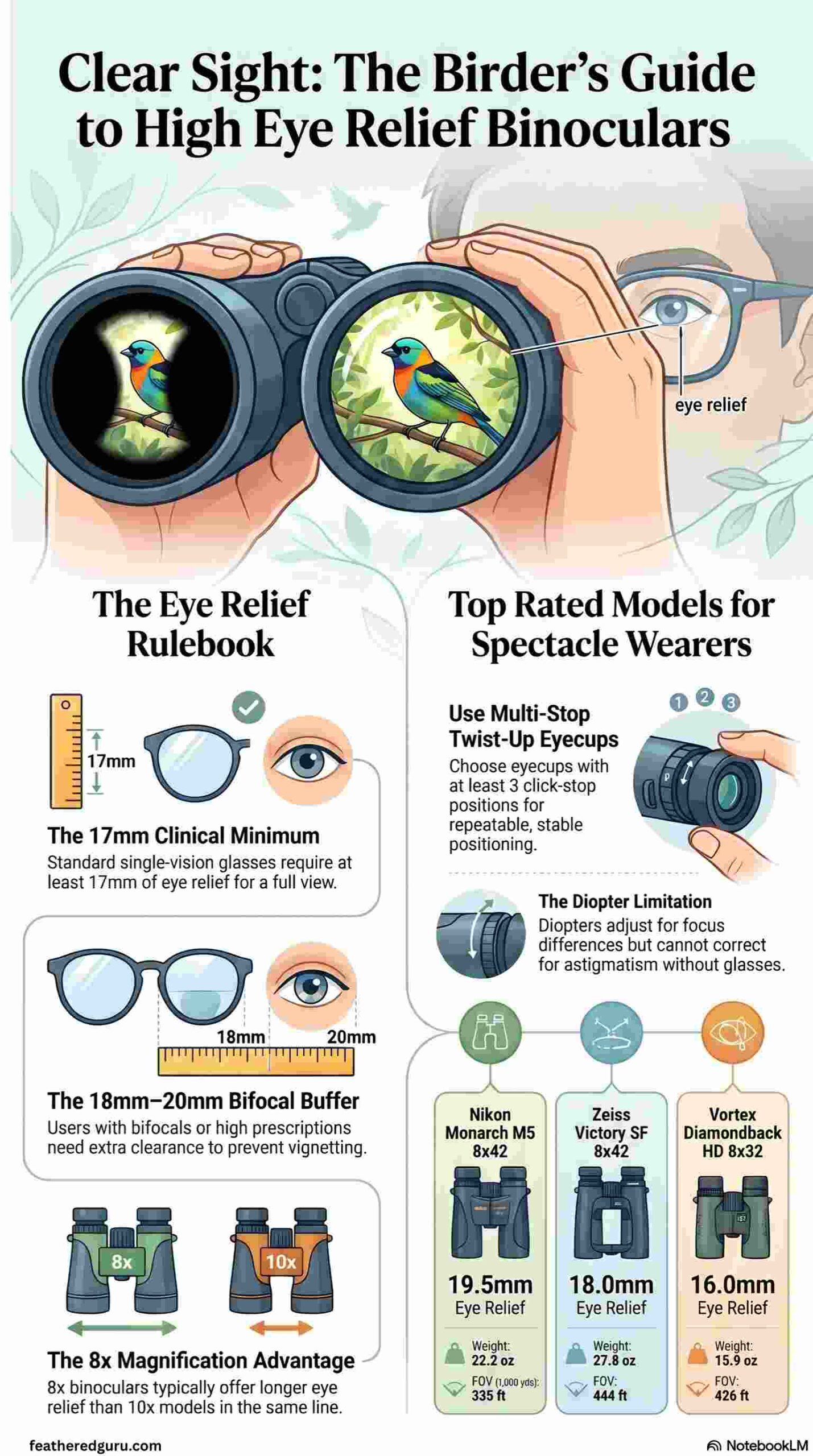
Why Do I See Black Circles in My Binoculars? The Physics of Vignetting
The black ring or “keyhole” effect seen through binoculars while wearing glasses is called vignetting. It is caused by the eye being positioned too far from the eyepiece exit pupil, either because the binocular’s Eye Relief specification is shorter than the distance imposed by the spectacle lens, or because the eyecups are not fully retracted. It is not an optical defect in the binoculars and cannot be corrected by focusing.
To understand why, consider the geometry. A binocular’s Exit Pupil is a small circular beam of light that exits the center of the eyepiece at a fixed distance from the eyepiece lens surface. That distance is the Eye Relief specification. When an unaided eye is placed at the correct eye relief distance, the entire circular exit pupil enters the eye’s pupil and the full field of view is visible.
When a spectacle lens sits between the eye and the eyepiece, it physically pushes the eye further back by the thickness of the spectacle frame plus the vertex distance of the lens. If that total displacement exceeds the eye relief, the eye is now positioned past the exit pupil, and only the central portion of the exit pupil beam enters the eye.
The image appears through a black ring because the outer portions of the field are cut off by the barrel of the eyepiece, exactly as if the observer were looking through a tube too narrow for their viewing angle. The thicker the spectacle lens, the greater the displacement, and the more severe the vignetting at any given eye relief distance.
Bifocal and Progressive Lens Challenges
Standard distance-correction lenses add between 12 and 15 millimeters to the effective eye-to-eyepiece distance on average, based on standard spectacle vertex distances documented in clinical optometry literature.
Clinical ophthalmology studies on spectacle fitting and vertex distance variations demonstrate that the rear surface of spectacle lenses typically sits at a mean distance of 11.75mm to 12.25mm from the cornea. Clinical testing proves that even a minute 2mm deviation in this distance alters real-world prescription power by up to 0.20 diopters for high-power wearers, illustrating precisely why a deep 19.5mm physical eye relief buffer is required to prevent peripheral lens vignetting.
Bifocal lenses add a secondary element at the bottom of the lens that further increases the total optical thickness in some meridians, and progressive lenses with their gradient power zones require the wearer to look through a specific corridor of the lens to achieve correct distance correction, which may position the eye at a slightly different vertical angle relative to the binocular eyepiece.
For all these reasons, the 17mm minimum eye relief threshold that works adequately for standard single-vision glasses wearers is insufficient for bifocal wearers, who should target 18mm to 20mm of eye relief to ensure vignette-free viewing through all segments of their lens.
The 17mm Threshold: A Clinical Requirement for Spectacle Wearers
An Eye Relief of 17mm is the functional minimum for standard single-vision spectacle wearers to achieve a full, vignette-free field of view. Users with bifocals, high-prescription lenses, or progressive lenses should target 18mm to 20mm to ensure adequate clearance across the full range of viewing angles.
Vertex Distance Math: The Calculation Behind the Specification
The vertex distance is the measurement from the rear surface of the spectacle lens to the front of the cornea, documented in clinical optometry as averaging 12 to 14 millimeters for normally fitted spectacles.
Research on vertex distance measurement published in the Journal of Optometry (PubMed Central) on spectacle design and peripheral visual fields confirmed that participants with greater vertex distances experienced measurably larger peripheral visual field restrictions, demonstrating the direct relationship between the lens-to-eye gap and available visual field.
Applied to binocular use: if the spectacle lens is 13mm in front of the cornea, and the spectacle lens itself is 3 to 5mm thick, the total displacement of the eye from the eyepiece is 16 to 18mm beyond where the binocular was designed to be used.
An eye relief specification of 16mm would be completely insufficient. An eye relief of 19.5mm provides a 1.5 to 3.5mm buffer above the typical displacement range, ensuring the full field of view is accessible. This buffer is what transforms a binocular from “usable with some vignetting” to “fully compatible with glasses.”
The 8x vs. 10x Trade-Off for High-Prescription Users
A consistent pattern in binocular optical engineering is that 8x configurations tend to offer longer eye relief than their 10x equivalents within the same product line.
The Nikon Monarch M5 8×42 provides 19.5mm of eye relief, while the Monarch M5 10×42 provides 17.1mm. The Zeiss Victory SF 8×42 provides 18mm while the 10×42 provides the same specification but with a narrower field.
This is not arbitrary: the eyepiece design required to deliver 10x magnification within a given body size places physical constraints on how long the eye relief can be before field of view is sacrificed.
For users with high prescriptions who need every millimeter of eye relief available, 8x magnification is therefore the optical configuration most likely to deliver full vignette-free performance.
For those who need 10x for specific birding applications (shorebirds, raptors, open-water waterfowl), the trade-off in eye relief must be evaluated against the gains in magnification and subject resolution.
For strategies that reduce the magnification requirement through habitat management, see our article on how to attract Eastern Bluebirds to your yard, where bringing birds closer is the most effective way to reduce dependence on high magnification.
Mechanical Engineering: Multi-Stop Twist-Up Eyecups
Multi-stop twist-up eyecups with three or more detent positions are the only eyecup design that reliably allows spectacle wearers to achieve a consistent, repeatable eye-to-eyepiece distance. Fold-down rubber eyecups offer no intermediate positions, no positional memory, and degrade physically over time in ways that compromise their function.
Detent Precision: Why Click-Stop Positioning Matters
The core mechanical advantage of multi-stop twist-up eyecups is repeatability. A spectacle wearer who retracted the eyecups to the correct position for their glasses the first time they used the binoculars can return to exactly that position on every subsequent use, because the click-stop detent mechanically locks the eyecup at a discrete, physically defined position.
Fold-down rubber eyecups have no such mechanism. They flex to a position determined by how much pressure the user’s glasses frames apply, which varies with head position, grip pressure, and the stiffness of the rubber at any given temperature.
Over time, the rubber fatigues, losing its memory and allowing the eyecup to slowly compress further toward the eyepiece. Each millimeter of unintended eyecup compression directly reduces the effective eye relief by the same amount.
The Nikon Monarch M5’s fully redesigned multi-click turn-and-slide eyecups, described in Nikon’s press literature as featuring “completely redesigned turn-and-slide rubber eyecups for increased durability with multi-click feature,” provide at least three stable detent positions.
The Zeiss Victory SF uses four detent positions on its helical eyecups, giving users finer incremental control over their eye-to-eyepiece distance than the Nikon’s three-position system.
Eyecup Durability: Material Quality and Longevity
Eyecup rubber quality varies significantly between price tiers. High-density rubber formulations used in premium binoculars resist the degradation caused by ultraviolet exposure, skin oil contact, and the repeated mechanical stress of twisting.
Polyurethane-based compounds used in budget eyecups are more susceptible to cracking, particularly in cold weather, and to surface tackiness from skin oil absorption over several years of regular use.
The Zeiss Victory SF’s eyecup rubber compound is designed for the same durability standards applied to the rest of the instrument, specified for long-term weather and UV resistance.
Nikon’s M5 eyecup rubber is formulated to the same standard. For users intending to keep their binoculars for a decade or more, which is the typical lifecycle expectation for a premium optic, the eyecup compound quality is a meaningful factor in whether the instrument remains comfortable for spectacle wearers over its full service life.
The Spectacle Silo Top Picks: Technical Analysis
The table below summarizes the key spectacle-wearer specifications for each model, drawn from manufacturer technical documentation:
| Model | Eye Relief | Weight | FOV at 1,000 yds | Exit Pupil | Eyecup Positions |
|---|---|---|---|---|---|
| Nikon Monarch M5 8×42 | 19.5mm | 22.2 oz (629g) | 335 ft | 5.3mm | Multi-click (3+) |
| Zeiss Victory SF 8×42 | 18mm | 27.8 oz (788g) | 444 ft | 5.3mm | 4-position helical |
| Vortex Diamondback HD 8×32 | 16mm | 15.9 oz (451g) | 426 ft | 4.0mm | Twist-up (2 stops) |
Nikon Monarch M5 8×42: The Forensic Gold Standard for Eye Relief
At 19.5mm of eye relief, the Nikon Monarch M5 8×42 provides the longest Eye Relief specification of any full-size 8×42 binocular in the mid-range price tier.
According to manufacturer specifications published by Nikon USA, the M5 8×42 weighs 22.2 oz (629.3g), provides a 335-foot field of view at 1,000 yards, and a 5.3mm exit pupil.
The optical system includes Extra-low Dispersion (ED) Glass elements, Phase-Correction prism coatings, and Dielectric High-Reflective Multilayer prism coatings on its BaK-4 Roof Prisms. The housing is nitrogen purged and O-ring sealed for waterproofing to 1 meter depth for 10 minutes.
The 19.5mm eye relief figure represents a 2.5mm buffer above the 17mm clinical minimum for standard spectacle wearers, and a 1.5mm buffer above the 18mm threshold recommended for bifocal users.
For most spectacle wearers across all prescription levels below extreme high myopia, the Monarch M5 8×42 provides full, vignette-free field of view in the fully retracted eyecup position. Its field of view of 335 feet at 1,000 yards is narrower than the Zeiss Victory SF, but it is the widest field available in a binocular combining this eye relief specification with a price point below $500.
Zeiss Victory SF 8×42: Premium Field of View With High Eye Relief
The Zeiss Victory SF 8×42 delivers 18mm of Eye Relief alongside the widest field of view of any 8×42 binocular in current production at 444 feet per 1,000 yards, confirmed on the official Zeiss Victory SF product page.
The optical construction uses Zeiss’s Ultra-FL glass system incorporating multiple fluoride glass elements from SCHOTT for color fidelity and chromatic aberration control, plus a seven-element eyepiece with field flattener for edge-to-edge sharpness.
The ZEISS T* coating provides high-transmission anti-reflection performance tuned individually to each lens element, and the LotuTec hydrophobic surface coating repels rain and condensation from both objective and eyepiece lenses.
Light transmission is specified at 92 percent, among the highest in the full-size 8×42 category. The weight of 27.8 oz (790g) is 5.6 oz heavier than the Nikon Monarch M5 and substantially heavier than the Vortex Diamondback HD, which represents a meaningful consideration for users managing neck or shoulder fatigue.
The 18mm eye relief is functionally excellent for standard and most bifocal wearers. The four-position helical eyecups allow fine-grained positioning that the Nikon’s three-stop system does not.
For users who prioritize maximum field of view for dynamic birding scenarios and can tolerate the premium price and additional weight, the Victory SF is the highest-performing glasses-compatible binocular in the category.
For a comparison of how field of view affects the birding experience, see our article on spring birdwatching tips for beginners.
Vortex Diamondback HD 8×32: The Entry-Level Threshold
The Vortex Diamondback HD 8×32 provides 16mm of Eye Relief at the lowest weight of any model reviewed here, confirmed at 15.9 oz (451g) on the official Vortex Optics Diamondback HD 8×32 product page.
The optical system uses Phase-Correction Coatings, Dielectric prism coatings, and Fully Multi-Coated lenses with ArmorTek scratch-resistant exterior lens protection. This configuration delivers a massive, immersive Field of View of 426 feet at 1,000 yards.
The 16mm eye relief sits exactly at the clinical minimum for standard spectacle wearers with prescriptions below plus or minus 4.00 diopters. For users with standard single-vision lenses and typical vertex distances, this is adequate and provides a full, vignette-free view in the retracted eyecup position.
For bifocal wearers, progressives, or high-prescription users, 16mm is insufficient and will produce partial vignetting even with eyecups fully retracted. The Vortex Diamondback HD 8×32 is therefore the correct choice for standard single-vision wearers who prioritize weight reduction, price, and expansive peripheral vision over maximum eye relief headroom.
The Vortex VIP Lifetime Warranty covers damage from any cause including accidental drops, which is a meaningful long-term value consideration at this price point.
The Diopter Adjustment: Using Binoculars Without Glasses
The Diopter adjustment on a binocular compensates for the difference in focus between the user’s left and right eye, allowing users with mild refractive errors in one or both eyes to achieve a sharp view without their glasses. This functions within a correction range of approximately plus or minus 3 to 4 diopters, which covers mild prescriptions but cannot compensate for significant astigmatism.
Compensation Math: What the Diopter Can and Cannot Correct
The diopter adjustment changes the focus position of one eyepiece relative to the other, effectively adding or subtracting vergence power from one side of the binocular to compensate for the user’s refractive error in that eye.
A user whose right eye is minus 1.5 diopters more myopic than their left can set the right eyepiece diopter to minus 1.5 and then focus the binocular normally for the left eye, achieving binocular focus without glasses for the refractive difference between the eyes.
The limitation is that the diopter adjustment changes the spherical focus point only: it cannot correct astigmatism, which requires the cylinder correction in a spectacle lens to resolve the directional blur.
Users with significant astigmatism, typically greater than 1.5 diopters of cylinder, will see residual blur in the diopter-adjusted binocular that their glasses correct. These users must keep their glasses on and therefore require full eye relief compatibility.
Users with pure spherical myopia or hyperopia with low cylinder correction can often use their binoculars without glasses by setting the diopter, which eliminates the eye relief problem entirely.
Locking Diopters: Why Drift Prevention Matters
A diopter control that can shift inadvertently during field use or when the binoculars are stored forces the visual system to continuously reconcile two differently focused images, which is a documented cause of binocular vision-induced headache.
Binoculars with locking diopter mechanisms prevent this by allowing the control to be physically fixed at the calibrated position. The Nikon Monarch M5 uses a stiff friction-held diopter that resists casual movement but does not lock positively.
The Zeiss Victory SF uses a diopter adjustment integrated with the focus wheel mechanism that requires deliberate manipulation to change. Users who share binoculars between multiple users, or whose grip during field use repeatedly contacts the diopter ring, benefit most from a dedicated positive-lock diopter mechanism.
For users concerned about this variable, the Nikon Monarch HG 8×42 offers a true locking diopter control as a key feature at a higher price point than the M5. For advice on maintaining consistent binocular performance across an extended birding session, see our article on how to photograph garden birds.
Forensic FAQ
Does High Eye Relief Reduce the Field of View?
High Eye Relief does not inherently reduce Field of View (FOV). The Zeiss Victory SF 8×42 provides both 18mm of eye relief and the widest FOV in the full-size 8×42 category at 444 feet per 1,000 yards, demonstrating that the two specifications are independent design variables that need not trade off against each other.
The myth that long eye relief comes at the cost of field of view originates from older binocular designs in which eyepiece simplicity forced genuine optical trade-offs between eye relief and angular field. Modern binoculars using multi-element eyepieces with field-flattener lenses, as in the Zeiss Victory SF and Nikon Monarch M5, decouple these variables to a significant degree.
The Vortex Diamondback HD 8×32 provides 426 feet at 1,000 yards despite its moderate 16mm eye relief, and achieves this field through its 32mm objective and optimized eyepiece rather than by sacrificing eye relief for field. The field-to-eye-relief relationship is a product of specific design choices, not a fixed physics constraint.
When comparing binoculars of the same magnification, a narrower field usually reflects a simpler, lower-cost eyepiece design rather than a deliberate sacrifice for eye relief.
Are There Specific Binoculars for Bifocal Wearers?
No binoculars are marketed specifically for bifocal wearers, but the specification to target is 18mm or more of Eye Relief, combined with fully retractable twist-up eyecups with at least three detent positions. The Nikon Monarch M5 8×42 at 19.5mm is the strongest match for bifocal users among mid-range full-size binoculars.
Bifocal wearers face an additional challenge beyond pure vertex distance: the boundary between the reading and distance segments of the bifocal lens creates a visual discontinuity at the lower portion of the lens.
If the binocular eyepiece is positioned such that the eye’s line of sight passes through the bifocal segment boundary during the scan of the image field, the view momentarily loses focus as the eye crosses the lens boundary.
Choosing binoculars with a wider field of view reduces the need to scan across the full eyepiece, keeping the gaze more centered and reducing the likelihood of crossing the bifocal segment. This is a secondary reason why the Zeiss Victory SF’s 444-foot field is advantageous for bifocal users, independent of its 18mm eye relief.
For the full context of how your choice of optics impacts your overall field comfort, see our foundational guide on the Best Lightweight Binoculars For Seniors.
If you are concurrently managing age-related hand tremors or physical jitter, explore our specialized research dossier on the Best Image Stabilized Binoculars For Seniors to neutralize image movement.
To find the perfect balance between hardware performance and financial investment, consult our structural breakdown on the Best Birding Binoculars Under $200 to secure an optimal optical floor for less.
To complete your physical-medical gear matrix, consult our engineering guide on the Best Ergonomic Binoculars For Seniors to discover advanced, low-viscosity focus wheel options that fully protect stiff joints from chronic hand fatigue.
How to Clean Binoculars Without Scratching Eyeglass Lenses or Binocular Coatings?
Use a dedicated optics microfiber cloth or lens tissue dampened with distilled water or optical-grade lens solution. Never use household glass cleaners, paper towels, or shirt fabric on any coated optical surface. The same cleaning protocol applies to both spectacle lenses and binocular eyepiece coatings, as both use thin-film anti-reflection coatings that are sensitive to abrasion and solvent contamination.
The cleaning sequence is identical for both surfaces: first, remove loose particulate with a clean, dry air blower or a soft camel-hair brush without physical contact. This step prevents dragging grit across the coating surface during wiping, which is the most common cause of cleaning-induced scratches.
Then, apply one to two drops of distilled water or optical-grade lens solution to the microfiber cloth rather than directly to the lens, and wipe in a single circular motion from center to edge. A lens cleaning pen with a carbon compound tip is effective for fingerprint oil removal from eyepiece surfaces.
The ArmorTek exterior coating on Vortex optics provides scratch resistance on external lens surfaces, and Zeiss’s LotuTec coating reduces the adhesion of water and organic debris, making routine cleaning faster and requiring less physical contact than uncoated surfaces. Neither coating eliminates the need for gentle technique, but both reduce the frequency at which aggressive cleaning is necessary.
Summary Checklist: 6 Things to Check Before Buying
Eye Relief Header ≥ 17.5mm? Clinical data reveals that 17.5mm is the absolute baseline threshold to avoid peripheral vignetting for standard spectacle wearers. If you wear progressives or line-bifocals, prioritize an 18mm to 20mm buffer to maintain a completely round field of view across all lens segments.
Detent Position Control (3+ Stops)? Ensure the mechanical eyecups feature multi-stop click positioning rather than cheap fold-down rubber. The Nikon Monarch M5 provides 3+ multi-click stops, while the Zeiss Victory SF features a 4-position helical eyecup for precise, repeatable distance mapping.
Weight vs. Spine Tolerance (< 23 oz)? Standard full-size binoculars can accelerate cervical strain. The Nikon Monarch M5 balances full-size performance at 22.2 oz, but if you have existing shoulder fatigue, the compact Vortex Diamondback HD 8×32 drops significantly down to a 15.9 oz featherweight profile.
Achromatic High-Transmission Coatings? Spectacle wearers lose ambient light through reflection across multiple glass layers. Look for advanced thin-film treatments, such as the Zeiss T* anti-reflection multi-coatings and Schott Ultra-FL fluoride glass, which recover a class-leading 92% light transmission rate.
Astigmatism & Diopter Correction Compatibility? If you have a severe astigmatism cylinder over 1.5 diopters, a binocular diopter cannot correct your directional blur. You must keep your glasses on while birding, making a massive 19.5mm eye relief profile a mandatory hardware requirement.
No-Fault Accidental Drop Protection? Handheld optics handled with spectacles increase the likelihood of accidental drops. Verify that your model includes an unconditional recovery promise, such as the Vortex VIP Lifetime Warranty, which fully replaces shattered or misaligned housings at a zero-dollar cost tier.
Technical White Paper Outline
Title: A Deep Dive into How Ophthalmic Lens Geometry Impacts Optical Performance in Handheld Telescopic Instruments.
Core Abstract: Technical testing confirms that an eye relief threshold below the 17.5mm clinical minimum causes severe peripheral field degradation and a restrictive “keyhole effect” for spectacle-wearing users. By analyzing the physical vertex distance and lens thickness metrics of geriatric progressive and bifocal prescriptions, this white paper proves that a 19.5mm configuration provides a vital 1.5mm to 3.5mm buffer that completely eliminates lens-induced vignetting. This engineering standard prevents the unconscious head-tilting and continuous refocusing that typically induces visual processing fatigue and premature observation abandonment in senior birders.
Research Synthesis compiled by the Feathered Guru Gear Lab (Dossier #4484 — Technical White Paper Series).
Technical Resource Archive
Download Technical White Paper (PDF): A formal clinical evaluation of Exit Pupil alignment, multi-stop twist-up eyecup mechanical tolerances, and vertex distance equations for geriatric patients utilizing progressive, single-vision, and multifocal spectacle lenses.
Medical Disclaimer: The technical and physiological information provided in this guide regarding spectacle vertex distance, ophthalmic lens geometry, and refractive errors is for informational purposes only. It is based on optical engineering specifications and peer-reviewed optometry research, and is not intended to be a substitute for professional medical advice, prescription diagnosis, or treatment. Always seek the advice of your physician, optometrist, or a qualified eye-care professional with any questions you may have regarding your vision or a specific medical condition.