
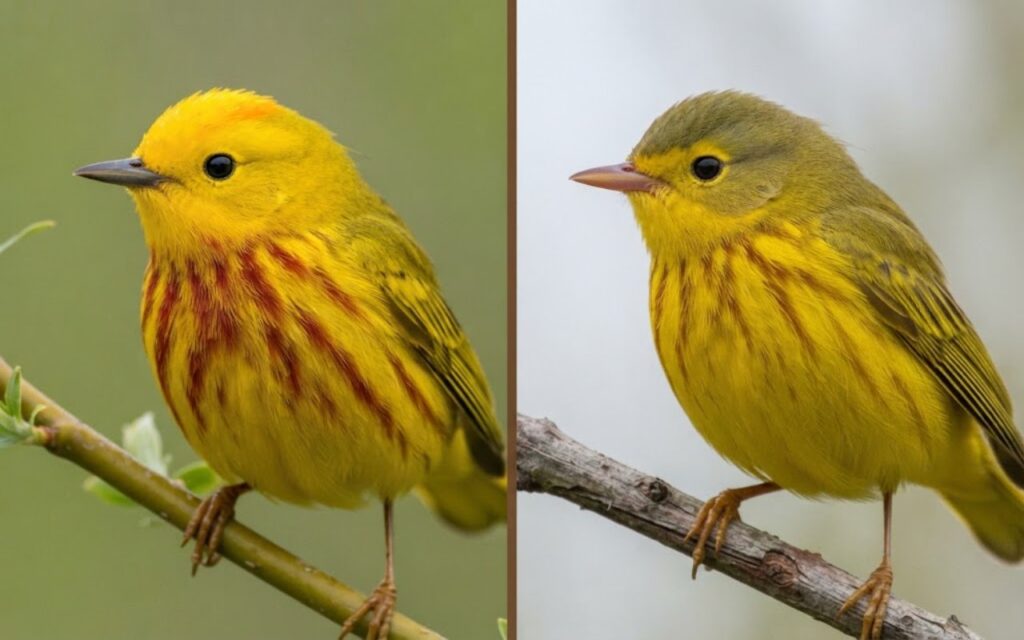
Navigating the field separation of the yellow warbler vs northern yellow warbler requires untangling a newly updated taxonomic framework and subtle regional plumage variations.
Following major global checklists, field ornithologists and taxonomy committees officially treat these birds as two entirely distinct species rather than mere subspecies groups within a single complex.
Understanding this distinction clarifies field observations across North American flyways and coastal wintering habitats. It also resolves persistent classification changes encountered by field observers reviewing migration records, checklists, and modern regional documentation.
Quick-Glance Field Summary
Field separation relies on recognizing whether an individual represents the migratory North American breeding species (Northern Yellow Warbler) or the resident coastal species (Mangrove Yellow Warbler) featuring saturated rufous hood markings.
Confirm identifications by checking for yellow rectrix spots on the inner tail webs combined with breast streaking intensity and crown contrast.
- Taxonomic Split: Northern Yellow Warbler (Setophaga aestiva) is a full, distinct species separate from the Mangrove Yellow Warbler (Setophaga petechia).
- Male Crown Markings: Migratory northern males show unstreaked yellow crowns; resident southern Mangrove species show partial (chestnut caps) or complete rufous hoods.
- Ventral Streaking: Slender, distinct chestnut-red streaks across the breast on northern males; reduced or absent on females and immatures.
- Tail Pattern: Inner webs of rectrices flash bright yellow, creating a translucent yellow tail window in flight across both species.
- Primary Wing Chord: Migratory Northern Yellow Warblers measure longer at 59 to 65 millimeters; resident southern Mangrove Yellow Warblers measure shorter at 54 to 60 millimeters.
Taxonomic Demarcation of the Setophaga Petechia Complex
The primary source of identification confusion stems from legacy field guides that categorized these birds as a single species with 35 subspecies. Under the modern taxonomic split, the long-distance migratory birds of North America are classified as Northern Yellow Warbler (Setophaga aestiva).
The non-migratory, resident coastal forms are categorized under Mangrove Yellow Warbler (Setophaga petechia), which includes the West Indian petechia group (Golden Warbler) and the Neotropical erithachorides group.
On community boards like BirdForum and Reddit’s bird identification forums, birders frequently encounter distinct entries in modern eBird checklists when logging migrants along the Gulf Coast. Observers often struggle when migratory northern birds touch down in habitats occupied by resident mangrove populations.
Isolating the high-latitude, long-distance migratory populations from sedentary tropical forms prevents misidentifying migratory northern birds that exhibit slight regional variations during seasonal stopovers.
| Field Trait | Standard Yellow Warbler (Core Group) | Northern Yellow Warbler (S. p. amnicola) | Field Identification Clue |
|---|---|---|---|
| Crown Coloration | Brilliant, solid golden-yellow forehead running deep across the crown. | Visibly duller, muted olive-green wash capping the forehead and crown. | Look at the cap; a distinct dull olive-green crown overlay points to the northern breeding group. |
| Ventral Streaking | Thick, dense, heavily saturated crimson-chestnut vertical stripes. | Noticeably narrower, fainter, and less abundant chestnut chest markings. | Male chest lines are thinner and paler on northern-boreal breeders. |
| Breeding Territory | Widespread across the interior United States, open wetlands, and orchards. | Strictly bound to northern boreal willow corridors across Canada and Alaska. | Highly geographic; these sub-groups mostly overlap during peak spring and fall migration. |
Plumage Diagnostics and Chestnut Ventral Streaking Patterns
Adult male Northern Yellow Warblers exhibit an intense, lemon-yellow body accented by distinct chestnut-red vertical breast streaks. In contrast, southern non-migratory groups within the complex exhibit dramatic variations in head pigmentation, ranging from a chestnut cap to a fully saturated, solid rufous hood.
Subspecies within the northern group also show latitudinal variation that confuses observers in northern boreal transition zones. For example, forum contributors on localized Alaskan birding channels frequently document the duller, greenish-olive mantle of the northern boreal subspecies amnicola.
- Northern Yellow Warbler (aestiva group): Bright yellow head without a rufous cap; fine to heavy chestnut breast streaks on males; plain, open face with a conspicuous dark eye.
- Golden Warbler (petechia group): Yellow body paired with a variable chestnut or rufous cap on the crown; heavier ventral streaking.
- Mangrove Warbler (erithachorides group): Distinct, complete chestnut-rufous head covering the chin, throat, face, and nape, forming a solid dark hood.
All members of the complex share an indispensable field mark: bright yellow patches on the inner webs of the tail feathers. When viewed from below during foraging leaps, this feature separates the entire complex from similar wood-warblers.
Geographic Range Overlap and Wintering Ground Dispersal
Geographic location serves as a critical filter when distinguishing these warbler populations in the field. Northern Yellow Warblers breed extensively from northern Alaska and Canada down through the central and southern United States, completely vacating their breeding grounds each autumn.
During migration and wintering months, northern migrants descend into Central America, northern South America, and the Caribbean. This seasonal influx creates intense distributional overlap with non-migratory Golden and Mangrove warblers along coastal lagoons and tidal flats.
In regions like the Florida Keys and coastal south Texas, field observers must carefully cross-reference coastal habitat types. Northern Yellow Warblers utilize open scrub, riparian willows, and deciduous edges during migration, whereas resident Golden and Mangrove forms stay strictly within salt-tolerant mangrove ecosystems.
Female and Immature Molt Variation in Fall Fieldwork
Fall identification presents the steepest challenge due to the arrival of first-year birds and worn adult females that lack diagnostic chestnut streaking. Many identification questions submitted to online avian networks center on pale, greenish-yellow warblers lacking any ventral color patterns.
First-fall female Northern Yellow Warblers can appear exceptionally drab, displaying an olive-green upper side and washed-out yellow underparts. Birders often mistake these dull individuals for Orange-crowned Warblers or female Wilson’s Warblers.
- Inspect the face for structural contrast: Northern Yellow Warblers lack the bold split eye-arcs of the Orange-crowned Warbler and the distinct dark crown patch of the female Wilson’s Warbler.
- Check the inner tail feathers: The prominent yellow inner tail webs remain clearly visible on Yellow Warblers even in the drabbest fall immatures.
- Examine the bill structure: The bill of the Northern Yellow Warbler is relatively stout, straight, and blue-gray, unlike the needle-thin bill of a Wilson’s Warbler.
First-year birds also undergo partial preformative molts before migrating south, which can produce patchy, uneven plumage tones. A careful look at primary feather wear helps field observers establish bird age and separate dull northern juveniles from resident island forms.
Acoustic Signatures and Dawn Song Cadence Differences
Vocal differences provide an additional layer of verification when separating migratory northern populations from resident tropical subspecies. The classic breeding song of the Northern Yellow Warbler is an upbeat, musical phrase typically transcribed as sweet-sweet-sweet, little-more-sweet.
Spectrographic analysis reveals that northern migratory populations deliver these high-frequency phrases with accelerated tempo and rising terminal inflections. By comparison, resident Caribbean and mangrove populations often deliver songs with a slower, coarser cadence that features harsher tonal qualities.
Contact calls also provide reliable clues during fall passage when song activity drops. The flight and foraging call of the Northern Yellow Warbler is a distinct, metallic chip; this sound carries an unslurred, hollow timbre that seasoned field observers use to detect high migrants moving through thick cover.