
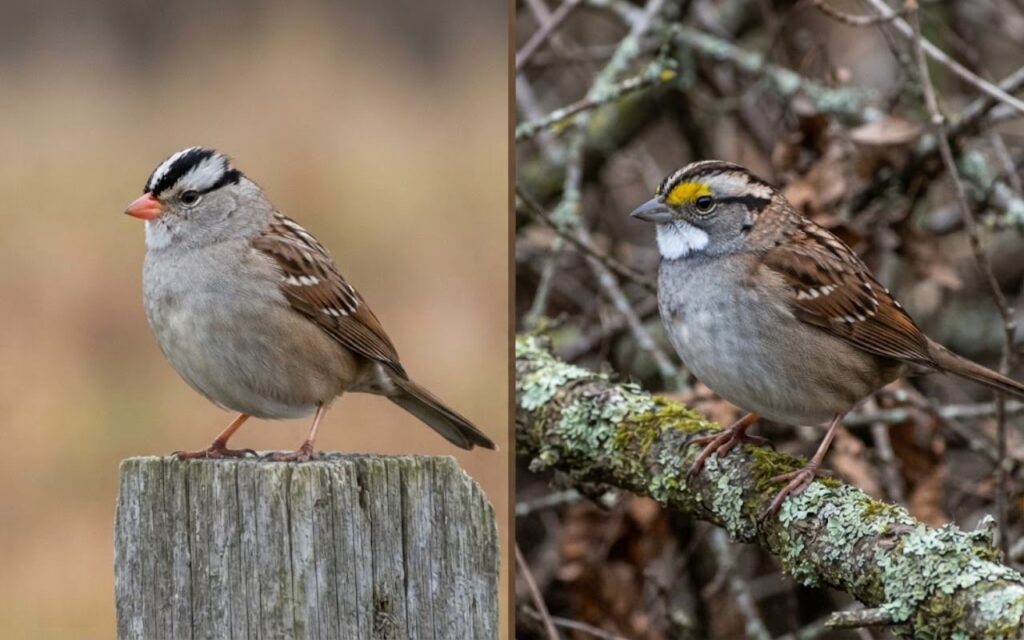
Mastering White-crowned Sparrow vs White-throated Sparrow identification requires moving past basic field guides and evaluating structural markings that persist across every lighting condition. While classic illustrations depict striking adult birds in pristine breeding plumage, winter backyard flocks present a dizzying mix of polymorphic adults, dull immatures, and shadowed silhouettes. Birders frequently struggle to separate these two common Zonotrichia species when birds are hidden deep within thickets or foraging in low winter light.
Field observers must combine bill color, head stripe architecture, and subtle throat borders to make an accurate diagnosis. Relying on a single field mark frequently leads to errors because variable morphs and juvenile molts mimic adjacent species. By focusing on consistent physical traits and distinct microhabitat behaviors, you can confidently log both species at your feeding stations and along dense brush margins.
Quick-Glance Field Summary
Accurate field identification relies on checking bill pigmentation first and then confirming the presence or absence of a cleanly framed white throat patch. While adult crown patterns draw immediate visual attention, bill color remains diagnostic across all age classes, plumage phases, and lighting scenarios.
- Bill Color: Pink to bright orange-yellow on White-crowned; dull dark gray to blackish horn on White-throated.
- Throat Pattern: Uniform pale ash-gray blending into breast on White-crowned; crisp white patch framed by dark borders on White-throated.
- Loral Spot: Plain gray or white supraloral area on White-crowned; bright to pale yellow supraloral patch on White-throated.
- Crown Structure: Sleek, high-domed crest with black-and-white or rufous-and-tan stripes on White-crowned; flatter head with white-striped or tan-striped genetic morphs on White-throated.
- Feeding Zone: Open lawn edges, gravel borders, and high brush stems for White-crowned; deep interior leaf litter, brush piles, and damp forest floors for White-throated.
Bill Culmen Pigmentation and Low-Light Optical Distortions
The single most reliable structural field mark separating these two sparrows is the bill color. A White-crowned Sparrow displays a striking, bright bill that ranges from clear bubblegum pink to warm yellowish-orange depending on the regional subspecies. In contrast, the White-throated Sparrow consistently shows a dark culmen and lower mandible, appearing dull charcoal, slate, or dark horn gray.
On community forums like r/whatsthisbird, novice birders frequently upload shadowy feeder photos asking for identification help when head stripes appear washed out. Multiple experienced contributors note that backyard birders routinely misjudge birds on overcast winter mornings because dull sky reflections can make dark bills look lighter. Checking the bill against the surrounding facial feathers under binoculars instantly cuts through ambient lighting tricks.
Even when an immature bird lacks adult head stripes entirely, bill pigmentation remains steadfast. Young White-crowned Sparrows retain their warm, pale pinkish-orange bills from their first autumn through adulthood. If the bird hopping on your ground tray has a dark slate-gray bill, you can immediately eliminate the White-crowned Sparrow from your notes.
| Anatomical Trait | White-Crowned Sparrow (Z. leucophrys) | White-Throated Sparrow (Z. albicollis) | Field Identification Clue |
|---|---|---|---|
| Throat Profile | Solid, uniform pearl-gray neck that blends seamlessly down into the breast. | Stark, brilliant white throat bib sharply delineated by a crisp, dark mustache stripe. | Look at the neck; a framed white bowtie instantly confirms a White-Throated Sparrow. |
| Facial Lores | Clean black and white facial stripes; completely free of secondary pigments. | A vibrant, bright splash of lemon-yellow directly in front of and above the eye. | Check the eyebrow; yellow loral spots mean White-Throated; clean gray means White-Crowned. |
| Bill Coloration | Bright orange or pinkish-yellow bill; stands out crisply against gray face. | Dull, uniform dark gray or horn-colored beak. | Bill color is a great backup check; bright pink-orange confirms White-Crowned. |
Polymorphic Tan-Striped Morphs and Immature Crown Traps
Crown patterns create immense confusion during late fall and winter due to species-specific plumage variations. White-throated Sparrows exhibit true genetic polymorphism, occurring in roughly equal numbers of white-striped and tan-striped morphs regardless of biological sex. White-striped individuals feature bright white median and superciliary stripes bordered by jet-black lateral crown stripes, while tan-striped morphs show muted tan stripes framed by dull brown bands.
A common pitfall discussed across regional birding threads involves confusing tan-striped White-throated Sparrows with first-winter immature White-crowned Sparrows. Immature White-crowned Sparrows do not show clean black-and-white head stripes until their first spring prealternate molt. Instead, their crowns feature warm rufous-brown lateral stripes separated by a pale buffy-tan central stripe, closely mimicking a tan-striped White-throated Sparrow at first glance.
- Adult White-crowned: Bold black lateral crown stripes flanking an unstreaked, snow-white central stripe.
- Immature White-crowned: Rich reddish-brown lateral stripes enclosing a muted gray-tan median stripe.
- White-striped White-throated: Crisp black lateral stripes surrounding a clean white central crown line.
- Tan-striped White-throated: Dark brown lateral stripes bordering a warm tan median line with variable dusky breast streaks.
To solve this crown puzzle, observe the bird’s profile and head posture. White-crowned Sparrows have a distinctly high-crowned, crested appearance with a peaked forehead that gives them an alert, regal posture. White-throated Sparrows have a rounder, flatter head profile that seamlessly flows into the nape without creating an elevated crown puff.
Supraloral Yellow Pigment and Throat Framing Contrast
The yellow supraloral spot, located directly between the eye and the base of the bill, is an iconic trademark of the White-throated Sparrow. In bright white-striped adults, this golden yellow patch glows intensely against the dark eye line. However, forum users frequently point out that on tan-striped morphs and first-winter birds, this yellow spot can be reduced to a faint, dirty yellow wash that disappears entirely in shadowed brush piles.
When the yellow supraloral patch is too faint to detect, shift your focus to the throat area. The White-throated Sparrow features a clean, bright white throat bib that looks like a miniature silk ascot. This white patch is cleanly separated from the gray breast by a crisp, darker border, creating high tonal contrast that stands out even in deep shade.
The White-crowned Sparrow completely lacks yellow facial pigmentation at all life stages. Furthermore, its throat does not form an isolated bib; instead, the pale gray throat wash blends continuously into an unstreaked, pearly ash-gray breast. If the throat appears to have a defined horizontal lower boundary separating it from the chest, you are viewing a White-throated Sparrow.
Brush Pile Microhabitats and Leaf-Litter Foraging Mechanics
Both species employ a vigorous double-scratch foraging maneuver, using both feet simultaneously to kick back ground litter while hunting for seeds. Despite this shared behavior, their habitat preferences diverge significantly when foraging in mixed winter flocks. White-throated Sparrows are classic woodland floor dwellers that rarely venture far from dense, protective cover.
Backyard observers reporting on feeder dynamics highlight that White-throated Sparrows linger deep inside briar patches, tangled hedgerows, and layered mulch. They prefer staying shaded underneath evergreen shrubs or within the bottom layers of assembled brush piles. If disturbed, a White-throated Sparrow immediately dives deeper into the dark interior of the thicket rather than flying out into open view.
White-crowned Sparrows demonstrate greater ecological plasticity, regularly foraging out in open terrain. You will frequently find them feeding along exposed gravel roadsides, agricultural ditch lines, and expansive turf lawns several yards away from cover. When startled, White-crowned Sparrows tend to flush upward to perch conspicuously on top of high exposed fence wires or outer tree branches.
Winter Chip Notes and Acoustic Diagnostic Separation
When dense foliage prevents clear binocular views, acoustic clues provide immediate species confirmation. Both sparrows frequently utter sharp contact calls while foraging in communal winter flocks. Learning these short notes allows you to catalog hidden birds moving beneath dense brush piles without waiting for them to emerge.
The White-throated Sparrow delivers a hard, metallic chip note that sounds like a distinct “chink” or “tseet.” This sound carries a sharp, percussive quality that resonates through damp undergrowth. The bird also gives a drawn-out, high-pitched lisping call that warns flock members of passing aerial predators.
- White-throated Contact: A hard, loud metallic “chink” with resonant acoustic punch.
- White-throated Song: The familiar, clear whistling cadences of “Old Sam Peabody Peabody” or “Oh Sweet Canada.”
- White-crowned Contact: A softer, sharper, glass-like “pink” note that sounds slightly dry.
- White-crowned Song: A variable series of sweet, thin whistles transitioning into rapid, buzzing descending trills.
The White-crowned Sparrow produces a diagnostic “pink” note that possesses a drier, clicking timbre. Community birders often compare this sound to two small river stones clicking together under water. When heard side by side in mixed flocks, the White-throated call sounds distinctly heavier, while the White-crowned call remains thinner and more brittle.