
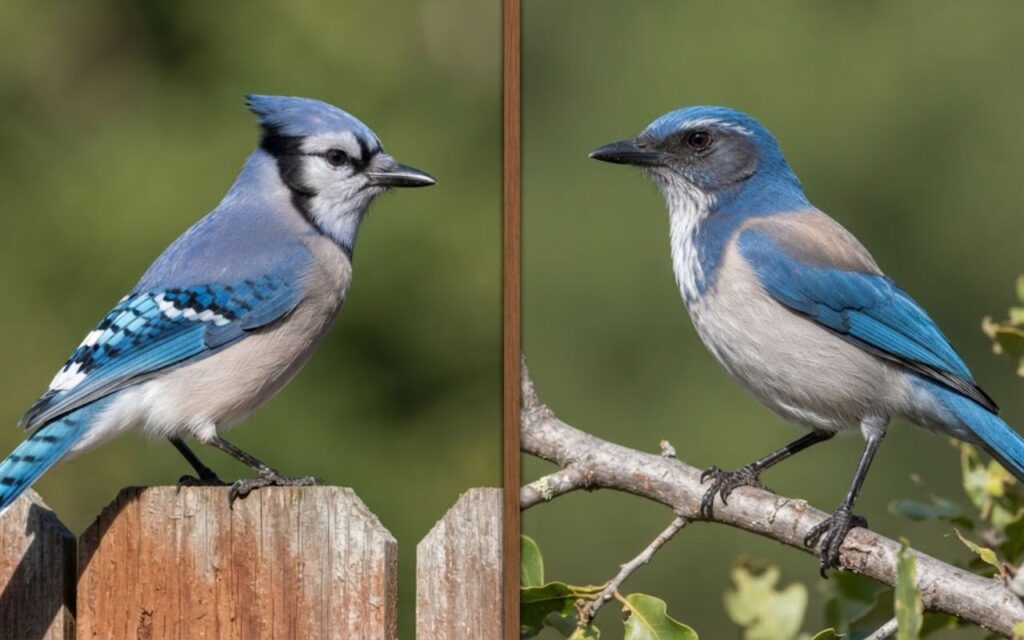
Navigating a visual identification between a Blue Jay vs. California Scrub-Jay requires looking past shared blue feathers to evaluate head structure, chest markings, and geographic coordinates. Both corvids exhibit striking cerulean shades, but they belong to entirely different genera with unique evolutionary paths. Understanding their morphological contrasts and behavioral signatures quickly settles one of the most persistent identification questions in North American backyard birding.
While field guides display clean regional splits, birders frequently struggle when observing unfamiliar yard visitors during migration or when relocating across the country. Backyard observers often find that structural silhouettes, vocal repertoires, and feeding postures clarify a bird’s identity far quicker than plumage color alone.
Quick-Glance Field Summary
Field identification centers on the presence of an articulating crest and complete black breast collar on the Blue Jay versus the flat crown and soft white throat bib of the California Scrub-Jay. Geographic range provides an immediate reality check, as these two species do not have overlapping resident breeding territories.
- Blue Jay Head: High articulating feather crest that raises during alarm and lowers when relaxed.
- California Scrub-Jay Head: Sleek, crestless, rounded crown with an azure cap and white eyebrow stripe.
- Breast and Neck Markings: Complete black necklace wrapping around the throat on the Blue Jay; broken, diffuse blue-gray breast band framing a white throat on the California Scrub-Jay.
- Wing and Tail Markings: Bold white wing bars, white tail corners, and black cross-barring on the Blue Jay; solid, unbarred ultramarine wings and tail on the California Scrub-Jay.
- Ventral Body Plumage: Off-white to light gray breast and belly on the Blue Jay; pale smoke-gray belly with white undertail coverts on the California Scrub-Jay.
Morphological Separation: Crest Structure, Throat Collars, and Spongy Keratin
The most definitive physical marker separating these two corvids sits directly atop the skull. The Blue Jay (Cyanocitta cristata) possesses a prominent, muscular feather crest that it raises or lowers depending on social context and agitation levels. In contrast, the California Scrub-Jay (Aphelocoma californica) features a completely smooth, rounded head profile that never displays an erectile crest under any circumstances.
Neck markings establish an equally definitive boundary between the two species during close field observations. A Blue Jay carries a bold, continuous black bridle that circles its nape, borders the auricular feathers, and joins across the upper breast like an unbroken necklace. The California Scrub-Jay lacks this dark band entirely, exhibiting a clean white throat bib bordered by soft streaks and an incomplete, diffuse bluish breast band.
Neither species produces true blue pigments within their feather follicles. Their vivid coloration is entirely structural, produced by coherent light scattering through spongy keratin matrices containing microscopic air cavities.
The Blue Jay pairs this structural blue with stark white secondary patches and dark melanin bars across the flight feathers, whereas the California Scrub-Jay displays uniformly colored, unbarred blue wings framing a soft brownish-gray mantle.
| Field Identification Mark | Blue Jay (Cyanocitta cristata) | California Scrub-Jay (Aphelocoma californica) | Quick-Glance Identification Key |
|---|---|---|---|
| Head Crown Profile | Prominent, pointed crown crest that raises or lowers based on emotional state. | Completely smooth, flat, and rounded head profile; lacks any crest structure. | Look at the crown; Blue Jays are crested, California Scrub-Jays are sleek and round. |
| Wing & Tail Markings | Bold black bars and clean white wing panels; prominent white tips on tail feathers. | Solid deep blue wings with a dull grayish-brown back mantle; zero white checkers. | Check the wings; Blue Jays have bold white bars, California Scrub-Jays are unbarred. |
| Throat & Neck Collar | Stark, complete midnight-black necklace wrapping under the throat up past the nape. | Faint, smoky blue breast band framing a streaky white throat patch; no sharp black necklace. | Neck checking; if it has a hard black ring around its throat, it is a Blue Jay. |
Vocal Diagnostics: Distinguishing Hawk Mimicry from Shrill Scrub Rasping
Vocalizations offer instant clarification long before a bird emerges from dense foliage. The Blue Jay possesses an expansive acoustic catalog featuring the loud, ringing “jay-jay” alarm call alongside a rhythmic, metallic “pump-handle” vocalization. Furthermore, Blue Jays regularly perform pitch-perfect vocal mimicry of Red-shouldered and Red-tailed Hawks to intimidate competitor birds near high-value food sites.
The California Scrub-Jay utilizes a harsher, more abrupt acoustic repertoire lacking true musical whistles. Its definitive contact call is a rising, raspy “weep” or a series of dry, rapid “shcheck-shcheck-shcheck” bursts echoing across scrub terrain. These birds rarely mimic predatory raptors, relying instead on localized, sharp scolding notes to coordinate territorial defenses with nearby family groups.
Pitch profile and delivery cadence provide dependable clues when birds call from thick brush. The Blue Jay produces calls with clear resonant harmonics, allowing the sound to carry across dense eastern hardwood canopies. The scrub-jay produces vocalizations with a distinctively dry, gravelly texture that cuts through dry chaparral and suburban yard plantings.
Geographic Boundaries, Range Disjunction, and the Woodhouse Dilemma
Geography serves as an absolute barrier for these two species under normal ecological conditions. The Blue Jay is widely distributed across central and eastern North America, reaching from the Atlantic seaboard westward to the eastern foothills of the Rocky Mountains. The California Scrub-Jay is strictly confined west of the Sierra Nevada crest, maintaining residential strongholds along the Pacific coast from Washington state down through Baja California.
Backyard birders often encounter confusion due to taxonomic splits within the scrub-jay complex itself. Recent splits officially divided the Western Scrub-Jay into two distinct species: the coastal California Scrub-Jay and the interior Woodhouse’s Scrub-Jay (Aphelocoma woodhouseii).
In localized threads across r/birdwatching, birders in western Texas and eastern Colorado frequently report birds they mistake for Blue Jays, only to discover they are observing Woodhouse’s Scrub-Jays inhabiting pinyon-juniper canyons.
- Blue Jay Core Range: Eastern deciduous forests, southern pine flatwoods, suburban parks east of the 100th meridian, and localized pockets across the Canadian prairies.
- California Scrub-Jay Core Range: Oak savannas, chaparral hillsides, suburban gardens, and Pacific coastal valleys from Puget Sound south to Mexico.
- Woodhouse’s Scrub-Jay Range: Interior Great Basin, Rocky Mountain pinyon-juniper foothills, and the scrub deserts of Utah, Arizona, Nevada, and New Mexico.
- True Range Overlap: Functional wild overlap between Blue Jays and California Scrub-Jays does not exist in native breeding habitats.
A vagrant Blue Jay will occasionally stray into the Pacific Northwest during severe winter weather systems. When this occurs, observing birders can easily confirm the stray by verifying the black collar and crisp white wing patches against resident scrub-jays.
Feeder Aggression, Peanut Hoarding, and Hardware Excluder Spacing
Both species dominate backyard feeding stations, yet their handling of whole peanuts highlights key behavioral divergence. In recent community observations on r/backyardbirds, hobbyists noted that California Scrub-Jays systematically test several in-shell peanuts by weight before choosing the heaviest nut to cache underground.
Blue Jays, by contrast, frequently manipulate multiple whole nuts directly into an expandable esophageal pouch to transport several food items simultaneously.
Managing these large corvids requires precise feeder dimensions if you intend to preserve seeds for smaller clinging species. Standard hopper perches easily support both species, which frequently clear out sunflower supplies within hours. Installing exclusion caging around hanging platform feeders safely regulates foraging pressure without injuring aggressive corvids.
- Wire Mesh Spacing: A 1.5-inch vinyl-coated wire cage excludes both jay species while allowing chickadees, titmice, and nuthatches unobstructed access.
- Feeder Clearances: Maintain a minimum 3-inch gap between the outer wire exclusion barrier and internal seed ports to prevent extended bill reach.
- Dedicated Station Placement: Position an open tray containing whole, raw, unsalted in-shell peanuts at least 15 feet away from mixed-seed tube feeders to divert both jay species. Leading wildlife conservation sources recommend raw peanuts over roasted varieties, as raw, un-processed nuts preserve optimal natural fats and better facilitate instinctive corvid caching and foraging behaviors.
- Window Safety Positioning: Mount platform feeders within 3 feet of exterior windows, or relocate them beyond 30 feet to mitigate fatal collision hazards caused by sudden scrub-jay territorial departures.
Providing dedicated feeding zones satisfies the caching drive inherent to both corvids. Diverting their powerful bills keeps hopper ports intact while reducing harassment directed at smaller backyard visitors.
Molt Wear Anomalies, Juvenile Plumage, and Community Forum Discoveries
Juvenile plumage stages often prompt misidentification reports on localized wildlife forums. Young Blue Jays leave the nest with muted gray-blue crests and incomplete, washed-out neck collars that can briefly mimic scrub-jay proportions. Conversely, juvenile California Scrub-Jays completely lack blue tones on their crowns for their first summer, showing a solid mouse-brown head that confounds inexperienced backyard watchers.
Late-summer feather wear introduces additional visual anomalies that can mislead birders. Blue Jays undergo a complete late-summer prebasic molt where individuals occasionally drop all crown feathers simultaneously, leaving a bald, black-skinned head that completely eliminates their crest silhouette.
Forum contributors frequently post photos of these bald birds, suspecting skin parasites or assuming they have encountered a rare, crestless vagrant species.
Scrub-jays do not suffer synchronized head feather drops during their annual molt, keeping their rounded silhouettes intact throughout the fall transition. Inspecting the wings for dark cross-barring and white terminal tail spots will instantly identify a bald molting bird as a Blue Jay. Tracking these seasonal plumage shifts ensures accurate yard documentation regardless of physical wear or regional weather anomalies.