
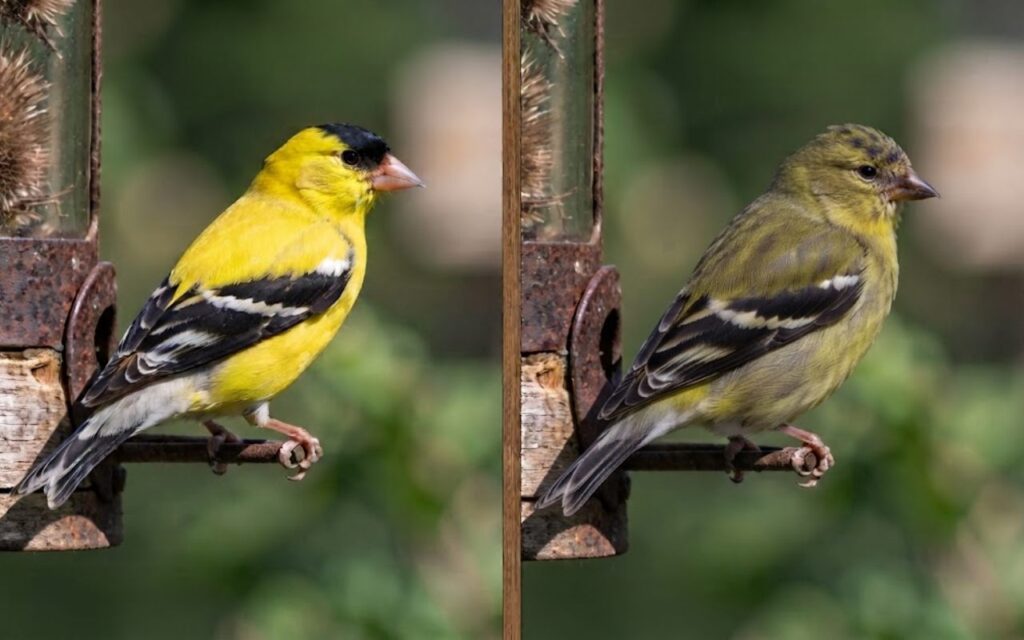
Mastering an American Goldfinch vs Lesser Goldfinch: Quick ID challenge in the field requires looking beyond basic yellow feathers. Birders across western regions frequently struggle to separate these two small finches when they visit the same backyard feeders or weed patches.
While breeding males in peak summer plumage seem unmistakable in field guides, real-world lighting, molt stages, and regional morphs create constant confusion. Focusing on specific anatomical markers like undertail coverts and wing patches provides an immediate, foolproof identification.
Quick-Glance Field Summary
To reliably separate these species at a glance, immediately check the undertail coverts beneath the tail and look for a bold white patch at the base of the primary flight feathers. American Goldfinches always show bright white undertail coverts regardless of season, whereas Lesser Goldfinches display solid yellow undertail coverts alongside a prominent white primary flash.
- Size: American Goldfinch measures 4.3 to 5.1 inches; Lesser Goldfinch measures 3.5 to 4.3 inches
- Undertail Coverts: Pure white on American Goldfinch; bright or pale yellow on Lesser Goldfinch
- Wing Markings: American shows broad wing bars without a primary base patch; Lesser shows a distinct white square at the base of the primaries
- Male Dorsal Color: American has an unstreaked bright yellow back in summer; Lesser shows an olive-green or glossy black back year-round
- Bill Color: American exhibits a conical pink-orange bill in summer and dusky horn in winter; Lesser retains a dull yellowish-gray or dark horn bill
Undertail Coverts and Tail Geometry Diagnostics
The single most dependable field mark separating these two species across all ages, sexes, and seasons is the undertail covert region. American Goldfinches maintain crisp, chalk-white feathers beneath the base of the tail throughout the entire year. In contrast, Lesser Goldfinches show bright yellow to pale butter-yellow undertail coverts that match their lower belly plumage.
This distinction eliminates the risk of misidentifying drab autumn immatures or worn winter birds. Even when an American Goldfinch molts into its dull, buffy-tan non-breeding plumage, the white vent area remains starkly visible. A quick view from beneath the bird as it feeds on an elevated thistle sock settles the identification instantly.
Tail structure and feather patterning provide secondary confirmation when birds perch overhead. Lesser Goldfinches feature large, squarish white patches on the inner webs of their tail feathers, which create a flashing banded look when spread. American Goldfinches carry white patches closer to the tips of their outer rectrices, presenting a distinctly different tail spread in flight.
| Field Identification Mark | American Goldfinch (Spinus tristis) | Lesser Goldfinch (Spinus psaltria) | Quick-Glance Identification Key |
|---|---|---|---|
| Back Mantle Coloration | Brilliant, uniform lemon-yellow in summer breeding plumage; turns drab olive-tan in winter. | Solid dull olive-green or glossy jet-black year-round; never turns solid yellow across the back. | Check the back; American is bright yellow, Lesser is always dark green or black. |
| Undertail Covert Area | Stark, clean white belly and undertail fluff; creates a distinct two-toned look from below. | Continuous bright yellow running completely from the throat down to the undertail base. | Look under the tail; American shows white undertail fluff, Lesser is solid yellow. |
| Wing Pattern Details | Jet-black wings with bold, thick white bars; prominent white crescent patches on the rump. | Black wings with thinner white bars and a large, distinct white patch at the base of the primaries. | Wing checking; Lesser shows a large, solid white base flash on its outer wing feathers. |
Dorsal Plumage Variations and Green-Backed Morphs
Male dorsal plumage can baffle observers because Lesser Goldfinches exhibit significant geographic variation across their North American range. In western populations from the Pacific Coast to the Rocky Mountains, males belong to the green-backed form, retaining olive-green upperparts with dark caps. Eastward into Texas and Mexico, the black-backed form dominates, sporting solid obsidian-black backs that mimic tiny chickadees from behind.
In community discussions on Reddit’s r/whatisthisbird, observers in Central Texas and Colorado frequently report second-guessing these birds due to intermediate color phases. Users often mistake green-backed Lesser males for faded or molting American Goldfinches during early spring transitions. A true breeding male American Goldfinch never displays an olive or black back; its mantle is completely solid, brilliant lemon-yellow between its black cap and tail.
Female dorsal patterns also provide vital clues under good optics. Female Lesser Goldfinches show uniform grayish-olive backs that blend smoothly into their caps and napes without strong contrasts. Female American Goldfinches present a warmer, brownish-olive cast above, often showing a faint contrast between a paler nape and darker back feathers.
Wing Base Markings and Primary Projection Metrics
Wing architecture offers an immediate structural tell when identifying finches perched at garden feeding stations. Lesser Goldfinches possess a distinctive white patch at the base of their primary flight feathers. This white triangle or square is clearly visible as an isolated bright spot on the folded wing, standing out against the black remiges.
American Goldfinches completely lack this concentrated white primary base patch. Instead, American Goldfinches feature two distinct, clean wing bars formed by white or buff tips across the greater and median coverts. While Lesser Goldfinches also show pale wing bars, their upper wing bar is typically thinner and broken compared to the broad, crisp bands of the American Goldfinch.
Hand-wing projection also differentiates the two species due to their divergent migratory behaviors. American Goldfinches are strong, long-distance seasonal migrants that display longer primary extensions extending further down the tail. Lesser Goldfinches are largely sedentary or short-distance altitudinal wanderers, resulting in a noticeably more compact, short-winged silhouette on perches.
Molt Cycles and Seasonal Winter Confusion
Molt timing introduces substantial confusion for backyard birders during late autumn and mid-winter. American Goldfinches are among the few cardueline finches that undergo a complete prebasic molt in late summer followed by an extensive prealternate molt in late winter. This seasonal shift transforms the brilliant yellow summer American male into an olive-brown, unstreaked bird with a pale throat and dark bill.
Backyard birders on localized California forums frequently post photos in January wondering why their local goldfinches look washed out and dingy. Lesser Goldfinches undergo only one complete annual molt in late summer and retain their overall body color patterns year-round. A male Lesser Goldfinch maintains his black cap and green or black back straight through freezing temperatures without reverting to drab brown plumage.
Bill color closely tracks these seasonal hormonal cycles in American Goldfinches. During the late spring and summer breeding season, American Goldfinch bills turn bright conical orange-pink. Lesser Goldfinches maintain dull horn, slate-gray, or faintly yellowish bills across all seasons, never displaying the vivid orange tone of breeding Americans.
Feeder Niches, Seed Preferences, and Acoustic Distinctions
Field separation often comes down to vocal cues before a birder even lifts a pair of binoculars. American Goldfinches deliver a rhythmic, bouncy flight call often transcribed as “per-chick-o-ree” or “po-ta-to-chip” that syncs with their undulating flight bounds. Lesser Goldfinches announce themselves with sweet, plaintive rising whistles resembling a questioning “tee-yee” or a descending mournful cry.
At backyard feeding setups, both species readily accept nyjer seed and fine black oil sunflower chips. However, the smaller Lesser Goldfinch easily negotiates tight 0.25-inch wire mesh perches and flexible mesh socks that can feel awkward for the bulkier American Goldfinch. Providing diverse feeding ports reduces territorial squabbles between the two species during peak morning foraging hours.
Proper feeder hygiene is critical when managing high concentrations of both species at shared stations. Damp, compacted nyjer seed quickly harbors fungal pathogens such as Aspergillus flavus, which produces lethal aflatoxins in small songbirds. Feeder tubes and mesh reservoirs must be sanitized bi-weekly using a standard 1:9 bleach-to-water dilution and dried completely before refilling.