
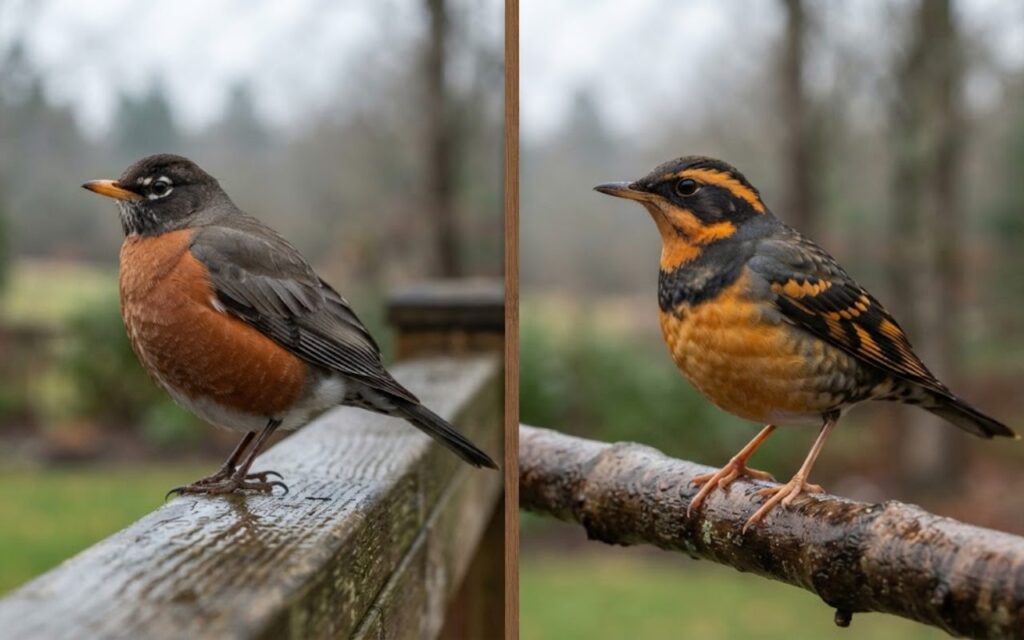
Telling the difference in an American Robin vs. Varied Thrush sighting often comes down to quick wing markings and posture when a bird flashes through backyard brush. Both species share the classic thrush silhouette and rich orange plumage, which leads to frequent misidentifications across western backyards.
Birders on Pacific Northwest forums regularly post photos of winter thrushes after heavy mountain snows drive secretive birds down to sea-level yards. Sorting out which bird is hopping across your lawn requires focusing on distinct facial stripes, breast band patterns, and flight calls.
Quick-Glance Field Summary
To separate these two thrushes instantly, check the chest for a dark collar and scan the wings for bright orange bars. Varied Thrushes feature intricate patterning with an orange eyebrow stripe, whereas American Robins display an unbanded brick-red chest, plain gray wings, and a broken white eye-ring.
- Breast pattern: American Robins show an unbroken red-orange breast; Varied Thrushes have a distinct black or slate-gray breast band across an orange chest.
- Face markings: American Robins have a broken white eye-ring; Varied Thrushes sport a bright orange eyebrow stripe extending behind the eye.
- Wing markings: American Robins have plain slate-gray wings; Varied Thrushes display two wide orange wing bars and orange flight feather patches.
- Song style: American Robins sing a cheerful caroling cheerily-cheer-up melody; Varied Thrushes produce a haunting, single-pitch metallic whistle.
- Typical habitat: American Robins occupy open lawns and suburbs across North America; Varied Thrushes prefer dense, wet conifer forests of the Pacific Northwest and northern Rockies.
Spotting Chest and Face Markings at First Glance
The chest coloration provides the fastest field mark when light is poor. An adult male American Robin displays an expansive, smooth breast ranging from rich brick red to deep peach. This warm color extends down to the lower belly, where it meets clean white undertail coverts without any interrupting dark bands.
A Varied Thrush breaks up this warm orange wash with a heavy, distinct breast band. On male Varied Thrushes, this band is solid black, creating sharp contrast against the bright orange throat and breast. Female Varied Thrushes sport a more muted, grayish-brown band, but the dividing line remains obvious at any angle.
Facial details reinforce this visual separation immediately. American Robins feature a dark gray or black head offset by a broken white eye-ring, which looks like tiny white brackets surrounding the eye. Varied Thrushes present an intricate facial mask with a dark ear patch and an orange stripe that runs directly over the eye toward the nape.
| Field Identification Mark | American Robin (Turdus migratorius) | Varied Thrush (Ixoreus naevius) | Quick-Glance Identification Key |
|---|---|---|---|
| Chest & Breast Adornment | Solid, uniform brick-red or rich orange breast running cleanly down to a white lower belly. | Bright orange breast split dramatically by a bold, heavy dark-slate horizontal chest collar band. | Look at the breast; if it has a hard, solid dark necklace bar across the orange, it is a Varied Thrush. |
| Wing & Flight Patterns | Plain, solid dark charcoal-gray wings completely free of any bright bars or orange patches. | Intricate black wings broken up by two prominent, vivid orange horizontal wing bars and panel patches. | Check the wings; American Robin wings are plain gray, Varied Thrushes show detailed orange stripes. |
| Facial Stripe Markings | Plain dark head with a subtle, broken white eye-ring striping pattern around a yellow bill. | Intense, bold orange eyebrow stripe running backward from above the eye over a dark face mask. | Face checking; look for a bright, continuous orange stripe sweeping back across the side of the head. |
Checking the Wings and Tail Patterns
Wing plumage removes all confusion if a bird is foraging facing away from you. American Robins have uniform gray, slate, or brownish-gray wings with minimal ornamentation. Aside from subtle pale edges on fresh winter flight feathers, the robin presents a smooth, unbarred wing surface.
Varied Thrushes carry striking wing patterns that catch the eye instantly. Their wings feature two bold orange wing bars across the greater and median coverts, accompanied by broad orange patches on the primaries. When the bird takes flight, these orange wing patches flash visibly against the dark slate background of the upperparts.
Tail patterns provide another helpful visual clue during take-off. American Robins show a dark charcoal tail with distinctive white corners on the outer tail feathers. Varied Thrushes have a slightly shorter, square tail that lacks those bright white terminal spots, showing slate-gray feathers with faint pale tips instead.
Listening for Songs and Call Notes in the Yard
Vocalizations between these two birds sound completely different in both tone and cadence. The American Robin produces an upbeat, rolling song consisting of liquid phrases often transcribed as cheerily, cheer up, cheer up, cheerily. Robins sing persistently at dawn and dusk throughout spring and summer across almost every neighborhood.
The Varied Thrush sings with an eerie, solitary tone that backyard birders often compare to a distant referee whistle or an antique telephone ring. The song consists of a single, long, drawn-out metallic buzz held on one specific pitch for about two seconds. After a brief pause, the bird repeats the whistle on a completely different pitch, echoing hauntingly through damp evergreen woods.
Call notes under backyard conditions also differ dramatically:
- American Robin alarm note: A sharp, rising peak or explosive tut-tut-tut series delivered rapidly when cats or raptors approach.
- American Robin flight call: A thin, high-pitched seep sound uttered during high transit flights or flock movements.
- Varied Thrush contact call: A low, heavy, abrupt chup or tchuck sound given low in the shrubs.
- Varied Thrush disturbance call: A quiet, nasal hum or wheeze delivered while retreating deeper into dense ground cover.
Learning these basic notes lets you identify birds hidden deep in thick cedar hedges without ever needing binoculars.
Watching Ground Behavior and Habitat Differences
Backyard observers on wild bird forums frequently note the surprising attitude differences between these two species. While both birds belong to the family Turdidae and hop on the ground, their comfort around human activity is rarely the same. American Robins are confident ground foragers that run short distances across wide lawns, pause upright to look for worms, and tolerate nearby foot traffic.
Varied Thrushes behave far more cautiously and prefer shadows over open turf. In online community discussions, gardeners often describe them as shy ground-dwellers that stick close to rhododendrons, salal, and damp leaf litter. When forced into the open, a Varied Thrush stays low to the ground and darts back to safety at the slightest motion.
Discussions on forum boards highlight that cold snaps radically shift Varied Thrush distribution. During heavy winter freezes in the Pacific Northwest, mountain snowpacks lock up natural foraging grounds. These weather events trigger localized downslope movements, pushing dozens of hungry Varied Thrushes directly into suburban valley yards where they aggressively dominate patch feeding areas.
Setting Up Backyard Feeders to Attract Both Species
American Robins rarely visit hanging tube feeders because their feet cannot easily grasp small perches. To feed robins during cold winter stretches, use wide platform trays or ground feeding spots loaded with softening foods. They focus their energy on energy-rich fruits, raisins soaked in warm water, and live or dried mealworms.
Varied Thrushes enjoy fruit but also rely heavily on seeds and nuts during winter cold snaps. Hobbyists on birding message boards report great success attracting them with suet crumbles, hulled sunflower chips, and cracked corn spread directly beneath large shrubs. Keeping seed scattered under overhanging evergreens provides the sheltered foraging environment they prefer.
If you maintain backyard stations, follow sound hardware practices to keep visiting thrushes safe:
- Install window collision deterrents using exterior decals spaced no more than two inches apart, or keep feeders within three feet of windows to prevent fatal high-speed strikes.
- Place tray feeders beneath weather domes spanning at least 12 to 18 inches to protect wet ground foods from soaking rains.
- Clean feeding platforms weekly using a 1:9 bleach-to-water dilution to eliminate dangerous bacterial buildup, allowing wooden surfaces to dry completely before refilling.
- Rake damp seed husks away from feeding zones regularly to stop mold pathogens from developing in wet Pacific Northwest ground litter.
Providing food close to natural vegetation gives shy Varied Thrushes the protective escape routes they need to feed comfortably alongside bolder robins.