
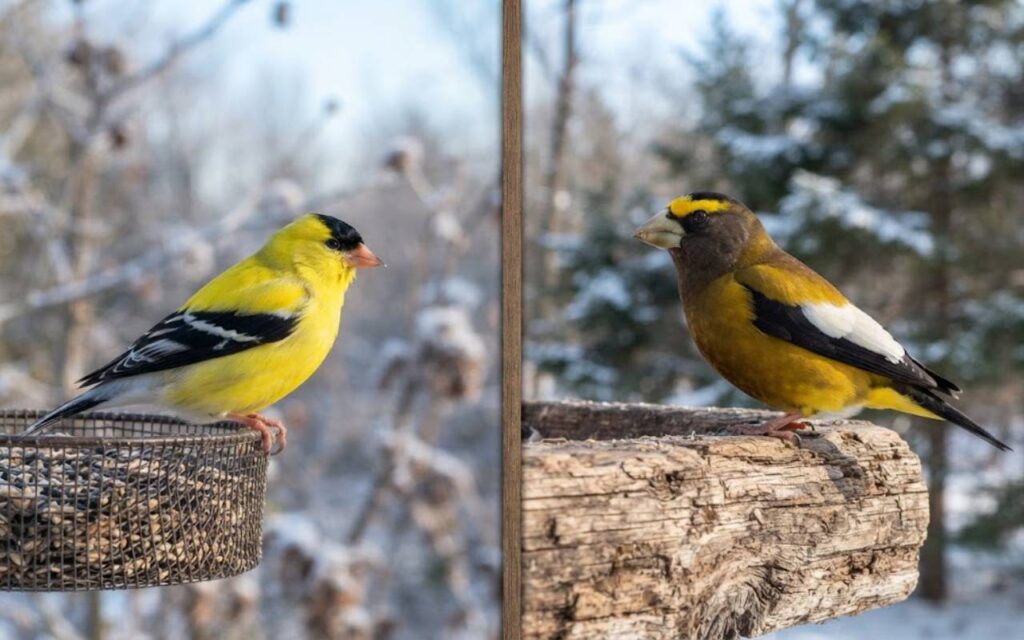
Telling the difference between an American Goldfinch vs. Evening Grosbeak comes down to body scale, bill mechanics, and feeding posture. Both species display striking yellow and black feather patterns, but confusing them usually happens when viewing silhouettes against bright skies or sorting through drab winter flocks.
Backyard observers frequently encounter identification challenges during northern irruption years when grosbeaks travel far south of their typical breeding range. Recognizing how their physical profiles, bill shapes, and feeder behaviors contrast will help you identify both species accurately and set up your yard gear properly.
Quick-Glance Field Summary
American Goldfinches are petite seed-gleaners with slender, sharp bills suited for tiny nyjer seed, while Evening Grosbeaks are heavy-bodied finches sporting massive, bone-crushing bills built for sunflower shells. You can separate them in seconds by evaluating overall body mass, bill thickness, and wing patch patterns at your feeding station.
- Body Length: American Goldfinch measures 4.3 to 5.1 inches; Evening Grosbeak measures 6.3 to 8.3 inches.
- Body Weight: American Goldfinch weighs 11 to 20 grams; Evening Grosbeak weighs 53 to 74 grams.
- Bill Structure: Sharp, slender conical bill in goldfinches; massive, thick, pale ivory to chalky greenish-yellow cone in grosbeaks.
- Wing Markings: Narrow white wing bars on black wings for goldfinches; broad, solid white secondary patch on black wings for grosbeaks.
- Feeder Hardware: Clinging mesh tubes and 0.25-inch thistle socks for goldfinches; heavy-duty wooden platform trays or hopper feeders for grosbeaks.
Looking at Body Size and Bill Shape in the Field
The easiest way to separate these two birds is sheer physical bulk. An Evening Grosbeak is nearly double the length and roughly four times the weight of an American Goldfinch. Seeing an Evening Grosbeak for the first time usually surprises people because the bird resembles a stocky, neckless cardinal wrapped in goldfinch colors.
The bill design tells the real story of how these birds live. American Goldfinches carry small, sharply pointed conical beaks designed to pluck fine seeds from composite flowers like thistles and coneflowers. Their beaks change color seasonally, shifting from a dull grayish-brown in winter to a bright, fleshy orange in the spring breeding season.
Evening Grosbeaks possess an enormous, heavy bill anchored to a massive skull structure. This bill allows them to crack open tough tree seeds, cherry pits, and hard sunflower hulls with minimal effort. In winter, their bill appears pale ivory or chalky bone, turning a vibrant pastel blue-green when spring hormones surge.
| Field Identification Mark | American Goldfinch (Spinus tristis) | Evening Grosbeak (Coccothraustes vespertinus) | Quick-Glance Identification Key |
|---|---|---|---|
| Total Sizing & Bulk | Tiny and slender; averages 4.5 to 5.0 inches in length with a lightweight, compact frame. | Massive and robust; averages 7.0 to 8.5 inches in length with a heavy, thick-necked silhouette. | Look at the bulk; grosbeaks are giant, chunky birds that tower over small yard finches. |
| Beak Profile & Scale | Small, sharply pointed conical pinkish beak designed for picking tiny thistle seeds. | Gargantuan, thick conical bill; ranges from dull ivory-white in winter to pale green in spring. | Check the bill; grosbeaks display a massive, crushing beak that dominates their entire face. |
| Wing Mark Patterning | Jet-black wings broken cleanly by two thin, distinct white horizontal wing bars. | Jet-black wings broken by a large, massive solid white secondary patch panel block. | Wings check; grosbeaks show a giant, solid snowy-white block patch on the lower half of the wing. |
Spotting Plumage Differences in Summer and Winter
Male breeding goldfinches show bright lemon-yellow bodies offset by a jet-black cap set directly above the eyes. Their wings are black with crisp, narrow white wing bars, and their rumps display clean white feathering. Female goldfinches during summer remain far more subdued, showing dull olive-yellow tones without the black forehead cap.
Male Evening Grosbeaks carry a rich, dark mustard-yellow body that blends into a deep brownish head and neck. Instead of a small black cap, they show a brilliant golden-yellow forehead stripe that extends over the eye like a bright mask. Their black wings feature enormous, brilliant white patches across the secondary flight feathers that stand out even when the bird perches deep inside tree canopies.
Winter identification causes the most confusion for casual observers. American Goldfinches undergo a complete autumn molt into an unassuming, drab olive-tan or grayish-brown coat with subtle dark wings. Evening Grosbeaks never turn buff-brown; females and immature birds remain soft silver-gray with yellowish nape washes, dark wing tips, and large, unmistakable white wing patches.
How Feeder Styles Separate Goldfinches from Grosbeaks
Physical agility dictates how each bird approaches your feeding station. American Goldfinches are light, acrobatic acrobats that easily hang upside down from seed heads or balance on miniature pegs. They happily crowd around narrow tube feeders or cling to fine mesh socks filled with tiny nyjer seed.
Evening Grosbeaks are heavy, flat-footed perchers that lack the acrobatic dexterity of smaller finches. They cannot comfortably use standard finch tubes or narrow hanging perches because their bodies are simply too bulky to balance. Grosbeaks require wide, open feeding platforms, fly-through tray feeders, or broad hopper perches where they can sit upright while eating.
Dietary preferences also keep these species at separate feeders. Goldfinches focus their attention on small, oil-rich seeds like nyjer, hulled sunflower chips, and natural weed seeds. Grosbeaks ignore tiny thistle seeds entirely, preferring large black oil sunflower seeds, striped sunflower, and safflower seeds that require high jaw pressure to crack open.
Solving Feeder Spills and Flock Bullying in Your Yard
Backyard birders on platforms like Reddit’s r/birdwatching frequently report severe feeder issues when winter grosbeak flocks arrive. During irruption winters, dozens of grosbeaks descend at once, causing lightweight hanging feeders to swing violently and spill expensive seed across the ground.
One practical hack shared by users on r/backyardbirds involves anchoring hanging platforms with heavy bottom-eyelet bungee cords or switching to pole-mounted wooden trays weighted with clean flat river rocks.
- Hang small nyjer tube feeders with 0.25-inch perches to give goldfinches a dedicated space away from heavy birds.
- Install broad 18-inch catch trays underneath high-capacity hopper feeders to capture discarded sunflower shells.
- Space your feeding stations at least ten feet apart so shy goldfinches are not intimidated by aggressive grosbeak flocks.
- Mount platform feeders on rigid poles using heavy metal brackets rather than hanging them from free-swinging tree branches.
Excess seed spillage from voracious grosbeak feeding frenzies creates a serious health hazard on the ground below. Damp, discarded seed hulls quickly cultivate fungal pathogens like Aspergillus flavus, which produces toxic aflatoxins that poison native birds. Rake the ground under your platforms weekly and soak feeder trays in a 1:9 bleach-to-water solution to keep both finch species safe from disease.
Listening to Flight Calls and Watching Movement Patterns
Flight patterns provide an immediate visual clue before a bird ever lands in your yard. American Goldfinches fly with an exaggerated, undulating motion that looks like a miniature roller coaster. They flap their wings rapidly during the upward climb, close their wings to dip downward, and vocalize on every single drop.
Evening Grosbeaks fly in a much straighter, deliberate path. Their wingbeats are strong, steady, and fast, propelling them through the air like small, stocky missiles without deep swoops. They tend to travel in tight, cohesive flocks that stay high in the forest canopy before dropping directly down onto food sources.
The calls of these two birds sound completely different once you hear them side by side. Goldfinches give a cheerful, bouncy call in flight that sounds like “po-ta-to-chip” or a high-pitched “per-chick-o-ree.” In contrast, Evening Grosbeaks produce a sharp, metallic chirp that sounds remarkably like an amplified House Sparrow call, paired with short, burry flight whistles that echo across winter woods.