
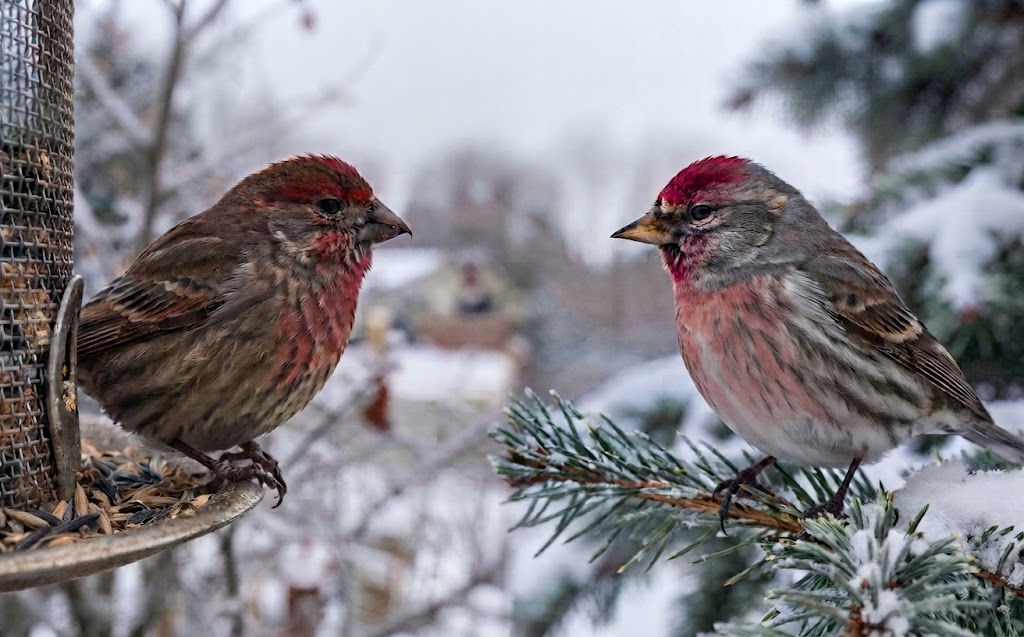
Telling the difference between a House Finch vs. Cassin’s Finch can frustrate even experienced birders when a flock lands on a feeder. Both of these red-capped finches share similar body sizes, overlapping ranges in western North America, and an appetite for black oil sunflower seeds.
Small field marks make identification simple once you know where to focus your binoculars. Paying attention to bill shape, crown feathers, and underbelly streaking reveals reliable differences between these two common cousins.
Side-by-Side Comparison Summary Table
| Identification Trait | House Finch | Cassin’s Finch |
|---|---|---|
| Culmen (Upper Bill Profile) | Noticeably curved, swollen, and bulbous; gives a blunt, stubby appearance | Sharp, razor-straight edge; forms an elongated, needle-sharp conical wedge |
| Male Color Tone & Cast | Warm brick-red, strawberry, or yellow-orange; bleeds heavily onto brown flanks | Intense, cool raspberry-pink or wine-red; contrasts sharply against a pale neck |
| Crown / Head Silhouette | Always smooth, flat, and uniformly rounded | Spiky, peaked cap; often raised into a deliberate crest when alert |
| Belly & Flank Streaks | Broad, blurry, diffuse gray-brown stripes | Fine, crisp, high-contrast dark pencil lines |
| Underbody Background | Dirty white, dull grayish-buff, or cream-toned | Pristine, stark, snow-white canvas |
| Undertail Coverts | Thick, broad, smudged dusky brown center streaks | Bright white feathers; clean or marked only with hairline shaft streaks |
| Breeding Elevation | Lowland valleys, urban zones, and human landscaping | Mature montane conifer forests strictly above 4,000–5,000 feet |
Checking the Shape and Curve of the Bill
The bill provides the single most reliable anatomical feature for separating these two birds. A House Finch shows a noticeably curved upper bill edge, known as the culmen, which creates a rounded, stubby profile. The lower mandible also curves upward slightly, giving the bird a blunt face that looks built for cracking hard yard seeds.
A Cassin’s Finch possesses a bill with a sharply straight culmen that comes to a fine, needle-like point. Both the top and bottom edges of the bill form straight lines, creating an elongated, conical wedge shape. This straight profile helps the Cassin’s Finch extract seeds from tough pine cones across high-elevation evergreen forests.
Birders in online identification forums frequently share close-up side photos where lighting obscures feather colors entirely. Forum contributors on r/whatsthisbird regularly remind novice observers to trace the top silhouette of the bill before considering plumage. If the bill looks swollen or arched like a tiny parrot, you are looking at a House Finch.
Looking at Red Feather Tones and Head Crests
Male plumage shows distinct differences in both saturation and distribution across the head and back. A male House Finch wears a wash of warm brick-red, strawberry, or sometimes yellow-orange across its forehead, throat, and rump. This color contrasts against a dull, grayish-brown back marked with thick, indistinct dark streaks.
A male Cassin’s Finch carries an intense raspberry or wine-red coloration that looks much cooler in tone. The brightest patch concentrates into a brilliant, squarish cap that stands out sharply against a paler pink neck and throat. The brown feathers on its back also feature clean pink edges, creating a frosted appearance.
Backyard birders on regional birding boards often note that male Cassin’s finches look like they have a messy, peaked hairdo. Cassin’s finches frequently raise their bright crown feathers into a distinct, peaked crest when alert or feeding alongside rivals. A House Finch keeps its crown smooth and rounded without showing this tufted display.
Spotting the Streaks on the Belly and Undertail
Female and juvenile finches lack bright red feathers, which makes underbody streaking your best field mark. A female House Finch displays soft, blurry, gray-brown streaks across a dirty white or buff background. These diffuse streaks start high on the upper breast and run continuously across the entire belly and sides.
Female and immature Cassin’s finches show much crisper, high-contrast markings against a bright, snowy white chest. The streaks resemble fine, dark pencil strokes that stop cleanly before the lower belly. The overall contrast looks sharp and clean rather than smudged.
Checking the undertail coverts beneath the tail feathers provides another solid checkpoint. In forum troubleshooting threads, wildlife photographers point out that House Finches display wide, dusky brown central streaks under the tail. A Cassin’s Finch has clean white undertail coverts, occasionally marked only by hairline streaks along the feather shafts.
- Examine breast background tone: Buff-gray on House Finch; clean, stark white on Cassin’s Finch
- Check streak definition: Broad and smudged on House Finch; narrow, distinct pencil lines on Cassin’s Finch
- Inspect lower belly: Streaked continuously on House Finch; clean, unstreaked white on Cassin’s Finch
- View undertail feathers: Thick, dusky markings on House Finch; bright white with minimal marking on Cassin’s Finch
Identifying the Confusing Female Plumages
Cracking the Code on Female and Juvenile Finches
Brown finches without bright crown colors cause the absolute highest volume of diagnostic panic on community bird boards. When a flock of streaked, drab females arrives at your feeding station, you can bypass color altogether by evaluating background contrast and streak geometry.
A female House Finch looks muddy, soft, and blended. The gray-brown streaks lack distinct borders because they spread lazily across a buffy-gray background. These smudged stripes run continuously down the breast, spread entirely across the mid-belly, and saturate the flanks.
A female Cassin’s Finch looks remarkably crisp, tailored, and high-contrast. The markings are compressed into narrow, dark, distinct pencil lines that jump out vividly against an immaculate, stark white chest.
Crucially, these fine lines stop abruptly before reaching the lower abdomen, leaving the lower belly clean and unstreaked. If you catch a glimpse of the underside of the tail, look for fine, needle-thin lines restricted directly to the central feather shafts on an otherwise bright white background.
Listening to Their Calls and Watching How They Act
Sound offers immediate clues when birds hide inside dense foliage or feed high in conifer trees. The House Finch delivers a loose, cheerful song that rises and falls before ending on a sharp, rising wheeer or cheeer note. Their flock flight call is a simple, dry chirp similar to the sound of an English House Sparrow.
The Cassin’s Finch sings a much faster, louder, rolling cascade of musical notes that lacks the nasal buzz of the House Finch. Skilled listeners often hear subtle vocal mimicry woven into the melody, including snippets of red-breasted nuthatch or western tanager calls. Their flight call consists of a rolling, three-syllable kee-up or tidilip note.
Feeding behavior also changes depending on which species lands at your feeder station. House finches tend to stay low, comfortably gathering on platform trays, window ledges, and tube feeders. Cassin’s finches remain flighty, often perching high on tree branches and dropping down briefly before retreating into tall timber.
Knowing Where and When Both Species Overlap
Habitat selection separates these finches throughout most of the spring and summer breeding seasons. House finches live as habitat generalists, thriving in urban gardens, farms, deserts, and suburban neighborhoods at lower elevations. They tolerate human activity well and build nests in porch eaves, hanging planters, and yard shrubs.
Cassin’s finches spend their breeding season in open, mature conifer forests, especially among ponderosa pine, lodgepole pine, and Douglas fir stands. They rarely drop into urban neighborhoods during the summer unless a town sits inside a mountain valley above 5,000 feet. You will almost never see a wild Cassin’s Finch nesting in low coastal valleys or eastern suburbs.
Winter weather forces high-elevation Cassin’s finches down the mountain slopes, leading to temporary feeder mix-ups. Irruptive winter movements bring flocks into foothills and nearby valley floors where they compete directly with resident house finches. When snowpack covers mountain cones, watch your tube feeders closely for the pale, raspberry-capped finches mingling among your local birds.
Managing Winter Flock Bullying and Feeder Dynamics
Troubleshooting Winter Flock Bullying at Your Station
Winter altitudinal migrations change feeder dynamics instantly. When heavy alpine snow forces flighty, high-elevation Cassin’s Finches down into valleys, their arrival can trigger intense territorial squabbles with your resident, sedentary House Finches.
Because Cassin’s Finches are highly competitive and travel in dense, aggressive winter flocks, they can easily monopolize standard platforms and push resident backyard songbirds away.
You can break up flock crowding and restore peace to your yard using targeted hardware adjustments:
- Pivoting to Small Mesh or Tube Ports: House Finches and Cassin’s Finches are both generalist seed-eaters that love broad platform trays where they can crowd out other birds. Switch your presentation to tube feeders with small metal ports or specialized weight-sensitive perch configurations that limit the number of active feeding spaces.
- Separating Your Seed Stations: Deploy multiple distinct feeding zones across your yard rather than clustering everything on a single pole system. Hang one tube feeder with large black oil sunflower seeds to satisfy the heavy-billed Cassin’s Finches, while placing a separate nyjer or hulled sunflower chip station twenty feet away.
- Leveraging Geometric Cages: If aggressive winter finches are completely draining your premium blends, deploy a wire exclusion cage around your core feeders. Cages with 1.5-inch grid openings easily accommodate small wintering songbirds while forcing tightly packed finch flocks to feed in an orderly, spaced manner along the exterior perimeter.