
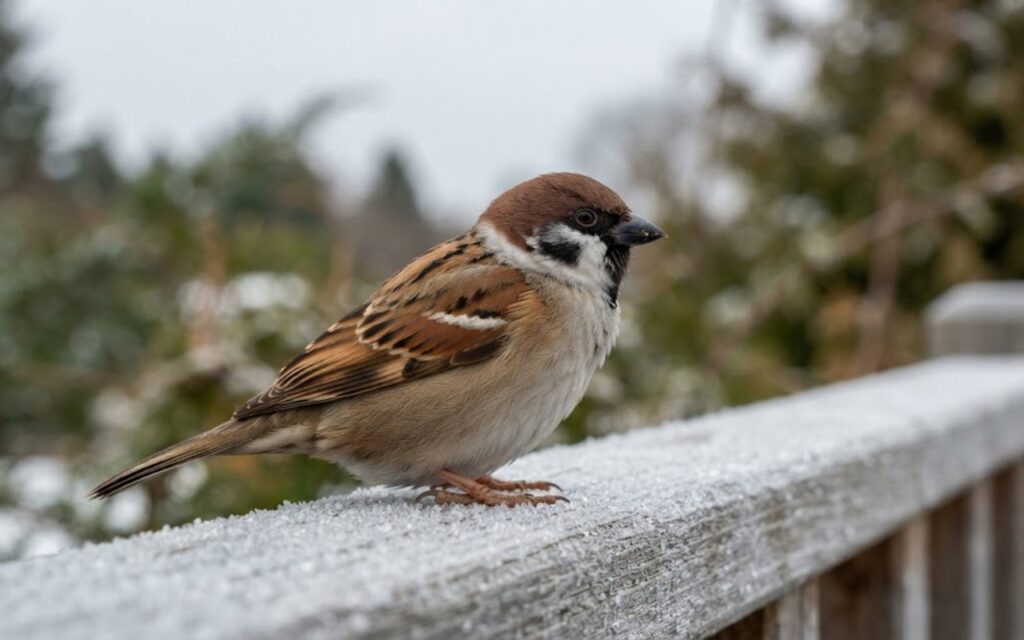
Telling the difference between a House Sparrow vs. Eurasian Tree Sparrow comes down to spotting a few fine head markings and noticing how the birds group together. Backyard birders frequently confuse these two closely related weaver finches because they share similar body shapes, stout seed-cracking bills, and rich brown plumage patterns.
Once you know where to look on the face and neck, sorting them out takes only a few seconds through a basic pair of binoculars. Paying attention to geographic range, sexual dimorphism, and feeding habits will give you absolute certainty on your next feeder count.
Quick-Glance Field Summary
Telling these two sparrows apart requires checking for a bold black ear patch on an all-white cheek and checking whether the crown is pure chestnut or slate gray. Eurasian Tree Sparrows share identical plumage across both sexes, while House Sparrows show dramatic differences between males and females.
| Feature / Field Mark | Male House Sparrow | Eurasian Tree Sparrow | Female House Sparrow |
|---|---|---|---|
| Head Crown | Slate gray center flanked by deep chestnut | Pure chocolate chestnut | Dull sandy gray |
| Cheek Patch | Plain dingy gray without any spots | Crisp black spot on white background | Plain buff-gray with pale eyebrow stripe |
| Black Bib | Broad bib spreading wide across the breast | Compact patch restricted to chin and throat | None |
| Wing Bars | One broad white bar, one faint bar | Two distinct, thin white wing bars | Faint, muted buff bars |
| Sex Differences | Highly dimorphic (males bold, females drab) | Monomorphic (males and females look identical) | Highly dimorphic |
| North American Range | Continent-wide urban and rural footprint | Limited to eastern Missouri and west-central Illinois | Continent-wide urban and rural footprint |
Look Closely at the Cheek Spot and Crown Color
The fastest, most reliable field mark sits directly on the bird’s cheek. A Eurasian Tree Sparrow possesses a stark white cheek broken by an unmistakable, neat black spot right over the ear coverts. Male House Sparrows lack this isolated cheek dot entirely, showing a wash of pale ash-gray across the face that blends into their darker bib.
Next, look straight at the top of the head. A Eurasian Tree Sparrow wears a rich, solid chocolate-brown or deep chestnut cap that extends smoothly down the nape of the neck. In contrast, a male House Sparrow displays a slate-gray crown bounded on the sides by deep chestnut wings that sweep backward from behind the eye.
The black bib beneath the bill provides another distinct visual clue. A Eurasian Tree Sparrow maintains a compact, tidy black patch restricted to the chin and immediate throat. Male House Sparrows sport a much broader bib that often spreads wide across the breast, especially during the spring breeding season when feather wear exposes deep black feather bases.
Check if the Males and Females Look Alike
Sex differentiation represents a massive divide between these two species. If you observe a pair of sparrows where one bird has rich markings while the other is plain sandy brown, you are definitely looking at House Sparrows. Female House Sparrows have completely plain, buff-gray breasts, no black facial markings, and a distinct pale yellowish-buff eyebrow stripe running behind the eye.
Eurasian Tree Sparrows are sexually monomorphic, meaning adult males and adult females look completely identical in the field. Every adult bird in an active Eurasian Tree Sparrow flock shows the same solid chestnut cap, bright white cheek, and prominent dark ear spot. If every sparrow hopping under your feeder displays a dark bib and a cheek patch, you are watching a group of tree sparrows.
Juvenile plumage can occasionally introduce minor confusion during late summer and early autumn. Young Eurasian Tree Sparrows resemble their parents almost immediately, though their cheek spots and bibs appear duller and less defined for their first few weeks. Young male House Sparrows can look patchy as they molt, but they never develop the isolated cheek spot characteristic of their cousins.
Watch How They Act Around Your Feeders
Backyard observers on wild bird forums frequently discuss the behavioral differences between these two species when sharing backyard feeding stations. Members of community birding groups in the American Midwest note that Eurasian Tree Sparrows tend to act more cautious and skittish around domestic activity than standard House Sparrows. When a mixed flock approaches a feeding platform, the tree sparrows often hold back along the perimeter in nearby shrubs before darting in to grab food.
Discussion threads on regional birding boards highlight that House Sparrows readily bully other birds, aggressively monopolizing hanging hopper feeders and tube ports. Eurasian Tree Sparrows prefer feeding on flat ground trays or low platform feeders, happily sifting through dropped seeds alongside native native sparrows. They rarely show the same drive to chase off native finches or chickadees that aggressive male House Sparrows exhibit daily.
Their foraging movements in tree canopies also differ noticeably. Eurasian Tree Sparrows spend considerable time gleaning tiny insects and weed seeds from high tree limbs, true to their common name. House Sparrows spend far more time strutting along open pavement, concrete patios, and structural rooflines near human dwellings.
Map the Birds to Your Specific Location
Geography narrows down your identification options immediately if you are birding in North America. House Sparrows thrive across the entire continent, nesting in every state, province, and urban center from Alaska down through Central America. Eurasian Tree Sparrows occupy an extremely restricted North American footprint centered around the St. Louis metropolitan area, west-central Illinois, and southeastern Iowa.
The North American Eurasian Tree Sparrow population originated from just twenty birds released into St. Louis city parks in 1870. While House Sparrows quickly swept across the entire continent, tree sparrows remained largely contained within regional river valleys and agricultural countrysides. If you spot a sparrow with a cheek spot outside of this Midwestern pocket, verify your sighting thoroughly and report it to regional bird record committees.
In Europe, the United Kingdom, and Asia, both species overlap extensively across rural and suburban borders. European field observers note that urban cores belong almost exclusively to House Sparrows, while Eurasian Tree Sparrows stick to open farmland, hedgerows, and woodland edges. Understanding your local habitat context prevents simple visual misidentifications before you even lift your optics.
Choose the Right Nest Boxes and Food to Help Them
Backyard hobbyists hoping to attract Eurasian Tree Sparrows while discouraging massive flocks of House Sparrows must tailor their food offerings. Fill your hopper feeders with black oil sunflower seeds, safflower, or nyjer rather than cheap commercial mixes heavy in cracked corn and milo. House Sparrows swarm cracked corn and wheat fillers, whereas tree sparrows happily consume pure sunflower hearts and white proso millet scattered on elevated trays.
Nesting site competition creates severe conflict between these two cavity nesters. House Sparrows will aggressively enter nest boxes, destroy eggs, and kill competing cavity-dwelling birds to claim territory. While a 29-millimeter hole is often recommended for Eurasian Tree Sparrows, it will not reliably exclude a determined House Sparrow. To truly restrict larger House Sparrows and give Eurasian Tree Sparrows a nesting advantage, use an entrance hole diameter of exactly 28 millimeters, or place your boxes deeper into rural settings away from the urban cores where House Sparrows dominate.
If you clean out your wooden nest boxes before each spring breeding season, use a simple dilution soak of one part household bleach to nine parts clean water. Avoid applying synthetic chemical sprays, petroleum deterrents, or paint inside the nest chamber, which can disrupt feather waterproofing and cause hypothermia. Mount nest boxes on metal poles equipped with smooth stovepipe predator baffles at least five feet above the ground to keep both species safe from climbing predators.