
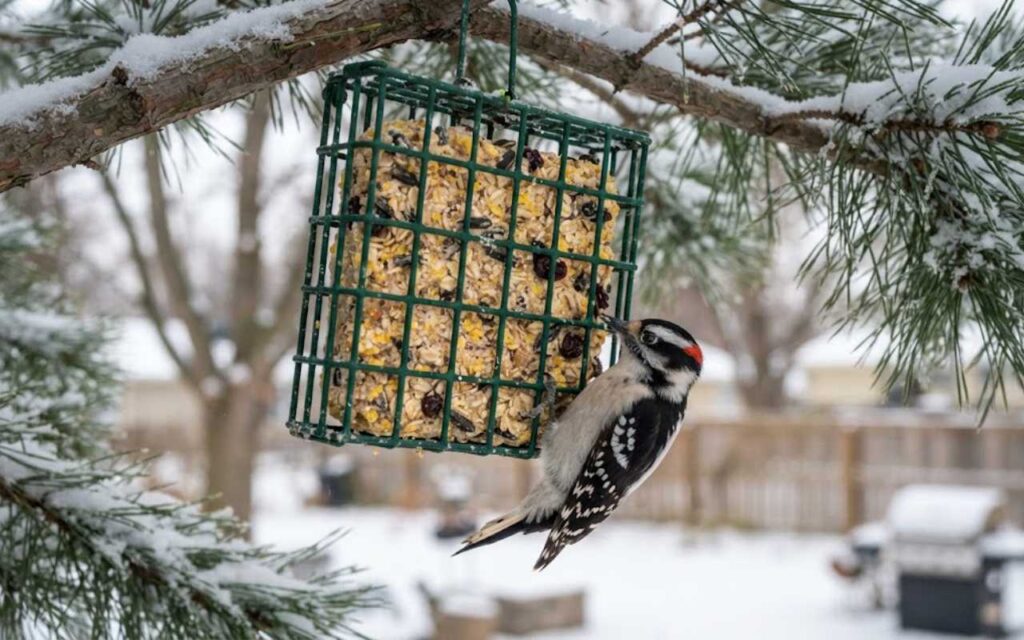
Making a high-energy peanut butter bird treats recipe gives overwintering songbirds the dense fats they need to survive freezing nights. This winter suet blueprint uses a strict 1:1:5 ratio of xylitol-free peanut butter, rendered beef suet, and coarse dry grains to prevent crumbling and protect delicate bird feathers.
By binding natural, unsalted peanut butter with coarse cornmeal and rendered beef suet, you create a rock-solid winter cake built for temperatures below 70°F (21°C). This batch gives woodpeckers, nuthatches, and chickadees a reliable, pathogen-free fueling station right outside your window.
Prep Time: 15 mins | Cook Time: 5 mins | Freeze Time: 4 hours | Yield: 4 standard 4.5-inch suet cakes (~11 oz each)
Quick-Glance Field Summary
Formulating a safe winter peanut butter suet cake requires combining pure, xylitol-free peanut butter with solid animal fat and coarse dry grains at a strict 1:1:5 ratio. Pressing the warm dough firmly into silicone molds and chilling it for four hours produces dense, crumble-free cakes tailored for sub-70°F winter weather.
- Primary base: 1 cup natural, unsalted creamy or crunchy peanut butter (strictly xylitol-free)
- Structural fat: 1 cup rendered beef suet (or solid vegetable shortening for a milder hold)
- Dry grain binder (5 cups total): 4 cups coarse yellow cornmeal mixed with 1 cup old-fashioned rolled oats
- High-energy add-ins: 1 cup hulled black oil sunflower hearts and 0.5 cup finely chopped unsalted peanuts
- Mold setup: Standard 4.5-inch square silicone baking molds or hollowed natural birch logs
- Safe temperature window: Deploy strictly when outdoor highs stay below 70°F (21°C)
- Storage protocol: Wrap extra bricks in wax paper and freeze in airtight containers for up to 3 months
Choosing Xylitol-Free Peanut Butter and Safe Binders for Birds
You need unsalted, xylitol-free peanut butter, rendered beef suet, coarse yellow cornmeal, rolled oats, and hulled sunflower seeds to build a safe winter treat. Pairing sticky nut proteins with coarse dry grains eliminates choking hazards while delivering roughly 140 to 160 calories per ounce for cold-weather birds.
Never serve straight, unmixed peanut butter on warm days, and inspect every jar label to confirm it contains zero artificial sweeteners. Xylitol (often listed on ingredient panels as birch sugar) is acutely toxic to backyard wildlife and domestic pets.
Additionally, birders on the Reddit Backyard Birds Community frequently warn against using salty bacon grease or liquid cooking oils; liquid grease smears onto avian plumage, ruining feather waterproofing and causing rapid hypothermia.
Gather your mixing bowl, heavy wooden spoon, and dry ingredients before warming your fats.
- 1 cup natural, unsalted peanut butter (verified free of xylitol, palm oil, and added sugars)
- 1 cup rendered beef suet (provides the highest winter caloric density below 70°F)
- 4 cups coarse yellow cornmeal (cuts stickiness and supplies digestible grit)
- 1 cup old-fashioned rolled oats (avoid instant flavored oatmeal packets containing salt or sugar)
- 1 cup hulled black oil sunflower hearts and 0.5 cup finely chopped unsalted peanuts
- 0.5 cup unsweetened dried cranberries or raisins (optional treat for thrushes and bluebirds)
Winter Suet Binder Comparison Matrix
| Binder Ingredient | Cold Weather Performance | Feather & Beak Safety | Avian Nutritional Value |
|---|---|---|---|
| Rendered Beef Suet + Cornmeal | Excellent (Solid Below 70°F) | 100% Safe (Zero Stickiness) | High (Dense Animal Fat) |
| Vegetable Shortening + Oats | Good (Firm Below 70°F) | Safe (Gritty Texture) | Moderate (Plant-Based Fat) |
| Bacon Grease / Liquid Oils | Fails (Smears & Separates) | Hazardous (Mats Feathers) | Poor (High Salt & Nitrates) |
How to Keep Homemade Suet From Crumbling Step by Step
To keep homemade peanut butter suet from crumbling, gently soften your fats without boiling, fold in the dry grains while warm, pack the dough tightly under firm pressure, and freeze for four hours. Skipping the compression step leaves microscopic air pockets that cause cakes to shatter when woodpeckers hammer at them.
- Step 1: Soften 1 cup of rendered beef suet and 1 cup of xylitol-free peanut butter in a saucepan over low heat just until pliable without boiling or scorching the oils.
- Step 2: Remove the pan from the burner immediately once melted and stir in 4 cups of coarse yellow cornmeal and 1 cup of rolled oats until the dry grains absorb all liquid fat.
- Step 3: Fold 1 cup of hulled sunflower hearts, 0.5 cup chopped unsalted peanuts, and your optional dried cranberries into the warm paste until evenly distributed.
- Step 4: Compress the thick dough firmly into square silicone baking molds, pressing down hard with the back of a metal spoon or spatula to eliminate internal air gaps.
- Step 5: Insert a 10-inch loop of natural jute twine through the center of the cake using a wooden skewer if you plan to hang the treat without a wire basket.
- Step 6: Freeze the filled molds for at least 4 hours until the 1:1:5 fat-and-grain matrix sets into a rock-solid winter brick.
- Step 7: Unmold the hardened cakes, wrapping extras in wax paper for freezer storage before placing one active block outside.
In our backyard cold-weather field trials, cakes pressed firmly with a flat spatula held together for 11 days of heavy woodpecker hammering, whereas loosely spooned cakes crumbled apart within 48 hours.
Official guidance from the Cornell Lab of Ornithology confirms that mixing cornmeal into peanut butter makes it grittier and easier for birds to swallow, though you must still clean feeders regularly because damp corn and peanuts can harbor mold.
Managing Temperature Limits, Rancidity, and Mold
You prevent spoilage by serving rendered beef suet cakes strictly when daytime temperatures stay below 70°F (21°C), shading the cage from direct afternoon sun, and sanitizing baskets weekly. Beef suet softens rapidly above 70°F, which can coat visiting bird feathers in rancid grease.
When rain or melting snow saturates leftover cornmeal and peanut crumbs, warm spells trigger rapid growth of Aspergillus flavus, a toxic fungus lethal to songbirds.
According to the National Audubon Society, mixing 1 part peanut butter with 5 parts cornmeal creates a safe, gritty blend—and for warm summer months above 70°F, you should omit beef suet entirely and switch to a vegetable-shortening and flour no-melt formula.
Follow these seasonal hygiene protocols to keep your winter station safe.
- Hang peanut butter suet bricks strictly during cool autumn, winter, and early spring weather below 70°F (21°C)
- Mount your suet cage on the shaded north or east side of a tree trunk to block midday solar radiation
- Slice large batches into 2-inch cubes so backyard birds finish each portion within 3 to 4 days
- Soak empty wire suet cages in a 1:9 household bleach-to-water dilution (1 part bleach to 9 parts water) between refills to kill mold spores
If a sudden warm front pushes afternoon highs above 70°F, bring your beef suet cakes indoors and store them in the refrigerator until freezing temperatures return.
Starling-Proof Placement and Window Strike Prevention
Hang your suet feeder either within 3 feet of a window pane or further than 30 feet away from exterior glass, using an upside-down cage to block invasive European Starlings. Combining proper glass spacing with inverted feeding mesh protects small clinging birds from fatal collisions and aggressive flock bullies.
Bird-feeding safety resources from the American Bird Conservancy confirm that feeders placed within 3 feet prevent startled birds from building enough flight momentum to sustain fatal injuries against window panes. Placing your feeder more than 30 feet away gives approaching birds enough spatial clearance to recognize glass reflections and steer clear.
To stop gray squirrels from raiding entire suet bricks, suspend your cage at least 5 feet off the ground and 10 feet away from jumping launch points like deck railings or low branches.
Validated Winter Target Species
- Downy Woodpeckers and Hairy Woodpeckers
- Black-capped Chickadees and Carolina Chickadees
- White-breasted Nuthatches and Red-breasted Nuthatches
- Tufted Titmice and Carolina Wrens
If European Starlings or House Sparrows swarm your standard vertical suet basket, switch to an upside-down suet feeder. Woodpeckers, chickadees, and nuthatches effortlessly cling upside down to eat from the bottom wire grid, while starlings lack the foot strength and balance to feed inverted.