
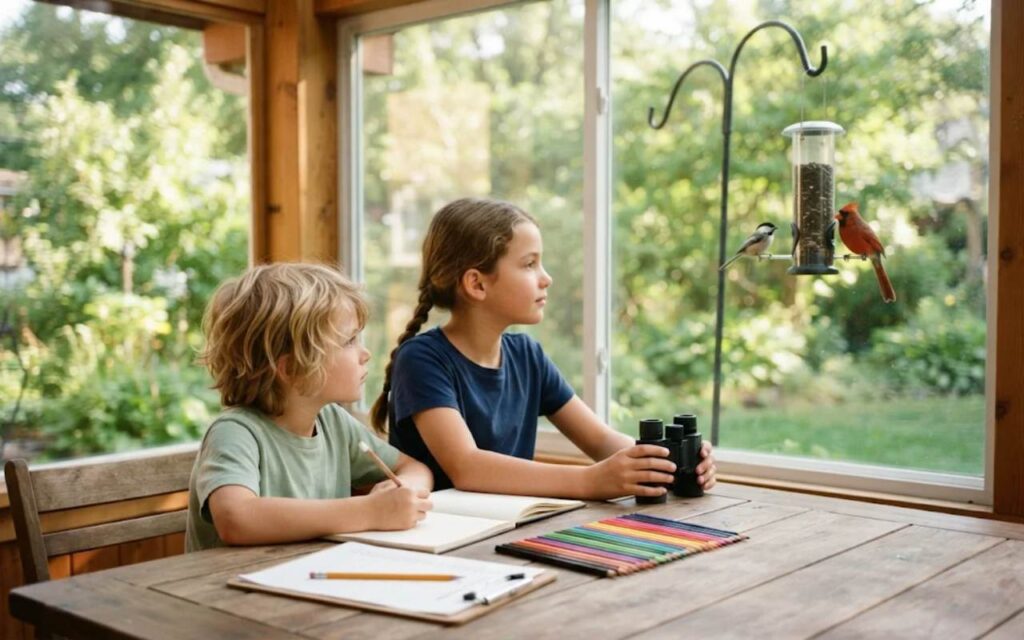
The best backyard birdwatching activities for kids pair hands-on feeder building and habitat projects with short, interactive observation games like sound mapping, feather-color bingo, and 10-minute feeder counts.
Young children rarely enjoy sitting motionless for an hour waiting for a rare warbler to appear, so successful family birding flips the script by letting kids actively build food stations, collect data like real field scientists, and spot familiar neighborhood species right outside the kitchen window.
Whether you have a sprawling wooded yard, a suburban patio, or a single balcony window box, these 8 age-tailored activities turn everyday backyard wildlife into an exciting outdoor routine across every season.
Quick-Glance Summary: Top Birdwatching Activities by Age
- Ages 3 to 5 (Preschool): Feather-color scavenger hunts, 5-minute window feeder counts, and simple pinecone or apple-ring seed feeders.
- Ages 6 to 9 (Early Elementary): Backyard sound mapping, nesting-material baskets, DIY birdbath water stations, and hand-drawn field journals.
- Ages 10 to 13+ (Tweens & Teens): Citizen science data logging (Project FeederWatch or eBird), bird-by-ear call quizzes, and wildlife photography challenges.
1. Set Up a “10-Minute Window Count” Station
Long nature hikes often tire out younger children before they spot a single bird. Instead, bring the birds directly to a ground-floor window by setting up a 10-minute morning feeder count during the first 60 to 90 minutes after sunrise, when backyard feeder traffic peaks right around breakfast time.
- 1. Position the Feeder Safely: Hang a tube or platform feeder loaded with black oil sunflower seeds either within 3 feet of a window (so birds cannot build enough flight speed to injure themselves on the glass) or more than 30 feet away, following U.S. Fish & Wildlife Service collision-prevention guidelines. To keep squirrels from chasing birds away mid-count, mount the feeder roughly 5 feet off the ground and 8 to 10 feet away from fences, tree trunks, or deck railings that act as jumping launch points.
- 2. Create a Simple Tally Sheet: Give your child a clipboard with pictures of 5 to 6 common local visitors, such as Black-capped Chickadees, Northern Cardinals, Blue Jays, Mourning Doves, Downy Woodpeckers, and American Goldfinches.
- 3. Set a 10-Minute Timer: Have your child make a tally mark every time a species lands on the feeder or ground below. Short, timed bursts keep focus high and build real counting and pattern-recognition skills.
2. Play Backyard “Sound Mapping” with Eyes Closed
Experienced birders rely on sound to locate and identify the vast majority of songbirds before ever lifting binoculars. Sound mapping teaches kids to slow down and tune into directional hearing without needing any gear.
- Draw the Map: Hand each child a blank index card with an “X” drawn in the center to represent where they are sitting.
- Listen for 3 Minutes: Have everyone sit quietly on the grass or porch steps with their eyes closed and one fist raised. Every time they hear a distinct bird song, call note, or woodpecker drumming, they lift one finger.
- Plot the Sounds: When the timer ends, kids draw symbols on the card showing where each sound came from relative to the center “X” (for example, musical notes near the top-left corner for a robin in the oak tree, or a zigzag line behind them for a jay).
3. Build a No-Nut Pinecone or Apple-Ring Bird Feeder
Hands-on feeder crafts give kids immediate ownership over their backyard habitat, especially when local birds visit their creation within a day or two.
- Allergy-Safe Pinecone Feeder: Tie a 12-inch piece of natural jute twine around the top scales of a clean, dry pine cone. Let kids spread sunflower seed butter (or vegetable shortening) into the crevices using a butter knife, then roll the cone in a shallow tray of black oil sunflower seeds and hulled millet.
- Threaded Apple-Ring Feeder: Core a crisp apple and slice it into 1/2-inch rings. Have kids thread the slices onto sturdy twine, press sunflower seeds into the flesh, and hang the garland from a sturdy branch for orioles, woodpeckers, and chickadees.
- Important Hygiene Rule: Replace homemade fruit or seed-butter feeders after 5 to 7 days (or sooner in warm, rainy weather) so birds are never exposed to spoiled fats or moldy seeds.
4. Assemble a Spring Nesting-Material Basket
During spring breeding season, female songbirds make hundreds of trips gathering soft fibers to line their nests. Kids love setting up a “bird supply store” and watching which species shop at it.
- 1. Choose a Safe Container: Use an empty wire suet cage, a clean mesh produce bag, or a small whisk hung from a shaded branch.
- 2. Stock Safe Natural Materials: Fill the holder with dried grass clippings (untreated with lawn chemicals), short twigs, pine needles, dead leaves, and natural plant fluff such as cattail down or milkweed silk.
- 3. Skip Dangerous Items: Never offer dryer lint (which crumbles into wet paste and carries detergent residue or microplastics), processed cotton batting (which absorbs water like a sponge and chills eggs or hatchlings), human hair, tinsel, cellophane, or any yarn or string (which can entangle nestlings’ legs).
5. Run a Color-and-Behavior Backyard Bingo Game
Younger children often struggle to aim binoculars at tiny moving targets in treetops. A visual bingo card shifts their focus from tricky species names to obvious colors and behaviors they can spot with the naked eye.
Include easy-to-spot squares such as:
- A bird with bright red feathers (Northern Cardinal or House Finch)
- A bird hopping on the ground with two feet together (Dark-eyed Junco or Song Sparrow)
- A bird climbing upside down down a tree trunk (White-breasted Nuthatch)
- A bird pecking or drumming on wood (Downy or Hairy Woodpecker)
- A bird taking a drink or splashing in water
- A bird carrying a seed or twig in its beak
6. Start a Kid-Friendly Field Sketch Journal
Rather than handing kids a dense adult field guide filled with confusing plumage charts, give them a blank sketchbook and colored pencils to document what they actually see.
Encourage them to focus on four key field marks whenever a bird lands nearby:
- Size Comparison: Is it smaller than a sparrow, about the size of a robin, or as big as a crow?
- Beak Shape: Does it have a short, thick cone bill for cracking seeds, or a sharp, pointed bill for probing bark and insects?
- Color Patches: Where are the boldest markings (a black cap, a white eye-ring, wing bars, or a spotted chest)?
- Tail Action: Does it flick its tail up and down, fan it out in flight, or prop it stiffly against a tree trunk like a woodpecker?
7. Build a Shallow Pebble Birdbath Station
Offering fresh water attracts species that rarely visit seed feeders, including robins, bluebirds, cedar waxwings, and migrating warblers.
- Keep It Shallow: Birds need water no deeper than 1 to 2 inches so they can bathe safely without soaking their feathers. Place a clean terra-cotta plant saucer on a stump or low table and arrange flat river stones inside so small birds have non-slip perches.
- Add Moving Water: Hang a recycled plastic milk jug with a tiny pinhole punctured in the bottom directly above the dish. The slow, steady drip creates ripples and gentle splashing sounds that draw curious birds from across the yard.
- Scrub Every 2 to 3 Days: Have kids dump out old water, scrub away algae with a stiff brush, and refill with fresh tap water to prevent mosquito larvae and bacterial buildup.
8. Join a Real Citizen Science Project
For older kids and tweens who want their observations to count toward real wildlife conservation, family backyard counts feed directly into university research databases:
- Project FeederWatch (Cornell Lab of Ornithology): Runs from November 1 through April 30, allowing families to count the highest simultaneous number of each species seen at their feeders over two consecutive days each week.
- The Great Backyard Bird Count: A free, four-day global event held every February where families spend as little as 15 minutes counting birds in their yard or local park and submitting results online.
- Merlin Bird ID App (Sound ID): Use the free Merlin app on a phone or tablet as an interactive “listening game” by letting kids guess who is singing first, then checking the live spectrogram to confirm their guess.
Backyard Birdwatching Activities Comparison Table
| Activity | Best Age Group | Time Needed | Core Skill Built |
|---|---|---|---|
| 10-Minute Window Count | Ages 4 to 12 | 10 minutes | Species identification & basic data tallying |
| Backyard Sound Mapping | Ages 5 to 14 | 10 to 15 minutes | Active listening & spatial awareness |
| Pinecone / Apple Feeders | Ages 3 to 10 | 20 minutes | Fine motor skills & wildlife stewardship |
| Nesting-Material Basket | Ages 4 to 11 | 15 minutes | Seasonal ecology & safe vs. unsafe habitat materials |
| Color & Behavior Bingo | Ages 3 to 8 | 15 to 20 minutes | Visual observation without needing binoculars |
| Citizen Science Counts | Ages 8 to 16+ | 15 to 30 minutes | Real-world scientific recording & conservation |
Choosing the Best First Binoculars for Kids
Adult binoculars are often too heavy for small hands and have barrels spaced too wide for a child’s eyes. Look for 6×30 or 8×32 roof-prism binoculars with rubber armor, a center focus wheel, and a center hinge that folds narrow enough to match a child’s interpupillary distance (typically 50mm to 55mm). If your child wears glasses, twist or fold the rubber eyecups all the way down so their lenses sit close enough to see the full field of view without dark tunneling.
Before heading outside, practice the “eyes first, binoculars second” rule: have your child lock their eyes onto a stationary target (like a birdhouse or mailbox), then bring the binoculars up to their eyes without looking away from the target.
Frequently Asked Questions
What is the best age to start birdwatching with kids?
Children as young as 3 or 4 years old can enjoy backyard birdwatching when sessions are kept to 10 minutes and centered around bright colors, window feeders, and simple craft projects rather than long walks or heavy optics.
How do you attract birds to a backyard quickly for kids to see?
Hang a feeder filled with black oil sunflower seeds roughly 10 to 12 feet from dense evergreen shrubs or trees, and add a shallow dish of fresh water nearby. Most neighborhood chickadees, cardinals, finches, and jays will discover a new sunflower feeder within 2 to 7 days.
What should kids never put out for backyard birds?
Kids should never feed birds bread, crackers, salted snacks, chocolate, or avocado, and they should avoid putting dryer lint, cotton batting, yarn, human hair, or pet fur treated with flea medications into spring nesting baskets.