
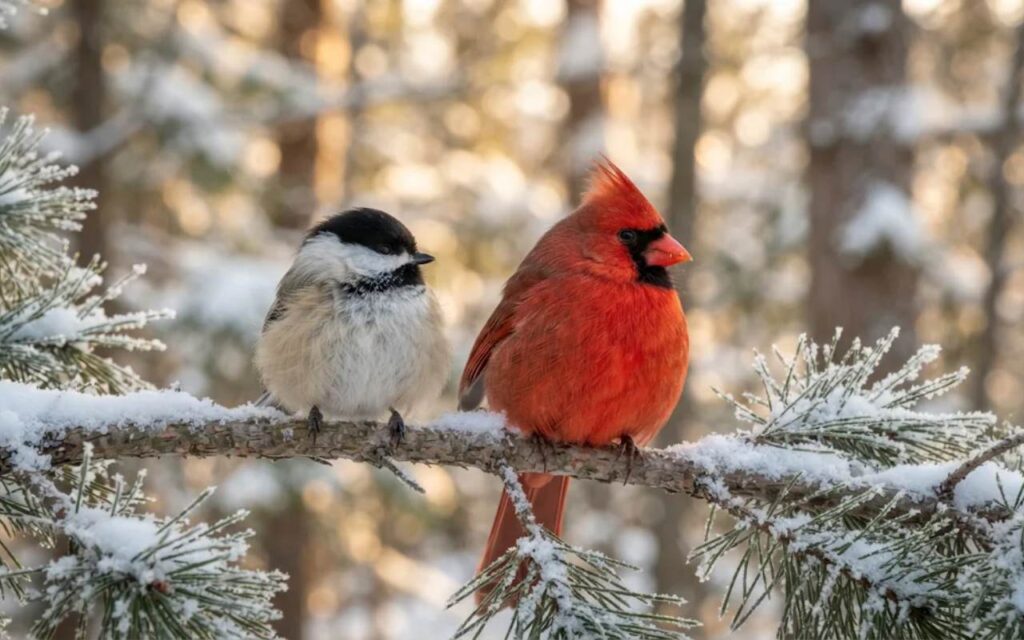
Birds stay warm in the winter by trapping heat inside dense plumage, recycling warmth through specialized leg blood vessels, shivering flight muscles, burning daily fat reserves, and roosting in cavities or snow burrows. While human core temperature sits around 98.6°F (37°C), songbirds maintain an internal temperature of 102°F to 109°F (39°C to 43°C), even when sub-zero Arctic winds drop air temperatures below -20°F (-29°C).
In Fairbanks, Alaska, wildlife biologist Susan Sharbaugh documented that a 10- to 12-gram Black-capped Chickadee gains roughly 10% of its body weight in fat every winter day, burning nearly all of it shivering through one freezing night.
Looking closely at the 8 adaptations winter birds rely on also reveals the most effective ways to help backyard flocks survive severe ice storms and deep freezes.
Quick-Glance Summary: How Birds Survive Freezing Weather
- 1. Extra Winter Plumage & Feather Fluffing: Birds grow roughly 30% more feathers in autumn and puff them outward to trap insulating pockets of body-warmed air.
- 2. Oil-Gland Waterproofing: Birds coat outer feathers in waxy lipids from their preen gland to shed freezing rain and sleet.
- 3. Countercurrent Leg Circulation: Intertwined arteries and veins warm returning blood while keeping bare feet around 33.8°F (1°C), just above freezing.
- 4. Extremity Tucking: Birds stand on one leg and bury their bare bills beneath shoulder feathers to seal off unfeathered skin.
- 5. Isometric Muscle Shivering: Birds contract opposing pectoral flight muscles simultaneously to generate heat without flapping.
- 6. High-Fat Foraging & Scatter-Hoarding: Resident birds spend daylight hours eating oil-rich seeds and retrieving thousands of autumn-cached food items.
- 7. Regulated Hypothermia & Torpor: Chickadees and hummingbirds drop their overnight body temperature by 12°F to 50°F to slash calorie burn.
- 8. Communal Roosting & Snow Burrows: Birds pack into tree cavities or dive into deep snowbanks that stay between 20°F and 32°F (-6.7°C to 0°C).
1. Growing Extra Winter Feathers and Fluffing Plumage
A bird’s first line of defense against winter cold is an insulating coat that outperforms synthetic winter gear ounce for ounce. During their late-summer and early-autumn molt, cold-climate songbirds such as Black-capped Chickadees grow roughly 30% more feathers than they carry during summer.
This winter coat works through two distinct feather layers:
- Inner Down Layer: Soft, fluffy down feathers sit directly against the skin, trapping thousands of microscopic pockets of body-warmed air.
- Outer Contour Layer: Stiff, overlapping contour feathers lock together via microscopic hooks (barbicels) to block wind and driving snow.
On frigid mornings, cardinals, sparrows, and chickadees often look twice their normal round size. They are performing piloerection, using tiny dermal muscles at the base of each feather follicle to lift their plumage outward. Expanding the dead-air space between their skin and outer feathers slows conductive heat loss, turning trapped body heat into a personal down parka.
2. Waterproofing Outer Feathers with Preen Oil
Wet feathers collapse and lose their insulating air pockets immediately, which is life-threatening in freezing weather. To keep their outer contour feathers dry, most birds rely on the uropygial gland (commonly called the preen gland), a small organ located at the base of the tail.
During daily preening sessions, a bird presses its bill against this gland to collect a waxy, lipid-rich oil and combs it along every feather shaft. This coating repels sleet, freezing mist, and icy water while keeping feather keratin flexible.
(A few bird families, most notably pigeons and mourning doves, lack a functional uropygial gland and instead grow specialized powder down feathers whose tips crumble into a water-repellent, talc-like dust. Herons have both a functional preen gland and powder down patches, using the powder first to strip fish slime and mud from their plumage before applying waterproofing oil.)
3. Countercurrent Heat Exchange: Why Bird Feet Don’t Freeze
One of the most common winter wildlife questions is how ducks, gulls, and songbirds stand barefoot on solid ice without getting frostbite. First, bird legs and feet consist mostly of tough tendons, bone, and protective scales, with very little muscle or fluid-rich soft tissue that could freeze.
Second, as detailed by the Cornell Lab of Ornithology, birds run a vascular heat-recovery system called countercurrent heat exchange:
- 1. Warm Arterial Outflow: Warm arterial blood leaving the bird’s 105°F core travels down the leg toward the toes.
- 2. Heat Transfer Bridge: In the upper leg, incoming veins and outgoing arteries intertwine in a dense capillary network called the rete mirabile (“wonderful net”). Heat transfers directly from the warm outgoing arterial blood into the cold venous blood returning from the foot.
- 3. Chilled Toes, Warm Core: By the time arterial blood reaches a duck’s webbed foot, it has cooled to roughly 33.8°F (1°C), which is just warm enough to prevent tissue freezing, yet close enough to ice temperature that heat loss through the feet accounts for only about 5% of total body heat. Meanwhile, returning venous blood is pre-warmed before re-entering the body core, conserving vital energy.
4. Tucking Bare Bills and Feet Into Feathers
Even with countercurrent circulation, unfeathered skin loses heat faster than thick plumage. To seal off remaining thermal leaks while resting, birds use simple postural adjustments:
- One-Legged Standing: Ducks, gulls, and songbirds frequently draw one leg completely up into their warm belly feathers, cutting exposed leg surface area in half and alternating feet periodically.
- Bill-Tucking: Sleeping birds turn their heads backward and bury their bare beaks deep beneath their scapular (shoulder) feathers. Because a bird’s bill has a rich blood supply and no feather cover, tucking it into plumage reduces facial heat loss and warms inhaled air before it reaches the lungs.
5. Isometric Shivering Without Flapping
When insulation alone cannot offset sub-zero air temperatures, birds generate internal heat by shivering. Unlike human shivering, which relies on involuntary, jerky muscle spasms, birds shiver by contracting opposing pectoral (flight) muscles simultaneously.
Because the muscles pull against each other in equal balance, they burn fuel and produce substantial metabolic heat without causing visible wing movement or wasting energy on flight. A small songbird can boost its resting heat production up to fivefold through sustained pectoral shivering during severe cold snaps.
6. High-Fat Foraging and Autumn Scatter-Hoarding
Continuous shivering burns calories at a relentless pace, forcing winter birds to spend nearly every daylight hour searching for calorie-dense foods:
- Scatter-Hoarding Specialists: Chickadees, nuthatches, and jays hide tens of thousands of seeds, nuts, and dormant insects inside individual bark crevices and lichen patches during autumn. To retrieve them months later under snow, a Black-capped Chickadee actually expands the volume of its hippocampus (the brain region governing spatial memory) each fall, a seasonal adaptation detailed by the University of Alaska Fairbanks Geophysical Institute.
- Bark-Probing Insectivores: Downy Woodpeckers, Hairy Woodpeckers, and Brown Creepers hammer into dead timber to extract fat-rich overwintering beetle larvae and carpenter ants.
- Seed-Cracking Songbirds: Cardinals, goldfinches, and grosbeaks target oil-rich seeds that pack maximum calories into every bite.
7. Nocturnal Torpor and Regulated Hypothermia
Even with a full stomach of seeds at sunset, tiny birds face an energy deficit during 14- to 16-hour winter nights. To avoid burning through their fat reserves before dawn, several species intentionally lower their internal thermostat overnight:
- Regulated Hypothermia (Chickadees & Kinglets): According to the National Wildlife Federation (How Chickadees Weather Winter), Black-capped Chickadees lower their nocturnal body temperature by 12°F to 15°F (7°C to 8°C) while roosting, conserving up to 25% of their hourly energy expenditure.
- Deep Nocturnal Torpor (Hummingbirds): Year-round Anna’s Hummingbirds along the Pacific coast enter a state of deep, hibernation-like torpor on freezing nights. Their heart rate drops from over 1,200 beats per minute in flight down to roughly 50 beats per minute, and their body temperature falls from 105°F to around 48°F (9°C), slowing metabolism by 90% to 95%.
8. Communal Roosting, Cavities, and Snow Burrows
Where a bird spends the night often matters just as much as what it eats during the day. At dusk, winter birds abandon exposed branches in favor of sheltered microclimates that block windchill:
- Tree Cavities & Roost Boxes: Woodpeckers excavate dedicated winter roost holes facing away from prevailing winds. Chickadees, nuthatches, and Eastern Bluebirds pack tightly inside empty tree cavities or wooden roosting boxes, sharing collective body warmth.
- Dense Evergreen Conifers: Cardinals, Dark-eyed Juncos, and Golden-crowned Kinglets huddle shoulder-to-shoulder beneath thick spruce, cedar, and white pine boughs that trap radiating ground heat.
- Subnivean Snow Burrows: Ruffed Grouse and ptarmigan dive headfirst into deep, powdery snowbanks at dusk, spending up to 16 hours beneath the surface. Because air trapped inside fluffy snow acts as a natural insulator, a grouse snow cave warms to between 20°F and 32°F (-6.7°C to 0°C), even when howling winds above the snowpack plunge to -30°F (-34°C).
Winter Survival Strategies by Bird Species
| Bird Group / Species | Primary Thermoregulation Tactic | Overnight Shelter Strategy | Key Winter Fuel Source |
|---|---|---|---|
| Black-capped Chickadee | Regulated hypothermia (-12°F to -15°F drop) + shivering | Small tree cavities & roost boxes | Cached seeds, suet, dormant spiders/larvae |
| Ducks, Geese & Gulls | Countercurrent leg circulation (~33.8°F feet) + preen oil | Open water rafts or ice edges | Aquatic plants, grains, fish, invertebrates |
| Ruffed Grouse | Feathered nostrils/toes + full crop digestion | Insulated snowpack burrows (20°F–32°F) | Birch, aspen, and willow buds/catkins |
| Golden-crowned Kinglet | Communal huddling + continuous foraging | Tight clusters under dense evergreens | Dormant bark insects, caterpillars, suet |
| Anna’s Hummingbird | Deep nocturnal torpor (HR ~50 bpm, temp ~48°F) | Sheltered evergreen twigs | Tree sap, tiny winter gnats, nectar feeders |
How to Help Backyard Birds Stay Warm in Winter
While native birds are adapted to endure harsh cold, freezing rain and prolonged ice storms can lock natural food and water under thick glaze. In a landmark 1988 field study published in Ecology, ornithologists Margaret Brittingham and Stanley Temple found that Black-capped Chickadees with access to supplemental feeders had a 69% winter survival rate, compared to just 37% for birds without feeder access during severe cold spells.
Four practical backyard adjustments make the biggest difference:
- Offer High-Fat, High-Calorie Foods: Stock feeders with black oil sunflower seeds, raw beef suet cakes, shelled peanuts, and nyjer seed. Avoid inexpensive filler blends heavy in red milo or cracked corn that birds kick onto the snow.
- Provide Unfrozen Drinking Water: Liquid water is often harder for birds to find in midwinter than food. A thermostatically controlled heated birdbath provides drinking water and lets birds bathe briefly to keep their feathers clean, fluffy, and insulating. (Never add antifreeze, salt, or glycerin to birdbaths, as these are toxic or ruin feather waterproofing).
- Leave Natural Shelter Standing: Delay cutting back ornamental grasses, dead perennial seed heads, and brush piles until spring. Dense evergreen shrubs and brush piles act as crucial windbreaks.
- Prepare Nesting Boxes for Winter Roosting: Clean old summer nesting material out of wooden birdhouses in late autumn, and plug top ventilation slots temporarily if your box has reversible winter panels so chickadees and bluebirds can huddle inside out of the wind.
Frequently Asked Questions
Do wild birds freeze to death in the winter?
Healthy, well-fed wild birds rarely freeze to death from cold air temperatures alone. Winter mortality usually happens when prolonged ice storms seal seeds and bark insects under ice, depriving small birds of the calories required to fuel overnight shivering.
Why do birds puff up their feathers when it’s cold?
Birds puff up their feathers (a behavior called piloerection) to trap a thicker layer of warm, stagnant air between their skin and the cold outside air, turning their plumage into a natural down coat.
Should I take my bird feeders down if I go on winter vacation?
No. Wild birds forage across dozens of natural and neighborhood food sources daily and will not starve if one backyard feeder empties temporarily, though keeping feeders stocked consistently during severe blizzards gives local flocks a high-efficiency calorie boost.