
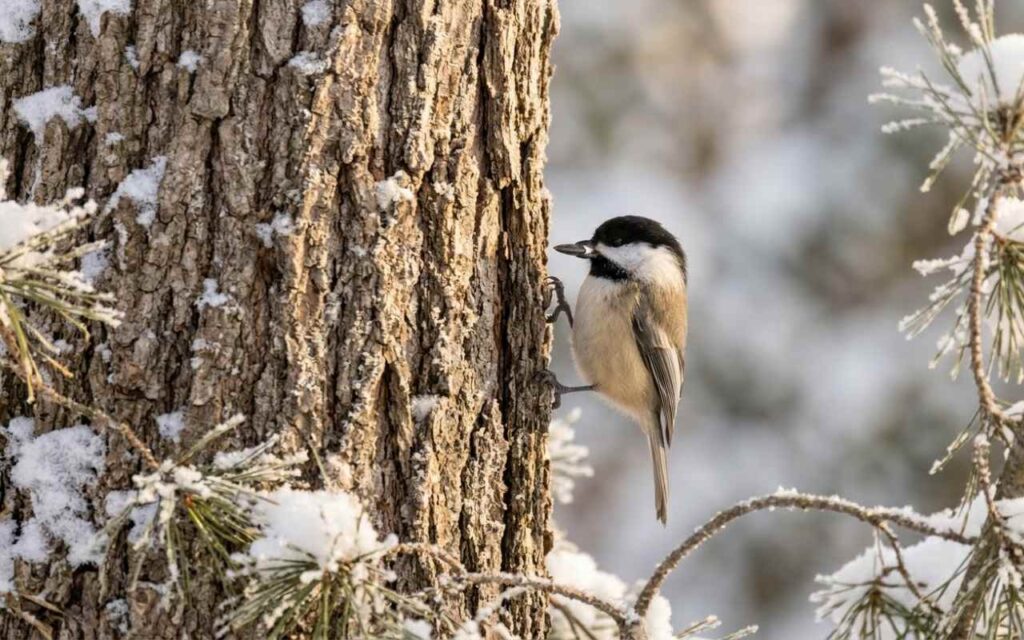
Yes, many non-migratory birds store food for the winter through a survival behavior called caching, hiding tens of thousands of seeds, nuts, and insects inside bark crevices, soil, and tree cavities during autumn and winter. To relocate these scattered pantries under snow, food-storing species such as Black-capped Chickadees and Clark’s Nutcrackers rely on landmark-based spatial memory and seasonal remodeling in their brain’s hippocampus.
While migratory songbirds fly thousands of miles south to follow warm-weather insect hatches, year-round residents in northern climates stay behind and prepare for scarcity by building hidden food reserves.
Instead of storing all their food in one vulnerable pile like a chipmunk, most backyard birds practice scatter hoarding, tucking single seeds across hundreds of separate hiding spots throughout their territory. Understanding how birds cache food, and how you can stock feeders to support their hoarding, helps your local flock survive harsh winter freezes.
Quick-Glance Summary: How Birds Store Winter Food
- The Core Behavior: Food caching (hoarding) allows resident birds to harvest surplus seeds, acorns, and insects and retrieve them during winter storms.
- Two Main Caching Strategies: Most songbirds use scatter hoarding (thousands of single-item hiding spots spread across trees and ground litter), whereas Acorn Woodpeckers and shrikes use larder hoarding (centralized storage trees or impaled larders).
- Seasonal Brain Plasticity: In autumn, the hippocampus (the brain’s spatial memory center) of food-caching birds expands in volume through dendritic branching, synaptic remodeling, and ongoing neuron turnover to map thousands of hiding spots.
- Top Backyard Food Hoarders: Black-capped Chickadees, Tufted Titmice, White-breasted Nuthatches, Blue Jays, Red-bellied Woodpeckers, and Northern Shrikes.
- How You Can Help: Offer whole black oil sunflower seeds, safflower, and unshelled peanuts (for moisture-protected bark storage) alongside hulled sunflower hearts (for fast-stash calories).
Scatter Hoarding vs. Larder Hoarding: Two Avian Storage Strategies
Ornithologists divide avian food storage into two distinct strategies depending on how a species defends its territory:
1. Scatter Hoarding (Individual Hidden Pantries)
Most backyard songbirds and corvids hide one seed or nut per spot across a wide area. Because field studies show that 20 to 50 percent or more of cached items are pilfered by rodents and rival birds, scatter-hoarding species hide tens of thousands of individual items across trees and ground litter so no single thief can wipe out their winter supply.
- Black-capped Chickadees & Tufted Titmice: A single chickadee can hide up to 80,000+ seeds each autumn (and over 100,000 items in a full year), carefully wedging each seed into bark fissures or lichen.
- Blue Jays & Steller’s Jays: Equipped with an expandable throat pouch (the gular pouch), a Blue Jay can carry up to five whole acorns at once, holding 2 to 3 in its upper esophagus/gular pouch, 1 in its mouth, and 1 at the tip of its bill, burying thousands of acorns in forest soil every fall.
- White-breasted & Red-breasted Nuthatches: Nuthatches jam seeds and suet chunks deep into vertical bark furrows and frequently cover the opening with a tiny flake of bark, lichen, or snow to disguise it from other birds.
2. Larder Hoarding (Centralized Storage)
A smaller group of species defends a concentrated, visible pantry against intruders:
- Acorn Woodpeckers: As detailed in the National Audubon Society’s report on Acorn Woodpecker granaries, family groups in western North America drill up to 50,000 individual holes into a single dead snag or utility pole called a granary tree, wedging one acorn tightly into each hole and rotating the nuts as they dry and shrink.
- Northern & Loggerhead Shrikes: Known as “butcherbirds,” shrikes impale grasshoppers, beetles, and small rodents onto sharp hawthorn thorns or barbed wire fences to preserve meat for lean winter days.
Pre-Caching Prep: Why Chickadees Shell Seeds Before Hiding Them
Before wedging food into bark crevices, chickadees and titmice often prepare the item for fast winter consumption. When caching black oil sunflower seeds, chickadees frequently hammer off the outer hull first and hide the bare, calorie-dense kernel, or remove the heads and wings from caterpillars and insects before stashing them.
By storing ready-to-eat kernels and insect bodies, a freezing bird can pull a meal from a bark crack on a sub-zero morning and swallow it in seconds without wasting precious body heat hammering open tough shells.
How Birds Remember Where They Hid Thousands of Seeds
Hiding tens of thousands of seeds is useless if you cannot find them under six inches of January snow. Rather than relying on smell, caching birds use landmark-based spatial memory powered by seasonal brain plasticity.
According to landmark research summarized by the Cornell Lab of Ornithology’s All About Birds, food-storing birds experience a physical expansion of the hippocampus every autumn as daylight shortens:
- Synaptic Remodeling & Neuron Turnover: Chickadees and nuthatches remodel neural connections through dense dendritic branching alongside ongoing neuron turnover in the hippocampus during peak caching season, boosting spatial mapping capacity when they need it most.
- Chickadees’ 28-Day Rolling Memory Window: Controlled experiments show that Black-capped Chickadees remember the exact locations, food types, and relative perishability of their caches for up to about 28 days (four weeks). Because they continually cache and retrieve food on a rolling three- to four-week cycle all through autumn and winter, they eat perishable insects first while cycling fresh seed caches throughout the cold months.
- Clark’s Nutcracker Long-Term Mastery: High-elevation Clark’s Nutcrackers bury up to 30,000 to 100,000 pine seeds across mountain slopes each fall and accurately relocate the vast majority of them up to nine months later using nearby rocks, logs, and tree trunks as geometric landmarks.
Winter Food-Storing Birds Compared
Different backyard visitors rely on distinct hiding spots, carrying capacities, and favorite caching foods:
| Bird Species | Storage Strategy | Typical Hiding Spots | Favorite Foods to Cache |
|---|---|---|---|
| Black-capped Chickadee | Scatter hoarding (up to 80,000+ items/fall; ~28-day recall) | Tree bark crevices, evergreen needles, knotholes | Black oil sunflower seeds (often de-hulled), peanuts, insects |
| Blue Jay | Scatter hoarding (3,000–5,000 acorns/fall; carries up to 5) | Under leaf litter, mossy soil, lawn turf | Whole acorns, beechnuts, in-shell peanuts, corn |
| White-breasted Nuthatch | Scatter hoarding (often camouflaged with bark or lichen) | Deep furrows on rough oak and maple trunks | Sunflower seeds, suet nuggets, hickory nut pieces |
| Acorn Woodpecker | Communal larder hoarding (granary trees up to 50,000 holes) | Drilled holes in dead snags and wooden poles | Acorns, almonds, walnuts, pecans |
Which Backyard Birds Do NOT Store Food?
Not every winter visitor hides seeds for later. Granivores with heavy seed-cracking bills, such as Northern Cardinals, Mourning Doves, Dark-eyed Juncos, House Finches, and American Goldfinches, do not cache food.
Instead, these non-caching birds rely on daily foraging, flock scouting, and internal fat storage, eating rapidly before dusk to build an overnight energy layer that fuels shivering until sunrise. Because they have zero hidden pantries to fall back on, keeping feeders cleared after snowstorms is especially vital for cardinals, doves, and finches.
How to Help Food-Storing Birds in Your Backyard
If you notice chickadees, nuthatches, and Blue Jays making rapid back-and-forth trips from your feeders every 15 seconds in autumn and winter, they are actively stocking their caches. Support their efforts with four simple steps:
- Offer Whole-Shell Seeds Alongside Hulled Hearts: Supply in-shell black oil sunflower seeds, striped sunflower seeds, and whole unsalted peanuts for Blue Jays and nuthatches (intact shells protect kernels from moisture inside damp bark), alongside hulled sunflower hearts for chickadees looking for fast-stash calories.
- Leave Dead Snags and Rough-Barked Trees Standing: Mature oaks, maples, pines, and safe deadwood snags provide thousands of natural bark fissures for chickadees and nuthatches to hide food.
- Skip Fall Leaf Blowing Under Shrubs: Leaving a natural layer of fallen leaves around garden beds gives Blue Jays and titmice soft ground cover to tuck nuts safely away from visual thieves.
- Watch Out for “Cache Raiders”: Chickadees and jays will delay hiding a seed if they notice a rival bird or squirrel watching them, sometimes flying behind a dense evergreen screen before tucking the seed out of sight.
Frequently Asked Questions
Why do chickadees grab one sunflower seed and fly away immediately?
Chickadees rarely eat right on an exposed bird feeder. They grab a single seed, fly to a sheltered branch to either hammer open the shell and eat it immediately or wedge the seed into a bark crevice for winter storage, and return for another.
Do squirrels steal food that birds hide for winter?
Yes, gray squirrels, red squirrels, and rival jays steal roughly 20 to 50 percent of accessible caches. That is why scatter-hoarding birds spread tens of thousands of single seeds across high tree branches, tight bark cracks, and dense conifers where heavy squirrels cannot easily reach.
Do birds eat all the seeds and acorns they bury?
No. Blue Jays and Clark’s Nutcrackers leave behind a small percentage of buried nuts each spring, making food-caching birds some of nature’s most effective tree planters for oak and pine forests.