
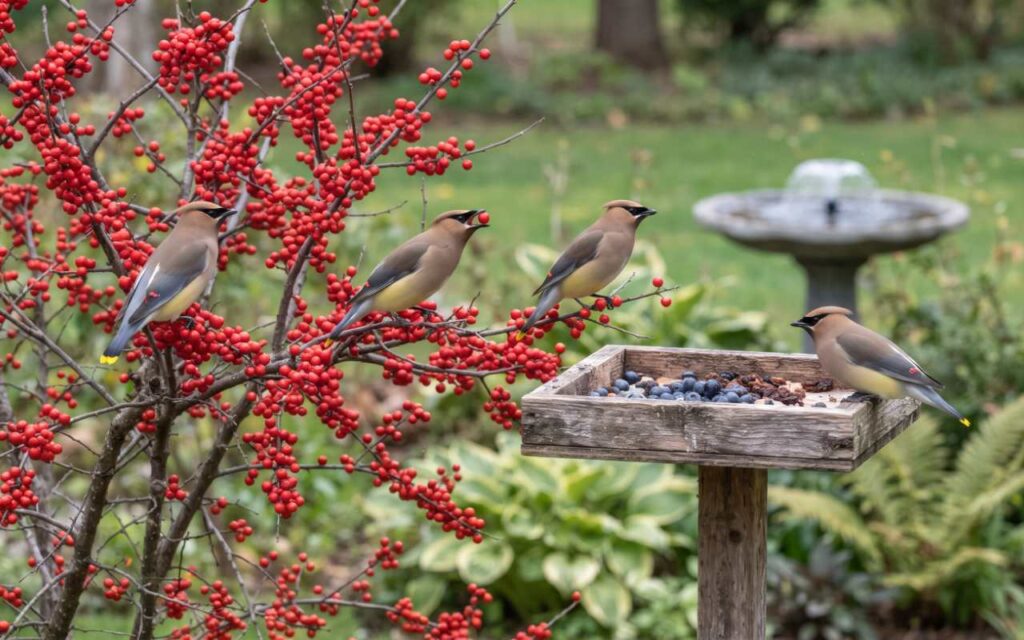
Learning how to attract Cedar Waxwings requires a completely different backyard strategy than attracting cardinals, finches, or chickadees. Because Cedar Waxwings are nomadic frugivores that travel in tight, high-pitched whistling flocks, they almost completely ignore standard tube feeders filled with sunflower seeds, millet, or suet.
Instead, Cedar Waxwings drop into gardens that offer persistent berry-producing trees and shrubs matched to their narrow gape width, shimmering moving water, and elevated open perches where flocks can rest between foraging runs. By pairing region-matched native berry-bearers with thawed fruit trays, acoustic call recognition, and flock-safe window protection, you can turn your yard into a reliable stopover year-round.
Quick-Glance Summary: Cedar Waxwing Garden Attractants by Season
| Garden Attractant | Best Placement | Peak Visiting Seasons | Field-Tested Function |
|---|---|---|---|
| 1. Native Serviceberry & Mulberry | Sunny yard border or woodland edge | Late spring & summer | Soft, high-sugar summer berries during nesting season |
| 2. Persistent Winterberry & Crabapple | Open lawn accent or hedgerow | Late fall & winter | Small fruit (under 1/2 inch) softens after freeze-thaw cycles |
| 3. Elevated Tray of Thawed Berries | 5 to 6 feet high on a pole or deck rail | Winter & spring migration | Provides swallow-whole fruit when wild trees are stripped |
| 4. Shallow Moving Water Birdbath | Open area 10 to 12 feet from shrubs | Year-round (especially hot & freezing days) | Supports high-volume berry digestion and flock bathing |
| 5. Dead Snags or Tall Perch Poles | Near berry shrubs & water features | Summer & early fall | Lets waxwings sally out to catch flying insects midair |
1. Plant Native Summer Berry Trees Like Serviceberry and Mulberry
During late spring and summer, Cedar Waxwings search neighborhoods for trees loaded with soft, sugar-rich fruit that they can swallow whole in a single gulp.
- Top Summer Choices. Plant native serviceberry (Amelanchier species), red mulberry, black cherry, or elderberry. A single fruiting serviceberry tree in June or July regularly draws flocks of 15 to 40 Cedar Waxwings at once.
- Establishment Timeline. Newly planted serviceberry or elderberry shrubs typically begin producing modest berry crops in years 2 to 3 after planting, reaching heavy flock-drawing yields by year 4 or 5 when planted in full sun with moist, well-drained soil.
- Avoid Invasive Nandina Berries. Skip invasive non-native heavenly bamboo (Nandina domestica), which contains cyanogenic glycosides that can fatally poison Cedar Waxwings when flocks gorge on the red berries, as documented by the Audubon Society warning on Nandina berries.
2. Add Persistent Winterberry Holly and Small-Fruited Crabapples
Because Cedar Waxwings wander nomadically all winter in search of leftover fruit, planting shrubs that hold their berries through snow and ice turns your garden into a high-value winter stopover.
- Match Fruit Diameter to Gape Width. Cedar Waxwings lack the hooked bill needed to tear chunks out of large fruit and instead swallow berries whole. Choose native winterberry holly (Ilex verticillata, pairing one male pollinator shrub for every three to five female berry-bearing bushes), eastern red cedar, hawthorn, or persistent small-fruited crabapples whose fruit measures 1/4 to 1/2 inch in diameter (such as ‘Red Jewel’ or ‘Sugar Tyme’). Skip large-fruited ornamental crabapples (3/4 inch or wider), which waxwings cannot swallow until late-winter freeze-thaw cycles soften the pulp.
- Regional Picks by Climate Zone.
- Northeast & Midwest. Downy serviceberry, winterberry holly, and pagoda dogwood.
- Southeast & Gulf Coast. American beautyberry, yaupon holly, and red mulberry.
- Pacific Northwest & West. Pacific serviceberry, red flowering currant, and cascara buckthorn.
3. Offer an Elevated Platform Tray of Thawed Berries and Chopped Fruit
While Cedar Waxwings ignore seed tubes, they will visit an open platform tray stocked with whole, bite-sized fruit, especially during late winter ice storms or early spring migration when wild trees are stripped bare.
- What to Put on the Tray. Serve thawed frozen blueberries, halved seedless grapes, diced apples, soaked raisins or currants (plumped in warm water for 15 minutes so they are soft), and pomegranate arils.
- Exact Fruit Size Rule. Cut larger fruits into 1/4- to 3/8-inch cubes so waxwings can swallow pieces whole in one motion without choking or dropping them.
- Prevent Fermentation & Spoilage. Put out small portions each morning and discard uneaten fruit every 2 days. Overripe, fermented fruit can cause alcohol intoxication in waxwings, leading to disorientation and fatal collisions.
4. Install a Shallow Birdbath with Moving Water
Because Cedar Waxwings possess a wide intestinal tract adapted to process bulky fruit in high volumes (often clearing berries in 20 to 40 minutes), flocks feed heavily and seek fresh water frequently throughout the day.
- Optimal Birdbath Setup. Use a wide, shallow basin (1 to 2 inches deep) fitted with a solar fountain bubbler, water wiggler, or dripper, and add a thermostatically controlled heater in winter.
- Safe Placement Distance. Set the bath in a visible spot at least 10 to 12 feet away from dense ground shrubs so outdoor cats cannot ambush bathing flocks, while keeping taller tree branches nearby for quick hawk escape.
5. Leave Tall Open Perches for Midair Insect Catching
Although fruit makes up roughly 80 to 85 percent of a Cedar Waxwing’s annual diet, summer adults and nestlings also rely heavily on flying insects (such as mayflies, dragonflies, midges, and beetles) caught on the wing.
- How to Create Hunting Perches. Preserve a dead upper tree limb, install a tall wooden garden trellis, or place an 8- to 10-foot shepherd’s hook near open garden space so waxwings can perch in the open, launch outward to snatch flying bugs, and return to the same branch.
6. Grow Native Vines Along Fences and Arbors
Climbing native vines pack dense clusters of berries into compact vertical spaces without requiring room for full-sized shade trees.
- Top Native Vines. Train Virginia creeper (Parthenocissus quinquefolia), riverbank grape, or coral honeysuckle along a sunny fence, arbor, or pergola. Virginia creeper produces dark blue-black berries in late summer and fall that rank among Cedar Waxwings’ favorite migration fuels.
7. Provide Soft Plant Fibers for Nest Building
Cedar Waxwings breed later in summer than most North American songbirds (often June through August) to align their nesting with peak summer berry ripening.
- Safe Nesting Materials. Leave small tufts of untreated dry grass, dead plant stems, pine needles, and milkweed or cattail fluff in a wire suet cage in June and July. Never put out dryer lint, synthetic yarn, or pet fur treated with flea medications.
8. Eliminate Garden Insecticides and Fruit Sprays
Because Cedar Waxwings swallow wild berries whole and hawk flying insects directly over garden beds, spraying synthetic pesticides on fruit trees, vines, or perennials exposes flocks to chemical residues and eliminates their summer insect food.
- Organic Garden Care. Let ladybugs, lacewings, and visiting songbirds manage garden pests naturally, and wash any store-bought fruit thoroughly before placing it on a platform feeder.
9. Prevent Window Collisions Near Berry Trees and Baths
Tight, fast-flying flocks of 20 or more Cedar Waxwings can suffer multiple simultaneous window strikes if a glass patio door or large picture window reflects nearby berry trees or water features.
- Proven Glass Safety. Following U.S. Fish & Wildlife Service window collision guidelines, apply high-contrast exterior white decals, tempera paint dots, or hanging 1/8-inch paracord curtains across large reflective windows facing your garden using the exact orientation spacing rules:
- Vertical Paracord Curtains or Vertical Stripes. Space vertical cords or stripes no more than 4 inches apart horizontally.
- Horizontal Stripes. Space horizontal lines no more than 2 inches apart vertically.
- Dots or Decals. Space individual decals or tempera paint dots in a 2-inch by 2-inch grid to protect small songbirds and hummingbirds.
10. Learn Their High-Pitched Whistle and Plant in Three-Season Clusters
Most backyard birders hear Cedar Waxwings long before spotting them high in the canopy. Learning their contact calls helps you spot flocks overhead and refresh fruit trays while they are still circling the neighborhood.
- Acoustic Recognition Cue. Listen for a thin, high-pitched, slightly trilled “see-see-see” or “bzeee” whistle repeated continuously by the entire flock as they fly in tight formation or land in unison.
- Social & Pair-Bonding Berry Passing. If you spot a line of perched waxwings passing a single serviceberry or crabapple back and forth from bill to bill before one bird finally swallows it, you are watching their signature social and pair-bonding ritual.
- Simple Three-Season Planting Trio. Combine serviceberry (June to July fruit), elderberry or Virginia creeper (August to October fruit), and winterberry holly or small-fruited crabapple (November to March fruit) in one sunny garden border so nomadic flocks return month after month.
Cedar Waxwing vs. Bohemian Waxwing: How to Tell Winter Flocks Apart
In northern states and Canada during winter, larger Bohemian Waxwings occasionally mix into Cedar Waxwing flocks feeding on crabapples and mountain-ash berries. Use these four field marks to tell them apart:
| Field Mark | Cedar Waxwing | Bohemian Waxwing |
|---|---|---|
| Belly & Flank Color | Soft pale yellow belly with gray-brown flanks | Uniform smoky gray belly and flanks (no yellow) |
| Undertail Coverts (Vent) | Crisp white feathers under the base of the tail | Rich cinnamon-rust feathers under the base of the tail |
| Wing Markings | Plain gray-brown wings with red waxy tips | Bold white and yellow wing patches plus red waxy tips |
| Winter Range | Widespread across most of the U.S. & southern Canada | Mainly Canada, Alaska & northern-tier U.S. states |
Frequently Asked Questions
Why don’t Cedar Waxwings come to my regular bird feeders?
Cedar Waxwings rarely visit standard tube or hopper feeders because their diet consists primarily of whole berries, sugary fruits, and flying insects rather than hard seeds like sunflower, safflower, or millet. To attract them, offer whole thawed blueberries, halved grapes, or soaked raisins on an open platform tray alongside native berry shrubs and moving water.
What is a Cedar Waxwing’s absolute favorite berry?
Native serviceberry, mulberry, elderberry, Virginia creeper, eastern red cedar, and winterberry holly are among Cedar Waxwings’ top wild berries. For backyard fruit trays, thawed blueberries and soaked raisins are eaten most reliably.
When is the best time of year to attract Cedar Waxwings?
You can attract Cedar Waxwings year-round depending on your region, with peak backyard visits occurring during spring migration (April to May), summer berry season (June to August), and winter cold snaps (December to March) when nomadic flocks search neighborhoods for persistent crabapples, winterberries, and unfrozen water.