
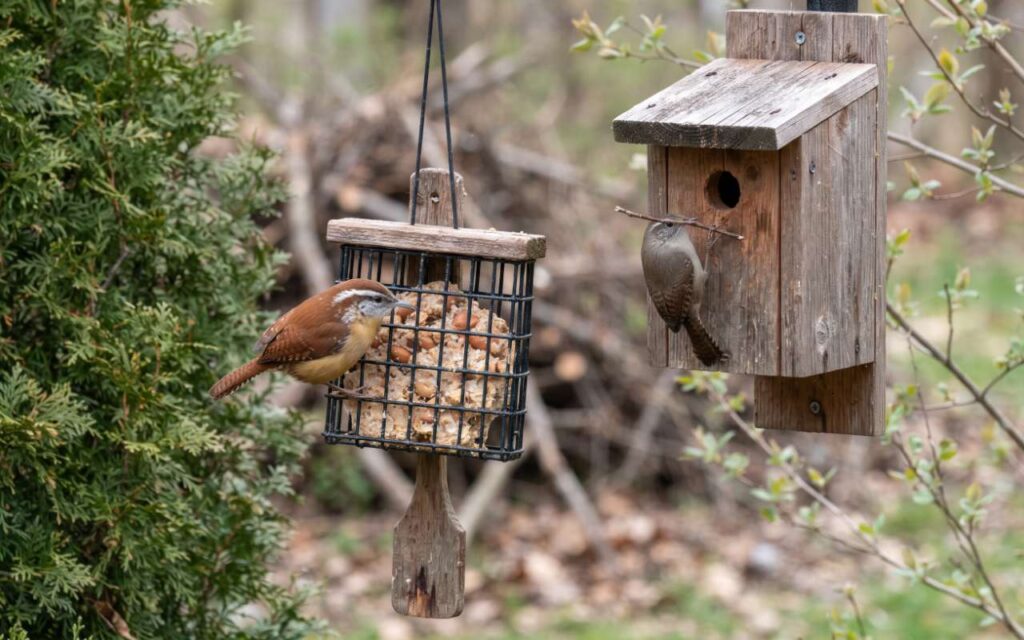
Learning how to attract House Wrens and Carolina Wrens requires understanding one major seasonal difference between these two energetic songbirds.
House Wrens migrate south each autumn after raising summer broods (with only small populations overwintering in the extreme southern United States), whereas Carolina Wrens stay all winter across their eastern and central North American range, relying heavily on high-fat suet, mealworms, and sheltered roosting boxes to survive freezing weather.
Because neither species eats standard millet or whole striped sunflower seeds, offering soft high-protein foods alongside dense brush cover, properly mounted nest boxes, and territory-smart spacing keeps both wrens singing in your yard from spring through winter.
Quick-Glance Summary: House Wren vs. Carolina Wren Preferences
| Feature | House Wren | Carolina Wren |
|---|---|---|
| Seasonal Presence | Spring & summer breeder (migrates south in fall) | Year-round resident (stays all winter) |
| Signature Appearance | Plain gray-brown with faint barring & subtle eye ring | Warm rusty-brown back, buff belly & bold white eyebrow stripe |
| Top Feeder Foods | Live or soaked mealworms, suet crumbs (occasional) | Suet cakes, spreadable suet, mealworms, hulled sunflower chips |
| Nest Box Mounting & Hole | 1 to 1 1/8-inch hole; accepts hanging or pole-mounted boxes | 1 1/8-inch round hole or 1 1/8-inch slot; requires firmly mounted box |
| Territory Spacing | Space boxes at least 100 feet apart | Space boxes at least 300 to 330 feet apart |
1. Offer High-Fat Suet All Winter for Carolina Wrens
While House Wrens head south before frost arrives, Carolina Wrens stay all winter and face severe cold stress because they are primarily insectivores. Offering high-fat suet gives overwintering Carolina Wrens the dense calories they need to survive freezing nights.
- Best Winter Suet Formats. Hang standard rendered beef suet cakes, peanut-blend suet plugs, or spreadable suet paste in a cage feeder mounted near dense shrubs or tree trunks.
- Easy Perching Rule. Choose a suet cage with a small bottom tail-prop or wooden frame so wrens can grip easily while pecking out soft fat crumbs.
2. Serve Live or Rehydrated Mealworms Year-Round
Both House Wrens and Carolina Wrens feed almost exclusively on spiders, caterpillars, beetles, and crickets in the wild, making mealworms the most reliable feeder food for both species.
- How to Serve Them. Place live mealworms, or freeze-dried mealworms soaked in warm water for 10 minutes, in a small smooth-sided ceramic cup mounted 4 to 5 feet off the ground near shrub cover.
- Winter & Nesting Boost. Offer mealworms at dawn during winter cold snaps for Carolina Wrens, and keep cups stocked from May through July when House Wrens are feeding hungry nestlings.
3. Stock Fine Hulled Sunflower Chips and Peanut Splits
Wrens lack the heavy conical bills needed to crack open tough seed shells, so they ignore standard sunflower mixes. However, Carolina Wrens readily visit feeders stocked with soft, shell-free nut and seed pieces.
- Best Seed Texture. Fill a small sheltered tray or cling-mesh feeder with finely chopped sunflower hearts (sunflower chips), shelled peanut splits, or pecan pieces.
4. Mount Wren Nest Boxes with House Sparrow-Proof Entry Holes
Both species eagerly use backyard birdhouses, but exact hole dimensions and mounting rigidity determine which wren moves in and keep invasive House Sparrows out. According to Cornell Lab of Ornithology NestWatch guidelines, matching entrance dimensions to the target species prevents larger competitors from taking over the box.
- For House Wrens (Hanging or Pole-Mounted). Provide a wooden box with a 1 to 1 1/8-inch diameter hole mounted 5 to 10 feet high. House Wrens are the only North American wren species that readily accept a free-hanging, swinging nest box suspended from a tree branch, which naturally deters House Sparrows.
- For Carolina Wrens (Firmly Mounted Only). Unlike House Wrens, Carolina Wrens avoid swinging boxes and require a firmly mounted box attached 5 to 8 feet high on a post, tree trunk, or sheltered wall. While Carolina Wrens can squeeze through a 1 1/8-inch round hole or a 1 1/8-inch horizontal slot (which blocks House Sparrows, since sparrows need at least a 1 1/4-inch opening), wider 1 1/4- to 1 1/2-inch holes or open-front shelf boxes should only be used in yards free of House Sparrows.
- Skip Exterior Perches. Never attach wooden dowel perches below the entrance hole, as wrens cling directly to rough wood and perches only give predators or House Sparrows a foothold.
5. Build a Brush Pile for Year-Round Shelter
Wrens are low-foraging thicket birds that rarely cross wide, manicured lawns. A simple backyard brush pile functions as an all-in-one hunting ground, hawk shelter, and winter windbreak.
- How to Layer It. Stack thicker fallen branches and logs at the bottom in a crisscross grid to create ground-level tunnels, then pile smaller twigs, pruned shrub limbs, and evergreen boughs on top in an out-of-the-way corner near your feeders.
6. Provide a Winter Roosting Box or Porch Shelf for Carolina Wrens
Because Carolina Wrens do not migrate, subzero temperatures and ice storms are their biggest threat. Unlike summer nest boxes that vent heat at the top, a winter roosting box traps body warmth.
- Roosting Box Setup. Choose a wooden roosting box with the entrance hole near the bottom (so rising warm air stays trapped inside), interior wooden dowels for multiple wrens to huddle together, and sealed top vents.
- Porch & Carport Perches. Carolina Wrens also love sleeping inside hanging flower baskets, wreaths, or sheltered shelves under covered porches, so leaving an empty hanging planter up through winter gives them an instant wind-sheltered bed.
7. Offer Short Natural Twigs for Nest Building
Watching a male House Wren stuff a nest box is one of spring’s best backyard shows. Males build multiple “dummy nests” out of hundreds of small twigs before a female selects one and lines the cup with soft feathers and grass.
- How to Help. Leave small piles of 3- to 6-inch dry twigs, pine needles, and dried moss near your nest boxes in April and May so males do not have to fly far for building supplies.
8. Plant Dense Native Shrubs and Understory Cover
Wrens feel safest when they can hop from branch to branch under leafy cover rather than flying through open airspace.
- Top Wren-Friendly Shrubs. Plant native serviceberry, viburnum, elderberry, ninebark, inkberry holly, or eastern red cedar within 6 to 10 feet of your suet and mealworm station. Evergreen shrubs are especially valuable for giving Carolina Wrens dense wind protection in January and February.
9. Keep a Heated Shallow Birdbath Running in Winter
While House Wrens get most of their moisture from summer insects, overwintering Carolina Wrens need reliable liquid water when puddles and streams freeze solid.
- Best Birdbath Setup. Use a shallow birdbath (1 to 2 inches deep) fitted with a thermostatically controlled de-icer in winter and a solar dripper in summer. Place a rough flat stone in the center for secure footing, and keep the bath near low shrubs.
10. Leave Leaf Litter and Mulch Beds Undisturbed
Wrens spend hours flipping dead leaves and probing garden mulch with their slender, slightly curved bills in search of beetles, pillbugs, spiders, and overwintering insect pupae.
- Backyard Rule. Leave a layer of natural autumn leaves under garden beds, shrubs, and along fence lines instead of raking every square inch bare in November.
11. Eliminate Garden and Lawn Pesticides
Both House Wrens and Carolina Wrens feed their nestlings almost exclusively invertebrates, including caterpillars, spiders, beetles, and tiny snail shells for calcium, while relying on hidden bark and leaf insects all winter. Broad-spectrum insecticides wipe out this critical food supply.
- Safe Yard Management. Avoid spraying synthetic insecticides on shrubs, perennials, or lawn borders, and let backyard wrens act as natural organic pest control around your garden.
12. Space Nest Boxes Properly and Use Wren Guards
Male House Wrens are fiercely territorial during breeding season and are known to pierce or remove eggs from nearby cavity nesters to eliminate competition, while Carolina Wrens defend large year-round territories.
- Territory Spacing Rules. Space House Wren boxes at least 100 feet apart and keep them at least 75 to 100 feet away from open-field Eastern Bluebird or Tree Swallow boxes. Space Carolina Wren boxes at least 300 to 330 feet apart to match their larger territory needs.
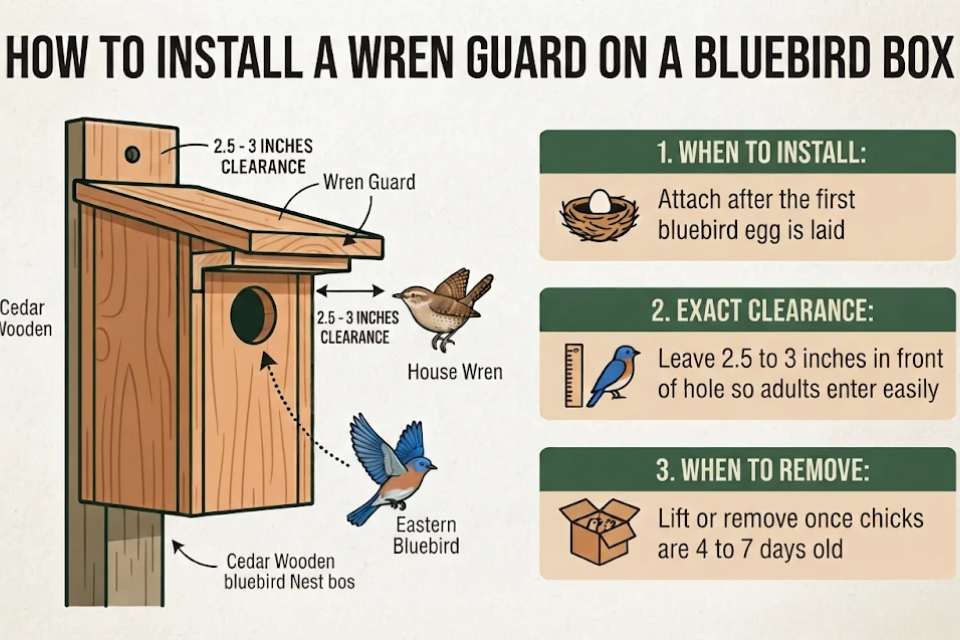
- Install Wren Guards on Bluebird Boxes. If House Wrens share your yard with nesting bluebirds, attach a simple wooden Wren Guard (an L-shaped visual baffle mounted 2.5 to 3 inches in front of the entrance hole after the bluebird lays her first egg), which blocks passing wrens from spotting the cavity entrance while leaving plenty of clearance for adult bluebirds to enter underneath. Remove or lift the guard once chicks are 4 to 7 days old so parents can feed easily and fledglings exit safely.
- Legal Nest Cleaning Rule. Both House Wrens and Carolina Wrens are protected under the federal Migratory Bird Treaty Act (MBTA), making it illegal to disturb an active nest containing eggs or chicks without a permit. Always verify a box is completely empty of eggs and fledglings before cleaning out old nesting material at the end of the breeding season.
Frequently Asked Questions
Do Carolina Wrens stay all winter, and what do they eat?
Yes, Carolina Wrens are year-round residents that stay all winter across the eastern and central United States. Because winter insects are scarce, they rely heavily on backyard beef suet cakes, spreadable suet paste, live or soaked mealworms, hulled sunflower chips, and shelled peanut pieces to maintain body heat.
What size birdhouse hole do House Wrens and Carolina Wrens need?
House Wrens need a 1 to 1 1/8-inch diameter entrance hole on a hanging or pole-mounted box, which lets wrens enter while blocking invasive House Sparrows. Carolina Wrens require a firmly mounted box with a 1 1/8-inch round hole or 1 1/8-inch horizontal slot to exclude House Sparrows (or up to a 1 1/4- to 1 1/2-inch hole in yards without House Sparrows).
How do you tell a House Wren apart from a Carolina Wren?
Look at the face and color tone. Carolina Wrens are larger, have a warm rusty-reddish back, a buff-orange belly, and a bold bright white eyebrow stripe above the eye, whereas House Wrens are smaller, dull gray-brown overall, and lack a prominent white eyebrow stripe.