
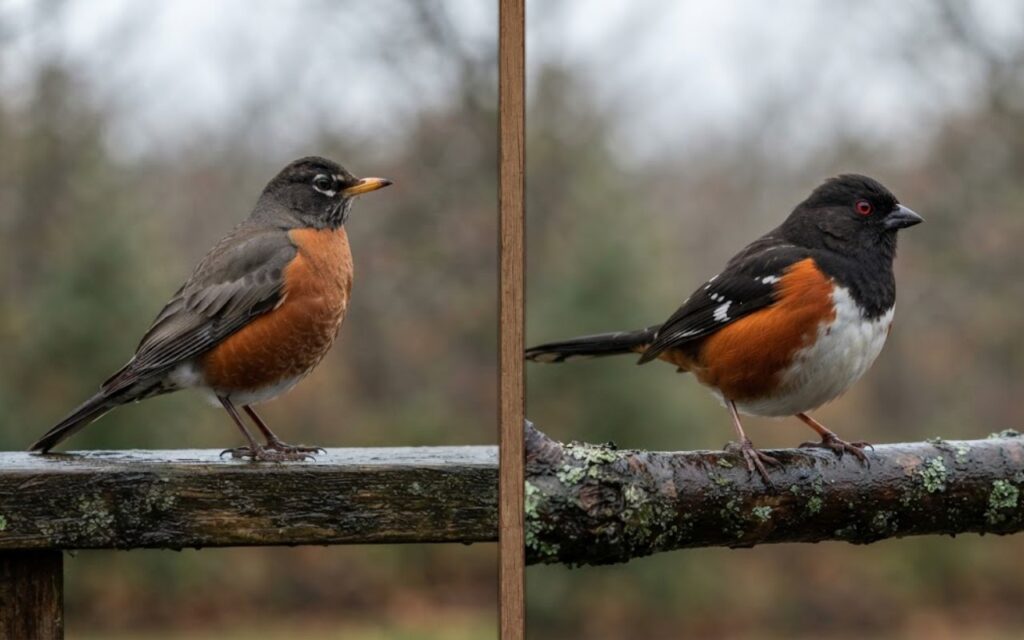
Telling the difference between an American Robin vs. Eastern Towhee often trips up backyard bird watchers catching quick glimpses through thick garden shrubs. Both species display contrasting dark upperparts paired with vibrant warm-toned bellies, making a fleeting glance misleading.
A closer look at feather patterns, ground behavior, and beak structure quickly clears up any confusion. Once you know what to check, separating these two common backyard birds takes only a few seconds.
Quick-Glance Field Summary
Robins show a solid brick-red breast extending down the center of the abdomen, while towhees have a clean white belly bordered by bright chestnut-rufous flanks. Look closely at feeding behavior; robins run and pause upright on open lawns, whereas towhees stay buried in leaf litter doing an energetic two-footed backward kick.
- Size: Robin measures 8 to 11 inches; Towhee measures 6.8 to 8.2 inches
- Belly pattern: Robin is solid terracotta-orange across the chest; Towhee has white belly center with rufous sides
- Eye color: Robin shows a dark brown eye with broken white eye-arcs; Towhee shows a brilliant red or straw-yellow iris
- Beak shape: Robin carries a slender yellow omnivore bill; Towhee carries a heavy, conical black seed-cracking beak
- Foraging motion: Robin uses run-and-stop visual scanning; Towhee uses a double-scratch hop in leaf litter
Looking at the Belly and Chest Feathers
The most common visual mistake comes from catching a side profile in dim lighting. On forums like r/whatsthisbird, backyard observers frequently upload blurry shots of a towhee beneath deck stairs, convinced they spotted a strangely marked robin. The key difference lies in the center of the bird’s underside.
An American Robin displays a continuous wash of rich brick-red across its breast, extending all the way down toward its lower belly. Only the lower vent and undertail coverts shift to white feathers. Its back and wings are a slate gray, which can look almost black when wet or shadowed.
An Eastern Towhee carries a sharply divided three-color pattern. The male features a solid jet-black hood and back, while the female replaces the black with warm chocolate brown. Both sexes feature striking chestnut-rufous flanks surrounding a bright white central belly, creating a distinct white stripe right down the middle.
Clarifying the Towhee Triad: Eastern vs. Spotted Towhee Confusion
When diagnosing a dark-backed bird with rufous flanks, western observers or birders along the Great Plains transition zone must look past the American Robin entirely. The true challenge lies in separating the Eastern Towhee from the closely related Spotted Towhee.
While both sparrows share identical size constraints, vocal patterns, and white belly patches, their upper body ornamentation diverges completely. A male Eastern Towhee features a solid, unblemished jet-black back and wing surface.
Conversely, the Spotted Towhee displays heavy rows of crisp white spots across its scapulars and wing coverts. Tracking this wing plumage avoids geographic identification errors where the ranges of these two sister species overlap.
| Key Metric | American Robin | Eastern Towhee | Spotted Towhee |
|---|---|---|---|
| Family | Turdidae (Thrush) | Passerellidae (Sparrow) | Passerellidae (Sparrow) |
| Belly Center | Solid Terracotta | Pure White | Pure White |
| Flanks & Sides | Continuous orange from chest | Rich Chestnut-Rufous | Rich Chestnut-Rufous |
| Wing Markings | Plain slate gray No white bars |
Solid unblemished black Warm brown on females |
Heavy white spots Distinct rows on back |
| Foraging Style | Rapid run-and-stop sprint across open lawns | Vigorous double-footed backward kick in leaf litter | Vigorous double-footed backward kick in leaf litter |
Watching How They Move and Hunt for Food
Watching a bird interact with the ground tells you its identity faster than plumage details alone. A member of the r/backyardbirds community recently pointed out that you can identify a towhee with your eyes closed just by listening to mulch fly. Towhees spend their entire day performing a vigorous two-footed backward jump to churn up fallen leaves.
This double-scratch motion sends dried leaves scattering in all directions as the bird digs for hidden beetles, seeds, and spider eggs. Eastern Towhees rarely step out into open grass where hawks can spot them. They prefer staying buried beneath dense foundation plantings, blackberry briars, and cedar thickets.
American Robins hunt in an entirely different style out on open sod. A robin takes four or five fast steps across the grass, abruptly freezes upright, and cocks its head to visually detect earthworms. Robins probe directly into the turf with their bills rather than kicking surface debris backward with their feet.
Checking Eye Color and Beak Shapes
If the bird sits motionless on a low perch, examine the head and facial hardware. Beak morphology reflects completely separate diets and evolutionary backgrounds. Robins belong to the thrush family, while towhees belong to the New World sparrow family.
The American Robin features a relatively slender, slightly down-curved yellow bill built for snatching soft-bodied earthworms, caterpillars, and soft berries. Its eye is dark brown, ringed by delicate, broken white feather arcs that give the bird an alert expression.
The Eastern Towhee carries a thick, blunt, conical beak finished in deep black. This heavy bill easily crushes hard wild seeds, acorns, and dry berries that a thrush cannot process. In the northern and eastern parts of their range, adult towhees display an intense ruby-red iris, though coastal birds in Florida and southern Georgia carry a pale straw-yellow eye.
Listening to Their Calls in the Brush
Vocalizations frequently create confusion for birders using automated mobile audio apps. Several contributors on birding forums note that sound identification software often struggles when towhees call from the deep understory. A towhee’s explosive alarm note can easily register as an agitated thrush call to an untrained ear.
The primary territorial song of the Eastern Towhee is clean, bright, and famously sounds like “drink-your-tea.” The introductory high notes rise quickly, followed by a musical, bouncing trill that carries through suburban brush. Their short call note is a rising, raspy scuff that sounds like a human saying the word “chewink” or “tow-hee.”
Robins produce a continuous, rolling carol that rises and falls in pitch, often described as “cheerily, cheer-up, cheer-up, cheerily.” In addition, an alarmed robin gives sharp, rapid alarm notes and clicking sounds when cats or raptors approach. A robin rarely hides while singing; it chooses high, exposed canopy branches or chimney tops.
Setting Up Your Yard for Both Species
Attracting both birds requires catering to their distinct nutritional needs and protective instincts. Robins ignore standard hanging seed feeders because their beaks cannot crack hulls. To support robins, plant native fruiting shrubs like serviceberry, dogwood, and sumac, or offer softened mealworms on a shallow platform.
Eastern Towhees appreciate ground feeding areas scattered near safety cover. Scatter coarse black oil sunflower seeds, white proso millet, or cracked corn directly under shrubs or along mulched border edges. Towhees avoid elevated, swinging feeders out in the middle of a manicured lawn.
Both species require clean ground-level water for drinking and daily feather maintenance. Heavy concrete bird baths placed flat on the soil near shrubs will draw towhees out of the brush. Keep water levels under two inches to allow both species to bathe comfortably and safely without slipping.