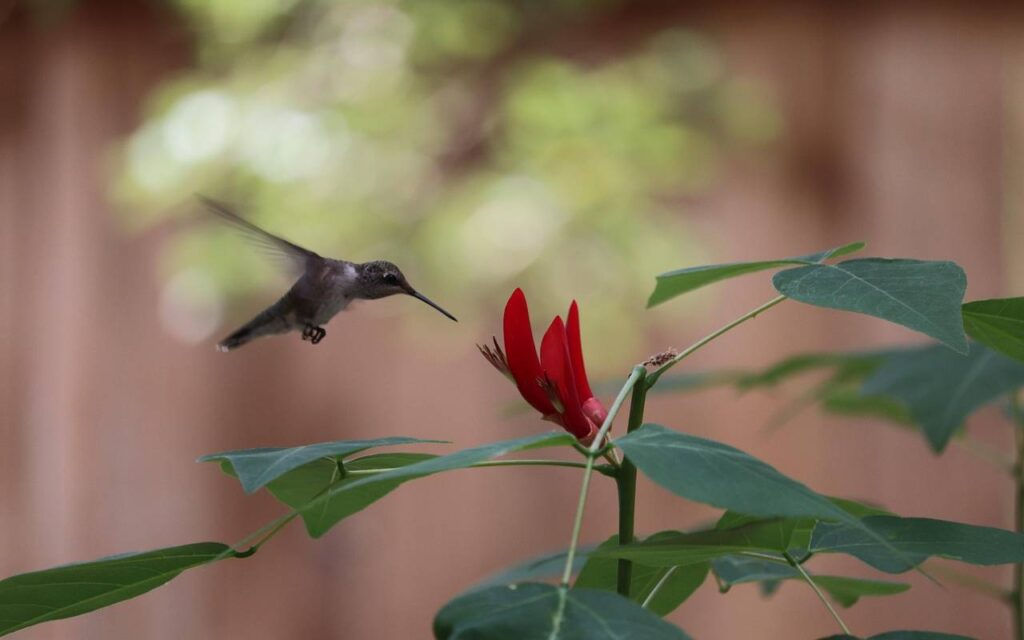
If you’re looking for the best flowering plants to attract hummingbirds, you’ll want more than just red blooms in your garden. Hummingbirds are drawn to flowers that deliver easy access to nectar, especially tubular, nectar-rich plants that match how they naturally feed. Attracting these birds comes down to understanding which flowers provide the right fuel and planting them at the right time to line up with hummingbird migration and breeding seasons.
This guide combines pollination studies, field observations, and ornithological research to explain exactly which flowering plants draw hummingbirds, how to select species with high nectar rewards, and why timing blooms to migration and nesting periods makes your garden irresistible to these birds 🙂. It also debunks common myths and provides practical tips for creating a hummingbird-focused landscape.
- Hummingbirds are drawn to nectar-rich, tubular flowers that match their feeding style.
- Planting a variety of bloom colors ensures visits; red is not the only option.
- Native plants support local insects, which are essential for feeding nestlings.
- Time blooms to hummingbird migration and breeding periods for maximum attraction.
- Include early, mid, and late-season bloomers for continuous nectar supply.
- Container gardening, vertical planting, and window boxes work for small yards.
- Supplement with feeders only when natural nectar sources are limited.
- Avoid pesticides to protect insects and maintain a healthy hummingbird habitat.
- Provide water sources like shallow birdbaths or gentle misters for drinking and bathing.
- Combine native and well-behaved non-native species for best results.
Video Guide: Best Flowering Plants to Attract Hummingbirds
Watch this quick explainer video to see which flowers will keep hummingbirds coming back to your garden.
Show Transcript:
0:00
Hey there! Today we’re diving deep into the fascinating world of hummingbirds, but we’re going way beyond the usual garden tips. We’re exploring the science behind creating a true hummingbird sanctuary where these incredible little birds can thrive. Let’s get started!
0:18
First, the classic advice: if you want hummingbirds, plant red flowers, right? Well, research shows that might be a misunderstanding.
0:34
A study from the Chicago Botanic Garden found that hummingbirds have no innate preference for red. That one fact changes everything about how we design hummingbird-friendly gardens.
0:47
So, if color isn’t the key, what are hummingbirds actually looking for? It all comes down to energy. Their tiny bodies have the highest metabolism of any warm-blooded animal. They are constantly searching for fuel to survive.
1:27
Their wings beat 50 to 80 times per second, and their heart rate can reach up to 1,200 beats per minute. To keep up, a hummingbird must consume half its body weight in sugar every day just to survive. This is the master key to understanding all their choices.
2:15
Now that we understand their relentless need for energy, let’s bust some common myths.
2:27
Myth #1: Hummingbirds are obsessed with red. Reality: they visit flowers of all colors. Red flowers mostly deter bees, giving hummingbirds a private nectar reserve.
2:54
Myth #2: They only like long, trumpet-shaped flowers. Reality: hummingbirds evaluate energetic profitability. They choose flowers based on nectar rewards versus the energy needed to access it. Open flowers with abundant nectar can be more appealing than perfect tubular shapes.
3:33
The key takeaway: think nectar first, not color or shape. Hummingbirds are little strategists constantly hunting for calories.
3:38
So, how do we turn this knowledge into a real hummingbird-friendly yard? It starts with bloom succession. The goal is a non-stop nectar buffet from spring to fall.
4:14
In spring, early bloomers like wild columbine help exhausted birds recover. Summer brings bee balm and cardinal flower to support nesting and raising young. In fall, late bloomers like anise hyssop provide high-energy fuel for migration.
4:39
Notice that all these are native plants. Native flowers not only provide nectar but also support insects and spiders, essential protein for feeding young hummingbirds. Their bloom times have evolved to align perfectly with hummingbird migration.
5:06
To build a true sanctuary, think beyond flowers:
- Eliminate pesticides – these kill insects that baby hummingbirds need.
- Provide a water source – they love fine mist or small fountains.
- Leave some garden debris in fall – dead stems and leaves help insects overwinter, providing spring food.
- Use native plants as the foundation – for nectar and insect support.
5:46
By applying these science-backed strategies, you can transform your yard from a simple garden into a vital hummingbird habitat, a life-saving rest stop on their incredible migration journey.
Why Flowering Plants Attract Hummingbirds
Hummingbirds possess the highest metabolism of any warm-blooded animal relative to body size. Their hearts beat 500-1,200 times per minute, and they must consume approximately half their body weight in sugar daily simply to survive. This extraordinary energy demand drives their constant search for nectar-rich flowers.
The evolutionary partnership: Many flowering plants exhibit traits that align with hummingbird morphology and behavior, such as tubular flower shapes that match bill lengths, abundant nectar placed deep within the corolla, and structural features that facilitate pollen transfer as hummingbirds feed. This pattern of floral trait evolution, often called a hummingbird pollination syndrome, reflects adaptive responses to hummingbird visitation documented in pollination research.
The mutual benefit: Plants provide high-energy nectar fuel for hummingbirds. In exchange, hummingbirds provide extraordinarily efficient pollination services. Research on jewelweed (Impatiens capensis) demonstrates this efficiency: when hummingbirds visit jewelweed flowers, their movements cause the flower to wobble, rubbing substantial pollen onto the bird’s face. Bumblebees visiting the same flowers move more delicately, leaving with significantly less pollen for transfer.
Beyond simple feeding: Field studies show that hummingbirds actively select flowers based on nectar volume, sugar concentration, flower shape, and overall energy payoff. Research published in PMC found that hummingbirds increase visits to flowers with higher nectar rewards, especially when visual and morphological cues are present.
What Hummingbirds Look For in Flowers
Contrary to popular belief, hummingbird flower preferences are more complex than “anything red and tubular.” Research from the Chicago Botanic Garden reveals surprising findings that challenge traditional assumptions about hummingbird pollination syndromes.
Color: The Red Myth Debunked
The popular belief: Red flowers exclusively attract hummingbirds because hummingbirds have an innate preference for red.
The research reality: According to Chicago Botanic Garden scientist Paul CaraDonna and his collaborators, hummingbirds show no innate preference for the color red. Their acute color vision allows them to see and visit flowers across the entire color spectrum. Observational studies consistently document hummingbirds routinely visiting flowers lacking “typical” hummingbird characteristics, including white, yellow, blue, and purple flowers.
Why red appears common: Red and orange flowers evolved these colors partially because bees cannot see red wavelengths effectively. This reduces nectar theft by bees, reserving nectar for hummingbird pollinators. Additionally, red flowers signal high visibility to migrating hummingbirds scanning landscapes. However, hummingbirds readily visit non-red flowers when they offer adequate nectar rewards.
The takeaway: Plant diverse flower colors. Hummingbirds will visit them if nectar rewards justify the visit.
Shape and Morphology: What Actually Matters
Tubular flowers: Long, narrow tubes physically exclude many insect pollinators while accommodating hummingbird bills and tongues. Research shows hummingbirds can extract nectar from both long and shallow flowers, but tubular morphology reduces competition from bees and butterflies.
Bill-flower matching: Field studies documented in PubMed research on hummingbird foraging preferences show that floral morphological traits can constrain access by short‑billed hummingbird species to nectar resources, with short‑billed birds preferring short, straight flowers and longer‑billed species feeding more from longer flowers, indicating that bill and flower traits influence nectar access.
Important insight: According to the Oecologia study on nectar extraction by hummingbirds, handling time increases markedly at corolla lengths exceeding bill length. Hummingbirds visiting artificial flowers showed handling times positively correlated with corolla length, nectar volume, and nectar concentration. This explains why diverse flower shapes work, birds select based on energetic profitability, not rigid morphological matching alone.
Perchless, dangling flowers: Many hummingbird-adapted flowers lack landing platforms and dangle on flexible stems. These traits favor hovering hummingbirds over perching insects.
Nectar: Quality and Quantity
Sugar concentration: Research reveals that typical hummingbird-pollinated flowers produce relatively dilute nectar at 20-25% sugar concentration. Yet in laboratory choice tests, hummingbirds consistently prefer concentrations exceeding 45%. This apparent contradiction resolves through understanding that hummingbirds balance nectar concentration against nectar volume and accessibility.
According to studies published in Animal Behaviour, rufous hummingbirds generally preferred 65% sucrose solutions over more dilute options when tested at low volumes typical of natural flowers, generating near-maximal energy intake rates over foraging bout timescales.
Nectar volume matters: Studies on Silene virginica published in the American Journal of Botany study on Silene virginica found that ruby-throated hummingbirds selected flowers based on traits correlated with high nectar volume and total sugar reward. Flower size positively correlated with nectar production, and hummingbirds preferentially visited larger flowers.
The profitability calculation: Recent research from the Chicago Botanic Garden found that “typical” and “atypical” hummingbird flowers overlapped considerably in energy content and profitability. Hummingbirds visit diverse flower types when energetic returns justify the visit, regardless of color or exact morphology.
Why this matters for gardeners: Plant flowers producing abundant nectar throughout the day. Nectar volume often matters more than perfect tubular shape or red color.
Scent: The Scentless Myth Reconsidered
Traditional pollination syndrome theory describes hummingbird flowers as scentless, since hummingbirds were believed to lack functional olfaction. However, a 2021 study on hummingbird smell and foraging decisions found that hummingbirds can detect chemical scent cues in sugar water feeders, suggesting they may use scent alongside visual cues when locating flowers. Further research is needed to confirm whether scent plays a significant role in natural flower selection.
Best Flowering Plants to Attract Hummingbirds
Based on field observations, pollination research, and regional native plant recommendations from Audubon, university extension services, and botanic gardens, here are proven hummingbird-attracting plants organized by bloom season and region.
Spring-Blooming Plants (Early Season Migration)
For Eastern & Midwestern Gardens:
Coral Honeysuckle (Lonicera sempervirens)
- Bloom time: April-September (peak April-June)
- Why it works: According to Choose Natives, this native vine offers “bright red tubular flowers with abundant nectar and little floral odor” typifying hummingbird-pollinated species
- Benefits: Long bloom period, non-invasive (unlike Japanese honeysuckle), supports nesting birds with cover
- Native range: Eastern U.S., zones 4-9
- Growing conditions: Sun to part shade, well-drained soil
Wild Columbine (Aquilegia canadensis)
- Bloom time: April-June
- Why it works: Unique spurred flowers perfectly sized for ruby-throated hummingbird bills
- Benefits: Early nectar source coinciding with spring migration arrival
- Native range: Eastern North America, zones 3-8
- Growing conditions: Part shade to sun, well-drained soil
Native Azaleas (Rhododendron species)
- Bloom time: April-May
- Why it works: Virginia Department of Forestry notes that native azaleas like pinxter flower (R. periclymenoides) “feed the earliest hummingbird migrants on their way back from wintering grounds”
- Native range: Various species across eastern U.S.
- Growing conditions: Acidic soil, part shade to filtered sun
Fire Pink (Silene virginica)
- Bloom time: April-June
- Why it works: Early-blooming energy source for spring migrants, studied extensively for hummingbird preference research
- Native range: Eastern U.S., zones 4-8
- Growing conditions: Part shade, well-drained soil
For Western Gardens:
Penstemons (various Penstemon species)
- Bloom time: April-July (varies by species and elevation)
- Why it works: According to Audubon Rockies, penstemons have “tube-shaped flowers jam-packed with nectar”
- Native range: Throughout western North America
- Growing conditions: Full sun, well-drained soil, drought-tolerant once established
Hummingbird Trumpet (Epilobium canum, syn. Zauschneria californica)
- Bloom time: Late summer-fall but some bloom spring
- Why it works: Coral-pink trumpet-shaped flowers on tall spikes
- Native range: Western U.S., zones 5-10
- Growing conditions: Hot, dry, sunny, well-drained locations
Summer-Blooming Plants (Peak Nesting Season)
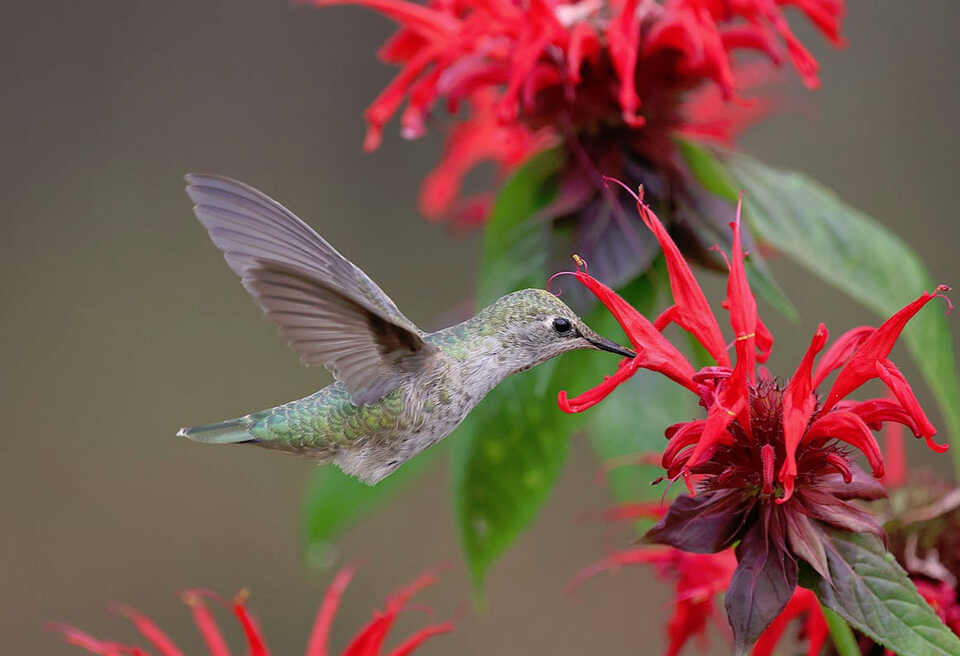
Bee Balm/Scarlet Bergamot (Monarda didyma)
- Bloom time: June-August
- Why it works: Bright red flowers, abundant nectar production, host plant for multiple moth caterpillars
- Native range: Eastern North America, zones 4-9
- Growing conditions: Sun to part shade, moist rich soil, spreads by rhizomes
- Note: Susceptible to powdery mildew in humid climates but doesn’t harm the plant
Trumpet Vine (Campsis radicans)
- Bloom time: July-September
- Why it works: According to Smithsonian research, trumpet vine comes into bloom in “early to mid-summer when hummingbirds have established territories and are busy tending nests and young families”
- Benefits: Large orange tubular flowers, “copious amounts of nectar,” lengthy bloom period
- Caution: Aggressive spreader, plant where it has room or contains it
- Native range: Eastern U.S., zones 4-9
- Growing conditions: Full sun, tolerates various soils, drought-tolerant
Cardinal Flower (Lobelia cardinalis)
- Bloom time: July-September (late summer timing critical for migration)
- Why it works: Brilliant red flowers perfectly sized for ruby-throated hummingbirds, blooms when young hummingbirds are learning to feed
- Native range: Eastern North America, zones 3-9
- Growing conditions: Moist soil, sun to part shade, excellent for rain gardens and water edges
Jewelweed (Impatiens capensis)
- Bloom time: July-September
- Why it works: Research shows that jewelweed flowers wobble when hummingbirds visit, which helps deposit the maximum amount of pollen through a specialized pollination mechanism.
- Benefits: Orange or yellow flowers on wobbly stems, self-seeds readily in moist shade
- Native range: Eastern North America, zones 2-11
- Growing conditions: Moist shade, often found naturally along streams
Late Summer/Fall-Blooming Plants (Migration Fuel)
Autumn Sage (Salvia greggii)
- Bloom time: Summer through fall
- Why it works: Long bloom period extending into fall migration season
- Benefits: Drought-tolerant, evergreen in southern zones, available in red, pink, purple, orange, white
- Native range: Texas, Mexico, zones 6-9
- Growing conditions: Full sun, well-drained soil, don’t overwater
Anise Hyssop (Agastache foeniculum)
- Bloom time: July-September
- Why it works: According to Wild Ones research, hyssops “offer a late-season nectar source for migrating hummingbirds after many plants have stopped blooming”
- Benefits: Also attracts native bees and butterflies, aromatic foliage
- Native range: Great Plains and Upper Midwest, zones 4-9
- Growing conditions: Full sun, well-drained soil
Mexican Sunflower (Tithonia rotundifolia) – Annual
- Bloom time: Mid-summer through frost
- Why it works: Large orange-red flowers, extremely high nectar production, blooms during fall migration
- Benefits: Heat and drought tolerant, self-seeds
- Growing conditions: Full sun, any soil
Scarlet Gilia (Ipomopsis aggregata)
- Bloom time: July-September
- Why it works: Western native that blooms late enough to “support young Broad-tailed and Black-chinned hummingbirds as they prepare for their first migration journey” according to Wild Ones Front Range research
- Native range: Western North America, zones 4-8
- Growing conditions: Sun, well-drained soil
Excellent Non-Native Options
While native plants provide optimal ecological benefits, several well-behaved non-native species offer exceptional hummingbird attraction:
Salvia (various Salvia species)
- Many salvia species from around the world attract hummingbirds
- ‘Black and Blue’ salvia (S. guaranitica): Dark blue flowers, hummingbirds visit readily despite non-red color
- Annual salvias (S. coccinea, S. splendens): Continuous bloom, high nectar production
Fuchsia (various Fuchsia species)
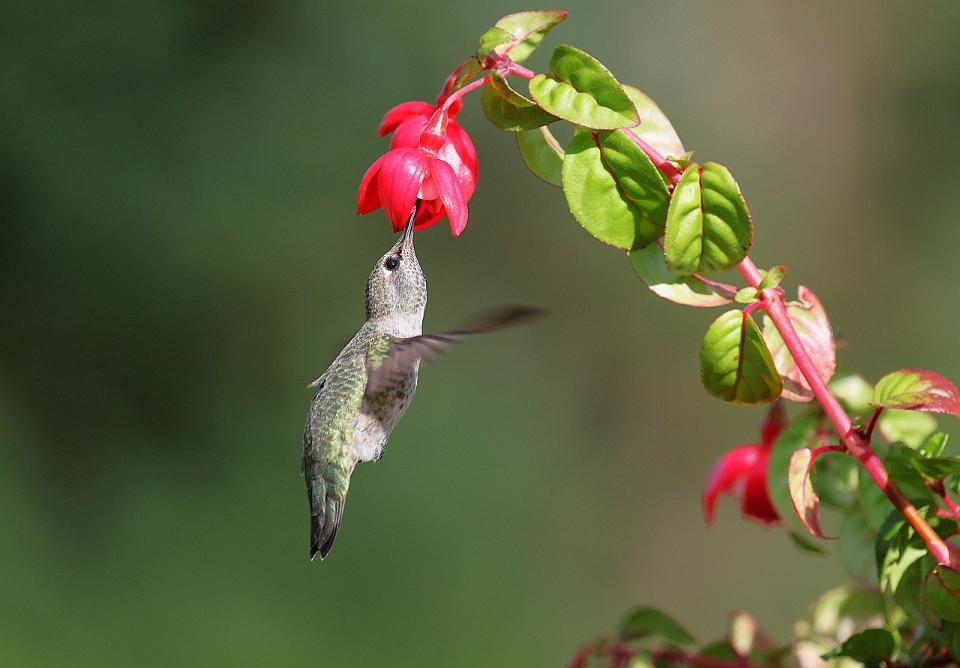
- Pendulous flowers perfectly adapted for hovering hummingbirds
- Shade-tolerant option for areas where native choices are limited
- Annual in most regions, perennial in mild climates
Lantana (Lantana camara)
- Clusters of tubular flowers, continuous blooming
- Caution: Invasive in warm climates (Florida, Texas, California coastal areas)
Native vs. Ornamental Flowers: What Research Shows
A common gardening question: do hummingbirds prefer native plants over ornamentals? Research provides nuanced answers.
The ecological case for natives: According to the PubMed study on native plants and bird communities, yards planted primarily with native species support significantly greater bird abundance, diversity, species richness, biomass, and breeding pairs than yards dominated by non‑native vegetation, partly because they also host more caterpillars and other insect prey, which are key food sources for birds.
Phenological timing: A 2025 Current Biology study on flowering phenology and hummingbird migration using over 1.6 million community-science observations found that red- and orange-flowering species bloom later in eastern North America, corresponding to migratory hummingbird arrival times. This phenological matching represents evolutionary co-adaptation, , with native plants blooming exactly when hummingbirds arrive.
Climate change concerns: According to the Audubon article on how climate change affects hummingbirds’ feeding behavior, warming temperatures are causing flowers to bloom earlier, potentially disrupting the timing between hummingbird migration and nectar availability. This mismatch highlights why diverse native plantings that flower across broader windows are increasingly important for supporting hummingbirds.
The practical reality: Field observations confirm hummingbirds visit both native and non-native flowers when nectar rewards justify visits. However, native plants provide broader ecological benefits: supporting native insects for protein, maintaining natural phenological relationships, and contributing to regional ecosystem health.
Balanced recommendation: Prioritize native plants, especially those matching your region’s hummingbird species and migration timing. Supplement with well-behaved non-native species for continuous blooms or specific garden conditions where native options are limited.
For comprehensive guidance on native plants for birds, including hummingbirds and other species, native plantings support complete backyard ecosystems.
When to Plant for Continuous Blooms Throughout Migration
Strategic timing ensures nectar availability from spring arrival through fall departure. Research on hummingbird migration and flowering synchrony provides planting guidance.
Understanding migration timing:
- Ruby-throated Hummingbirds (Eastern U.S.): Arrive late April-early May, depart August-September
- Rufous Hummingbirds (West): Spring migration along Pacific coast (March-May), fall migration through interior mountain states (July-September)
- Black-chinned Hummingbirds (Southwest): Arrive March-April, depart September-October
- Broad-tailed Hummingbirds (Mountain West): Arrive April-May, depart August-September
The bloom succession strategy:
Early Spring (Arrival Period): Plant species blooming April-May to fuel spring migrants after their arduous journey:
- Native azaleas
- Wild columbine
- Fire pink
- Coral honeysuckle (begins)
- Early penstemons (West)
Late Spring/Early Summer (Territory Establishment & Nesting): Plant species blooming May-July supporting breeding pairs and feeding nestlings:
- Coral honeysuckle (continues)
- Bee balm
- Coral bells
- Penstemons (various species for succession)
Mid-Late Summer (Fledgling Period): Plant species blooming July-August when juvenile hummingbirds are learning to forage:
- Trumpet vine
- Cardinal flower
- Jewelweed
- Bee balm (continues)
Late Summer/Fall (Migration Fuel): Critical: Plant species blooming August-September providing energy for southward migration:
- Cardinal flower (peaks)
- Autumn sage
- Anise hyssop
- Scarlet gilia (West)
- Mexican sunflower
Research-backed timing insight: A PMC study on hummingbird migration and flowering synchrony in Mexico found that rufous hummingbird abundance was significantly related to Salvia iodantha flowering, demonstrating the critical importance of late-season blooms along migration routes.
Planting schedule for continuous blooms:
- Spring: Plant bare-root perennials, transplant container-grown plants
- Early summer: Deadhead early bloomers to encourage reblooming
- Late summer: Allow late-season plants to finish blooming for migrating birds
- Fall: Plant perennials for next year, they’ll establish roots over winter
Pro tip: Stagger plantings of the same species 2-3 weeks apart to extend individual bloom periods.
Common Mistakes That Keep Hummingbirds Away
Despite good intentions, certain practices inadvertently make gardens less attractive to hummingbirds.
Mistake 1: Relying exclusively on red flowers Research proves hummingbirds visit diverse colors. Planting only red limits nectar availability and ignores excellent blue, purple, pink, orange, and yellow options hummingbirds readily visit.
Mistake 2: Using pesticides Hummingbirds consume thousands of tiny insects and spiders every day, which provide the protein needed for nestling growth and adult health. Insecticides remove this important food source. Herbicides destroy “weedy” native plants that may host these essential insects.
Mistake 3: Planting only large, showy ornamental cultivars Many modern cultivars are bred for massive blooms, double flowers, or extended bloom periods, which often reduces nectar production. Research shows native species and their straight-species cultivars typically produce more accessible nectar.
Mistake 4: Ignoring late-season blooms Many gardeners plant for spring and summer beauty but neglect fall. Late-blooming plants that provide migration fuel are perhaps the most important because hummingbirds need maximum energy for their long southward journey.
Mistake 5: Planting invasive species Japanese honeysuckle, Chinese wisteria, and trumpet creeper (in some regions) can become serious invasives displacing native plants. Choose native coral honeysuckle over Japanese honeysuckle, and contain aggressive spreaders.
Mistake 6: Using commercial “hummingbird seed mixes” These often contain annual flowers requiring full replanting each year. Perennials provide better long-term value and reliability.
Mistake 7: Poor feeder maintenance Dirty feeders or those left empty during peak migration harm more than help. If offering feeders, commit to weekly cleaning and consistent refilling. For guidance on how to attract hummingbirds including both natural food sources and supplemental feeding, proper setup matters.
Mistake 8: Excessive tidiness Removing all dead stems and leaves in fall eliminates overwintering sites for insects hummingbirds will eat come spring. Leave some “mess” for ecosystem health.
Mistake 9: Not providing water Hummingbirds need water for drinking and bathing. A shallow bird bath, fountain with fine mist, or water feature with gentle movement attracts them.
Mistake 10: Planting only in full sun While many hummingbird plants prefer sun, species like jewelweed, cardinal flower, coral bells, and native azaleas thrive in shade, expanding planting opportunities.
Quick Planting Tips for Small Yards and Containers
Limited space doesn’t prevent successful hummingbird attraction. Container gardening and strategic small-space planning work excellently.
Container selection:
- Minimum 12-inch diameter for most perennials
- 18-24 inch containers for larger plants like bee balm
- Ensure drainage holes prevent waterlogging
Best plants for containers:
- Salvia species (annual and perennial)
- Coral bells (Heuchera)
- Fuchsia
- Penstemons
- Compact bee balm varieties
- Autumn sage
- Mexican sunflower (dwarf varieties)
Small yard strategies:
Vertical gardening: Plant vines on trellises, fences, or arbors maximizing limited ground space:
- Coral honeysuckle
- Trumpet vine (where space allows aggressive growth)
- Crossvine (Bignonia capreolata)
Layered planting: Combine plants of different heights creating multiple feeding opportunities:
- Tall: Cardinal flower, bee balm, Mexican sunflower
- Medium: Penstemons, salvias, columbine
- Short: Coral bells, fire pink
Window boxes: Annuals like salvias work excellently in window boxes visible from indoors. Position 6-12 inches from window glass for close-up viewing without causing window strike risk.
Patio groupings: Cluster multiple container plants together creating visual impact and concentrated nectar sources. Hummingbirds notice grouped flowers more easily than scattered singles.
Hanging baskets: Fuchsias in hanging baskets at varying heights provide feeding opportunities at multiple elevations mimicking natural habitats.
The minimum garden: Even 3-4 strategically chosen plants provide meaningful hummingbird support:
- 1 early-season native (columbine or native azalea)
- 1 mid-season native (bee balm or trumpet vine)
- 1 late-season native (cardinal flower or autumn sage)
- 1 container salvia for continuous supplemental blooms
Supplemental feeding: In very small yards, a well-maintained feeder supplements limited planting space. However, research from Texas documented that hummingbirds prefer natural nectar sources over artificial feeders when both are available.
Regional Native Plant Recommendations
Different hummingbird species inhabit different regions, and native plant recommendations should match local ecology.
Eastern U.S. (Ruby-throated Hummingbird): Top natives according to Penn State Extension and Virginia Department of Forestry:
- Coral honeysuckle
- Cardinal flower
- Wild columbine
- Trumpet vine
- Bee balm
- Jewelweed
- Native azaleas
- Fire pink
Southeast U.S.: Additional species for longer growing seasons:
- Crossvine
- Coral bean (Erythrina herbacea)
- Standing cypress (Ipomopsis rubra)
- Native trumpet honeysuckle varieties
Mountain West (Broad-tailed, Rufous, Black-chinned, Calliope): Key natives from Audubon Rockies and Wild Ones:
- Multiple penstemon species for elevation diversity
- Scarlet gilia
- Hummingbird trumpet
- Western hyssop (Agastache species)
- Indian paintbrush (Castilleja)
- Parry’s beardtongue
Southwest Desert (Costa’s, Black-chinned, Anna’s): Drought-adapted natives:
- Scarlet bouvardia (Bouvardia ternifolia)
- Chuparosa (Justicia californica)
- Red yucca (Hesperaloe parviflora)
- Autumn sage
- Desert honeysuckle (Anisacanthus quadrifidus)
Pacific West (Anna’s, Allen’s, Rufous): Native species for coastal and valley gardens:
- California fuchsia
- Scarlet monkeyflower (Mimulus cardinalis)
- Western columbine (Aquilegia formosa)
- Hummingbird sage (Salvia spathacea)
- Woolly blue curls (Trichostema lanatum)
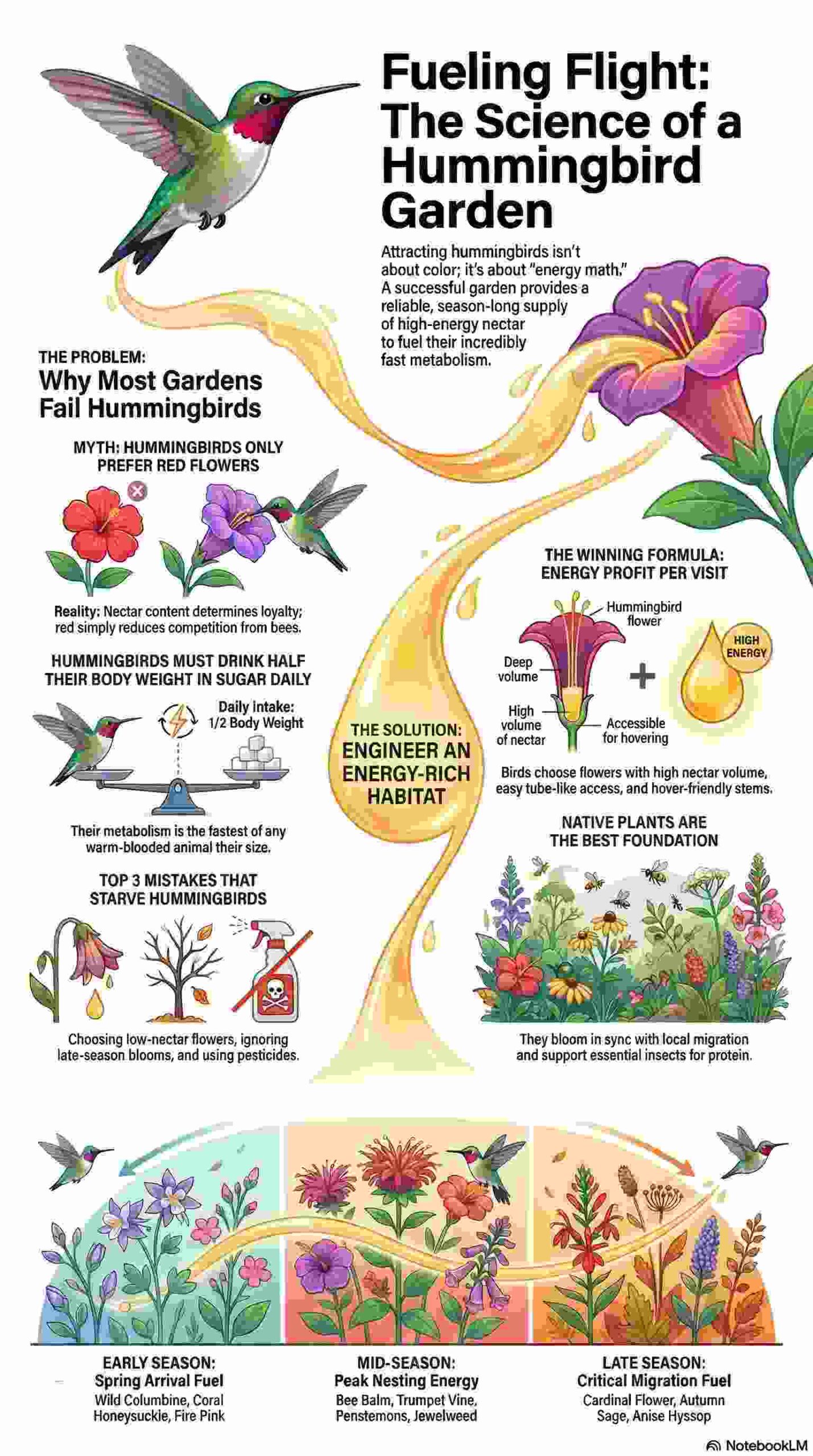
Hummingbird Garden at a Glance: Quick Visual Guide
Before we wrap up, here’s a quick visual guide to help you plan your hummingbird-friendly garden. It’s designed to serve as a quick reference when planning bloom timing.
Summary: Creating a Research-Based Hummingbird Garden
Attracting hummingbirds successfully requires understanding their actual preferences, not myths, and providing appropriate resources based on research:
What works:
- Diverse flower colors (not just red)
- Tubular flowers producing abundant nectar
- Native plants matching regional hummingbird species and migration timing
- Bloom succession from spring arrival through fall departure
- Late-season bloomers providing critical migration fuel
- Pesticide-free gardens supporting insects
- Supplemental water sources
What doesn’t work:
- Believing only red flowers attract hummingbirds
- Planting exclusively ornamental cultivars with reduced nectar
- Ignoring late-season bloomers
- Using pesticides that eliminate insect protein sources
- Planting invasive species
- Excessive garden tidiness
The minimum effective garden includes:
- Early-season native for spring migration arrival
- Mid-season native supporting breeding season
- Late-season native providing fall migration fuel
- Water source for drinking and bathing
Research clearly demonstrates that flowering plants for hummingbirds work best when they’re regionally appropriate natives planted in bloom-succession patterns matching migration and breeding chronology.
By understanding what hummingbirds truly need, based on scientific research rather than assumptions, gardeners can create landscapes that reliably attract and support these remarkable birds throughout their complete annual cycle.