
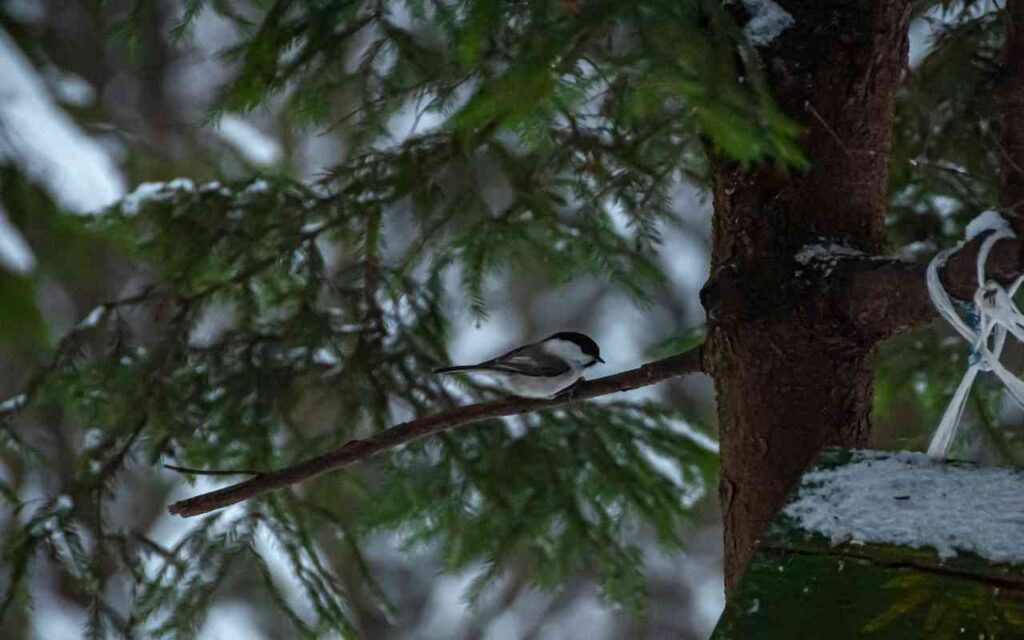
That tiny puffball at your feeder when it’s ten below zero isn’t just cute — it’s a tiny survival machine. Watching how chickadees survive the winter is like seeing a masterclass in endurance. I spent an entire January morning watching black-capped chickadees visit my feeder again and again, grabbing one seed at a time and vanishing into the trees. At first, I thought they were starving, but they were actually running a high-stakes food-stashing operation that would make a doomsday prepper proud.
These little birds don’t just brave the cold—they thrive in it. With tricks like controlled hypothermia, strategic seed caching, and even growing extra brain cells to remember where they hid their snacks, chickadees endure temperatures that would leave most creatures frozen in minutes. Half an ounce of pure determination, and somehow they make it look effortless. 🙂
- Chickadees survive extreme cold using torpor and fluffing feathers.
- They huddle together to share body heat on frigid nights.
- Winter flocks of 5–10 birds often include other species.
- Birds cache thousands of seeds and recall them with amazing memory.
- Feathers increase ~25% after fall molt for better insulation.
- Roosting in tree cavities protects against wind chill.
- They forage constantly for seeds, suet, and insects.
- Survival depends on food, water, shelter, and predator awareness.
- Backyard support: provide seeds, suet, heated water, and safe roosts 🙂
Chickadee Winter Behavior
Show Transcript
0:00 – 0:06
Okay, picture this. It’s one of those brutally cold winter days. Snow is everywhere. And then you see this tiny, impossibly fluffy bird just hopping around like it’s nothing.
0:06 – 0:12
That little bird is a chickadee. And get this—it weighs less than half an ounce. So, how in the world does it survive the harsh winter?
0:12 – 0:25
It turns out chickadees are masters of survival. Let’s dive into the chickadee’s winter playbook. That little puffball at your bird feeder isn’t just cute—it’s a finely tuned survival machine, thriving even in the harshest winter conditions.
0:25 – 0:57
Where does their survival start? It begins with the chickadee’s most powerful tool: its mind. These birds have incredible foresight and memory, which they use to stay alive when food is scarce.
0:57 – 1:26
The first survival strategy is called scatter-hoarding. Throughout the fall, chickadees make hundreds of trips daily, grabbing one seed at a time and hiding it in unique locations—under bark, in crevices, or inside pine needles. A single chickadee can hide up to 80,000 seeds in a season—and here’s the amazing part: it remembers where almost every single one is. This mental map of thousands of hidden food caches is vital for surviving winter.
1:26 – 1:49
Memory alone isn’t enough. The chickadee’s body is a piece of high-tech survival gear, perfectly engineered for the cold.
1:49 – 2:23
In the fall, chickadees grow about 25% more feathers than in summer. By fluffing them up, they trap pockets of air that act like a natural down jacket, keeping body heat in and the bitter cold out. But on brutally cold nights, even this isn’t enough—they have a secret weapon called torpor.
2:23 – 2:56
Torpor is a state of controlled hypothermia. Chickadees can drop their body temperature by up to 20°F, slowing their metabolism to save critical energy. Just before sunrise, they shiver to warm back up and start the day ready to forage.
2:56 – 3:53
Survival isn’t solo. Chickadees understand the power of community. In winter, they abandon territories and form small social flocks, often with other species like nuthatches and woodpeckers. The benefits are twofold: safety in numbers against predators and more efficient foraging. One bird finds a seed patch, and the whole flock eats.
3:53 – 4:16
Finding shelter is also critical. Wind chill can strip body heat in minutes, so chickadees roost in protected spots like tree cavities or nest boxes to survive the night. Winter for a chickadee is a constant balancing act: find enough food to fuel a high metabolism while conserving energy and staying warm.
4:16 – 5:04
Chickadees rely on high-energy, high-fat foods to survive. They dig for dormant insects under bark and forage seeds, including black oil sunflower seeds, at backyard feeders. These foods provide the fuel they need to survive freezing temperatures.
5:04 – 5:54
And here’s where humans can help. You can become a chickadee’s winter ally by:
- Providing high-energy foods like sunflower and safflower seeds.
- Offering fresh liquid water, ideally in a heated bird bath.
- Leaving dead trees standing or installing nest boxes for shelter.
- Planting native shrubs for cover from predators and wind.
- Avoiding pesticides to preserve natural insect food sources.
5:54 – 6:24
The next time you see a chickadee at your feeder, remember: it’s more than a cute little bird. It’s a memory champion, a master of endurance, and a living example of resilience. By feeding and protecting them, we help these tiny winter warriors survive and thrive.
6:24 – 6:28
The takeaway is simple: provide food, water, and shelter—and watch these remarkable birds flourish even in the coldest months.
Chickadee cold weather behavior changes dramatically once temperatures drop and daylight hours shrink. The solitary territorial behavior of summer disappears, replaced by highly organized winter flocks that serve multiple survival functions.
Chickadees form stable flocks of 5-10 individuals, typically including a breeding pair and several younger birds plus occasional members of other species like nuthatches, downy woodpeckers, and brown creepers.
According to research from the Cornell Lab of Ornithology, chickadees and titmice act as “nuclear species” in these mixed flocks, doing virtually all the communicating through contact and alarm calls, while “attendant species” like woodpeckers, nuthatches, and creepers trail along, exploiting the chickadees’ need to keep in contact with their own flock members. Each species forages in different microhabitats, minimizing competition while maximizing the “many eyes” advantage for detecting predators.
These flocks establish and defend winter territories ranging from 20-50 acres depending on habitat quality. Within flocks, chickadees maintain strict dominance hierarchies established through subtle interactions at feeders and roosting sites. Dominant birds get first access to premium food and the best roosting cavities, directly impacting their survival odds.
Chickadee roosting in winter is critically important and often underappreciated. Research by University of Alaska biologist Susan Sharbaugh found that chickadees in Alaska spent 18-hour nights in temperatures reaching 40 below zero by roosting in tree cavities, specifically preferring birch trees. She tracked radio-tagged chickadees to discover they squeezed into cavities as small as a quarter diameter, choosing enclosed spaces that retained body heat far better than exposed branches.
Roosting sites protect chickadees from wind chill, which can be as deadly as absolute temperature. A chickadee exposed to wind on an open branch loses heat exponentially faster than one tucked into a protected cavity. Finding quality roost sites can be as critical as finding food. Chickadees compete for limited cavities, with dominant individuals claiming the best spots while subordinates make do with less protected locations or simply huddling in dense evergreen cover.
Movement patterns also shift seasonally. Summer territories dissolve, and birds range more widely, following food availability and flockmates. They visit feeders more consistently and predictably in winter, with individual chickadees visiting feeders over 200 times per day according to Cornell research using GPS tracking. For more on chickadee behavior, visit black-capped chickadee facts.
How Chickadees Stay Warm
How small birds stay warm in winter requires multiple complementary strategies working simultaneously. Chickadees employ basically every trick in the avian thermoregulation playbook, and they need them all.
Feather insulation is the primary defense. Chickadees increase their feather count by approximately 25% after fall molt compared to summer plumage. These aren’t random feathers, they add specifically structured down feathers that trap insulating air layers next to the skin. The outer contour feathers interlock to create a wind and water-resistant shell.
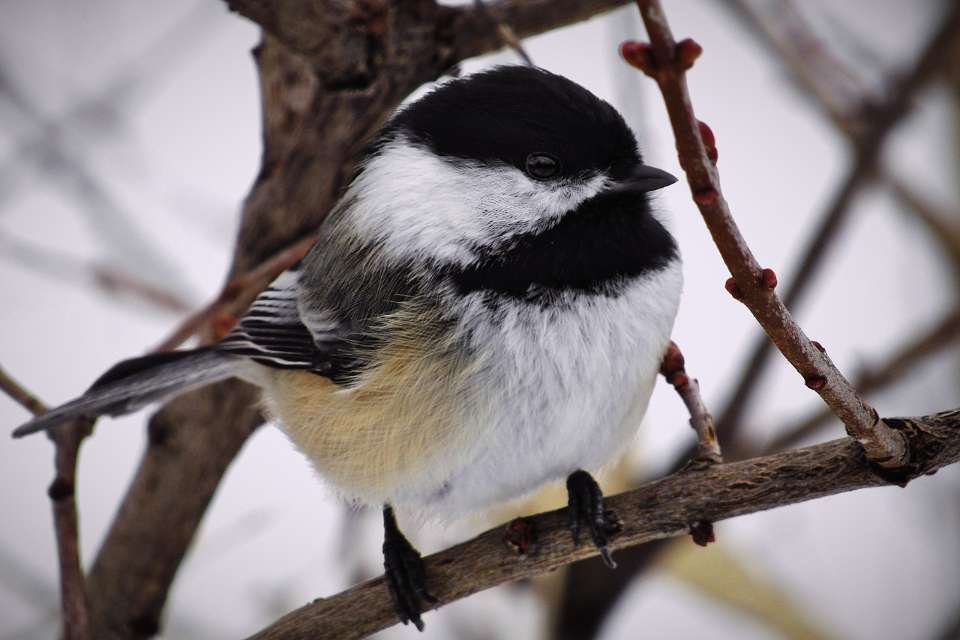
Fluffing these feathers dramatically increases insulation efficiency. A fluffed chickadee looks nearly spherical, maximizing the insulating air layer while minimizing surface area relative to body volume. This reduces heat loss substantially, though it only works in calm, dry conditions. Wind and rain compress feathers and dramatically reduce insulation, which is why chickadees seek shelter during storms.
Chickadee winter adaptations include behavioral thermoregulation too. On sunny winter days, chickadees orient their darker backs toward the sun, absorbing radiant heat. They tuck their poorly-insulated heads under wings when roosting. They huddle together in cavities, sharing body heat. Simple behaviors that make measurable differences in energy expenditure.
Here’s the really wild adaptation: torpor. When temperatures plummet and survival becomes precarious, chickadees can enter controlled hypothermia where body temperature drops from about 108°F to around 88-90°F. According to research published in the Journal of Comparative Physiology, birds exposed to 0°C exhibited metabolism 32-45% lower than predicted for a 12-gram homeotherm, with body temperatures dropping 10°C below normal nocturnal body temperature.
This isn’t accidental cooling, it’s a controlled, regulated energy-saving mechanism. Chickadees actively reduce shivering in extreme cold, allowing body temperature to drift downward in a manner that conserves fat reserves. Before dawn, they emerge from torpor by shivering intensely, warming themselves back to normal operating temperature over 30-60 minutes.
The survival strategies of northern birds like chickadees represent millions of years of evolutionary fine-tuning. These tiny creatures survive conditions that larger animals cannot by exploiting every possible physiological and behavioral advantage. IMO, torpor is the most impressive, deliberately lowering body temperature to save energy while remaining alive is a high-wire act that most mammals can’t pull off. For attracting chickadees year-round, see how to attract chickadees to your yard.
Chickadee Winter Diet & Feeding Habits
What do chickadees eat in winter shifts dramatically from their summer diet. During breeding season, chickadees consume primarily insects and spiders to feed protein-hungry nestlings. Winter changes everything.
Chickadee winter diet is roughly 50% animal matter (insects, spiders, insect eggs, pupae) and 50% plant material (seeds, berries). They’re remarkably adaptable omnivores who exploit basically any nutrition source available. This includes fat and meat from carrion when they find it, crucial during extreme cold when every calorie matters.
Chickadee feeding habits in winter become almost frantic. Research shows chickadees spend up to 20 times more time foraging in winter compared to summer. They must eat constantly during limited daylight hours to build fat reserves for overnight survival. A chickadee weighed in the morning has essentially zero body fat. The same bird weighed in late afternoon is visibly plump, having packed on 7-10% of its body weight in fat during a single day.
This daily cycle repeats throughout winter. Chickadees burn virtually all stored fat overnight just staying warm through shivering thermogenesis. Morning arrives with depleted reserves and an immediate need to start refueling. It’s an exhausting existence on a metabolic knife edge.
Bird suet for winter provides concentrated fat and protein that chickadees desperately need. High-quality suet cakes containing rendered beef fat, seeds, nuts, and dried insects deliver maximum calories in minimum feeding time. This efficiency matters when daylight is scarce and temperatures are brutal.
Black oil sunflower seeds are another winter staple. The high fat content (40-50% fat by weight) provides essential energy, and chickadees can crack the shells efficiently with their strong beaks. According to the Cornell Lab of Ornithology, chickadees also consume pine seeds, ragweed seeds, goldenrod seeds, and sumac seeds in winter, basically whatever high-quality seed sources they can access.
Insects don’t disappear entirely in winter. Chickadees probe bark crevices for overwintering insect eggs, pupae, and hibernating adult insects. They excavate cocoons and inspect under loose bark scales. This behavior provides crucial protein that seed-only diets lack. The combination of seeds for energy and insects for protein sustains chickadees through the coldest months. For complete diet information, check out what do chickadees eat.
How Chickadees Find Food When Snow Covers the Ground
How chickadees store food is one of their most remarkable survival adaptations. They engage in what biologists call “scatter hoarding”, storing individual food items in hundreds or thousands of separate locations throughout their territory.
A single chickadee can cache up to 1,000 seeds per day, or roughly 80,000 seeds over an entire season. Each seed goes into a different hiding spot: under bark flakes, in moss clumps, in clusters of pine needles, in tree bark crevices, even in structures like house siding and shingles. The diversity of cache sites protects against catastrophic loss if one cache is discovered by competitors or becomes inaccessible.
Here’s the truly incredible part: chickadees remember where each cache is located. Their spatial memory is so precise that they can relocate individual seeds weeks after hiding them, even under snow cover. How do chickadees stay warm in cold weather partially depends on this cached food providing energy when foraging conditions are terrible.
The hippocampus, the brain region responsible for spatial memory, literally grows larger in fall to accommodate cache location data. Research shows the chickadee hippocampus increases by approximately 30% in autumn compared to spring. When spring arrives and cached food is depleted, the hippocampus shrinks back to normal size. This neuroplasticity is rare in adult vertebrates and represents a stunning example of brain structure adapting to immediate survival needs.
Winter bird feeders for chickadees supplement but don’t replace caching behavior. Chickadees visit feeders constantly but rarely eat on-site. Instead, they grab seeds and fly to nearby cover to either eat them immediately in safety or cache them for later. That’s why you see chickadees making multiple rapid trips rather than lingering at feeders like some species.
When snow covers the ground, chickadees rely on three food sources: cached seeds they retrieve from memory, insects they extract from tree bark, and supplemental food from feeders. All three are essential. Remove any one element during extreme cold, and survival rates plummet. The integration of these strategies demonstrates why chickadee winter survival depends on complex behavioral flexibility rather than any single adaptation.
Probing bark becomes critically important when snow is deep. Chickadees systematically work over tree trunks and branches, inspecting every crack and crevice for hibernating insects. They hang upside-down, work horizontally, and cover every possible surface in their search for protein. This foraging style explains why chickadees prefer habitats with diverse tree species and abundant dead wood, more microhabitats mean more potential food.
Flocking & Social Behavior in Winter
Chickadee winter flocking behavior serves multiple survival functions that go beyond simple companionship. These flocks are highly organized social units with established hierarchies, territory boundaries, and coordinated activities.
The dominance hierarchy within flocks determines access to food and roosting sites. Dominant birds (usually older individuals and males) feed first, choose premium roost cavities, and monopolize high-quality food sources. Subordinate birds wait their turn, accept inferior roosts, and take higher risks when foraging. This hierarchy gets established through brief aggressive interactions, chases, threat displays, and displacement at feeders.
Why accept subordinate status? Because being in a flock, even as a subordinate, provides better survival odds than being alone. The “many eyes” principle means predators get detected sooner. Information sharing about food locations benefits all flock members. And subordinates who survive winter often inherit territory or climb the hierarchy when dominant birds die.
Mixed-species flocks provide additional benefits. When chickadees flock with nuthatches, woodpeckers, and kinglets, each species exploits different foraging niches on the same trees. This reduces direct competition while maintaining the vigilance and information-sharing advantages of group living. Research shows chickadees often serve as “nuclear species” that other birds follow, likely because chickadees are highly vocal and excellent at detecting predators.
Winter backyard birds that form these mixed flocks create dynamic, interesting viewing opportunities for observers. Watch how different species interact, who gives way to whom, and how alarm calls from one species alert the entire flock. Understanding these social dynamics adds depth to casual bird watching.
The stability of winter flocks varies. Core members remain together throughout the season, defending a winter territory and maintaining social relationships. Some individuals move between flocks or shift territories if food becomes scarce. Severe weather can concentrate multiple flocks at reliable food sources like well-stocked feeders, creating temporary super-flocks with complex social dynamics.
FYI, chickadee flocks aren’t just practical survival strategies, they also demonstrate surprising social complexity and individual recognition. Research suggests chickadees recognize individual flock members by voice and remember prior social interactions. These cognitive abilities support the sophisticated social structure that winter flocking requires.
Chickadees and Nesting During Winter
Chickadee nesting habits winter is a bit of a misnomer, chickadees don’t actually nest in winter. They’re cavity nesters that breed from late April through July, excavating their own nest holes in soft, rotted wood or using existing cavities from other species.
Winter shelter is completely different from nesting. During breeding season, females build nests inside cavities using moss, plant fibers, and soft materials like animal fur. These nests cradle eggs and nestlings. In winter, chickadees simply roost in cavities without building any nesting structure. They’re using cavities purely for thermal shelter, not reproduction.
That said, the availability of winter roosting cavities directly impacts breeding success come spring. Chickadees that survive winter in good condition because they had quality roost sites are more likely to breed successfully. Those that barely survived while roosting in exposed locations may be too stressed or depleted to breed at all.
Chickadees don’t reuse the same cavity year after year. Each spring, they select a new site and excavate it to their specifications. This means maintaining a diversity of dead and dying trees throughout your property provides both winter roosting sites and future breeding sites. Standing dead trees (snags) are critical habitat components that many property owners mistakenly remove.
Winter roosting behavior also differs from breeding behavior in terms of social organization. During breeding, pairs are territorial and aggressive toward other chickadees. In winter, multiple chickadees may roost near each other (though not in the same cavity) within flock territories. The shift from territorial aggression to social tolerance happens annually as seasons change. For comprehensive year-round guidance, visit the complete backyard birding guide.
Tips for Helping Chickadees in Your Backyard
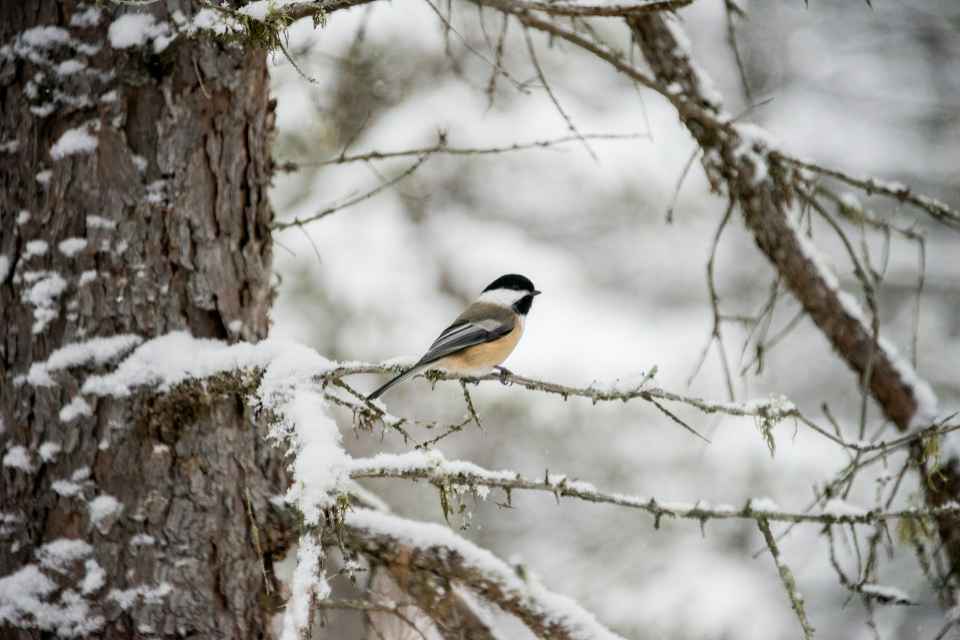
Supporting backyard bird winter survival tips for chickadees requires thinking beyond just feeders. Chickadees need food, water, and shelter integrated into a functional winter habitat.
Winter bird feeders for chickadees should offer black oil sunflower seeds and high-quality suet. Platform feeders, hopper feeders, and tube feeders all work, though chickadees prefer feeders with perches where they can land and grab seeds. Position feeders near cover (within 10-15 feet of shrubs or trees) so chickadees have quick escape routes from predators like sharp-shinned hawks.
Keep feeders consistently stocked, especially during extreme cold and storms. Chickadees come to depend on reliable food sources and integrate feeder locations into their mental maps of cache sites and foraging routes. Running out of seed during a blizzard can force chickadees into desperate, risky foraging that increases mortality.
Suet feeders should offer rendered beef suet without fillers, preferably with added nuts, seeds, and dried insects. Cheap suet cakes with grain fillers provide less nutrition. Quality matters when birds are burning calories at maximum rates just to stay alive.
Water is often overlooked but critically important. Chickadees need liquid water for drinking and bathing even in winter. Bathing maintains feather structure and insulation. A heated birdbath or birdbath heater prevents freezing and provides this essential resource when natural water is frozen solid. Learn more at how to keep bird baths from freezing in winter.
Shelter means preserving or creating roosting sites. Leave dead trees standing when safe to do so. Install nest boxes with 1 1/8-inch entrance holes, chickadees will use them for winter roosting even though they don’t nest in them. Mount boxes in sheltered locations protected from prevailing winds.
Plant native shrubs and evergreens that provide cover and natural food sources. Chickadees eat seeds from native plants like birch, alder, and conifers. Dense evergreens offer protected roosting spots on nights when chickadees can’t find cavities. The combination of planted cover and nest boxes creates a more complete habitat.
Avoid pesticides completely. Chickadees need insects year-round, and chemical treatments eliminate this food source. Even winter insect consumption matters, chickadees probing bark for overwintering insects are getting essential protein that seed-only diets can’t provide. Pesticide-free yards support more insects, which supports more chickadees. For additional winter support strategies, see how to attract birds during winter.
Create brush piles from pruned branches and yard debris. These provide dense cover that chickadees use for quick escapes from predators and as protection during storms. Brush piles also harbor insects that chickadees can glean during winter foraging.
FAQs About Chickadees in Winter
Do chickadees migrate in winter?
No. Black-capped chickadees are non-migratory permanent residents throughout their range. They establish territories and remain in the same general area year-round. This strategy avoids the dangers and energy costs of migration but commits them to surviving winter conditions locally. Some northern populations show limited irruptive movements during severe winters or food shortages, but true migration doesn’t occur.
Do chickadees hibernate in winter?
No, chickadees don’t hibernate. They remain active throughout winter, foraging daily to maintain energy balance. However, they do enter torpor, a state of controlled hypothermia where body temperature and metabolism decrease to conserve energy overnight. Torpor differs from hibernation in duration (hours vs. months) and depth (moderate temperature reduction vs. near-freezing body temperature).
How do chickadees survive extreme cold?
Through a combination of strategies: increasing feather insulation, eating constantly to build fat reserves, caching thousands of seeds for backup food, roosting in protected cavities, entering torpor during the coldest nights, and living in social flocks that improve predator detection and food finding. No single adaptation is sufficient, chickadees need all of these working together to survive temperatures below zero.
What’s the chickadee mortality rate in winter?
Research indicates that more than 25% of chickadees don’t survive winter, with starvation being the primary cause of death. Chickadees live on a metabolic knife edge where a few days without adequate food can be fatal. The average lifespan of a black-capped chickadee is only 2.5 years, with winter mortality being the main limiting factor.
Can I help chickadees too much with feeders?
Generally no, though there’s debate about dependency. Well-maintained feeders clearly improve winter survival rates by providing reliable food during extreme conditions when natural food may be inaccessible. However, dirty feeders spread disease, so regular cleaning is essential. The benefits of feeding far outweigh potential negatives when done properly 🙂
Conclusion
Understanding how chickadees survive the winter reveals one of nature’s most impressive survival stories packed into a half-ounce package. These tiny birds face overnight temperatures that would kill humans in hours, limited daylight for foraging, scarce food resources, and constant predation pressure. Yet they not only survive, they thrive, maintaining territories, social hierarchies, and complex behaviors throughout the harshest season.
Chickadee winter adaptations demonstrate evolutionary genius: growing extra brain cells to remember cache locations, increasing feather insulation by 25%, entering controlled hypothermia, burning and rebuilding fat reserves daily, and organizing into cooperative social flocks. Each adaptation alone would be impressive. Together, they create a survival system robust enough to withstand arctic conditions in a bird that weighs less than four quarters.
Backyard birdwatchers can significantly improve chickadee survival by providing high-quality food, liquid water, and shelter. Stock feeders with black oil sunflower seeds and quality suet. Maintain heated birdbaths. Leave dead trees standing for roost sites. Plant native shrubs. Avoid pesticides. These aren’t complicated or expensive interventions, but they make measurable differences in winter survival rates.
The chickadees visiting your feeder aren’t just opportunistically grabbing free food. They’re executing complex behavioral programs that integrate feeder visits with cache retrieval, bark foraging, social interactions, predator avoidance, and energy management. Every seed they take represents a calculation in an ongoing survival equation played out across thousands of visits throughout winter.
Last February during a multi-day cold snap with temperatures staying below zero, I watched chickadees at my feeder making trip after trip, grabbing seeds and disappearing into nearby spruce trees. I counted one individual making 47 trips in under two hours. That bird was fighting for its life, building fat reserves against nighttime temperatures that would plunge to minus 15°F. The determination and energy were humbling to witness.
By providing food, water, and shelter, you’re not just attracting cute birds, you’re participating in their survival story. Every seed matters. Every drink of liquid water matters. Every protected roosting cavity matters. Winter chickadee survival operates on such tight margins that your backyard habitat makes the difference between life and death for individual birds.
So keep those feeders full, maintain that heated birdbath, preserve those dead trees, and watch with appreciation as these remarkable little survivors navigate another northern winter. They’ve been perfecting these strategies for millions of years, and it shows.