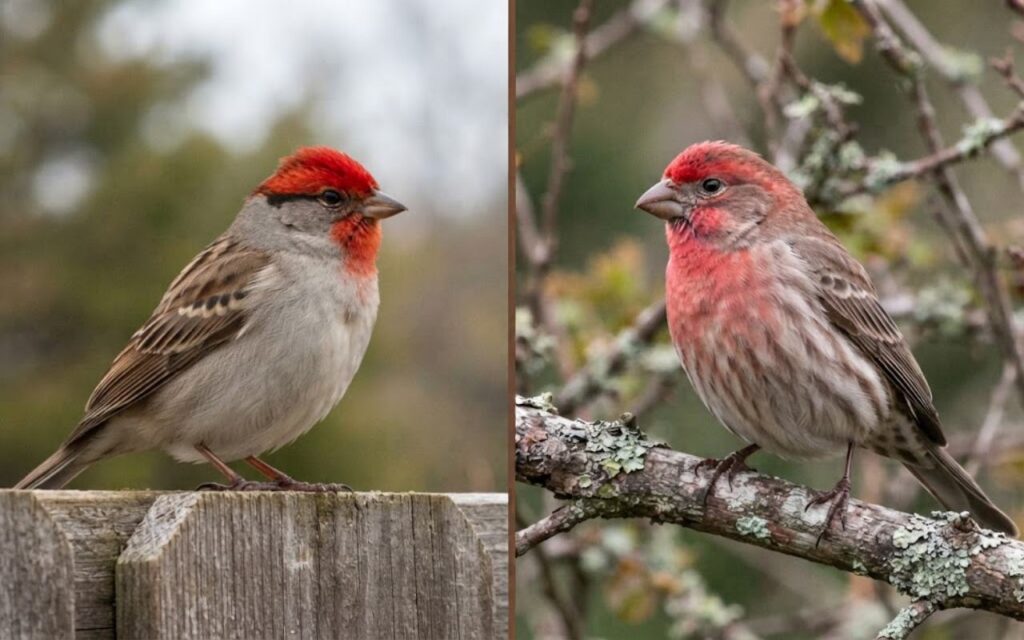
Disentangling the persistent backyard confusion of a red headed sparrow vs house finch begins with recognizing that the phrase itself represents a widespread ornithological misnomer. Backyard birders frequently spot a streaked brown songbird displaying a bright splash of crimson across its head and assume they have documented an exotic sparrow variant.
In North American ornithology, true sparrows of the family Passerellidae never exhibit rich red or raspberry plumage across their facial feathers and breasts. What observers are virtually always recording is the male House Finch (Haemorhous mexicanus), a prolific species whose distinct morphology and habits easily set it apart once key field marks are understood.
Quick-Glance Field Summary
The bird commonly reported as a red-headed sparrow is almost invariably a male House Finch, as true native sparrows display only rusty or rufous caps rather than saturated red facial wash. Checking bill curvature, lower flank streaking, and foraging posture provides an immediate identification at any backyard feeding station.
- Taxonomic family: House Finch belongs to Fringillidae; native North American sparrows belong to Passerellidae.
- Head coloration: House Finch shows diffuse scarlet or rose on the forehead, brow, and throat; sparrows show solid chestnut or rufous caps.
- Bill morphology: House Finch features a curved culmen with a swollen profile; sparrows carry straight, sharply pointed conical beaks.
- Ventral patterning: House Finch displays dense brown vertical streaks across a dirty white belly; common rusty-capped sparrows show clear, unstreaked gray bellies.
- Primary feeder zone: House Finch perches directly on elevated tube and hopper perches; sparrows prefer ground foraging or platform trays.
The Taxonomic Misnomer Behind the Red Headed Sparrow Mystery
On community forums like Reddit’s r/whatsthisbird, novice observers regularly post blurry photos asking for confirmation of a “red-headed sparrow” feeding on their sunflower seeds. Experienced forum moderators routinely point out that no species officially bearing that exact name exists in the wild bird registries of the American Ornithological Society.
The mistaken identity typically stems from the heavy brown and gray body streaking of the House Finch, which closely mirrors the camouflaged plumage of classic New World sparrows belonging to the family Passerellidae.
Backyard birders also occasionally cross paths with true native sparrows possessing prominent reddish plumage, which amplifies the linguistic confusion. Common backyard species like the Chipping Sparrow, Field Sparrow, and American Tree Sparrow display distinct rufous or chestnut caps atop their heads.
Furthermore, the eastern “Red” subspecies group of the Fox Sparrow (Passerella iliaca) defies the standard “little brown bird” stereotype by exhibiting a rich, saturated fox-red across its face, back, and heavily streaked breast.
However, a critical biochemical distinction remains: these true sparrows derive their earthy, rust-colored tones from fixed melanin pigments. This stable coloration is completely structurally distinct from the bright, diet-dependent, carotenoid-driven raspberry or scarlet red that blankets the forehead, brow, and throat of a male House Finch.
Understanding this core baseline eliminates confusion before complex field marks are even assessed:
The Sparrow Profile: If the bird displays an earthy, rich brick-red or fox-red restricted to a tight head cap or organized into heavy, chevron-shaped breast streaks set against a gray or white canvas, you are looking at a native sparrow.
The Finch Profile: If the songbird at your feeder possesses a bright scarlet, orange, or crimson wash enveloping the entire face, throat, and upper breast, you are observing a male finch.
Culmen Curvature and Bill Structure Differences
Evaluating the bill profile offers the most reliable structural method for distinguishing finches from sparrows when light conditions make color evaluation difficult. The House Finch possesses a heavy, conical bill with a noticeably curved upper ridge, known ornithologically as the culmen.
This curved profile creates a bulbous, slightly swollen appearance adapted specifically for shearing open tough sunflower and safflower seed hulls. Native sparrows maintain a distinctly straighter, more sharply pointed conical bill structure.
In species like the Chipping Sparrow, the upper and lower mandibles form a straight-sided, sharp wedge designed for manipulating tiny grass seeds and terrestrial invertebrates. The bill is proportionally smaller relative to the head than the bill of a House Finch.
Field observers posting on forums like BirdForum frequently emphasize that silhouette alone can confirm the bird when looking into strong backlight. A House Finch presents a blunt, rounded head shape that blends smoothly into its stout, curved beak. A sparrow exhibits a flatter, more angular forehead angle that terminates in a pinpoint beak tip.
Carotenoid Pigmentation and Plumage Distribution Patterns
The red coloration on a male House Finch is acquired entirely through the ingestion of carotenoid pigments found in wild berries and select seeds during their late-summer molt. Because this coloration depends entirely on dietary quality, individual males display variations ranging from deep strawberry red to warm orange or even dull brassy yellow.
The color blankets the forehead, flows down across the superciliary line, and pools heavily across the upper chest and rump. True sparrows derive their rusty head patterns from melanin pigments rather than dietary carotenoids.
Melanin creates stable, genetically fixed chestnut and rufous tones that do not fluctuate into yellow or orange shades based on food supply. Furthermore, this rusty tone is tightly restricted to the crown feathers, never spilling downward into the auriculars, throat, or upper breast.
Ventral streaking provides the secondary visual proof needed to close any identification debate. A male House Finch features crisp, heavy brown streaks running down its lower belly and undertail coverts, set against a dirty white baseline.
By contrast, adult rusty-capped sparrows feature unmarked, pearl-gray or clean buff underparts free of heavy abdominal streaking.
Feeder Station Behavior and Flocking Dynamics
Behavioral dynamics at backyard feeding setups provide immediate clues regarding which bird is visiting your yard. House Finches are highly gregarious, acrobatic feeders that travel in persistent flocks throughout the winter months.
They will happily cling to hanging wire-mesh socks, jostle on narrow tube-feeder perches, and occupy elevated hopper feeders for extended periods. Native sparrows behave in a markedly different fashion around elevated feeders.
Most sparrows are instinctual ground-scratchers that prefer collecting dropped seeds beneath hopper stations rather than monopolizing perches above.
Even when a Chipping Sparrow or Song Sparrow visits an elevated feeder tray, they typically feed as solitary individuals or in loose pairs rather than tight, chattering flocks.
Community birders on backyard wildlife subreddits note that House Finches display strong dominance over smaller seed perches, aggressively displacing American Goldfinches while ignoring larger birds.
Their feeding motion involves twisting seeds sideways within their mandibles to crack hulls using high jaw pressure. Sparrows, when feeding on the ground, use a rhythmic double-scratch kick with their feet to uncover fallen debris before picking out small morsels.
Diagnostic Hardware and Yard Setup for Confident Field Separation
Installing the correct backyard setup makes differentiating finches from sparrows effortless while protecting the health of visiting flocks. Because House Finches crowd onto tube perches, they are exceptionally prone to spreading Mycoplasmal conjunctivitis, an infectious bacterial eye disease that causes crusty swelling around the facial feathers.
Maintaining proper feeder hygiene prevents this pathogen from decimating local finch colonies.
- Feeder sanitation protocol: Soak tube and hopper feeders in a 1:9 bleach-to-water dilution every fourteen days, rinsing thoroughly with clean water to remove chemical residues.
- Window collision mitigation: Position all viewing feeders either within three feet of window glass or beyond thirty feet away, following standard safety geometry established by field researchers.
- Food selection strategy: Provide black oil sunflower seed or safflower in elevated perches for House Finches, while scattering white millet on low, open ground trays for native sparrows.
- Optical magnification baseline: Use an 8×42 roof-prism binocular to resolve subtle flank streaking and culmen curvature clearly in low morning light conditions.
Proper placement of seed trays allows both species to feed in their natural strata without competing directly for space. Sparrows will naturally gather on low platform surfaces or natural leaf litter where their camouflaged plumage provides shelter from raptors.
House Finches will dominate the upper canopy and elevated perches, giving you clean, unobscured angles to observe their vivid plumage patterns and curved bill profiles.