
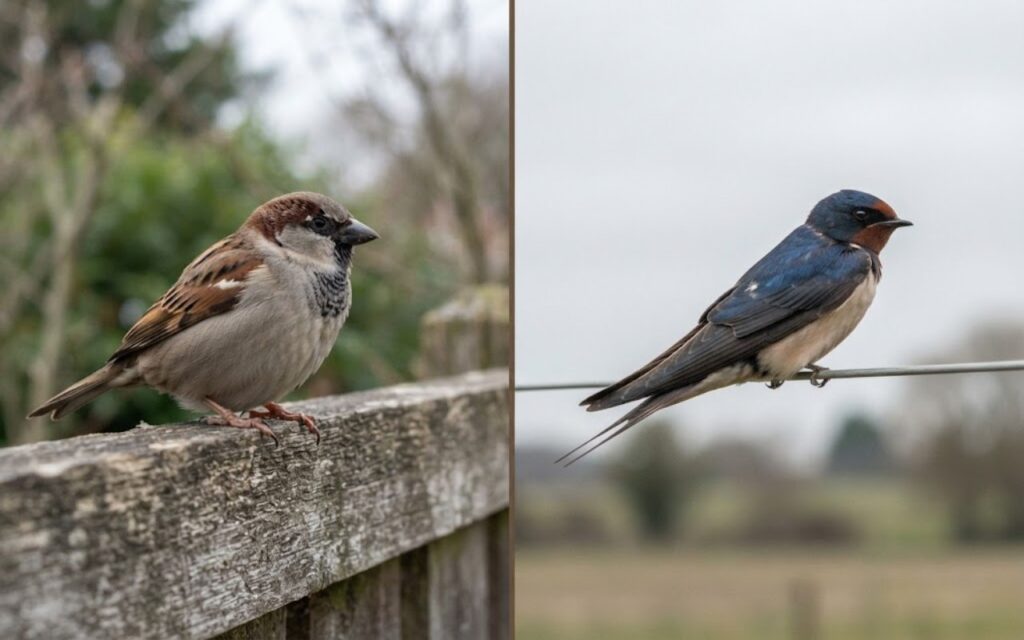
Telling the difference during a fast backyard flyby between a sparrow vs swallow often puzzles novice birders and experienced naturalists alike. While both groups share overlapping urban habitats and occasionally fight over the exact same garden real estate, their structural biology belongs to entirely separate avian branches.
Field identification becomes simple once you isolate specific body proportions, flight styles, and feeding habits. Taking a moment to analyze physical silhouettes and perch behaviors will quickly clarify which bird has entered your yard.
Quick-Glance Field Summary
Telling these two avian families apart requires looking closely at bill morphology and aerial agility rather than general body size alone. Granivorous sparrows feature stout conical seed-cracking bills and hops on turf, while insectivorous swallows display flat triangular bills, swept-back pointed wings, and fluid aerial acrobatics.
- Bill Structure: Thick conical seed-cracking bill for sparrows; short, flat triangular bill with a wide gape for swallows
- Flight Style: Undulating flap-and-glide bursts near ground cover for sparrows; continuous fluid swooping and gliding high in open air for swallows
- Wing Shape: Short, rounded wings built for rapid hedge maneuvering for sparrows; long, narrow, scythe-like pointed wings for swallows
- Tail Shape: Square or shallow-notched broad tail for sparrows; deeply notched or elongated fork for swallows
- Preferred Foraging Zone: Leaf litter, patio decks, and hopper seed feeders for sparrows; open airspace over lawns, pastures, and open water for swallows
- Nest Box Entrance Tolerance: House sparrows enter 1.25-inch to 1.5-inch holes readily; tree swallows squeeze through 1.375-inch to 1.5-inch holes but struggle below 1.25 inches
Morphological Silhouettes and Bill Geometry Differences
Body shape provides your first definitive field mark when separating these two avian families. Sparrows belong to the family Passerellidae (New World sparrows) or Passeridae (Old World house sparrows), carrying compact, barrel-chested bodies supported by relatively long, muscular legs built for walking and hopping.
Swallows belong to the family Hirundinidae, showcasing streamlined, torpedo-shaped torsos paired with tiny, vestigial legs designed solely for clinging to wires or perches rather than moving along the ground.
Bill anatomy reveals their respective dietary adaptations in dramatic fashion. A sparrow possesses a heavy, deep, conical bill designed to generate strong crushing force against hard seed hulls.
Swallows possess a tiny, flat, hook-tipped bill that opens into an expansive, cavernous mouth gape lined with sensitive rictal bristles engineered to scoop flying insects right out of the sky.
If a bird perches motionless on a fence wire, check the wingtip extension relative to the tail tip. A swallow features elongated primary flight feathers that extend well past the rump, often crossing cleanly over the base of the tail feathers.
A sparrow displays short, rounded wing primaries that stop well short of the tail base, leaving the broad rectrices fully exposed.
Aerial Insect Hawking Versus Ground Foraging Locomotion
Flight pattern provides the most immediate visual tell at a distance across a wide field or yard. Swallows spend the majority of their daylight hours aloft, executing acrobatic banks, sharp rolls, and sustained glides to capture aerial arthropods.
Sparrows rarely remain airborne for more than several seconds at a time, moving via low, choppy, undulating flaps before ducking straight back into protective brush piles or hedgerows.
On community forums like r/birdwatching, observers frequently discuss how birds interact with open water surfaces. A swallow dips low over swimming pools or livestock troughs to scoop up water mid-flight on the wing, relying on polarized reflections to gauge height without breaking stride.
A sparrow must land firmly along the edge of a saucer or rock shelf, dipping its beak downward and tilting its head backward to swallow. Ground locomotion immediately separates the two groups whenever birds land on open turf.
Sparrows utilize their strong tarsometatarsus bones to execute rapid, double-footed hops or methodical strides while sorting through fallen weed seeds.
If a swallow ends up on flat ground, it waddles awkwardly with uncoordinated steps, as its delicate foot musculature cannot support dynamic terrestrial foraging.
Nest Cavity Competition and Bluebird Box Clashes
Cavity nesting dynamics often create intense human-monitored conflicts between these species in early spring. Backyard trail operators on platforms like the North American Bluebird Society forum regularly document aggressive territory disputes pitting introduced House Sparrows against native Tree Swallows.
Both species aggressively seek out abandoned woodpecker cavities and artificial nest boxes that feature entrance holes measuring 1.5 inches in diameter.
Nesting materials inside the box reveal the occupant long before eggs appear. Swallows construct tidy, cupped nests lined with clean grass, invariably topping the interior with white flight feathers gathered from waterbirds or poultry.
Sparrows build chaotic, domed nests out of coarse straw, paper litter, and plastic debris, often packing the cavity completely to the roof while leaving a small side tunnel.
Forum members frequently detail heartbreaking nest site takeovers where aggressive sparrows displace native swallow pairs. Sparrows utilize their heavy conical bills as lethal bludgeons, easily overpowering lighter swallows trapped inside tight interior compartments.
Monitoring cavity boxes during the early April setup period remains essential for protecting vulnerable native fliers from invasive competition.
Plumage Markings and Tail Forking Distinctions
Examining plumage tones will quickly resolve identification confusion in direct sunlight. North American sparrows display intricate camouflaged patterns consisting of earthy browns, tans, buff streaks, and rufous caps that blend seamlessly into dried grasses and scrub.
Swallows feature smooth, unstreaked dorsal plumage often accented with intense structural coloration, such as the brilliant iridescent teal and violet sheen seen on adult Tree Swallows.
Tail geometry provides a distinct identifying silhouette against a bright sky. Barn Swallows display dramatically elongated outer tail streamers that form a deep, instantly recognizable fork.
Song sparrows, chipping sparrows, and house sparrows show square-cut or gently notched tails with broad, blunt feather margins that never produce extended scissor-like tips.
Facial markings also supply reliable field clues when viewing birds through spotting optics. Many sparrow species feature defined facial geometry, including distinct eyelines, lateral crown stripes, and pale submoustachial bands.
Swallows tend to show uniform facial coloration, frequently interrupted only by a dark mask, a clean white cheek patch, or a deep chestnut throat patch.
Backyard Exclusion Tactics and Nest Box Modification
Backyard bird enthusiasts seeking to support native swallows while deterring aggressive house sparrows must utilize hardware adjustments. Discussions across backyard birding communities emphasize that entrance hole geometry dictates which species successfully establishes territory. Installing specialized deterrent hardware on your nest boxes limits property damage and reduces fatal territorial attacks.
- Fit nest boxes with a standard 1.5-inch round entrance hole, which accommodates Tree Swallows while allowing you to add retrofitted wooden excluder blocks or deep oval portal extensions if sparrows begin staking claim.
- Install a Gilbertson Sparrow Resistant Nest Box, which features a constricted interior floor depth and an ultra-lightweight PVC body that tree swallows easily accept but house sparrows generally avoid.
- Hang thin, 6-lb monofilament fishing line vertically down the front face of the nest box on both sides of the entrance hole, spaced approximately 2.5 inches apart, to exploit sparrow skittishness without impeding swallow access or causing entanglement.
- Deploy an aerial sparrow spoofer device consisting of elevated, free-hanging weighted monofilament lines or mylar streamers above the box roof, a crowd-sourced hack widely praised on nest monitoring boards for disrupting sparrow landing paths.
- Mount your nest boxes in wide, open pasture zones at least 100 feet away from barns, outbuildings, and residential roof eaves where sparrows tend to form dense communal colonies.
Feed selection provides another practical avenue for controlling sparrow populations in residential spaces. Sparrows flock aggressively to commercial wild bird mixes containing high ratios of cracked corn, red milo, and white proso millet.
Switching to specialized hanging nyjer seed socks or elevated suet cages limits sparrow ground clustering, while swallows simply ignore these feeder stations to feast exclusively on natural insect populations.