
Spring migration transforms backyard birding from routine observation into urgent action requiring precise timing, strategic preparation, and daily decision-making. This spring migration checklist for backyard birders provides a practical framework for organizing tasks, tracking species arrivals, and maximizing observation opportunities during this brief but intense period.
Most backyard birders approach spring migration reactively, noticing migrants only after peak passage has passed rather than preparing systematically. This checklist lays out actionable steps, organized by timing, species, and daily maintenance, that experienced birders rely on to make the most of spring’s fleeting migration window. 🙂
- Spring migration is short and intense, so preparation must start before birds arrive.
- Complete habitat work by late February to be ready for early migrants.
- Native plants and insect-rich habitat are critical for refueling migrants.
- Clean feeders and bird baths frequently to prevent disease during peak traffic.
- Track arrivals using eBird and BirdCast to time observation windows.
- Peak migration runs late April through mid-May, with weather driving daily movement.
- Dawn surveys produce the highest diversity and best viewing opportunities.
- Different bird groups arrive in waves, from waterfowl and raptors to warblers.
- Consistent daily and weekly routines maximize sightings and habitat performance.
Watch: Spring Migration Tips for Backyard Birders
The video below walks through the key decisions backyard birders should be making as spring migration unfolds.
Show Transcript:
0:00
Spring migration is this incredible, almost magical event that can completely transform our backyards. But it moves so fast. If you’ve ever felt that sinking feeling that you just missed the best part, you are definitely not alone.
0:14
In this explainer, we’re going to break down exactly how to shift from being a casual observer to a truly strategic birder. The goal is to make sure you catch the main event this year.
0:22
Does this sound familiar? You start to see a few new birds and think, “Oh, cool, it’s starting.” But by the time you really get ready, it feels like the peak moment has already passed. That feeling of missing the most spectacular part is extremely common.
0:40
Think about it like this. The difference between seeing something you’ll remember for the rest of your life and missing it completely can literally come down to a single twenty-four-hour period. It all comes down to timing.
0:59
So how do you get the timing right? It’s not luck. It’s strategy. The big shift we all need is moving from reacting to whatever birds happen to show up to actively anticipating their arrival with a concrete plan. That’s the playbook we’re going to build together.
1:17
To understand why this is so important, consider one number: fifty percent. That’s right. Half of the entire spring migration is concentrated into just two to three weeks. That data comes from BirdCast, a project that uses weather radar to track bird migration in real time.
1:44
If you miss that narrow window, you’ve essentially missed the main event. That’s why having a strategic plan can completely change your season.
2:03
Here’s the roadmap. It all starts in February with prep work. March brings the first early arrivals. April is the buildup, and May is peak season. Let’s break it down month by month.
2:18
First, February. Success in May is decided by the work you put in now, long before migrants even start their journey north. Focus on two critical areas: your yard habitat and your personal gear. Gear failure during the peak window is simply not an option.
2:48
Migrating birds are running on empty. They need protein-rich insects like caterpillars to refuel, and native plants support the bugs they eat. Aim for at least seventy percent native plant coverage to create an effective refueling station.
3:08
Here’s your February checklist. Finish any major landscaping projects by the end of the month. Add keystone species like oaks and cherries, which support the most insect life. Set up a shallow birdbath with a dripper to attract tired birds.
3:31
On the gear side, clean your binoculars, test your camera, and clear your memory cards. That rare warbler landing in perfect light is the worst time to discover your camera battery is dead.
3:46
March is the first wave. These are the pioneers, and you also get the incredible spectacle of waterfowl migration. Keep an eye on local reports for early arrivals like eastern phoebes. Deep clean your feeders with a ten percent bleach solution, stock up on high-energy seeds, and clean out nest boxes by March twenty-fifth for early nesters.
4:17
Circle one key event on your calendar: the waterfowl peak in the second half of March. Massive flocks of ducks, geese, and swans push north, creating an amazing spectacle.
4:37
Now we’re heading into the main event: April and May. All that prep work pays off here. Understanding how birds arrive helps you anticipate the flow.
4:53
April is the buildup, dominated by short-distance migrants like sparrows and blackbirds. They’re the opening act, setting the stage for May, when long-distance superstars like warblers, tanagers, and orioles arrive.
5:14
The holy grail for a birder is the fallout. This isn’t just seeing a lot of birds; it’s a massive concentration caused when migrating birds hit bad weather, like a cold front with strong winds and rain. They land in huge numbers, creating one of the most spectacular birding opportunities imaginable.
5:35
During peak season, weather becomes your top priority. Check the BirdCast migration forecast every night for cold fronts that could trigger a fallout. From roughly April twentieth to May twelfth, that’s your window. Be out at dawn to catch it.
6:01
Here are three common mistakes that can derail your season. First, starting too late. Most people notice colorful birds after the peak of diversity has already passed. Prep in February and stay on top in April to set yourself up for an amazing May.
6:31
Second, ignoring the weather. Migration isn’t random; it flows with weather fronts. Beautiful sunny days after a warm front can be quiet. The magic happens on drizzly, windy mornings after a cold front.
6:54
Third, waiting too long in the morning. Most songbirds migrate at night, so dawn is the most active time for them to refuel. Waiting until mid-morning means missing the best action.
7:15
With this strategic playbook, the question isn’t whether you’ll see migration anymore. The real question is what you’ll be prepared to witness. Shifting from reacting to proactively planning unlocks a completely new level of birding.
7:33
Migration is coming. The only question is what you’ll be ready to discover.
Pre-Migration Preparation: February Tasks
Strategic preparation before migrants arrive positions yards to attract maximum diversity once migration begins.
Habitat Assessment and Modifications (By February 28)
Complete major landscape work by late February allowing disturbed areas to stabilize before early March arrivals. Research on spring migration timing demonstrates that migratory birds have advanced spring arrival by approximately one week since the late 1950s, with short-distance migrants advancing arrival by 1.5-2 days per decade. This earlier arrival compressed spring preparation timelines.
Audit native plant coverage assessing insect production potential. Migrants require protein-rich caterpillars for rapid refueling, making native trees and shrubs essential. If native coverage falls below 70% of total landscaping, prioritize adding keystone species like oaks, cherries, and native viburnums for future seasons.
Install or repair water features ensuring they function before waterfowl and early songbird arrivals in March. Position shallow basins (1-2 inches depth) in semi-open areas with escape cover 5-8 feet away. Add solar fountains or drippers creating movement and sound that advertises water availability to passing migrants.
Equipment Preparation and Inventory
Service binoculars checking for lens clarity, focus mechanism function, and eyepiece condition. Clean lenses using microfiber cloths and appropriate solutions. Spring migration’s compressed timeline doesn’t allow equipment failures during peak periods.
Update field guides and identification apps ensuring current information. Download updated species accounts and regional rarity alerts for your area. Verify smartphone apps function offline since prime birding locations often lack cellular coverage.
Test camera equipment confirming battery function, memory card capacity, and lens operation. Spring lighting creates exceptional photography opportunities, but equipment must work reliably during brief optimal conditions.
Early Migration Phase: March 1-31
Early spring brings waterfowl, raptors, and pioneering songbirds requiring different management than peak warbler season.
Week 1 (March 1-7): Initial Arrivals
Monitor local eBird reports tracking first arrivals of American Woodcock, Eastern Phoebe, and Tree Swallow. These pioneer species signal migration onset and indicate whether timing tracks historical patterns or shows advancement.
Clean all feeders thoroughly using 10% bleach solution. Early migrants encounter feeders contaminated from winter use, creating disease transmission risks. Empty, scrub, rinse, and dry feeders before refilling.
Refresh seed supplies emphasizing black-oil sunflower for arriving Fox Sparrows and Song Sparrows. These early ground-feeders concentrate beneath platform feeders, requiring fresh offerings after winter depletion.
Week 2-3 (March 8-21): Waterfowl Peak
According to Black Swamp Bird Observatory research on migration timing, peak waterfowl migration occurs March 16-31 with huge numbers of ducks, geese, and swans on lakes, marshes, and ponds. Scout nearby water bodies identifying viewing locations before peak arrival.
Monitor local reservoirs and wetlands every 2-3 days documenting species and numbers. Waterfowl migration pulses respond to weather fronts, with largest movements following warm spells and southerly winds.
Week 4 (March 22-31): Raptor Movement and Early Songbirds
Install or clean nest boxes by March 25 for earliest cavity nesters like bluebirds and chickadees. These residents begin territorial selection in late March, requiring available cavities before April.
Position brush piles if not completed during winter. Early thrushes and sparrows utilize ground-level cover immediately upon arrival, making late March the final practical installation window.

Peak Migration Phase: April 1-May 20
The 50-day peak period demands daily monitoring and strategic timing capitalizing on weather-driven fallouts. According to BirdCast’s analysis using 143 weather radar systems, spring migration runs from approximately March 1 to June 15 across the contiguous United States, with peak periods when 50% of total nocturnal migration traffic passes through each region compressed into just 2-3 weeks, typically late April through mid-May. This concentrated timeline demands
Early April (April 1-15): Building Diversity
According to research on spring migration patterns, the western Gulf of Mexico and Texas show later peak migration than the eastern Gulf, driven by species composition differences. Long-distance migrants (warblers, orioles) from Central and South America arrive through western Gulf states while short-distance migrants (sparrows, blackbirds) peak several weeks earlier in the Southeast.
Check BirdCast migration forecasts nightly after April 1. Forecasts predict migration intensity 72 hours ahead, allowing strategic schedule adjustments. Plan observation sessions following forecasted heavy migration nights when birds land at dawn to refuel.
Maintain water features rigorously with daily checks and twice-weekly cleaning during heavy migration. Hundreds of individuals may visit daily during peak periods, requiring constant maintenance preventing disease transmission.
Mid-April Through Early May (April 15-May 10): Warbler Waves
Black Swamp Bird Observatory data documents that sometime between May 1-10, weather conditions produce the first massive Neotropical migrant arrivals. Warbler counts may jump from about a dozen species to nearly 30 species overnight with other migrants similarly increasing.
Monitor weather patterns obsessively during this window. Cold fronts with north winds and precipitation create “fallouts” concentrating thousands of migrants in single locations. The morning following rainy nights with north winds often produces extraordinary diversity.
Conduct daily dawn surveys (30 minutes before sunrise through 2 hours after) during April 20-May 12. This 23-day window captures peak movement when daily species counts can exceed 80-100 in prime locations.
Document observations meticulously using eBird or similar platforms. Spring passage happens so rapidly that memory proves unreliable, and structured data collection identifies patterns informing future season timing.
Late May (May 11-31): Peak Diversity and Late Arrivals
Migration timing research shows May 11-20 hosts very high diversity with numbers varying daily based on weather. Among warblers, earlier migrants like Palm and Yellow-rumped decline while later ones like Magnolia, Blackpoll, and Bay-breasted arrive in numbers.
May 21-31 continues producing high migrant numbers despite full leaf-out making observation challenging. Connecticut Warbler peaks during this late window along with Mourning, Wilson’s, and Canada Warblers.
Adjust observation strategies accommodating foliage. Focus on forest edges, canopy gaps, and water features where birds remain visible despite leaves. Early morning offers best visibility before sun creates harsh canopy shadows.
Daily and Weekly Task Protocols
Consistent routines maximize observation opportunities and maintain habitat quality through migration.
Daily Tasks During Peak Migration (April 20-May 20)
Dawn Survey (5:30-7:30 AM)
- Check overnight migration forecast results on BirdCast
- Walk property systematically listening for new arrivals
- Document all species and notable individuals
- Photograph unknown birds for later identification
Morning Maintenance (8:00-9:00 AM)
- Refresh water in bird baths
- Check seed levels in all feeders
- Remove any obviously sick or injured birds from area
- Note weather conditions and bird activity levels
Afternoon Preparation (4:00-5:00 PM)
- Check evening migration forecast
- Refill depleted feeders
- Clean water features if visibly contaminated
- Plan next morning’s survey route based on forecast
Weekly Tasks Throughout Migration
Every 3-4 Days
- Deep clean all bird baths with bleach solution
- Rake ground beneath feeders removing waste
- Inspect feeder structural integrity
- Review and organize photographic documentation
Weekly
- Clean all feeders thoroughly
- Refresh suet and other perishable foods
- Review eBird data identifying missed species
- Assess habitat performance noting high-use areas
Species-Specific Arrival Windows and Preparations
Understanding species-specific timing allows targeted preparation maximizing observation of priority birds.
Waterfowl and Waterbirds (March 1-April 15)
Peak: March 16-31 Priority Species: Various ducks, geese, swans Preparation: Scout local water bodies, prepare spotting scope, monitor ice-out dates
Raptors (March 1-May 15)
Peak: March 15-April 30 Priority Species: Broad-winged Hawk, Sharp-shinned Hawk, Cooper’s Hawk Preparation: Identify ridge lines and thermal generation sites, prepare for sustained observation sessions
Early Songbirds (March 15-April 15)
Peak: Late March-Early April Priority Species: Eastern Phoebe, Tree Swallow, Fox Sparrow, Hermit Thrush Preparation: Clean nest boxes, position brush piles, ensure water availability
Warbler Wave (April 25-May 25)
Peak: May 1-20 Priority Species: 30+ warbler species including magnolia, blackpoll, bay-breasted, blackburnian Preparation: Study warbler identification, learn songs, prepare for dawn surveys, position lawn chairs at productive viewing spots
Late Migrants (May 15-June 10)
Peak: Late May Priority Species: Connecticut Warbler, Alder Flycatcher, Yellow-bellied Flycatcher Preparation: Maintain observation despite declining numbers, focus on specific microhabitats late species prefer
Equipment Checklist and Optimization
Having proper gear readily accessible prevents missing observation opportunities during brief optimal windows.
Core Equipment (Accessible in 30 Seconds)
- Binoculars (8×42 or 10×42): Mounted near primary viewing windows
- Field guide or smartphone app: Charged and updated
- Notebook and pen: Waterproof options for outdoor surveys
- Camera with telephoto lens: Charged with empty memory cards
Supplementary Gear (Accessible in 5 Minutes)
- Spotting scope with tripod: For waterfowl and distant observation
- Recording equipment: For documenting unfamiliar songs
- Weather gear: Rain jacket, hat, sunglasses based on forecast
- Insect repellent: Essential for extended observation sessions
For additional identification guidance, explore spring birdwatching tips for beginners.
Common Timing Mistakes
Even experienced birders make scheduling errors that diminish spring migration success.
Starting Too Late
By the time casual birders notice migrants, peak diversity often has already passed. Early April preparation proves critical even though May hosts maximum species counts. Missing early arrivals means missing species that pass through before peak warbler season.
Ignoring Weather Forecasts
Migration pulses directly respond to weather fronts. Birding on clear, sunny days following south winds often disappoints while avoiding the rainy, windy mornings following north winds misses the spectacular fallouts these conditions create.
Maintaining Winter Schedules
Winter birding works midday when birds are most active. Spring migration demands dawn observation when nocturnal migrants land and immediately begin foraging. Birders maintaining winter timing miss the first 2-3 hours of peak activity daily.
Regional Timing Variations
Adjust schedules based on regional patterns as peak migration shifts substantially across North America.
Gulf Coast (Texas to Florida)
Peak: April 15-May 10 Notes: Trans-Gulf migrants concentrate on first landfall after crossing Gulf of Mexico. Coastal locations see exceptional fallouts during unfavorable weather.
Mid-Atlantic and Northeast
Peak: May 1-25 Notes: Later peak reflects northern latitude. Urban parks in cities like New York host remarkable diversity during mid-May.
Midwest
Peak: April 20-May 20 Notes: Great Lakes create geographic concentration. Locations like Point Pelee and Magee Marsh rank among North America’s premier spring migration destinations.
Western States
Peak: April 10-May 15 Notes: Generally earlier than eastern regions. Mountain corridors and desert oases concentrate migrants.
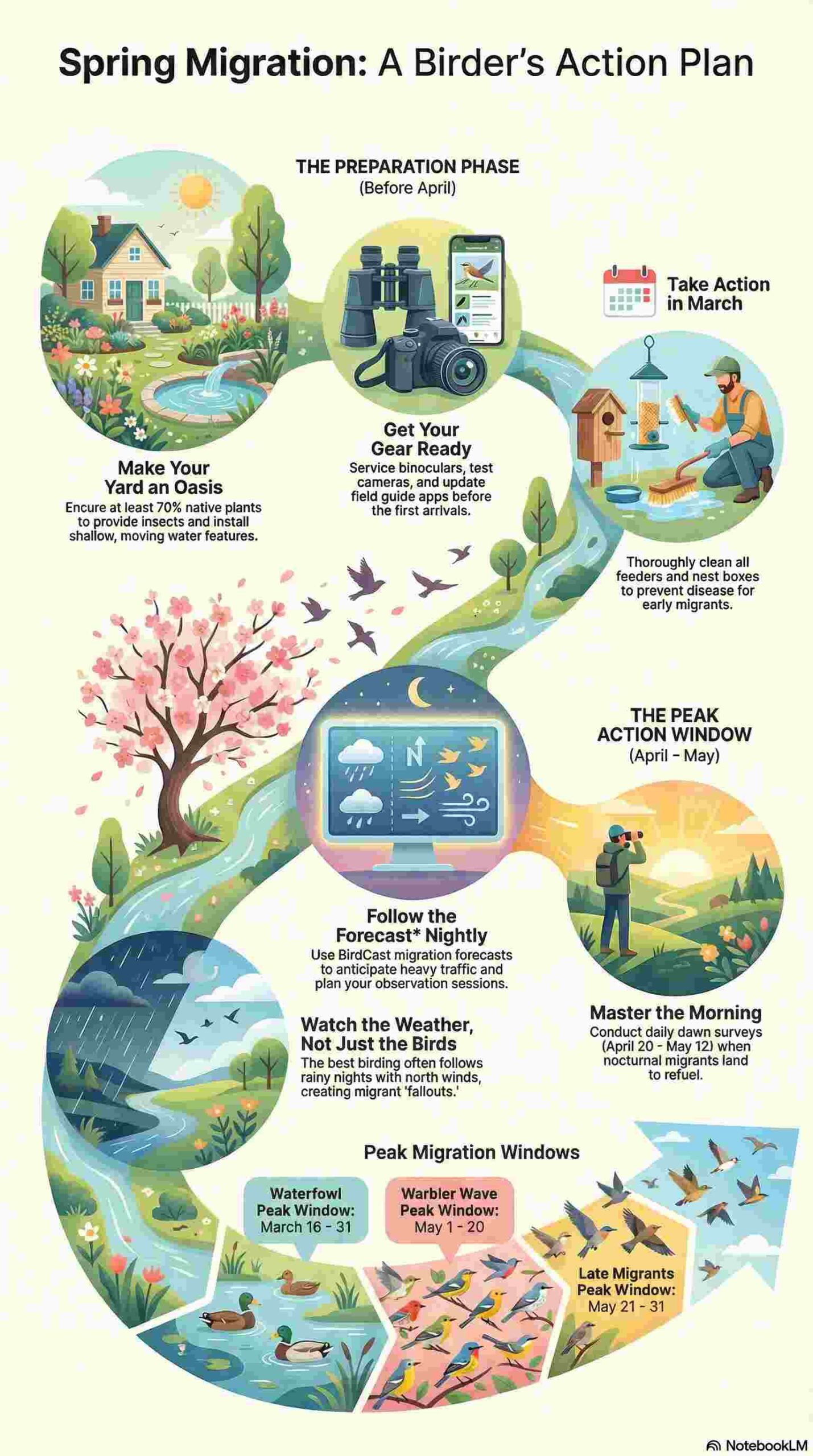
Spring Migration Checklist at a Glance
Short on time? This checklist pulls together the most important spring migration tasks in one quick view.
Conclusion: Systematic Preparation Maximizes Success
Spring migration rewards systematic preparation over casual observation. The compressed timeline when billions of birds pass through backyards demands advance planning, daily monitoring, and strategic timing capitalizing on weather-driven concentration events.
Begin preparation in February installing or repairing infrastructure before arrivals. Shift into daily monitoring mode by April 1 when diversity begins building rapidly. Maintain obsessive observation schedules during the critical April 20-May 20 window when 50% of annual migration compresses into just one month.
Document thoroughly creating records informing future season timing and species expectations. Spring migration happens just once annually, making every observation session during peak periods valuable for building long-term understanding of local patterns.
For additional guidance on migration preparation, explore how to prepare your yard for migrating birds and warbler migration.