
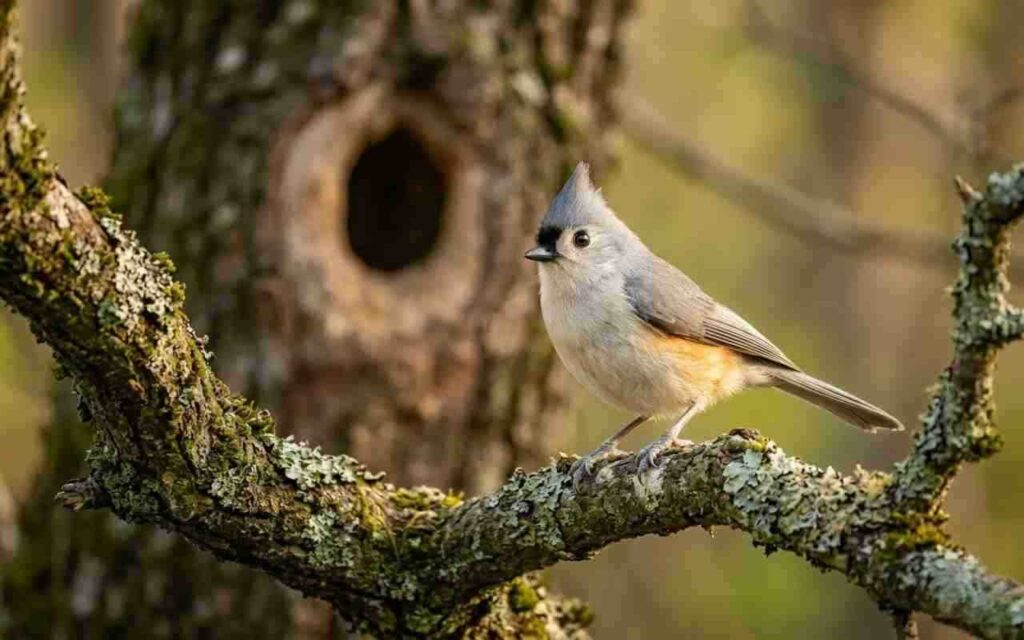
Tufted titmice are “secondary cavity nesters,” meaning they lack the powerful bills of woodpeckers and must rely on existing holes to raise their young. Understanding tufted titmouse nesting habits and behavior requires looking beyond the bird itself to the surrounding habitat of mature snags and abandoned excavations. From their famous “fur-plucking” to their “cup-within-a-cup” architecture, these birds have developed a sophisticated strategy for survival in the suburban canopy.
Quick Answer: What is the nesting behavior of a tufted titmouse?
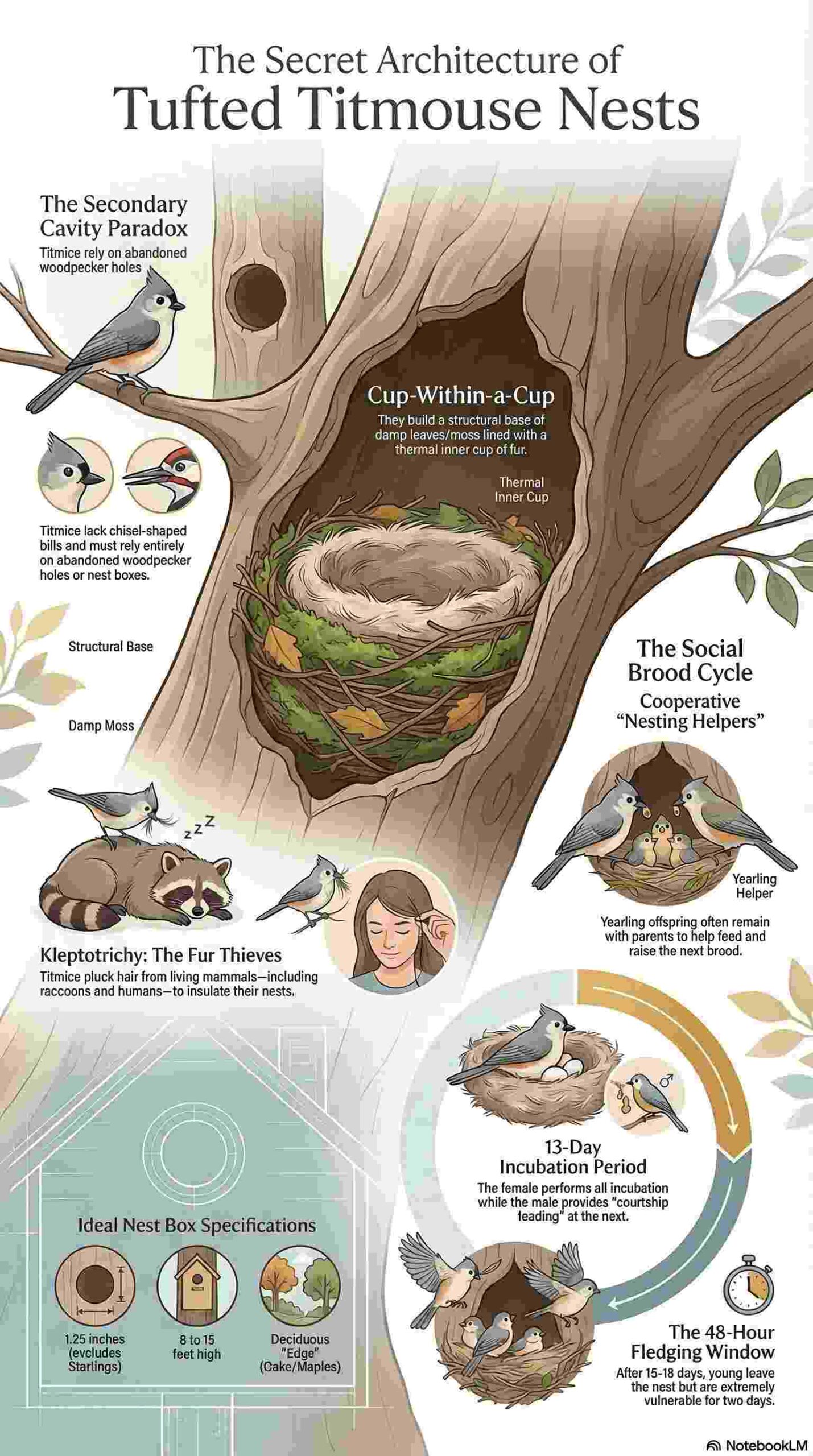
Tufted titmouse nesting habits and behavior center on their role as secondary cavity nesters, as they occupy abandoned woodpecker holes or nest boxes 3 to 90 feet high. Their architecture is unique, featuring a base of damp leaves and moss lined with soft animal fur plucked from living mammals. They typically raise one brood per year consisting of 5 to 7 eggs, with occasional “nesting helpers” from previous seasons assisting the parents.
Inside the Cavity: Decoding Tufted Titmouse Nesting Habits
To help you visualize the intricate layering of the ‘cup-within-a-cup’ nest and the surprising mechanical effort of fur-plucking, we’ve included a whiteboard analysis video below. This video breaks down the specific nesting habits and evolutionary trade-offs that allow a secondary cavity nester to thrive in a high-predation suburban canopy.
Show Transcript:
0:00
If you’ve spent time in a backyard in eastern North America, you’ve probably seen the tufted titmouse. That small gray bird with the pointy crest and curious eyes hides an annual drama: a housing crisis that forces it to become one of the cleverest, boldest birds around.
0:25
The core challenge is that tufted titmice must nest inside tree cavities but cannot excavate them. Unlike woodpeckers, whose strong beaks and reinforced skulls allow drilling, titmice have delicate bills built for seeds and insects—not creating holes. This makes them secondary cavity nesters, relying entirely on pre-existing holes for survival.
1:24
These pre-existing homes may be natural cavities from rotted branches, but more often they are abandoned woodpecker nests. Without woodpeckers, there’s essentially no housing market for titmice. They become expert real estate scouts, searching for ideal nesting cavities during late winter.
1:53
Location is critical. They prefer edge habitats where woods meet open areas—often suburban backyards. Deciduous trees like oaks and maples provide sturdy, high-quality cavities that meet their nesting needs.
2:13
The front door is essential: a 1.25-inch diameter hole acts as a security system. It allows the titmouse to enter but keeps larger, pushier birds like European Starlings out. Nest height also matters—between 20 and 35 feet off the ground keeps predators at bay while remaining within the zone where old woodpecker holes are common.
2:58
Once the perfect cavity is found, the interior setup begins. Titmice build a cup-within-a-cup nest. The female constructs the sturdy outer cup with damp leaves, moss, and bark, which provides structure and stability. Then she adds an incredibly soft inner cup using animal fur, hair, and other plush materials for insulation.
3:40
Recent studies show that tufted titmice sometimes pluck fur directly from live mammals in a behavior called kleptotrichy. This risky strategy provides the warmest insulation, may deter parasites, and could confuse predators. Observations include fur from raccoons, dogs, cats, rabbits, and even human hair.
4:24
Titmice also rely on social strategies. Cooperative breeding occurs when older siblings stay behind to help raise younger chicks. In documented nests, helpers contributed over 27% of food for the young, easing the parents’ workload and improving chick survival.
4:58
Despite their resourcefulness, the biggest challenge remains finding suitable cavities in modern landscapes with fewer old trees. Humans can help by providing nest boxes with the proper 1.25-inch entrance and predator baffles, leaving dead trees or snags standing, and planting native trees like oaks that host insects for chick nutrition.
5:30
To assist their nest-building, offer safe nesting materials. Avoid dryer lint, which can become wet and chill chicks. Instead, use fur from brushed pets in a sew-it cage to provide soft, safe insulation.
5:50
Observing the tufted titmouse reveals a new perspective on your backyard. It transforms a simple yard into a living habitat and encourages us to consider the space as a home for wildlife, not just a patch of grass and trees. Proper habitat support ensures these cavity-nesting birds thrive year after year.
The Secondary Cavity Paradox: Why Titmice Never Drill
Among cavity-nesting birds, the tufted titmouse occupies a fascinating and somewhat paradoxical position. It is entirely dependent on cavities for nesting and roosting, yet it has never evolved the physical tools to create its own.
Woodpeckers possess strong, chisel-shaped bills reinforced by thickened skull bones and shock-absorbing tissue, adaptations that allow them to pound against wood thousands of times per day without injury. The tufted titmouse, by contrast, has a relatively short, slender bill suited to crushing seeds and probing bark for insects. Attempting to excavate a cavity with that anatomy would be biologically futile.
Ornithologists classify the tufted titmouse as a secondary cavity nester, meaning it relies exclusively on pre-existing holes created by other species or by natural decay. According to Cornell Lab of Ornithology’s All About Birds, tufted titmice use natural holes and old nest holes made by several woodpecker species, including larger excavators such as the Pileated Woodpecker and Northern Flicker.
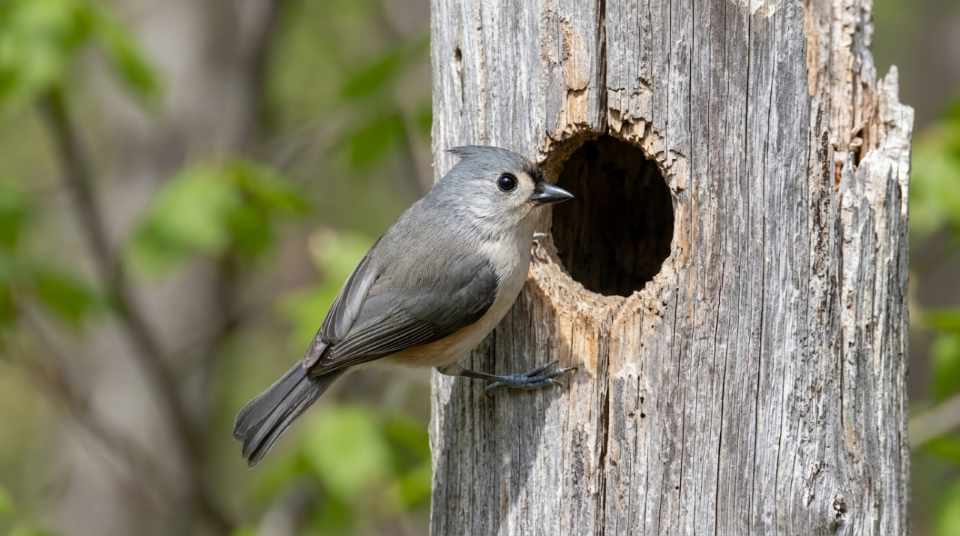
Abandoned cavities from Downy, Hairy, and Red-bellied Woodpeckers are also among the most commonly occupied sites.
This dependency creates a significant ecological relationship. Titmice are fundamentally downstream beneficiaries of woodpecker activity. Where woodpeckers are absent or where snags have been removed, titmouse populations tend to be lower.
The Cornell Lab notes that this species’ reliance on dead wood is one of the strongest arguments for leaving standing dead trees in forests and large gardens rather than cutting them down. A single well-decayed oak or maple can support multiple cavity-nesting species over decades, creating what ecologists sometimes call a cavity cascade.
The trade-off embedded in the titmouse’s nesting strategy is real but manageable. While the bird forgoes the ability to create its own shelter, it gains the metabolic efficiency of a lighter, more versatile bill optimized for exploiting a broad food base across seasons.
The secondary cavity nesting lifestyle works as long as suitable holes remain available, which is where nest boxes become critically important in managed suburban landscapes where natural snags are routinely removed.
Site Selection Biomechanics: Height, Diameter, and Edge Habitat
Not all cavities are created equal in the titmouse’s assessment. When a mated pair begins scouting nest sites in late February or early March, they are evaluating a surprisingly specific set of physical criteria.
Height is among the most important variables. According to Avian Report’s detailed field research summary, mated pairs begin inspecting potential nesting sites by early March, with the female ultimately responsible for the final selection. Natural cavities used by titmice have been recorded anywhere from 3 feet to 90 feet above ground, but the preference runs significantly higher than most people expect.
The optimal elevation for natural cavities is generally in the 20 to 35 foot range. That height is high enough to reduce ground predator access but still within the zone where decay-created openings and old woodpecker holes are most abundant.
Field guides and nest box installation resources frequently note that titmice show a strong preference for sites higher than the standard 5-foot bluebird box installation height. If you are mounting a box specifically for titmice, aim for 8 to 15 feet where possible.
Cavity entrance diameter matters enormously, both for physical access and predator exclusion. The standard recommendation from NestWatch (Cornell Lab of Ornithology) is a 1.25-inch entrance hole for nest boxes designed to attract titmice.
This diameter allows titmice to enter comfortably while effectively excluding European Starlings, which require a larger opening. It also provides a marginal barrier against House Sparrows, though persistent sparrows can still access a 1.25-inch hole.
The tufted titmouse shows a marked preference for edge habitat, the transitional zone between dense woodland and more open environments. Forest edges provide the mix of mature cavity-bearing trees and open foraging ground that titmice exploit during the breeding season.
Suburban landscapes with mature tree canopy and adjacent open lawns essentially replicate this edge structure, which explains why titmice have adapted so successfully to human-modified environments. Deciduous species such as oaks, maples, elms, and beeches are favored over conifers because their decay patterns and larger trunk diameters produce the types of cavities titmice prefer.
Cup-Within-a-Cup Architecture: How Titmice Build Their Nests
Once a female tufted titmouse has settled on a cavity, she begins one of the most methodically layered nest construction processes among North American songbirds. The architecture follows a cup-within-a-cup design, with the outer structure and inner lining serving distinct functional purposes.
Construction typically takes 6 to 11 days. During this time the male remains nearby, occasionally providing materials or standing guard against rival males.
The foundation layer consists of coarser, bulkier materials. Cornell Lab’s documentation confirms that females begin with damp leaves, moss, grasses, and bark strips packed into the bottom of the cavity. These materials provide the structural base and some initial thermal mass.
The dampness in fresh leaves is not accidental. Slightly moist plant material is easier to mold into shape and compresses into a denser, more stable structure as it dries. Bark strips, particularly shredded inner bark from deciduous trees, contribute both structure and flexibility to the outer cup.
The inner cup is where the titmouse’s construction instincts shift from structural to thermal. This innermost layer is lined with soft, insulating materials: fine hair, fur, wool, feathers, and cotton.
The resulting nest-within-a-nest creates a microenvironment of significantly higher insulation than the cavity walls alone would provide. This inner cup directly cradles the eggs during incubation and surrounds developing nestlings during their most thermally vulnerable period.
Naturalists have documented the extraordinary variety of materials woven into titmouse inner cups. Cornell Lab analysis of old nests has identified hair from raccoons, opossums, dogs, fox squirrels, red squirrels, rabbits, horses, cows, cats, mice, woodchucks, and even humans.
Some nests also incorporate snakeskin, a material used by Great Crested Flycatchers as well, and thought by some researchers to deter mammalian predators from investigating cavities.
The Fur-Plucking Phenomenon: Kleptotrichy and Its Purposes
Perhaps no titmouse behavior is more surprising to first-time observers than kleptotrichy, the deliberate plucking of fur from living mammals for nest material. What appears at first glance to be reckless behavior turns out to be a documented and apparently adaptive strategy, though one whose full purpose is still being investigated.

A landmark 2021 paper published in the journal Ecology, led by Mark Hauber of the University of Illinois Urbana-Champaign and co-authored by Henry Pollock and Jeffrey Brawn, was the first comprehensive scientific treatment of the phenomenon.
Reporting from the University of Illinois News Bureau described how the researchers found almost no prior scientific literature on the behavior despite it being widespread and frequently captured on video by birders. Their search turned up dozens of YouTube videos documenting titmice pulling fur from sleeping or resting raccoons, dogs, cats, and humans.
In many of the videos, the target animals did not react at all, apparently undisturbed by the small bird’s activity.
Why would a bird risk approaching an animal as formidable as a raccoon for something as seemingly minor as nest lining? The researchers proposed several non-exclusive explanations.
The thermal insulation benefit is the most straightforward: mammal fur traps air exceptionally well, and a nest cup densely lined with fresh fur creates a significantly warmer microclimate for eggs and nestlings. This matters most during early spring nesting when overnight temperatures can still drop sharply, threatening developing embryos and newly hatched chicks.
A second hypothesis involves parasite deterrence. Cavity nests are disproportionately vulnerable to mite and lice infestations, which can reduce chick survival and compromise feather development. Fresh mammal hair may provide an alternative substrate for these parasites, drawing them away from nestlings.
A third possibility is predator confusion: the scent of a large mammal embedded in the nest lining might deter smaller predators from investigating the cavity. Each of these explanations has some support, and all three may operate simultaneously.
For backyard gardeners, this research suggests practical alternatives to waiting for a titmouse to target your pets. Placing tufts of unprocessed wool, pet fur from brushing, or natural fiber materials in a mesh suet cage near your nest boxes gives females a safe and accessible supply of lining material.
Avoid dryer lint, which compacts when wet and can trap moisture. Stay away from synthetic fibers as well, since these can entangle nestlings.
Nesting Helpers: The Social Structure Behind Cooperative Breeding
Most songbirds breed as a simple pair, with both parents sharing incubation and feeding duties until the young fledge. The tufted titmouse occasionally complicates this picture with a behavior that is rare in the broader chickadee family: cooperative breeding involving nest helpers.
As NH Audubon’s species account explains, winter flocks of titmice disperse in spring, but sometimes a single yearling remains with its parents to help raise the next brood. The helpers are typically offspring from the previous breeding season who have not yet found mates or established territories of their own.
Empirical detail on this behavior comes from field observations documented in Birds of the World (Cornell Lab). At one Maryland nest studied by ornithologist H. Brackbill, the adult male was responsible for 36.6% of all nestling feedings, the adult female for 36%, and two helpers contributed 20.4% and 7% respectively.
The helper’s contribution meant nestlings received food from more individuals at higher combined rates, which presumably reduced the energy burden on each parent and improved overall chick survival.
Helping behavior in birds typically evolves when ecological conditions make it more advantageous for a young bird to assist relatives than to attempt independent breeding. For titmice, the combination of strong site fidelity, year-round territorial residency, and the difficulty of securing a high-quality cavity may push some yearlings toward the helper strategy.
The helper also gains experience with nest management and chick-rearing, potentially improving its own future breeding success.
Cornell Lab’s overview notes that unlike many chickadees, tufted titmouse pairs do not join larger flocks outside the breeding season. They remain on territory as a pair, frequently with one young from that year staying with them through winter. This family group structure creates the social conditions from which spring helpers emerge.
The Brood Cycle: Eggs, Incubation, and the Vulnerable Fledgling Window
Egg laying begins once the nest is complete, typically from late March through April depending on latitude. Southern populations start earlier, northern populations later. The breeding season can extend into mid-July for replacement clutches if a first attempt fails.
The female lays one egg per morning before leaving the cavity for the day.
Tufted titmouse eggs are small, less than an inch long, and white or cream in ground color with reddish-brown or purplish spots concentrated toward the larger end. A standard clutch contains 5 to 6 eggs, though the documented range extends from 3 to 9.
Full incubation begins after the female lays the second-to-last egg, ensuring that most eggs hatch within a tight window. According to Avian Report, the incubation period is 12 to 14 days, with 13 days being the most typical across the species range.
Incubation is performed exclusively by the female. During this period, the male feeds her at the nest through a behavior called courtship feeding, which strengthens the pair bond and reduces the female’s need to leave the eggs exposed.
Females are remarkably reluctant to abandon the cavity during incubation. Field researchers have noted that an incubating female may hiss like a snake if disturbed, a defensive behavior that may startle or confuse predators investigating the entrance hole.
Once hatched, nestlings develop rapidly. The female broods the chicks nearly continuously for the first several days while the male handles most feeding. By approximately day 12, when the female is no longer brooding during daylight, both parents share feeding duties equally.
If a helper is present, the combined feeding rate increases further, providing nestlings with more energy for growth.
Fledging typically occurs around 15 to 18 days after hatching. The immediate post-fledging window, roughly the first 48 hours after young titmice leave the cavity, represents one of the most dangerous periods in their lives.
Fledglings can make short, awkward flights but lack the muscle development and spatial awareness to evade predators effectively. They often land on the ground or low vegetation and remain motionless, relying on camouflage and the parents’ alarm calls for protection.
During this window, keeping cats indoors and avoiding disturbance of dense shrubbery where fledglings may be sheltering are the two most impactful things a gardener can do.
Managing Your Garden for Nesting Titmice
Creating a garden environment that genuinely supports tufted titmouse nesting goes beyond installing a nest box. It requires thinking through the full suite of conditions these birds need from February through July: suitable cavities, safe foraging habitat, protective cover for fledglings, and freedom from the most common hazards that kill cavity-nesting birds in suburban settings.
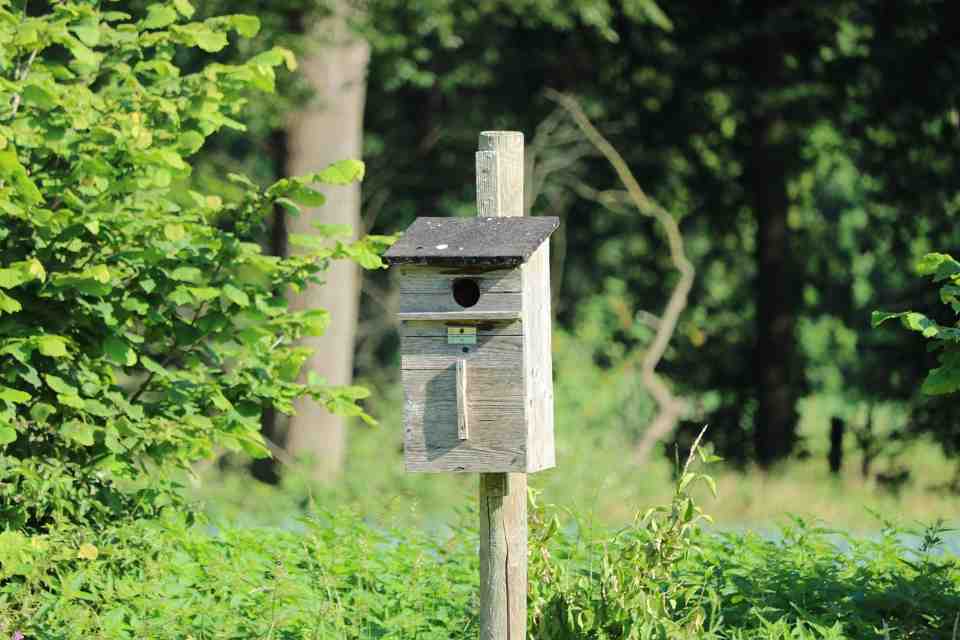
Window strikes are one of the leading causes of bird mortality in North American backyards. During the nesting season, inexperienced fledglings and adults distracted by territorial behavior are especially vulnerable.
The American Bird Conservancy recommends treating windows with external tape patterns, UV-reflective films, or closely spaced hanging cords to break up the reflective surface that birds mistake for open space. Positioning nest boxes away from large glass surfaces reduces risk significantly. Our guide to preventing finches from being bullied at feeders also covers broader principles of yard management during the breeding season.
Predator baffles are non-negotiable if you are mounting nest boxes for titmice. Raccoons, squirrels, and snakes are the primary nest predators in most eastern backyards, and all three are capable of entering a standard nest box if the mounting pole is unprotected.
A metal stovepipe or torpedo-style baffle mounted below the box on a smooth metal pole prevents raccoons and squirrels from reaching the entrance. For snake deterrence, a smooth metal pole without horizontal branches or attachments nearby is the most effective physical barrier.
Native plants play a dual role in supporting nesting titmice. During the breeding season, both parents make dozens of foraging trips per day, and the vast majority of what they bring back consists of caterpillars and other soft-bodied insects.
Research by entomologist Doug Tallamy has documented that native oak trees support more than 500 species of caterpillar, while exotic ornamentals support far fewer. A garden with mature native oaks, maples, cherries, and serviceberries produces the insect biomass that titmice need to raise a successful brood. See our guide on native plants for birds for a region-by-region breakdown of the most productive species.
Snags, standing dead trees or large dead limbs left in place, are among the most valuable features any bird-friendly garden can preserve. A snag not only provides the natural cavity sites that titmice prefer but also supports the wood-boring insects and decaying bark communities that form a significant part of their food supply.
If a dead tree poses no safety risk to structures or people, leaving it standing is one of the highest-impact decisions a gardener can make for cavity-nesting birds.
Timing also matters for nest box installation. Tufted titmice begin scouting cavities as early as late February in southern parts of their range. Installing and cleaning nest boxes by mid-February gives titmice first access before House Sparrows and other competitors claim the best sites.
For a broader view of the seasonal rhythms shaping bird activity in your yard, our spring migration checklist for backyard birders walks through month-by-month actions that support the widest range of breeding and transient species.
And if you are already managing habitat for titmice, exploring how to attract woodpeckers to your yard is a natural next step, since supporting woodpecker activity directly increases the availability of the high-quality cavities titmice depend on. You might also consider reading about where pileated woodpeckers nest, given that pileated cavities are among the most prized by titmice in forested areas.
The tufted titmouse nesting story is ultimately one of interdependence. These birds depend on woodpeckers for shelter, on native plant communities for food, on family helpers for chick survival, and increasingly on backyard gardeners who understand and preserve the ecological conditions that make a landscape suitable for breeding.
Each nest box mounted on a metal-baffled pole near a stand of mature oaks, each snag preserved rather than felled, each window treated to prevent strikes represents a concrete investment in the continuation of this bird’s remarkable annual cycle.
Pay attention in March when the persistent peter-peter-peter song begins echoing through your trees. A tufted titmouse scouting your yard for a nest site is not just passing through. It may be evaluating whether your garden is worthy of the extraordinary biological drama that follows.
Tufted Titmouse Nesting Habits: A Complete Seasonal Checklist
Conclusion
Tufted titmice are fascinating secondary cavity nesters that depend on pre-existing holes, cooperative helpers, and well-structured habitats to raise their young successfully. By providing properly placed nest boxes, preserving snags, planting native trees, and keeping fledglings safe from predators, gardeners can make their yards a thriving home for these clever birds.
Observing their unique nesting behaviors, from fur-plucking to cup-within-a-cup construction, offers a rare glimpse into the ingenuity of small songbirds. Supporting titmice also benefits other cavity-nesting species and helps maintain a balanced, bird-friendly ecosystem right in your backyard.