
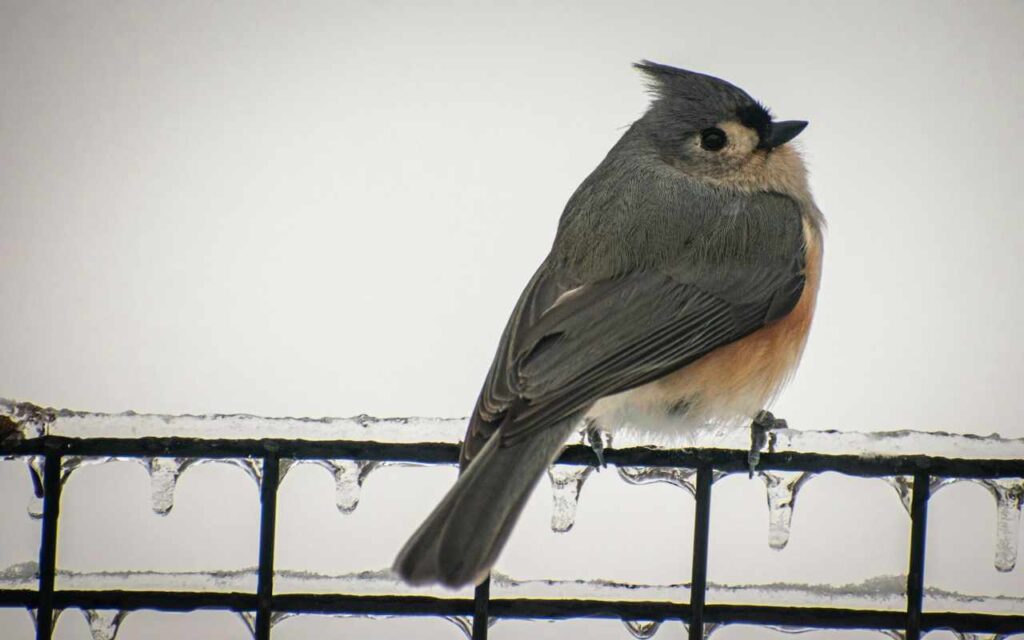
Tufted Titmouse winter survival is one of the more extraordinary feats in the North American backyard. The tufted titmouse does not migrate, does not hibernate, and does not slow down. When January temperatures plunge across the eastern United States, this 22-gram bird faces a physiological problem of extreme difficulty: maintaining a core body temperature near 107°F while the air around it sits below zero.
Understanding the mechanisms behind this resilience gives backyard birders a far more precise toolkit than simply putting out sunflower seeds. From shivering thermogenesis and controlled nocturnal hypothermia to hippocampal expansion and the peck-right hierarchy governing who eats first, this guide covers the full physiological and behavioral picture and translates it into concrete sanctuary design decisions you can act on right now.
Quick Answer: How do tufted titmice survive the winter?
Tufted titmouse winter survival relies on a 16.2% increase in metabolic capacity and a caching strategy where they store seeds within 130 feet of foraging sites. To help, homeowners should provide high-fat suet, shelled peanuts, and heated birdbaths, as liquid water is critical for maintaining feather insulation during extreme cold.
Visualizing the Titmouse Pantry: A Foraging Biomechanics Breakdown
To help you visualize how these acrobatic foragers manage their high-speed caching runs and unique seed-shattering techniques, we’ve included a whiteboard analysis video below. This video illustrates the specific energy calculations and structural requirements of a high-performance Titmouse feeding station in a suburban garden.”
Show Transcript:
0:00
Have you ever watched a tiny bird survive brutal winter cold and wondered how it’s even possible? One freezing morning, I spotted a tufted titmouse at my backyard feeder, unfazed by temperatures that felt unbearable. It raised a serious question: how does such a small bird survive extreme cold without freezing?
0:19
It may seem like these birds defy physics, but their survival is built on advanced biological adaptations and smart behavior. Winter bird survival isn’t luck—it’s a combination of energy management, insulation, and strategic feeding.
0:37
To understand the challenge, a tufted titmouse must maintain a body temperature of about 107°F, even when outside temperatures drop below zero. That’s a temperature difference of over 100 degrees, requiring a complete metabolic shift in winter.
1:00
Fuel is everything. In winter, a titmouse must eat up to 44% more food than in summer just to survive. Every seed matters, and every second of daylight becomes critical for foraging and maintaining energy levels.
1:23
The primary heat source isn’t digestion—it’s a process called shivering thermogenesis. The bird rapidly contracts its flight muscles without moving its wings, turning its body into an internal heat generator. This allows it to produce enough warmth to survive freezing conditions.
1:49
If you’ve watched a titmouse at a feeder, you’ve probably noticed it grabs a single seed and quickly leaves. This isn’t random behavior—it’s a calculated survival strategy.
2:11
Bird feeders attract predators like sharp-shinned hawks, making them dangerous feeding zones. The titmouse minimizes exposure by grabbing one seed at a time and retreating to safety.
2:27
Once safe, the bird cracks the seed and hides it instead of eating immediately. This behavior, known as caching, allows the bird to build a hidden food supply.
2:51
Over time, the titmouse creates a network of hundreds or even thousands of cached seeds within a small area. This “distributed pantry” allows access to food without returning to exposed feeders.
3:12
With heat production and food storage handled, insulation becomes critical. Feathers act as a highly efficient thermal system, even outweighing the bird’s skeleton in importance for survival.
3:35
When birds fluff their feathers, they trap air close to their body, creating a natural insulating layer. This acts like a built-in winter jacket, helping retain body heat in freezing conditions.
4:13
However, this insulation only works if feathers stay clean and properly aligned. That’s why access to water in winter is essential—birds need it for preening and maintaining feather condition.
4:38
Even with heat, food, and insulation, the biggest challenge is surviving long winter nights without feeding. This is where the titmouse uses its most extreme adaptation.
5:01
The bird enters a controlled state similar to hypothermia, lowering its body temperature by up to 15°F while roosting. This reduces energy loss and helps it survive until morning.
5:25
This strategy is critical. Without it, survival rates for small birds would be extremely low. With it, their chances of surviving winter increase dramatically.
5:52
This single adaptation can make survival more than five times more likely, allowing these small birds to endure harsh winter nights and see the next sunrise.
6:00
Understanding this changes how you see your backyard. A simple bird feeder becomes part of a complex survival system that supports winter birds every day.
6:16
You can help by offering high-fat foods like black oil sunflower seeds, which provide essential energy. Heated water sources help birds maintain feather insulation, and shelter like nest boxes or brush piles offers protection from wind and cold.
6:32
Using multiple feeders can also reduce competition, giving smaller birds better access to food. Each of these steps directly supports bird survival in winter.
6:48
Next time you look outside, remember you’re not just watching birds—you’re witnessing incredible survival strategies happening in real time.
The 16.2% Summit Metabolism: How Titmice Winterize Their Internal Systems
Most discussions of winter bird feeding focus on what titmice eat. The more useful starting point is how they burn it.
A tufted titmouse in January is not simply the same bird with different food preferences. It has undergone measurable changes at the cellular level that make it a fundamentally different thermal machine than it was in August.
The central metric is summit metabolic rate, or Msum, which measures the maximum rate at which a bird can generate heat through muscular effort. In small resident passerines, Msum rises substantially in winter compared to summer baselines.
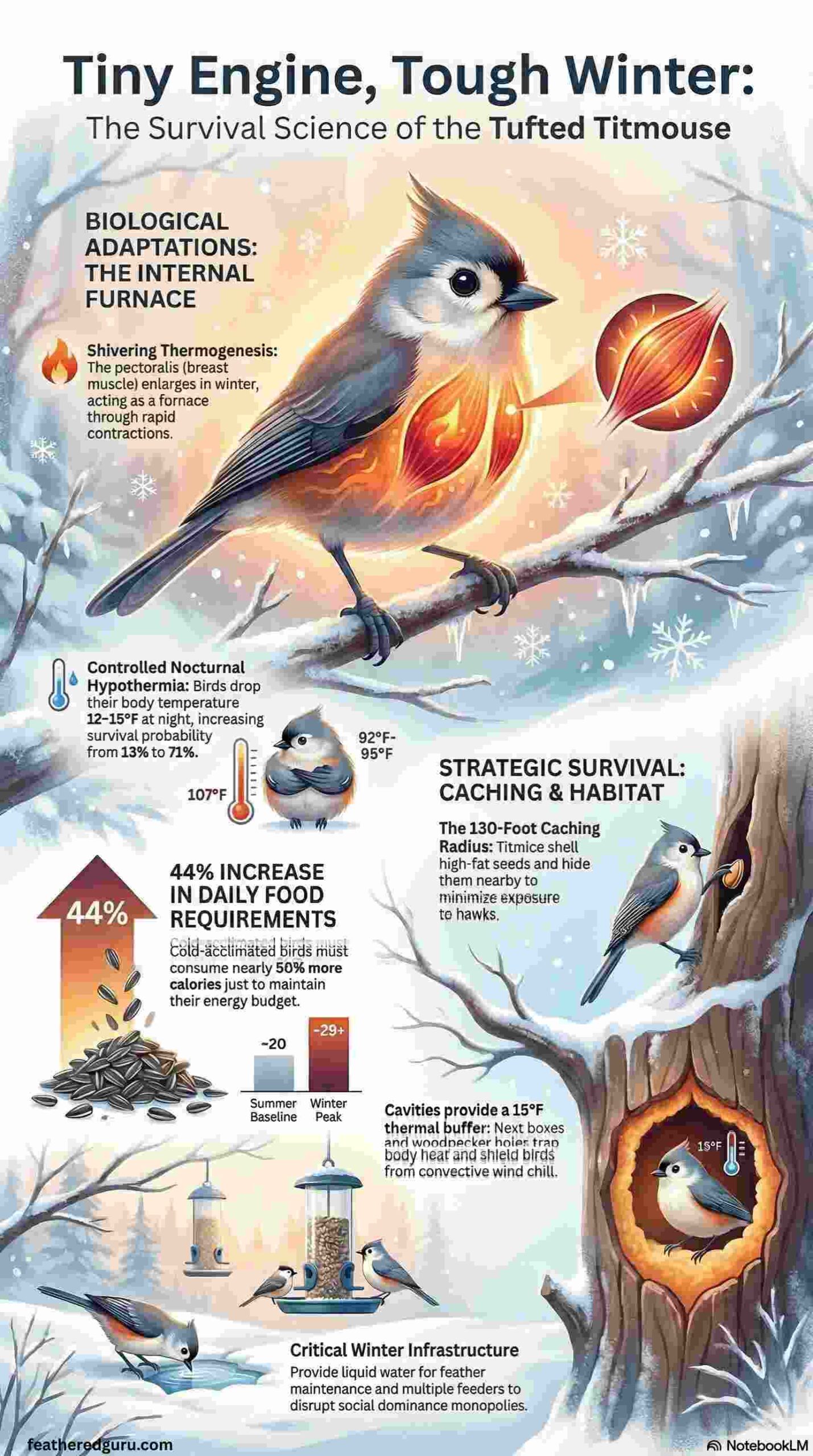
A 2018 study published in Scientific Reports (Nature Publishing Group) found that cold-acclimated black-capped chickadees, a close Paridae relative of the tufted titmouse, exhibited 20% higher summit metabolic rates and consumed 44% more food daily than birds held at thermoneutral temperatures. These figures provide a close physiological parallel for what titmice experience across their winter range.
A 44% increase in daily food requirement means a titmouse that manages on 20 sunflower seeds in summer may need 29 or more in January simply to break even on its energy budget. Every hour without food access in sub-freezing temperatures represents a genuine deficit that compounds through the night.
The engine driving this elevated heat output is shivering thermogenesis: rapid, non-locomotory contractions of the pectoralis muscle, the large flight muscle of the breast. These contractions generate heat without producing useful movement, co-opting the flight system as a furnace.
The pectoralis is ideally suited to this role because it is already among the most mitochondria-dense tissues in the bird’s body. Research published in Physiological and Biochemical Zoology (University of Chicago Press) found that pectoralis mass in passerine birds increases measurably in response to sustained cold exposure, with the muscle effectively enlarging to provide greater thermogenic capacity as winter deepens.
For backyard observers, the practical implication is direct: a titmouse in January is carrying proportionally more breast muscle mass than the same bird in July, and burning through fat reserves at a rate that makes reliable daily caloric intake genuinely life-critical.
Controlled Hypothermia: The Science of the Nightly Thermostat
Even with an expanded pectoralis running near capacity, a tufted titmouse cannot maintain full body temperature through a 14-hour winter night at sustainable energy cost. Evolution has provided a partial solution: deliberate, controlled nocturnal hypothermia.
Rather than holding their daytime core temperature of roughly 107°F through the night, titmice allow it to fall by 12 to 15 degrees Fahrenheit during roosting. This drop reduces heat loss by exploiting a simple physical principle: the smaller the difference between a body’s temperature and the surrounding air, the less heat it loses per hour.
A modeling study published in Oecologia (PubMed Central) found that nocturnal hypothermia can increase winter survival probability for small Paridae birds from roughly 13% to 71% across a 100-day cold season. At moderate ambient temperatures, a small parid saves approximately 35% of its overnight energy expenditure by allowing body temperature to drop 8 degrees. The math is stark: birds using hypothermia survive winter at rates more than five times higher than those that do not.
This is not the deep torpor of hummingbirds, which can drop to near-ambient body temperatures and save 90% or more of basal metabolic cost. Titmice maintain a hypothermia shallow enough to allow rapid arousal if a predator approaches.
A study published in Proceedings of the Royal Society B (PubMed Central) documented that deeper hypothermia significantly impairs flight ability, creating a predation trade-off that limits how cold a small bird can safely allow itself to become. The titmouse’s hypothermia sits in the zone that balances energy savings against the need to remain flight-capable.
The consequence of this overnight temperature reduction is that a titmouse waking at sunrise is both colder than normal and running on partially depleted reserves. This is why the first feeding opportunity after first light is the most metabolically critical event of the bird’s entire 24-hour cycle.
Plumage Engineering: The Physics of Feather Fluffing
While the pectoralis generates heat and nocturnal hypothermia reduces overnight expenditure, a third system determines how efficiently that heat is retained: the feather coat and its capacity for thermal loft.
A bird’s feathers collectively weigh roughly twice as much as its entire skeleton, a ratio that illustrates how much evolutionary investment has gone into this insulation system. In winter, titmice grow an augmented feather coat with increased plumage density, particularly in the downy underlayer closest to the skin.
Down feathers are structurally different from contour feathers. Their barbules lack the interlocking hooks that create the flat surface of flight feathers, allowing them instead to billow outward in all directions and trap compartmentalized air. As documented at AskNature (Biomimicry Institute), a single down feather may contain miles of barbule filament, each thinner than a strand of human hair, all working together to create a near-static warm air layer against the skin.
The “fluffing” behavior observers see in cold titmice is not a passive response. It is an active muscular action: tiny arrector muscles attached to each feather follicle contract to erect the shafts, increasing the depth of the trapped air layer from a few millimeters to roughly a quarter inch.
That quarter inch of still air, warmed by the bird’s body heat, functions as a biological down jacket. It is also extremely vulnerable to contamination. Feathers that are dirty, oiled, or structurally compromised lose the ability to maintain loft, collapsing the insulating air layer and stripping the bird of its primary thermal protection regardless of how much it has eaten.
This is the physical basis for the winter water mandate. A bird without access to clean liquid water cannot preen effectively, cannot maintain feather condition, and therefore cannot retain heat efficiently. Liquid water in winter is not a comfort amenity. It is structural maintenance for the bird’s most critical survival system.
The 130-Foot Caching Radius: Why the Pantry Is a Safety Barrier
Watch a tufted titmouse at your feeder on a January morning and you will observe what looks like inefficiency: it lands, takes one seed, and immediately leaves. A few minutes later it returns for another. It almost never eats at the feeder itself.
This behavior makes complete sense once you understand the predator dynamics of winter foraging. The feeder is a known, fixed food source. It is also known to Sharp-shinned Hawks and Cooper’s Hawks, both of which learn feeder locations and patrol them strategically. A titmouse that lingers to eat each seed in place maximizes its time in the feeder’s open kill zone.
By taking one seed and departing rapidly, the bird minimizes exposure at the most dangerous location in its territory. The caching system, distributing food across many hidden sites, means that even if a hawk forces the bird away from the feeder for hours, it has a distributed reserve accessible from cover. Cornell Lab’s All About Birds documents that storage sites are typically within 130 feet of the feeder, and that birds take only one seed per trip and usually shell the seeds before hiding them.
Shelling the seed before caching is a key efficiency step. A shelled kernel has no hull to process on retrieval, meaning the bird recovers its calories with a single pick rather than expending time and energy re-processing. Field research by Petit, Petit, and Petit (1989), summarized in Birds of the World (Cornell Lab), found that 80% of caching episodes involved pre-shelling, with seeds stored primarily in bark crevices and lichen patches on the upper surfaces of mid-canopy branches.
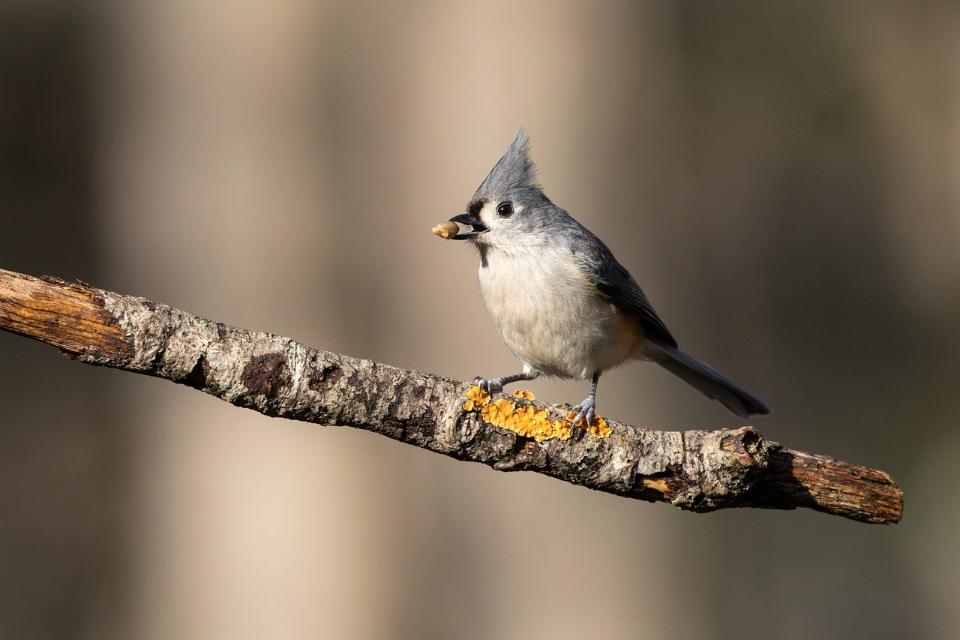
The memory architecture enabling cache retrieval is genuinely sophisticated. A 2024 study in Scientific Reports (Nature Publishing Group) confirmed the existence of spatial place cells in the tufted titmouse hippocampus for the first time. These neurons fire in response to specific locations in the environment, forming the neural substrate of the cognitive maps caching birds use to relocate thousands of individual hiding spots.
The paper also notes that hippocampal size correlates with caching intensity, and that titmice in harsher environments tend to have measurably larger hippocampi than conspecifics in milder climates.
Related Expert Guide: To choose the best high-energy fats for their winter pantry, see our detailed breakdown of what tufted titmice eat in suburban feeders and gardens.
Black oil sunflower seeds and shelled peanuts are the highest-value caching materials you can offer. Both are high in fat, easily processed, and eagerly stored. Millet and milo are rarely cached because their fat content is too low to justify the storage investment. If your goal is building your resident titmouse’s winter pantry rather than simply filling its crop, consistently offering these two foods gives the caching system the best raw material to work with.
Micro-Climate Selection: Finding the Thermal Buffers
Tufted titmice do not simply endure cold. They actively map the thermal landscape of their territory and make deliberate choices about where to forage, rest, and sleep based on micro-environmental temperature differentials invisible to casual observation.
Old woodpecker cavities and nest boxes function as the most important thermal refuges in the winter landscape. A wood-walled cavity traps the bird’s radiated body heat, creates a still-air interior, and shields the entrance from prevailing wind. Cavity interior temperatures in cold weather can run 15°F or more above ambient on still nights.
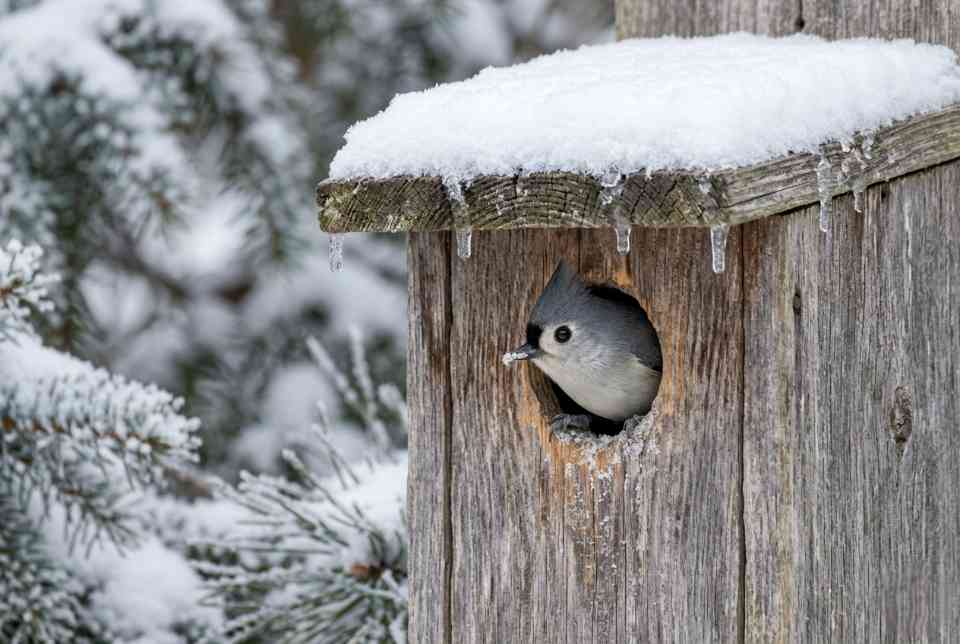
As seen in the ice-encrusted refuge above, this micro-climate selection is a cornerstone of the tufted titmouse winter survival strategy, allowing a 22-gram bird to maintain its core temperature during the coldest hours of the night.
According to NestWatch (Cornell Lab of Ornithology), tufted titmice use nest boxes and natural cavities for winter roosting as well as nesting. A well-placed nest box is therefore a year-round survival resource, not merely a spring nesting aid.
Windbreaks and evergreen canopy structures serve a different but complementary function during daylight hours. The primary heat loss mechanism for a small bird foraging in the open is convective stripping: moving air carries heat away from the feather surface faster than the bird can replace it. A titmouse foraging on the lee side of a dense arborvitae hedge faces dramatically lower convective heat loss than one in the open.
Brush piles with layered branch interiors and a central open air pocket provide ground-level refugia, sheltering both the birds and the overwintering insects they probe for as protein supplements on days when seeds are scarce. A well-built brush pile can maintain interior temperatures several degrees above ambient on calm nights.
Native evergreen plantings serve all three functions simultaneously: reducing wind chill, providing concealed roosting perches, and supporting the berry and insect communities that contribute supplemental winter nutrition. Our guide to native plants for birds covers the most productive species for supporting winter residents across the eastern United States.
Managing the Winter Sanctuary: Critical Infrastructure
Providing food, water, shelter, and thermal cover addresses the positive side of the winter support equation. The negative side, hazards that kill birds despite your best intentions, requires equal attention.
Liquid water is the non-negotiable winter provision most birders underinvest in. A submersible electric heater rated for birdbaths, typically 50 to 150 watts, maintains water just above freezing without boiling it. Keep depth at 2 inches maximum for safe bathing by small birds, position the bath in a sheltered spot out of the wind, and check it daily.
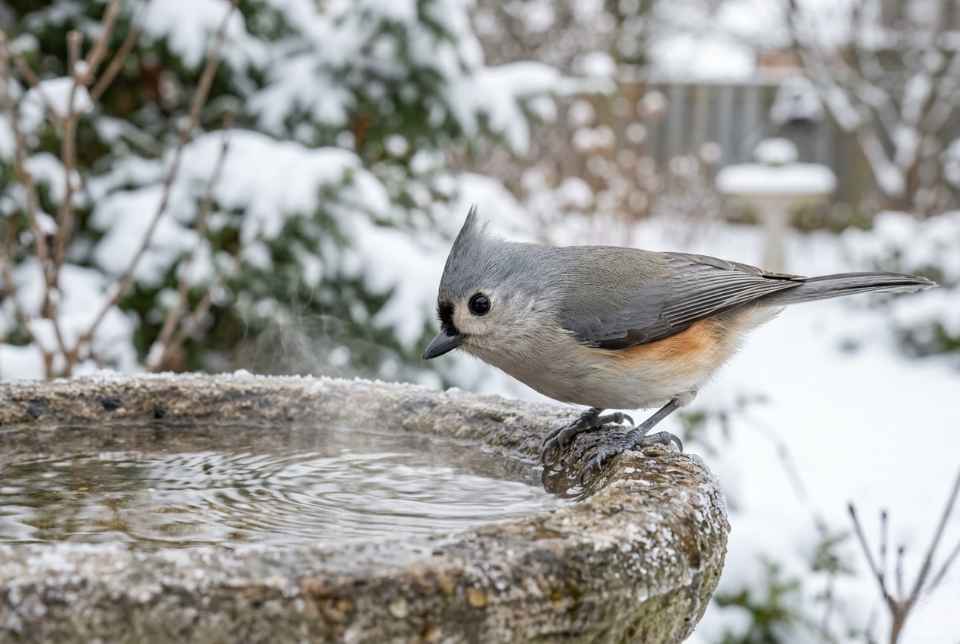
Our guide to how to keep bird baths from freezing in winter covers heater selection and placement in detail, and our piece on how to make a homemade bird bath heater offers a low-cost DIY alternative.
Window strikes increase in winter because titmice move faster between caches in cold conditions and because low sun angles produce stronger glass reflections. The American Bird Conservancy’s 2×4 rule applies here: external window markings spaced no more than 2 inches horizontally and 4 inches vertically create a visual barrier birds will not attempt to fly through.
The placement rule matters as much as the markings. Position feeders either within 3 feet of a window, too close for a bird to build dangerous velocity before impact, or more than 30 feet away, far enough that flight is stabilized before the glass is encountered. Our guide to how to prevent birds from hitting windows covers the most effective products for each window type and orientation.
The first-light feeding protocol has direct metabolic significance. A titmouse emerging from overnight hypothermia is running on a partially depleted energy budget. A feeder that emptied the previous afternoon and has not been refilled leaves the bird without critical fuel during its highest-demand window. Refilling before dusk ensures maximum food availability from the moment foraging begins at sunrise.
Our guide to feeding birds in winter covers maintenance schedules across climate zones. And our article on how to clean a bird feeder addresses winter hygiene, since wet seeds can mold within 24 to 48 hours even in cold conditions, producing aspergillosis-causing fungal spores that are frequently fatal in small birds.
Social Dominance and Survival: The Peck-Right Hierarchy
Tufted titmice do not move through winter as isolated individuals. They operate in loose family-based social units, and the structure of those units has direct consequences for which birds survive the hardest weeks and which do not.
Within any winter titmouse group, a clear dominance hierarchy governs access to food, roosting cavities, and high-quality foraging perches. As documented by Birdfact’s species account, males are dominant over females, and adults are dominant over juveniles of both sexes. At a feeder, the dominant male arrives first, displaces competitors, selects the highest-fat seeds, and caches them in the most advantageous sites within the 130-foot radius.
Subordinate birds, particularly juveniles and females, feed on what remains, at the times that remain, in the locations that remain. This has measurable survival consequences: dominant birds enter the coldest nights with larger fat reserves, better cache locations, and access to the best roosting cavities. Subordinate birds face the same overnight energy deficit with less fuel and less thermal shelter.
The helper dynamic documented in tufted titmouse family groups operates partly as a counter to this vulnerability. As Audubon’s Field Guide notes, a breeding pair may be accompanied by one of their offspring from the previous year, remaining through winter and into the next breeding season. This yearling helper benefits from association with the dominant pair’s territory, access to their cache knowledge, and a known roosting cavity it would not have as an isolated juvenile.
For the backyard birder, the social structure insight has a practical application. A single concentrated feeder creates a resource that dominant birds can monopolize entirely. Placing two or three feeders in different locations, separated by enough distance that a single bird cannot watch them all simultaneously, disrupts this monopoly and allows subordinate birds, particularly juveniles, to feed more consistently and maintain better energy reserves through the night.
For the full picture of how these social dynamics play out across the breeding season, our guide to tufted titmouse nesting habits and behavior covers the cooperative breeding structure and the helper’s role in detail. And for a broader look at which winter species benefit most from consistent year-round support, our guide to what birds stay in winter covers the full resident community sharing your winter landscape with the titmouse.
Tufted Titmouse Winter Habitat Management: A Quick-Reference Guide
Conclusion
Winter survival for a tufted titmouse is not luck. It’s a tightly coordinated system built on constant energy intake, smart food storage, precise temperature control, and access to safe shelter. Every behavior you see at your feeder, from grabbing one seed at a time to disappearing into nearby cover, is part of that system working in real time.
For backyard birders, the takeaway is simple but powerful. Reliable high-fat food, clean water that doesn’t freeze, dense cover, and safe feeder placement are not small upgrades. They directly improve a bird’s chances of making it through the coldest nights of the year.
If you get those basics right, you’re not just attracting titmice. You’re helping them survive winter.