
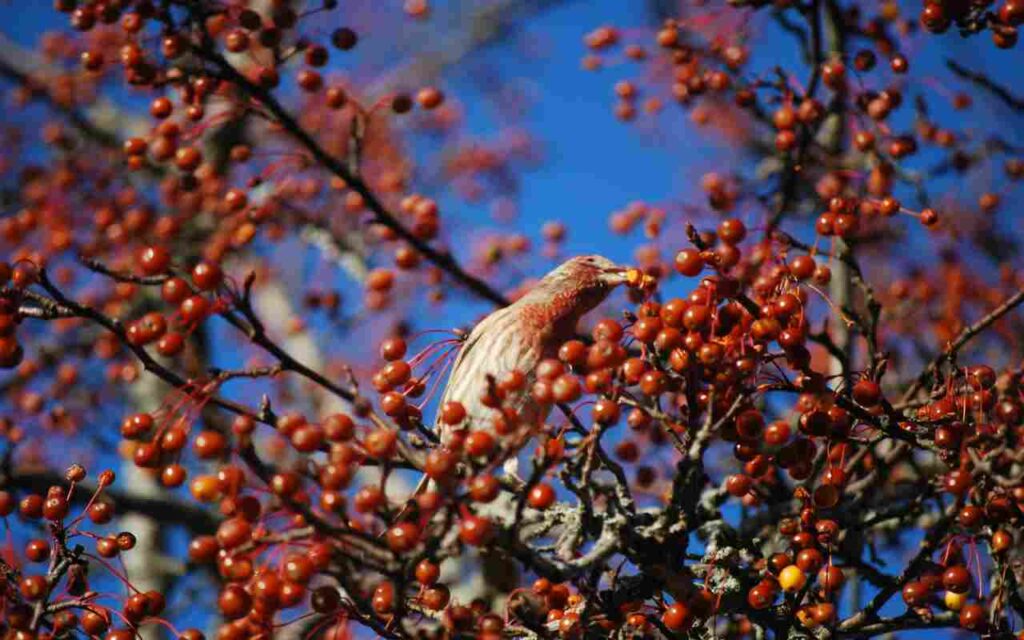
Winter finch feeding is one of nature’s smartest survival systems, and understanding what finches eat in winter reveals just how strategic these birds really are. When snow and freezing temperatures bury food, finches adapt instead of waiting it out. American goldfinches switch completely from insects to seeds, pine siskins can boost their metabolism up to five times in extreme cold, and common redpolls store seeds in expandable throat pouches to survive subzero nights. These biological and behavioral shifts keep finches active when many other songbirds struggle.
The winter diet of finches goes far beyond simply saying “they eat seeds.” They rely on a mix of natural berries, wild foods, and well-supported feeders when snow and ice limit access. This guide breaks down their true cold-season diet, explains why sunflower chips outperform whole seeds in freezing weather, shows how finches obtain mineral salt from roads, and highlights native plants that provide dependable winter food to keep finches visiting your yard all season long 🙂.
Quick Answer: What Do Finches Eat in Winter?
- High-Fat Feeder Seeds: Nyjer (thistle), black oil sunflower seeds, and energy-efficient sunflower chips.
- Natural Wild Foods: Seeds from birch and alder catkins, conifer cones (pine, spruce), and standing weed heads like ragweed.
- Emergency Fuel: High-protein tree buds (maple, elm) plus supplemental suet or bark butter during extreme cold snaps.
- Hydration: Liquid water from heated bird baths, which saves the massive energy cost of melting snow.
Watch: The Winter Finch Survival Toolkit
Knowing what finches eat in winter is only half the battle. From growing internal ‘grocery bags’ to boosting their metabolism by 500%, these tiny birds are biological marvels. Watch this short explainer to see how finches physically dominate subzero storms and learn the critical feeder mistakes you must avoid.
Show Transcript:
[0:00] How Do Tiny Birds Survive Winter Storms?
Have you ever looked out your window during a blizzard and spotted a tiny bird that weighs less than a nickel? It’s hard not to wonder how a small songbird survives brutal winter conditions. In this video, we uncover the remarkable winter survival strategies of finches and explain how these birds don’t just survive cold weather, they dominate it.
For winter birds, freezing temperatures, limited daylight, and deep snow aren’t minor inconveniences. Winter is a constant fight for survival. Snow buries food sources, cold drains energy, and every calorie matters. Yet finches are uniquely equipped to face these challenges head-on.
[0:36] Why Finches Are Built to Win Winter
Finches don’t simply endure winter. They are biologically engineered to thrive in it. Through specialized anatomy, advanced behaviors, and extreme metabolic adaptations, winter finches survive conditions that would kill many other songbirds.
These birds have evolved to treat subzero temperatures as routine. What feels like life-threatening weather to most animals is simply another day for a finch. Their survival toolkit is one of the most impressive examples of natural adaptation in the bird world.
[1:09] Inside the Winter Finch Survival Toolkit
So what are the secrets behind winter finch survival? How do species like goldfinches, pine siskins, redpolls, and crossbills stay alive when food is scarce and temperatures plunge?
Let’s open the full winter survival toolkit and break down the anatomical adaptations and feeding behaviors that give finches such a massive advantage during winter.
[1:30] Specialized Beaks Built for Snowy Conditions
The finch beak is one of its greatest survival tools. Unlike sparrows that feed on the ground, finches are adapted to feed above the snow line in trees and shrubs. Their beaks allow them to access seeds even when snow covers the ground.
Different finch species have evolved different beak shapes:
- American goldfinches have strong, conical beaks designed for crushing seeds
- Pine siskins use narrow, tweezer-like beaks to extract seeds from pine cones
- Crossbills have uniquely crossed beaks that function like pry bars to force open tightly closed cones
This is a perfect example of co-evolution between finches and seed-producing trees.
[2:25] The Hidden Seed Pantry Inside Redpolls
One of the most astonishing finch adaptations belongs to the common redpoll. These birds have expandable throat pouches that function as internal food storage.
Redpolls can pack seeds equal to nearly 10 percent of their body weight into this pouch. This allows them to gather food quickly in exposed areas, then retreat to sheltered locations to digest safely and conserve heat. It’s essentially a built-in grocery bag for winter survival.
[3:02] Sleeping Inside Snow to Stay Warm
When temperatures drop overnight, some northern finches use an extraordinary strategy: they burrow into deep snow to sleep.
Snow acts as a powerful insulator because it traps air. Inside a snow burrow, temperatures can be 50 degrees warmer than the surrounding air. When it’s -30°F outside, conditions inside the snow chamber may hover around 20°F. This behavior often makes the difference between life and death during extreme cold.
[3:44] What Do Finches Eat in Winter to Fuel Survival?
All of these adaptations require energy, and winter finch diets are built around one key nutrient: fat. High-fat seeds provide the calories finches need to maintain body heat and fuel rapid metabolism.
The best winter foods for finches include:
- Nyjer (thistle) seed, which contains up to 40% oil
- Black oil sunflower seeds, a reliable winter staple
- Sunflower hearts (chips), the most efficient winter food
Sunflower hearts are especially valuable because they eliminate the energy cost of cracking shells. In extreme cold, shell-free seeds can mean the difference between gaining energy and losing it.
[4:35] Natural Winter Food Sources Matter Most
Backyard feeders help, but natural habitat is the foundation of winter bird survival. Conifers like pines, spruces, and firs act as natural winter pantries. A single birch tree can produce millions of seeds.
Leaving native plants like coneflowers and sunflowers standing through winter provides critical natural food sources that support finches when conditions are harsh.
[4:59] How to Turn Your Yard Into a Winter Finch Sanctuary
This is where backyard birders can make a real difference. Supporting winter finches means providing more than just seed. Water is just as important.
In winter, finches often rely on snow for hydration. But melting snow inside their bodies burns a huge amount of energy. A small finch may burn the equivalent of 30 to 40 sunflower seeds just to get enough water for one day.
[5:43] Why Heated Bird Baths Are a Game Changer
A heated bird bath provides liquid water at almost zero energy cost to birds. This frees up calories for staying warm and finding food. During winter, heated water can be just as life-saving as high-fat seed.
[5:54] Why Finches Might Be Ignoring Your Feeder
If finches aren’t visiting your feeder, the cause is usually simple:
- Seed freshness – Nyjer seed spoils quickly due to its oil content
- Feeder cleanliness – Moldy seed is dangerous and avoided by birds
- Feeder placement – Feeders should be near cover but safely away from windows
Small adjustments can make a big difference in feeder activity.
[6:35] The One Word That Matters Most: Consistency
The key to helping winter finches is consistency. Reliable food, unfrozen water, and safe shelter must be available every day throughout winter. Sporadic feeding doesn’t provide meaningful support.
When your yard works with the natural survival strategies of finches instead of against them, it becomes part of their survival system.
[7:07] Final Thought: Will Your Yard Be a Winter Sanctuary?
Once you understand how incredible winter finches truly are, it changes how you see backyard bird feeding. You’re no longer just watching birds. You’re helping them survive one of the hardest seasons on Earth.
So the final question is simple: Will your yard be a winter sanctuary this year?
Quick-Start Winter Finch Menu
Top 5 High-Fat Seeds (Feeder)
- Nyjer (Thistle) – 35-40% fat content, ideal for goldfinches and siskins
- Black Oil Sunflower – 28% fat, thin shells for easy cracking
- Sunflower Hearts/Chips – No energy wasted cracking shells in extreme cold
- Millet – Preferred by redpolls, high carbohydrate energy
- Suet/Beef Fat – Emergency calories during temperature extremes
3 Natural Garden Must-Haves
- Native Conifers (pine, spruce, hemlock) – Cone seeds through winter
- Birch Trees – Catkins with abundant seeds persist all winter
- Perennial Seed Heads (coneflowers, sunflowers) – Leave standing through winter
The Evolutionary Advantage: How Finch Beaks Change for Winter
Power of the Cone-Shaped Beak
Finch beaks function as specialized seed-extraction tools precisely adapted to winter feeding challenges. According to research published in PLOS ONE, beak morphology in finches is tuned to loading demands, with beak shapes well-suited for mitigating risk of fracture in accordance with predominant feeding behavior. This optimization allows finches to access seeds that remain available through winter while other songbirds starve.
The conical shape creates mechanical advantage through leverage and bite force concentration. American goldfinches possess relatively short, thick beaks optimized for base-crushing of medium-sized seeds like sunflower and thistle. The broad base provides attachment points for powerful jaw muscles, while the tapered point allows precision targeting of individual seeds. This combination allows goldfinches to dehusk seeds rapidly without damaging the nutritious kernel inside.
Pine siskins demonstrate a different adaptation, with longer, more slender beaks suited for extracting seeds from tight conifer cones and catkins. The elongated profile allows them to probe deep into cone structures where other finches cannot reach, accessing food sources unavailable to species with broader bills. This specialization explains why pine siskins thrive in coniferous forests during winter when deciduous seed sources disappear.
According to research from the Proceedings of the National Academy of Sciences, finch beaks can be characterized by transverse parabolic shapes with curvature that increases linearly from base toward tip. This geometry optimizes both seed grasping and shell fracturing, creating a tool that functions efficiently across varying seed sizes and hardnesses encountered during winter feeding.
Winter-Specific Beak Advantages
Winter conditions favor finches over many other seed-eating birds through beak-related feeding efficiency. Sparrows and buntings possess beaks adapted primarily for ground feeding on scattered seeds. When snow covers the ground, these birds lose access to their primary food sources. Finches, however, feed extensively in trees and shrubs where seeds remain accessible above snow levels.
The crossbill represents the extreme example of winter beak specialization. Red crossbills and white-winged crossbills possess bills with overlapping mandibles that function like specialized pry bars, extracting seeds from closed conifer cones throughout winter. This unique morphology provides exclusive access to food sources other birds cannot exploit, explaining why crossbills breed in winter when cone crops peak.
What Do Finches Eat Naturally in Winter? The Wild Diet
Tree Seeds: The Winter Larder
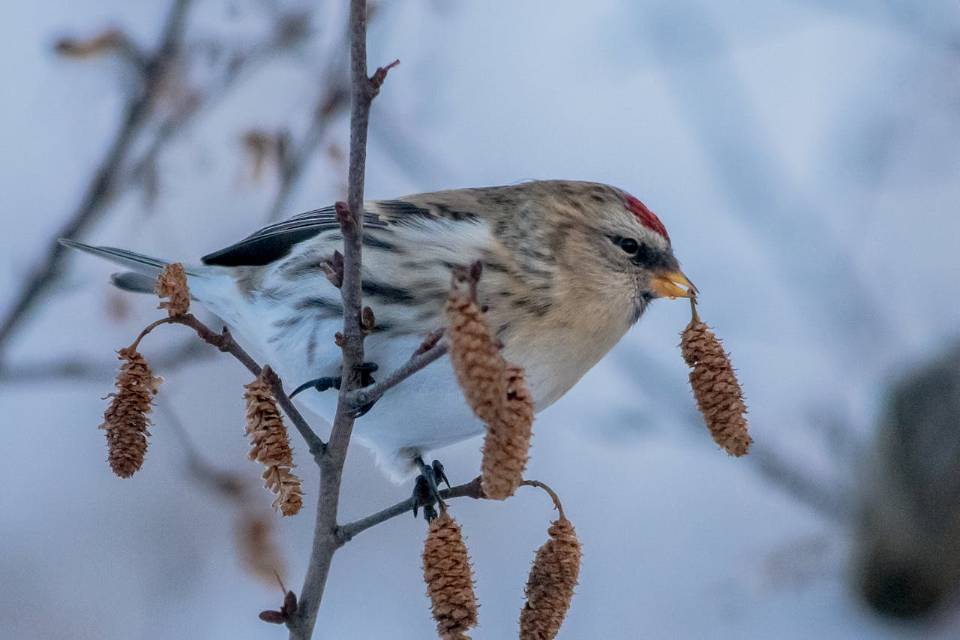
Native tree species provide the foundation of wild finch winter diets. Birch catkins (Betula species) remain on branches through winter, dehiscing gradually to release small seeds that goldfinches, siskins, and redpolls consume voraciously. A single mature birch can produce millions of tiny seeds, creating concentrated feeding opportunities that attract large finch flocks.
Alder catkins (Alnus species) function similarly, persisting through winter and providing protein-rich seeds accessible when snow buries ground vegetation. According to Cornell Lab of Ornithology research on pine siskins, these finches show particular fondness for seeds of pines, cedars, larch, hemlock, and spruce, but also feed extensively on deciduous seeds from alder, birch, sweetgum, and maples.
Conifer seeds become critical during mid to late winter when deciduous seed supplies dwindle. Pine, spruce, fir, and hemlock cones open during dry winter days, releasing winged seeds that finches pluck directly from opening cones or glean from snow surfaces. The high fat content of conifer seeds (40-50% in some pine species) provides concentrated calories essential for maintaining body temperature during extreme cold.
Weedy Field Seeds
Native weeds and grasses that persist through winter provide scattered but important food sources. Ragweed (Ambrosia species) produces abundant small seeds that goldfinches and siskins consume extensively. The seeds remain attached to standing stalks through much of winter, accessible even when snow covers lower vegetation.
Thistle (Cirsium species) and other composite flowers produce seeds equipped with pappus structures that aid wind dispersal but also keep seeds elevated and accessible during snowy periods. Finches demonstrate remarkable ability to locate these scattered resources, often feeding in mixed flocks that increase seed detection through collective searching behavior.
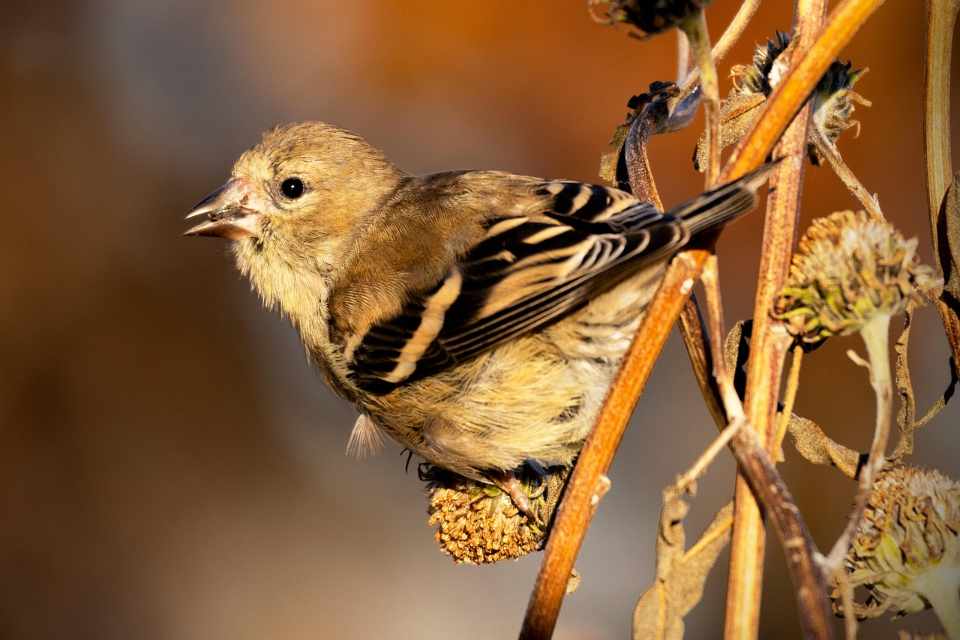
Grasses including panic grass, foxtail, and various native species hold seeds in elevated seed heads through winter. While individual grass seeds provide less nutrition than tree seeds, their abundance creates feeding opportunities especially during early winter before heavier snows bury low vegetation.
The Tree Bud Secret
As winter transitions to early spring, finches increasingly consume tree buds as they swell with stored carbohydrates and proteins. Willow, elm, and maple buds provide nutritious food when seed supplies diminish. This dietary transition begins in late winter and intensifies through March and April as trees prepare for spring growth.
The buds contain concentrated nutrients trees store for rapid spring growth, making them energy-dense food sources. Finches pluck buds from branch tips, often feeding while hanging upside down in acrobatic positions that larger birds cannot achieve. This feeding behavior provides finches with late-winter nutrition while other seed-eaters struggle to find adequate food.
Arthropod Emergency Fuel
While winter finch diets consist overwhelmingly of vegetable matter, protein from dormant insects and spiders provides critical nutritional supplements. Finches glean overwintering insect larvae, eggs, and pupae from bark crevices, dead leaves trapped in vegetation, and protected microhabitats where arthropods survive winter in dormant states.
Spider egg sacs attached to branches and bark provide concentrated protein during periods when finches need to rebuild muscle mass depleted by extreme cold. Pine siskins and other finches probe bark and persistent leaf clusters searching for these hidden protein sources.
The protein intake remains modest (5-10% of winter diet) but proves essential for feather maintenance, immune function, and reproductive preparation as winter progresses toward breeding season. Finches that fail to obtain adequate protein during winter show reduced breeding success the following spring.
Winter Berry Supplements
While goldfinches and siskins are dedicated seed-eaters, other winter finches like House Finches, Purple Finches, and Pine Grosbeaks rely heavily on winter-persistent fruits. Berries from Crabapple, Mountain Ash, and Hawthorn trees serve as “living bird feeders” that stay above the snow line.
These fruits provide more than just calories; they are a critical source of hydration when liquid water is frozen and offer essential carotenoid pigments that male finches need to maintain their vibrant red plumage.
If your yard lacks these natural shrubs, adding dried cranberries or blueberries to a platform feeder can attract these fruit-loving species during the harshest stretches of January and February.
Supplemental Feeding: The High-Octane Feeder Menu
The Big Three: Nyjer, Black Oil Sunflower, and Sunflower Hearts
Nyjer (Guizotia abyssinica), also called thistle seed, provides optimal nutrition for small finches including goldfinches, siskins, and redpolls. The tiny black seeds contain 35-40% oil by weight, delivering concentrated calories in package sizes perfectly matched to small finch bills. Specialized tube feeders with small ports accommodate finches while excluding larger, more aggressive birds.
Fresh nyjer proves critical. The seeds contain oils that turn rancid when exposed to moisture and heat. Stale nyjer loses both palatability and nutritional value. Purchase nyjer in quantities consumable within 2-3 months and store in cool, dry conditions to maintain freshness.
Black oil sunflower seeds provide the workhorse food for winter finch feeding. The seeds contain approximately 28% fat with thin shells that finches crack efficiently even during cold weather when metabolic resources must be conserved. The small seed size suits finch bills better than larger striped sunflower varieties.
Sunflower hearts represent premium winter finch food. The no-waste, shell-free seeds eliminate energy expenditure required for dehusking, allowing finches to obtain maximum calories with minimum effort. During extreme cold when every calorie counts toward survival, sunflower hearts provide decisive advantages over whole seeds.
The No-Energy Win: Why Sunflower Chips Excel in Extreme Cold
Seed dehusking requires muscular work that consumes calories and generates metabolic heat. Under moderate conditions, this caloric cost proves negligible. During extreme cold (below 0°F), however, the energy spent cracking shells can equal or exceed the energy gained from consuming the kernels, especially for small seeds with tough hulls.
Sunflower chips eliminate this energy tax entirely. Birds obtain nutrition without performing any mechanical work, allowing them to feed rapidly and return to sheltered positions where they conserve body heat. This efficiency becomes critical during winter storms and extreme cold snaps when finches must maximize caloric intake while minimizing exposure time.
The economics favor chips despite higher cost per pound. Whole sunflower seeds produce approximately 50% waste (shells), meaning half the weight you purchase provides zero nutrition. Sunflower chips deliver 100% edible content, effectively doubling nutritional value per pound despite premium pricing.
Suet and Fat: Emergency Calories
Finches traditionally avoid suet feeders, preferring seeds to animal fat. Recent observations, however, document increasing finch use of suet and bark butter products, particularly during extreme cold and when seed supplies run low. This behavioral flexibility demonstrates finches’ ability to exploit novel food sources when survival demands exceed normal dietary preferences.
Suet provides extraordinarily concentrated calories (approximately 85% fat by weight) that help finches maintain body temperature during temperature extremes. Small amounts consumed opportunistically can make decisive differences in overnight survival during severe cold snaps.
Bark butter (spreadable suet designed to smear on tree bark) appeals more strongly to finches than hard suet blocks. The spreadable consistency allows finches to peck small amounts while perched, matching their preferred feeding posture better than hanging from traditional suet cages designed for woodpeckers.
Winter Survival Hacks No One Discusses
The Salt Lick Secret
Pine siskins and other northern finches seek mineral salt with remarkable intensity during winter. According to Cornell Lab research, mineral deposits can lure pine siskins to otherwise unattractive habitats like winter road beds that are salted to melt snow and ice.
The behavior likely serves multiple physiological functions. Salt provides sodium and chloride ions essential for cellular function, neural transmission, and muscle contraction. Winter seed diets contain minimal salt, creating potential deficiencies that finches address through deliberate salt consumption.
The roadside feeding presents significant mortality risk. According to wildlife research on salt consumption, vehicles kill untold numbers of wild birds that gather on and alongside salt-treated pavement to eat salt supplements. The nutritional benefit they seek becomes a deadly trap when traffic strikes birds focused on feeding rather than predator awareness.
Maple Sap Sipping
Evening grosbeaks and purple finches have been observed snipping small maple twigs during late winter to access sap flow as trees mobilize stored sugars in preparation for spring growth. The sweet sap provides readily accessible carbohydrates when seed supplies dwindle and energy demands increase.
This behavior intensifies during late February through March when daytime temperatures rise above freezing while nights remain below zero. These freeze-thaw cycles drive sap movement in sugar maples, red maples, and other species, making sap available to birds clever enough to access it.
Pine siskins have been documented visiting sapsucker wells (rows of holes drilled by yellow-bellied sapsuckers) to drink tree sap. This opportunistic behavior demonstrates finches’ ability to recognize and exploit food sources created by other species, expanding feeding opportunities beyond seeds alone.
The Throat Pouch (Esophageal Diverticulum)
Common redpolls possess a specialized anatomical structure called an esophageal diverticulum, a pouched expansion of the esophagus that functions as temporary seed storage. According to ornithological research, this partially bi-lobed pocket is analogous to the crop of gallinaceous birds and is referred to in The Birder’s Handbook by Ehrlich, Dobkin and Wheye as enabling specialized winter-feeding behavior.
The diverticulum allows redpolls to practice “speed eating” where they rapidly gather seeds in exposed, dangerous locations, then retreat to dense cover to process the food safely. According to research from Natural Resources Council of Maine, a special, expandable pouch in the redpoll’s throat allows it to store seeds gathered quickly in cold weather, which it can then eat in a warmer, sheltered spot over the course of several hours.
The storage capacity equals approximately 2 grams of seeds (up to 10% of body weight), providing enough energy to sustain redpolls through 4-5 hours of rest at temperatures as low as 0°F. This biological innovation allows redpolls to survive in Arctic and sub-Arctic environments where few other songbirds can persist through winter.
Pine siskins possess similar though less developed crop storage, allowing them to store up to 10% of body weight in seeds overnight. This overnight food reserve helps them survive the most dangerous period (the long, cold hours between sunset and sunrise) when they cannot feed but must maintain body temperature through metabolic heat production.
Hydration: The Invisible Winter Requirement
Eating Snow: The Caloric Cost
Snow provides water but at tremendous metabolic cost. Melting snow requires heat energy that birds must generate through calorie consumption. According to physiological research, melting one gram of ice/snow to liquid water requires 80 calories of heat energy. For a 15-gram goldfinch to obtain 10 grams of water by eating snow requires approximately 800 calories, equivalent to the energy content in 30-40 sunflower seeds.
This energy tax compounds during extreme cold when birds need maximum calories for thermoregulation. Finches that depend on snow for hydration must increase food consumption significantly just to compensate for water-melting energy costs, reducing net energy available for survival.
Cellular Respiration: Creating Internal Water
Finches produce metabolic water as a byproduct of cellular respiration. When cells burn fats and carbohydrates for energy, the chemical reactions produce carbon dioxide, heat, and water. The metabolic water equation shows that complete oxidation of 100 grams of fat produces approximately 107 grams of water, while burning 100 grams of carbohydrate yields about 55 grams of water.
This internal water production allows finches to survive periods without access to liquid water, though it cannot meet total hydration needs indefinitely. Finches eating dry seeds must obtain some water from external sources to maintain proper hydration over extended periods.
Heated Bird Baths: Energy Conservation
Providing liquid water through heated bird baths represents one of the most valuable services backyard bird supporters can offer during winter. According to research on winter bird physiology, access to liquid water eliminates the massive energy cost of melting snow, allowing finches to allocate those saved calories toward thermoregulation and survival.
The energy savings prove most critical during extreme cold snaps and overnight periods when finches deplete fat reserves maintaining body temperature. A finch that drinks liquid water rather than eating snow conserves hundreds of calories daily, calories that may determine survival versus death during the coldest nights.
Strategic Habitat: Creating Thermal Cover
Microhabitats: Blocking Windchill
Dense evergreens create thermal refugia where finches shelter from wind, reducing convective heat loss that can exceed metabolic heat production during extreme conditions. A 20 mph wind at 0°F creates windchill equivalent to temperatures far below zero, dramatically increasing the calories finches must burn to maintain body temperature.
Plantings of spruce, fir, pine, hemlock, and arborvitae create windbreaks that reduce air movement by 50-70%, substantially decreasing heat loss from roosting finches. The microclimate within dense conifer groves may be 10-15°F warmer than surrounding open areas during windy conditions, representing the difference between survival and death for small finches.
Brush piles constructed from pruned branches and yard debris provide similar thermal benefits with minimal investment. Loosely piled branches create air-pocket insulation while blocking wind, creating sheltered spaces where finches roost overnight and escape daytime temperature extremes.
The Snow Tunnel Roost
Common redpolls and other northern finches have been observed burrowing into snow to create overnight roosting chambers. The insulating properties of snow (which contains approximately 90-95% air) create microenvironments substantially warmer than ambient air temperatures.
Snow temperature rarely drops below 20°F even when air temperatures plunge to -30°F or lower. A redpoll roosting in a snow tunnel experiences an effective temperature 30-50 degrees warmer than a bird exposed to open air. This temperature difference allows redpolls to survive Arctic winters where exposed birds would freeze.
The behavior requires sufficient snow depth (8+ inches) and demonstrates remarkable behavioral flexibility. Redpolls tunnel into drifts at dusk, creating chambers that trap body heat while preventing heat loss to wind. The birds emerge at dawn to feed, having survived the night with minimal fat depletion.
Troubleshooting: Why Are Finches Ignoring My Feeder?
Dirty Seed and Feeder Contamination
Moldy or contaminated seed repels finches through both scent and visual cues. Seeds that appear discolored, clumped, or dusty indicate mold growth, moisture damage, or bacterial contamination. Finches avoid these seeds instinctively, recognizing health risks that humans may not notice.
Clean feeders weekly during winter using hot water and vinegar solution (1:4 vinegar to water ratio). Discard seed that shows any signs of moisture, mold, or clumping. The investment in fresh seed and clean feeders yields dramatically higher finch visitation than savings achieved through using stale seed.
Stale Nyjer
Nyjer goes rancid faster than other seeds due to high oil content. Finches reject stale nyjer with remarkable consistency, often ignoring feeders full of seeds that smell or taste “off” to their sensitive systems. Store nyjer in cool, dry conditions and purchase quantities consumable within 2-3 months.
Test nyjer freshness by crushing a few seeds between fingers. Fresh nyjer releases oil and produces a nutty scent. Stale nyjer feels dry and produces little oil or scent when crushed. Discard any nyjer that fails this test.
Poor Feeder Placement
Feeders placed too close to windows (within the 3-15 foot danger zone) create collision risks that finches instinctively avoid. Position feeders either within 3 feet of windows (preventing momentum for fatal strikes) or beyond 15 feet (allowing adequate distance for birds to recognize glass barriers).
Feeders positioned in completely open areas without nearby cover receive less finch traffic than those placed near (but not in) dense shrubs or trees. Finches prefer feeding stations where they can quickly escape to protective cover if threatened. Place feeders 10-15 feet from dense evergreens or brush piles for optimal results.
Natural vs. Feeder Foods: What Finches Eat to Survive Winter
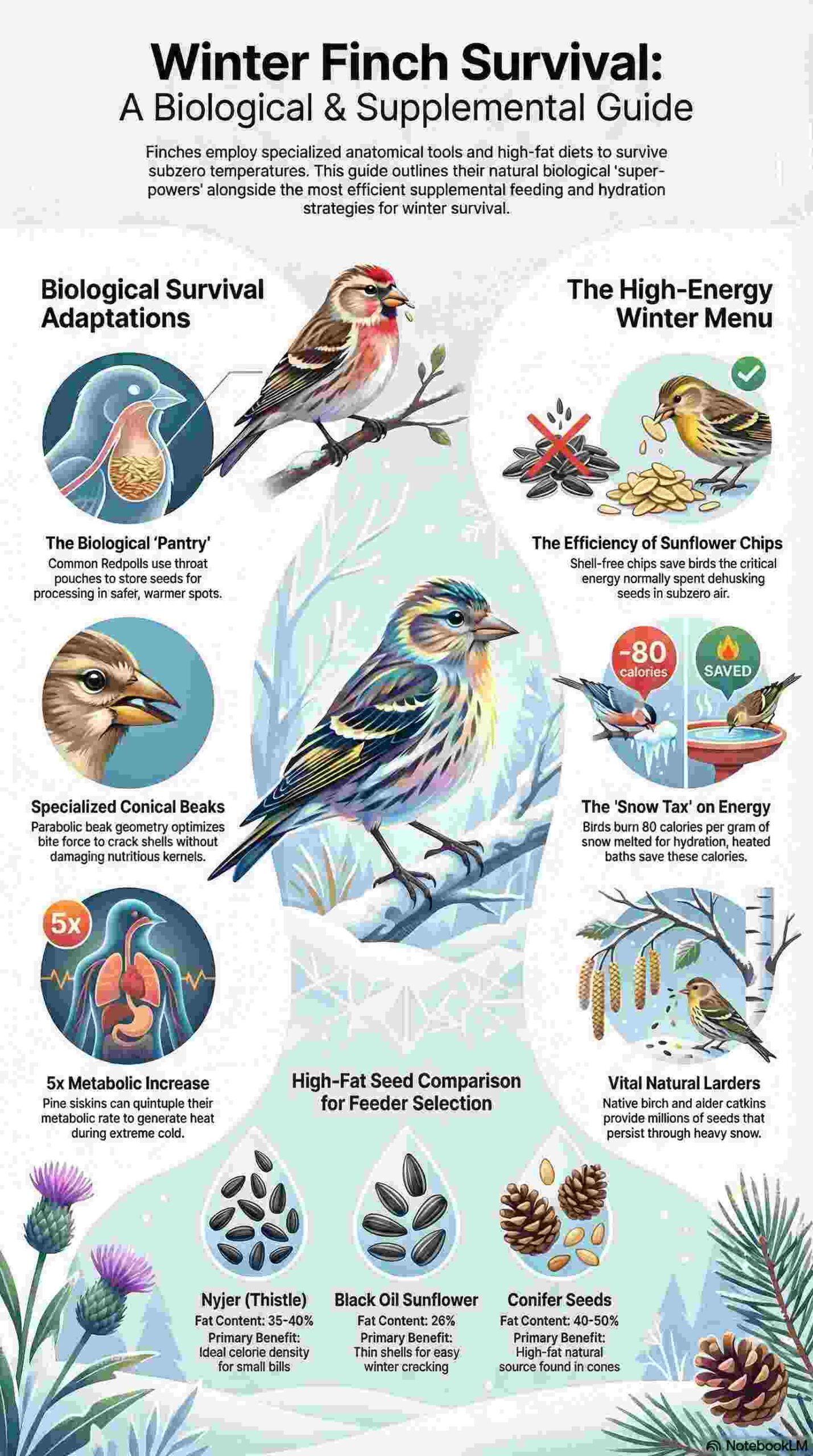
To help you stock your yard correctly, this Winter Finch Food Cheat Sheet summarizes the best natural and supplemental resources at a glance. Feel free to Pin this to your favorite birding board for quick reference!
Conclusion: Becoming a Winter Finch Guardian
Winter finch survival depends on the intersection of natural food availability, feeder supplementation, liquid water access, and thermal shelter. Finches that successfully navigate winter demonstrate remarkable physiological adaptations including enhanced metabolic rates, seed storage capabilities, and behavioral innovations like salt consumption and snow tunneling. Your role as a finch supporter involves recognizing these biological realities and creating environments that work with, rather than against, finch survival strategies.
The most effective winter finch support combines native plantings (birch, alder, conifers) that provide natural food sources with strategic feeder placement offering high-fat seeds during periods when natural supplies become inaccessible. Adding liquid water through heated bird baths eliminates the massive energy cost of melting snow. Creating thermal shelter through evergreen plantings and brush piles provides the windbreak and insulation finches need to survive the coldest nights.
Success requires consistency throughout winter rather than sporadic support. Finches that locate reliable food, water, and shelter return daily, establishing feeding territories they defend against competitors. Irregular feeding creates uncertainty that drives finches to seek more dependable resources elsewhere. Commit to daily feeder maintenance, fresh seed, clean water, and year-round habitat rather than seasonal support that fails finches during their most critical survival period.
For additional information on supporting winter finch populations, explore guides on winter bird feeding strategies, attracting finches to your yard, and identifying different finch species. Understanding which seeds to use in winter feeders and preventing bird bath freezing complete the knowledge foundation for successful winter finch stewardship.