
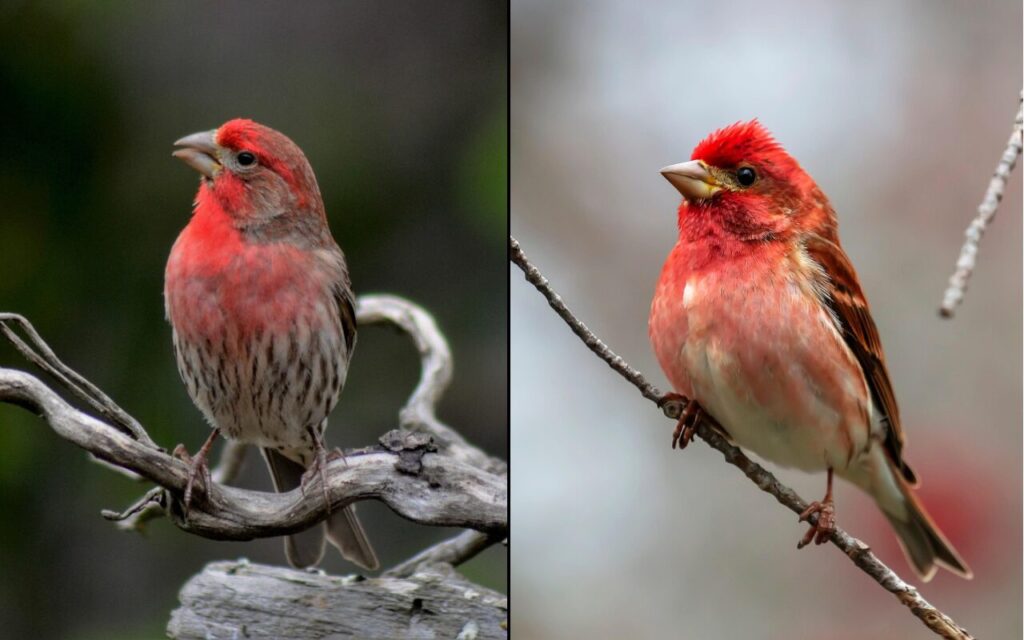
Backyard birders know how frustrating it is when a flashing glimpse of crimson at a feeder turns into a confusing guessing game. A close House Finch vs Purple Finch comparison usually comes down to checking where the red feathers actually stop on the bird’s body.
If you are trying to learn how to tell the difference between a house finch and a purple finch, you need to focus your binoculars straight on the flank markings and face borders. Spotting heavy brown belly stripes or a bold, creamy eyebrow line will give you an instant visual answer, making it easy to sort your local songbird flocks.
Fastest Ways to Tell a House Finch vs Purple Finch Apart
The fastest way to tell a house finch vs purple finch apart is checking the distribution of male red plumage. A purple finch features an extensive raspberry wash that uniformly floods across its entire head, back, and flanks, while a house finch carries a bright strawberry red color restricted tightly to its face and upper chest.
To verify standalone sightings without a direct color view, look directly at the side markings. House finches display heavy, blurry brown flank streaking patterns down their bellies, whereas purple finches maintain a much cleaner lower torso scaling that finishes on pure white undertail feathers.
Video Explainer for Finch Identification Marks
This animated whiteboard walkthrough illustrates the precise color saturation patterns and facial feather boundaries needed for accurate field tracking. Reviewing these illustrated visual shortcuts helps you confidently distinguish lookalike backyard species under diverse outdoor conditions.
Geographical Range Boundaries and Preferred Breeding Habitats
Evaluating the native territories and localized movements of these lookalikes reveals clear differences that do half of your identification work before you even raise your binoculars. While human development has altered their historic nesting boundaries, their core environmental preferences remain distinctly separate across North America.
Their regional distributions rely on specific landscape preferences:
| Visual Indicator Metric | House Finch (Haemorhous mexicanus) | Purple Finch (Haemorhous purpureus) |
|---|---|---|
| Native Regional Origin | Historic Western United States climates | Native Eastern and Northern conifer zones |
| Landscape Preferences | Urban centers, suburban tracts, backyard gardens | Dense mixed forests, conifer woods, deep groves |
| Feeder Visit Frequencies | Highly consistent, permanent daily guests | Sporadic winter wanderers, shy woodland visitors |
| Nesting Site Selections | Porch ledges, hanging planters, building crevices | High evergreen canopies, remote wilderness branches |
Because house finches are highly adaptable suburban birds, they thrive across populated residential developments, backyard garden grids, and municipal city parks. Conversely, purple finches are reclusive woodland creatures that spend their spring and summer breeding seasons high inside remote evergreen canopies.
To explore how these woodland habitat selections impact cold weather migrations, review our specialized analysis of what birds stay in winter across northern zones.
Male Color Saturation and Plumage Distribution Patterns
Focusing your tracking view directly on the specific shade and structural distribution of a male’s red feathers provides your absolute best field sorting tool. While both birds display striking red coloration, the exact biological distribution of their pigments follows completely separate evolutionary rules.
Analyzing these bright visual indicators reveals two highly distinct color profiles:
- The Saturated Raspberry Finch: A mature male purple finch looks like a bird completely dipped in rich raspberry jam. According to comparative tracking data compiled by the official Audubon Finch Identification Guide, this deep, wine red hue washes uniformly across its entire face, floods over its crown, runs continuously down its back, and tints its side flanks.
- The Patchy Strawberry Finch: A mature male house finch carries a brighter, lighter strawberry red or slightly orange tint. This brighter color is restricted to a tight mask across its forehead, eyebrows, and upper breast patch, leaving its crown and back a dull, streaky brown.
- Seasonal Molting Variances: Late summer molting windows can cause male house finch plumage to look temporarily patchy, faded, or dull. These dietary plumage color shifts align with tracking data mapped out in our guide on why do goldfinches change color, as wild carotenoid levels alter seasonal brightness.
Observing the back profile of the bird reveals the identification instantly. A purple finch shows a rich, colorful crimson saddle running down its spine, whereas a house finch displays a plain, scruffy brown back with zero uniform color wash.
Male House Finch
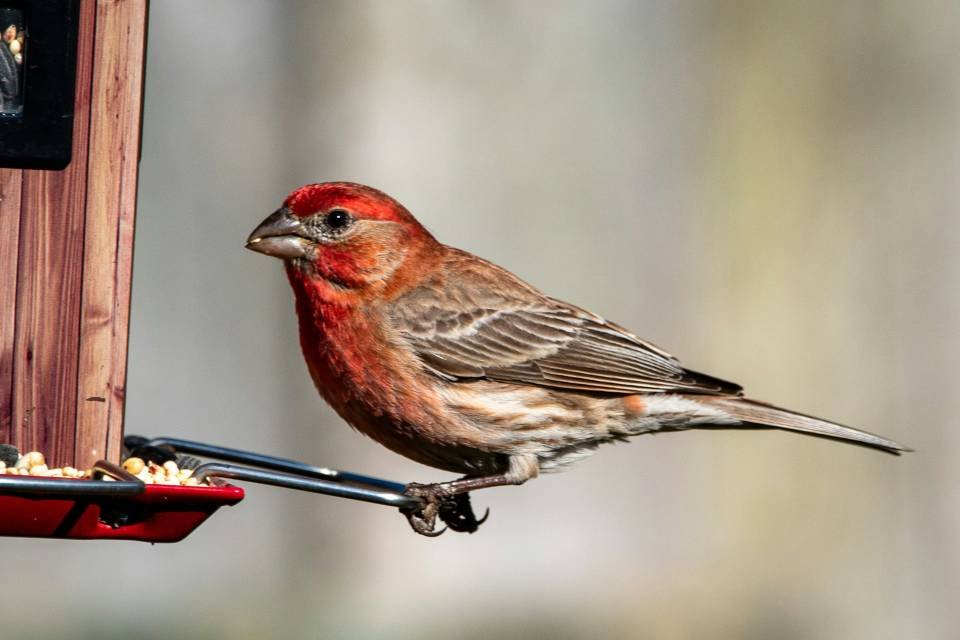
- Red coloring mostly on the head, chest, and sometimes up to the back.
- The red is usually orange-ish or strawberry-toned, not a true deep red.
- Brown streaks cover the belly and sides, making them look a bit scruffy at times.
Male Purple Finch
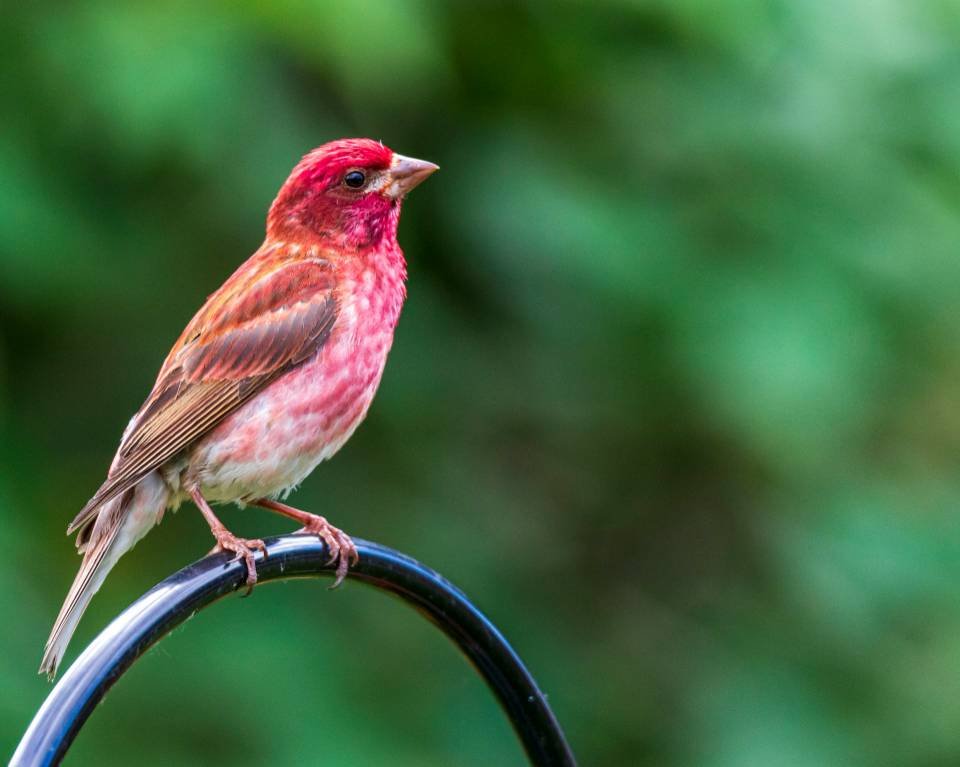
- Rich rosy-raspberry wash that covers the head, chest, and back more uniformly.
- The red plumage is visibly deeper and less patchy than a typical House Finch profile.
- The sides are streaked, but the belly is usually cleaner than the House Finch’s.
Pro tip: If the red looks like it could double as raspberry jam, you’re probably looking at a Purple Finch. House Finch red is more like a soft peachy stain.
Female Finches: Don’t Ignore the Browns
Now, females might make you question your bird ID skills. They don’t have the showy reds, but there are differences:
Female House Finch
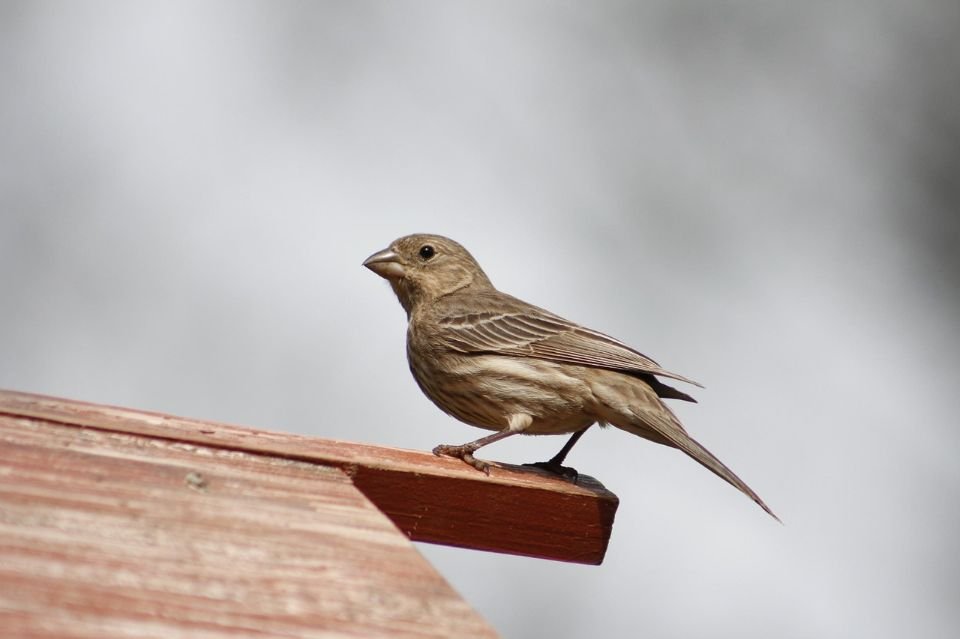
- Brown streaks cover the body.
- Face and chest are dull with a slight pale eyebrow.
- Overall, they’re more delicate-looking and less heavily streaked than female Purple Finches.
Female Purple Finch
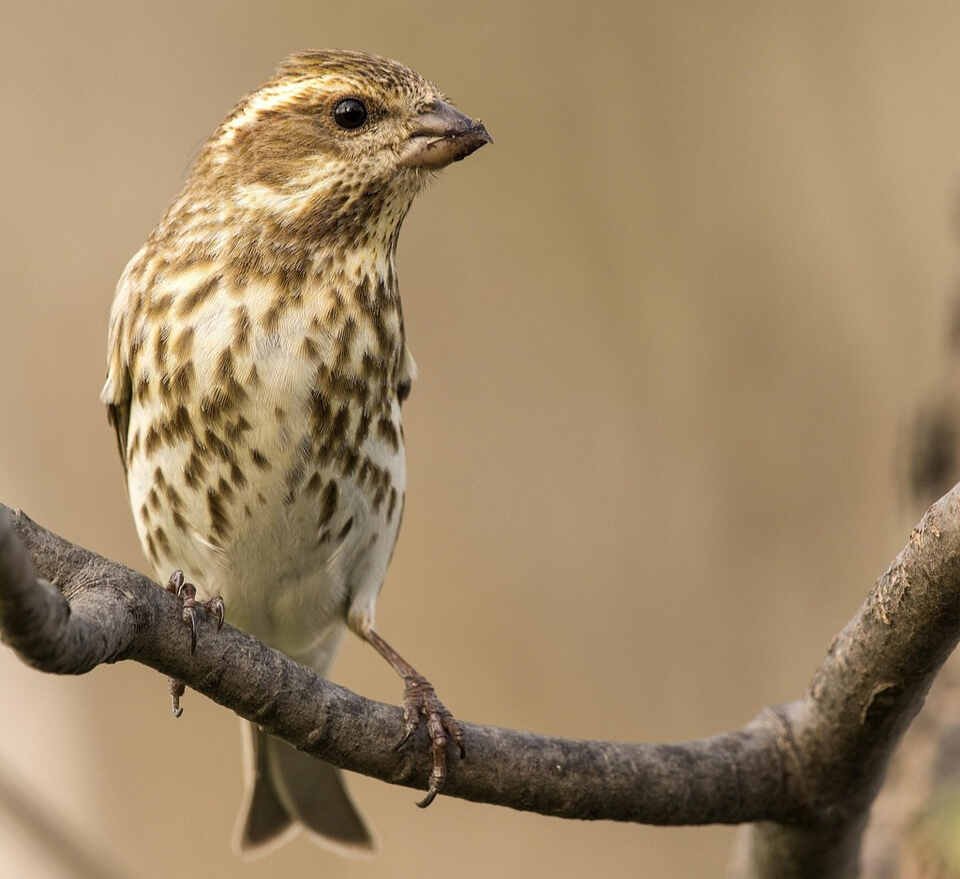
- Heavier streaking, especially on the chest and sides.
- Slightly more robust build.
- Subtle white or pale edging on the wing feathers.
Honestly, females are the ultimate test of your birding patience. But once you spot the streak patterns, your confidence will soar.
Lower Torso Scaling and Flank Streaking Marks
When low backyard lighting conditions or deep woodland shadows make it impossible to judge exact red color shades accurately, you must shift your tracking focus down to the bird’s lower torso. Checking the texture of the lower belly feathers provides an exceptional secondary confirmation tool.
These lower belly checking metrics follow two strict patterns:
- Scruffy Blurry Flank Lines: The lower chest and side flanks of a house finch are covered in heavy, blurry brown streaks. These prominent dark markings run all the way down its belly, giving the bird a noticeably scruffy, striped lower torso profile.
- Clean Unmarked Lower Torsos: The belly feathers of a purple finch are remarkably clean, smooth, and bright white. While light, delicate rosy streaks can sometimes track down its upper flanks, its center belly and undertail regions remain free of heavy brown lines.
To see how these distinct lower torso patterns look when sorting lookalike varieties, check our visual reference on how to identify male and female finches to master field color charts. Training your eyes to check the lower belly lines prevents you from making mistakes when bad weather distorts your color view.
Female Face Markings and Streak Contrast Levels
Identifying female finches represents the ultimate test of backyard birdwatching patience because both varieties completely lack bright red plumage. Separating these overall brown, heavily striped birds requires focusing your tracking lens exclusively on their facial feather borders.
A female house finch features a plain, uniform, and indistinct face profile. Her facial features lack strong color changes, displaying light, blurry brown lines that blend smoothly across her cheeks. Conversely, a female purple finch displays a bold, high-contrast facial design, featuring a prominent creamy white eyebrow line paired with a dark, defined jaw stripe and a deep brown cheek patch.
Her structural streaking patterns follow separate quality boundaries:
Interspecific Aggression Dynamics: Because female house finches lack bold facial marks, they are sometimes misidentified or displaced by other species. To protect your nesting target birds from territorial competition, review our defensive strategy guide on preventing finches from being bullied at shared spaces, you’ll recognize the songs like old friends. Personally, I can ID a Purple Finch from a block away just by their melody.
Sharp High Contrast Lines: Female purple finches feature dark, distinct, and highly defined teardrop streaks across their white chests.
Blurry Low Contrast Lines: Female house finches carry soft, faded, and blurry brown lines that spread across a light gray background.
Beak Profiles and Cranial Symmetry Variations
When bird behavior or dense foliage blocks your view of plumage patterns, inspecting beak shapes reveals a subtle anatomical marker that never lies. Morphometric data published in the Cornell Lab of Ornithology Identification Center confirms that these sister lineages carry uniquely shaped mandibles adapted to process separate food resources in the wild.
A house finch features a short, compact, and distinctly curved beak profile. The upper line of its beak curves gently downward toward the tip, giving its small head a pointier look. Conversely, a purple finch carries a chunkier, straight, and heavily conical beak with an exceptionally broad base. This heavy structure features straight edges that form a large, powerful triangle, making its entire head look bulkier.
This anatomical variance dictates their natural wild feeding preferences:
- Suburban Small Grain Crackers: The curved beak of the house finch is built to crack small residential garden grains, niger seeds, and thin sunflower hulls.
- Heavy Forest Seed Crushers: The broad beak of the purple finch is designed to crack hard tree seeds, evergreen buds, and dense wild forest berries.
To attract both types of specialized beak structures to your yard while maintaining absolute safety protocols, implement the layouts detailed in our guide on how to choose the right bird feeder for year-round use. Watching how individual birds handle seeds at your feeding trays can clue you in before color even registers.
Auditory Vocalizations and Flight Rattle Tempos
When target finches remain hidden inside dense summer leaves, you can easily distinguish them by listening closely to their unique calls and singing styles. A foundational population ecology study hosted in Oecologia demonstrates that intense interspecific competition for food resources causes these species to defend distinct acoustic boundaries across urban edges.
Their acoustic profiles follow two distinct patterns:
- The Cheerful Repetitive Chatter: A house finch emits a long, rapid, and jumbled warbling song that rises and falls randomly. This energetic chatter sounds repetitive and frequently finishes with a distinct, harsh, upward slurring sound. Their flight call is a simple, high-pitched cheep or tsip note.
- The Elegant Warbling Melody: A purple finch sings a rich, beautiful, and fluid warbling song that flows cleanly like a musical flute. This elegant arrangement is less repetitive, moves across varied musical tones, and lacks any harsh upward notes. Their flight call is a clear, metallic tick or tek sound that stands out in a quiet forest canopy.
Learning to recognize these unique sounds allows you to identify your backyard visitors before you even step outside. For more tips on setting up an accurate audio census log in your yard, refer to our comprehensive layout tracking how to set up a backyard bird survey.
Seasonal Plumage Variations and Breeding Cycle Molts
Tracking seasonal molting windows prevents property owners from making common lookalike mistakes when regional resources shift throughout the calendar year. Avian feather structures degrade over time from physical wear and environmental friction, meaning that the pristine red hues observed during early spring breeding peaks will naturally alter by late summer.
These calendar-based feather updates follow separate physical tracks:
- Late Summer House Finch Molts: Mature male house finches maintain their base orange-red facial tint across all twelve months. However, entering their primary late summer molting window can cause their strawberry highlights to look temporarily patchy, faded, or dull as new quills replace old flight surfaces.
- Autumn Purple Finch Softening: Adult male purple finches frequently appear slightly duller or more deep wine-toned during late summer after completing their strenuous nesting cycles. Conversely, female and immature juvenile purple finches lack any red highlights, displaying heavy brown designs that can cause them to look nearly identical to standard female house finches.
- Visual Color Intensity Shifts: Observing a prominent red patch across your garden feeding grids in July does not guarantee the same color intensity or crisp feather borders seen in April.
Understanding these physical transformations allows birdwatchers to look past temporary feather scruffiness to focus exclusively on permanent structural landmarks like curved beak profiles and lower torso scaling marks.
Field Tracking Pitfalls and Technical Identification Mistakes
Avoiding common field classification errors requires property owners to look past initial surface impressions to analyze distinct physical markers during high-traffic seasonal migrations. Because lighting conditions and foliage can distort your visual perspective, misclassifying these lookalike finches is common unless you use a systematic cross-examination strategy.
These frequent visual pitfalls center on three distinct areas:
- Misclassifying Striated Females: Immature and female specimens of both species appear entirely brown and heavily striated at a glance. Correcting this mistake requires focusing exclusively on high-contrast facial feather borders and lower torso scaling textures rather than general sizing boundaries.
- Assuming Broad Regional Exclusivity: Assuming every colorful visitor across suburban neighborhoods is automatically a common house finch causes observers to miss passing migratory flocks. Many temporary backyard visitors are actually purple finches shifting territories during late autumn weather drops.
- Overlooking Feeding Ground Behaviors: Purple finches are naturally cautious woodland creatures that spend substantial time hunting in high tree canopies, whereas house finches display a highly social, feeder-obsessed behavior pattern.
Documenting these rapid aerial movements accurately is often enhanced by utilizing precision digital photography to capture freeze-frame wing bars and bill contours. Reviewing these high-resolution details on a secondary screen allows you to study subtle feather lines that are difficult to isolate on an active feeding tray.
Quick Reference Finch Identification Matrix
Using the structured data grid below helps you cross-reference primary physical properties and behavioral traits to ensure absolute identification accuracy under variable field conditions.
| Diagnostic Visual Indicator | House Finch (Haemorhous mexicanus) | Purple Finch (Haemorhous purpureus) |
|---|---|---|
| Male Plumage Mapping | Brighter strawberry red limited to face and chest | Extensive wine raspberry wash across head and back |
| Lower Torso Scaling | Heavy blurry brown streaks running down belly | Pure clean white feathers below lower breast lines |
| Female Facial Borders | Plain uniform gray cheeks with low contrast lines | High contrast dark cheek patch and white eyebrow line |
| Beak Curve Profiles | Short compact bill featuring a curved upper edge | Broad heavy straight conical triangle structure |
| Acoustic Vocalizations | Rapid cheerful repetitive jumbled chatter | Fluid rich melodic flute like warbling song |
| Foraging Preferences | Social feeder obsession favoring garden grains | Shorter woodland visits favoring conifer seeds and berries |
Summary Identification Checklist for Lookalike Finches
Reviewing these advanced visual clues, anatomical proportions, and distinct behavioral habits ensures you can quickly classify individual yard visitors across all four seasons. Instead of relying on a single, uncertain color guess when a red bird lands on your tray, you can cross-reference multiple reliable field markers to make a certain identification.
Verifying a patchy strawberry mask paired with blurry brown flank streaks provides immediate visual confirmation that you are watching a common house finch. Conversely, tracking a uniform rosy crimson wash that covers the entire back, paired with a bold white female eyebrow line, confirms the presence of a robust purple finch.
Combining these physical checks with auditory tracking of song variations guarantees absolute identification accuracy under any field conditions.