
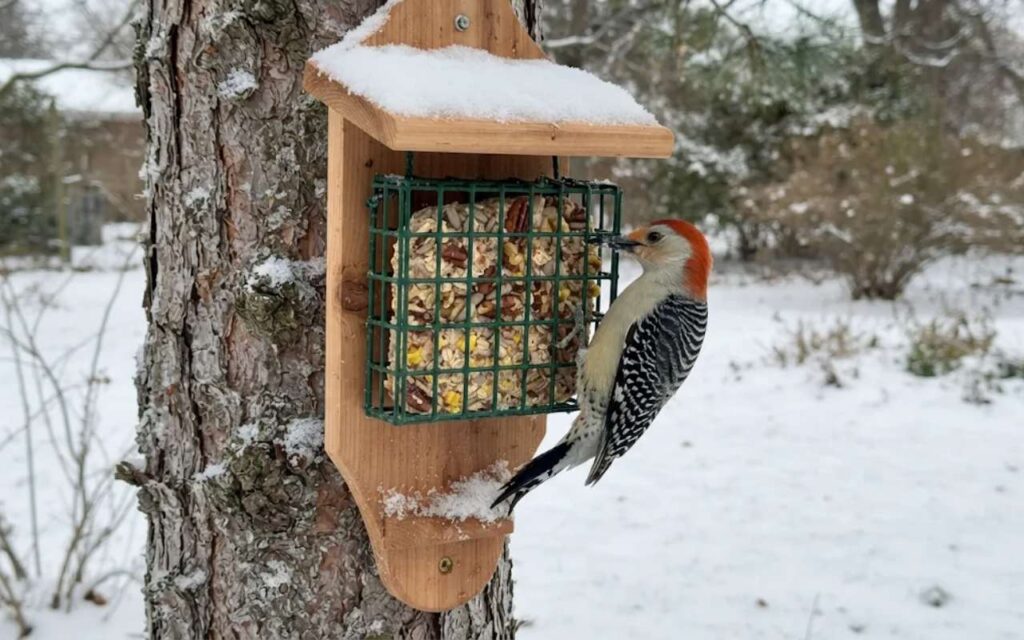
Making a high-fat woodpecker suet recipe gives Downy, Hairy, Red-bellied, and Pileated Woodpeckers the dense animal fats and tree nuts they need for winter foraging.
Unlike commercial suet bricks loaded with cheap corn and red milo fillers, this double-rendered beef suet formula binds chopped pecans, walnuts, and sunflower hearts into a firm, crumble-free cake.
You can batch-render five 10-ounce suet cakes in about an hour using raw beef kidney fat and basic dry pantry staples.
Prep Time: 15 mins | Cook Time: 45 mins | Chill Time: 4 hours | Yield: 5 standard 4.5-inch suet cakes (~10 oz each)
Quick-Glance Field Summary
Formulating a woodpecker-specific suet cake requires rendering raw beef suet twice to remove moisture and impurities before folding in coarse cornmeal, tree nuts, and hulled seeds.
Pressing the warm mixture firmly into silicone molds and chilling until solid creates a rock-hard winter block designed for daytime temperatures below 70°F (21°C).
- Primary fat base: 2 cups double-rendered beef suet (yielded from ~1.5 lbs raw beef kidney fat)
- Nut protein binder: 1 cup natural, unsalted creamy or crunchy peanut butter (strictly xylitol-free)
- Structural dry grit: 2 cups coarse yellow cornmeal mixed with 1 cup old-fashioned rolled oats
- Woodpecker nut favorites: 1 cup finely chopped raw pecans and walnuts (unsalted)
- High-oil seed boost: 1 cup hulled black oil sunflower hearts and 0.5 cup dried mealworms
- Safe temperature window: Deploy strictly in cool autumn, winter, and early spring weather below 70°F (21°C)
- Feeder style: Standard wire suet cage with a 2-to-3-inch wooden tail-prop paddle at the bottom
Why Woodpeckers Prefer Double-Rendered Beef Suet Over Seed Mixes
Woodpeckers prefer double-rendered beef suet packed with chopped tree nuts because their long, barbed tongues and chisel-like bills are built to extract concentrated fats and insects rather than crack hard seed shells.
Rendering raw beef suet twice drives off residual water and blood proteins, producing a pure, odor-free white fat that resists spoiling and stays firm during outdoor cold snaps.
According to bird-feeding guidance from the Cornell Lab of Ornithology, suet provides an essential high-energy fat source that attracts insect-eating species like woodpeckers, nuthatches, and creepers that rarely visit standard seed tubes.
Never substitute salty bacon grease, turkey drippings, or liquid vegetable oils; liquid grease smears onto avian feathers, ruining their natural insulation and waterproofing.
Gather your heavy saucepan, fine-mesh strainer, and dry ingredients before melting your fats.
- 2 cups double-rendered beef suet (yielded from roughly 1.5 lbs of raw chopped beef kidney fat)
- 1 cup natural, unsalted peanut butter (verified 100% free of xylitol/birch sugar and added salt)
- 2 cups coarse yellow cornmeal (eliminates stickiness and adds digestible grit)
- 1 cup old-fashioned rolled oats (do not use flavored instant oatmeal packets)
- 1 cup finely chopped raw pecans and walnuts (strictly unsalted)
- 1 cup hulled black oil sunflower hearts
- 0.5 cup dried mealworms (adds extra insect protein that Pileated and Red-bellied Woodpeckers target)
Woodpecker Suet Fat & Binder Comparison
| Fat & Add-In Formula | Woodpecker Attraction | Warm-Weather Stability | Feather & Beak Safety |
|---|---|---|---|
| Double-Rendered Beef Suet + Pecans | Highest (Mimics Larvae Fat) | Winter Only (Below 70°F Cutoff) | 100% Safe (Zero Moisture/Grease) |
| Vegetable Shortening + Cornmeal | Good (Downy & Hairy Visits) | Mild Weather (Up to ~75°F) | Safe (Plant-Based Binder) |
| Bacon Grease / Liquid Drippings | Moderate (High Salt Risk) | Fails (Smears & Melts Rapidly) | Hazardous (Mats Plumage/Hypothermia) |
How to Make Woodpecker Suet Step by Step
To make homemade woodpecker suet that holds together under heavy pecking, render raw beef fat slowly over low heat, strain out solids, stir in peanut butter and coarse dry grains, pack the warm dough tightly into silicone molds, and freeze for four hours.
Compressing the mixture firmly removes internal air pockets that cause cakes to fracture when large woodpeckers hammer at them.
- Step 1: Chop 1.5 pounds of raw beef kidney suet into small 1/2-inch cubes (or ask your butcher to grind it) and place it in a heavy-bottomed saucepan over low heat.
- Step 2: Render the fat slowly for 25 to 30 minutes, stirring occasionally until the fat melts completely into clear liquid tallow without smoking or browning, then pour it through a fine-mesh strainer lined with cheesecloth to remove solid cracklings.
- Step 3: Cool the strained liquid suet for 15 minutes until opaque and slightly thickened, then re-warm gently over low heat for 5 minutes—this second heating (“double rendering”) drives out any remaining trace moisture for a harder, shelf-stable cake.
- Step 4: Whisk 1 cup of natural, xylitol-free peanut butter into the warm liquid suet until smooth and fully incorporated.
- Step 5: Fold 2 cups coarse yellow cornmeal, 1 cup rolled oats, 1 cup chopped pecans and walnuts, 1 cup hulled sunflower hearts, and 0.5 cup dried mealworms into the fat mixture until every grain is coated.
- Step 6: Compress the thick paste firmly into five 4.5-inch square silicone molds, pressing down hard with a flat metal spatula to eliminate air gaps.
- Step 7: Freeze the filled molds for at least 4 hours until rock-solid, then unmold and wrap extra bricks in wax paper for freezer storage up to 3 months.
Choosing the Best Tail-Prop Feeder for Large Woodpeckers
Mount your homemade suet cakes inside a tail-prop suet feeder featuring a 2-to-3-inch wooden paddle extending below the wire basket so larger woodpeckers can brace themselves comfortably while eating. Unlike chickadees and nuthatches that cling effortlessly to small wire squares, Hairy, Red-bellied, and Pileated Woodpeckers rely on stiff, pointed tail feathers to prop their body weight upright against tree trunks.
- Downy Woodpeckers (6.5 inches): Comfortably use standard 4.5-inch square wire cages without a paddle.
- Hairy & Red-bellied Woodpeckers (9 to 10 inches): Strongly prefer a feeder with at least 3 inches of solid wood below the cage to support their tail tips.
- Pileated Woodpeckers (16 to 19 inches): Require a heavy-duty double-cake tail-prop cedar feeder mounted securely to a thick tree trunk or 4×4 wooden post so the basket does not swing wildly when they strike it.
Validated Backyard Woodpecker Target Species
- Downy Woodpeckers and Hairy Woodpeckers
- Red-bellied Woodpeckers and Golden-fronted Woodpeckers
- Pileated Woodpeckers
- Northern Flickers (especially drawn to the mealworm and cornmeal base)
- Yellow-bellied Sapsuckers (late autumn and early spring migrants)
Safe Temperature Limits, Mold Prevention, and Starling Deterrence
Serve homemade beef suet strictly when daytime temperatures stay below 70°F (21°C), sanitize wire cages between refills, and switch to an upside-down feeder if invasive starlings swarm your yard. Warm weather softens animal tallow rapidly, which can coat bird feathers in rancid grease and seal pores on incubating eggs during nesting season.
While properly rendered beef tallow has a higher melting point than vegetable shortening, using 70°F (21°C) as your conservative seasonal cutoff prevents oil separation and bacterial spoilage; during warm summer months, switch to commercial no-melt suet cakes or a shortening-and-cornmeal summer log.
Wildlife feeding guidelines from the National Audubon Society emphasize cleaning feeders regularly to prevent mold and disease transmission. Between every cake refill, scrub your wire suet basket with dish soap and warm water, soak it in a 1:9 household bleach-to-water solution (1 part bleach to 9 parts water) for 10 to 15 minutes, rinse thoroughly with clean water, and air-dry completely before inserting a fresh brick.
If European Starlings or House Sparrows monopolize your vertical feeder, hang an upside-down suet cage beneath a branch or baffle. Woodpeckers, chickadees, and nuthatches hang inverted with ease to peck upward through the bottom grid, whereas starlings lack the foot strength and balance to feed upside down.