
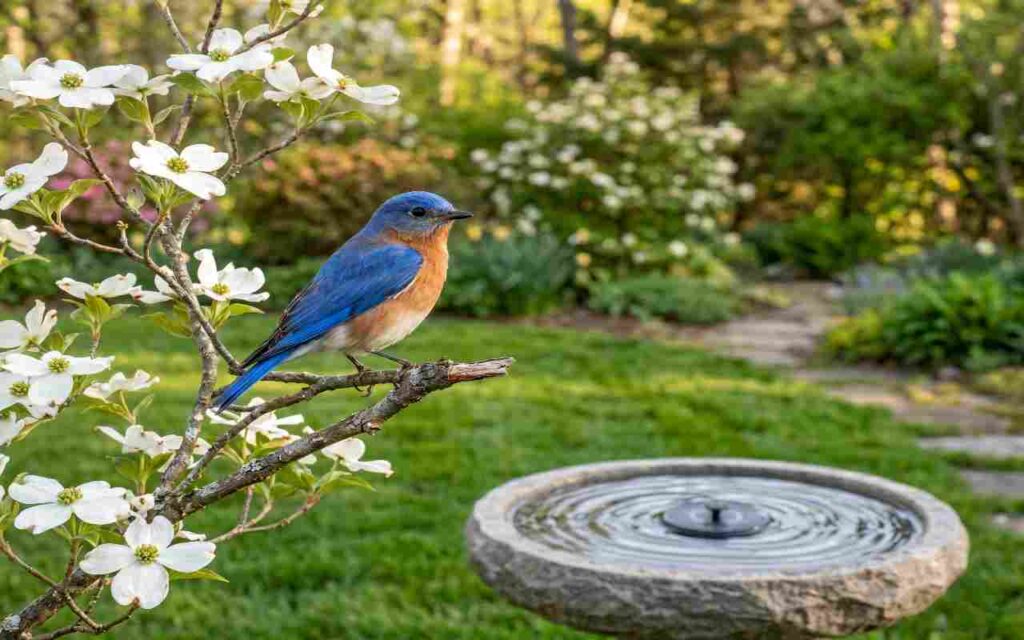
Eastern Bluebirds are among the most sought-after species in North America, yet they are notoriously particular about their environment. For homeowners learning how to attract Eastern Bluebirds to your yard, success requires moving beyond standard seed mixes. These birds demand a specific habitat blueprint of specialized food types, native plant structures, and acoustic water features before they will commit to a territory.
This guide provides a total habitat audit covering food, plants, water, and winter survival. Each section is organized to answer the most critical biological questions, providing the “Forensic” depth required for long-term success. If you are already managing a nesting site and want the advanced placement math, see our dedicated guide on how to attract Eastern Bluebirds to a birdhouse.
Quick Answer: The 3-Pillar Formula for Attracting Bluebirds
To attract Eastern Bluebirds, you must provide a “Full Lifecycle Habitat” consisting of three non-negotiables: Moving Water (acoustic attraction), High-Protein Live Prey (mealworms for recruitment), and Native Berry-Producing Shrubs (winter survival). While birdhouses are critical for nesting, bluebirds choose yards based on total foraging quality, safety, and a 100% pesticide-free “insect cafeteria.”
Attracting Eastern Bluebirds: The Forensic Habitat Blueprint Video
While understanding individual components like native plantings and moving water is essential, seeing the “Forensic Habitat Blueprint” in action provides the ultimate clarity for your backyard conversion. Watch the technical breakdown below to see how these environmental variables, including Acoustic Water Signaling and insect-heavy foraging zones, interact to recruit and retain a successful breeding pair.
Show Transcript:
0:00
For years, I looked out at my backyard feeling frustrated. I had premium sunflower seeds, high-quality suet, clean bird baths, and feeders packed with finches, cardinals, and woodpeckers. But the one bird I desperately wanted to attract, the eastern bluebird, never showed up.
0:24
This explainer follows my journey of trial and error and how I finally transformed my empty yard into a thriving eastern bluebird habitat filled with returning generations of bluebirds.
0:36
As I dug into the research, I realized eastern bluebirds are not typical feeder birds. They have highly specialized biological needs and will not respond to the standard backyard bird setup that works for finches, sparrows, and chickadees.
0:59
Every detail in my yard mattered. I was trying to force a specialized insect-eating bird into a generic seed-feeding environment, and it simply was not going to work.
1:11
The breakthrough came when I discovered the three-pillar formula for attracting bluebirds. Moving water, live high-protein insects, and native berry-producing plants. These three elements create a complete bluebird life-cycle habitat.
1:35
At first, I offered sunflower seeds, millet, and cracked corn. Then I learned eastern bluebirds physically cannot crack hard seeds. Their slender bills are designed for catching insects, not breaking seed shells like finches and sparrows.
2:01
I realized I was offering food they literally could not eat. Research on more than 800 bluebirds showed their diet is roughly 68% insects and only 32% berries and fruit.
2:34
That discovery completely changed my feeding strategy. I stopped using traditional bird seed and focused on insects instead.
2:42
My first attempt was dried mealworms, but the bluebirds ignored them. I soon learned eastern bluebirds are visual hunters that react to movement. Motionless dried worms do not trigger their hunting instincts.
3:01
So I switched to live mealworms placed in escape-proof dishes. The response was immediate. Bluebirds began striking at the moving prey almost instantly.
3:13
During breeding season from March through July, I provided roughly 100 mealworms daily for each nesting pair to support their high protein demands.
3:31
Then I discovered another critical detail through nesting research. About 40% of food delivered to bluebird chicks consists of caterpillars. Nestlings need soft-bodied insects for muscle and feather development.
3:56
That realization changed my landscaping plans completely. I planted native oak and cherry trees to naturally support caterpillars and create a sustainable insect food source for nesting bluebirds.
4:12
Even after solving the food issue, passing flocks still ignored my yard. That led me to another discovery. Bluebirds locate water sources by sound, not sight.
4:29
A still bird bath is almost invisible from the air. Moving water creates splashing sounds that attract birds flying overhead through thick vegetation.
4:44
I added a solar dripper to my bird bath to create continuous movement and sound. I also kept the water shallow and added a nearby perch so birds could safely dry their feathers after bathing.
5:08
Once I added moving water and proper perches, bluebirds finally started landing in my yard regularly.
5:16
Getting them to visit was one challenge. Getting them to nest was another. I replaced decorative birdhouses with scientifically designed eastern bluebird nest boxes.
5:31
The ideal bluebird house requires a precise 1.5-inch entrance hole to exclude larger birds like European starlings. The interior dimensions must also balance warmth, airflow, and predator protection.
5:42
I mounted untreated cedar nest boxes on smooth metal poles with predator baffles and removed exterior perches, which only help invasive birds and predators.
6:01
Then I discovered the harsh reality of nest competition. House sparrows aggressively attack eastern bluebirds, destroy eggs, kill nestlings, and take over nest boxes.
6:22
To protect bluebirds, I had to monitor nest boxes every five to seven days and remove invasive house sparrow nesting material immediately.
6:39
Another major lesson involved pesticides. I established a strict 300-foot pesticide-free zone around active nest boxes because eastern bluebirds rely heavily on live insects.
7:07
Broad-spectrum insecticides wipe out caterpillars, beetles, and other prey, creating a biological desert where bluebird parents cannot find enough food for their chicks.
7:25
Once my bluebirds began breeding successfully, I faced a new challenge: helping them survive winter. That is when I created a seasonal planting strategy using native berry-producing shrubs and trees.
7:40
Serviceberry supported adults during nesting season. American elderberry provided food in late summer. Flowering dogwood supplied high-fat berries in fall, while eastern red cedar sustained birds through winter.
8:02
I also planted sumac as an emergency winter food source. Bluebirds usually ignore sumac berries until severe weather buries all other food sources under snow and ice.
8:36
During brutal winter cold snaps, I supplemented natural foods with homemade high-calorie suet made from peanut butter, cornmeal, and rendered fat.
8:54
I cleaned nest boxes in late fall but left them open because eastern bluebirds often use them as winter roosts. Multiple birds huddle together inside to conserve heat on freezing nights.
9:19
This hobby became deeply personal when I learned eastern bluebird populations declined by nearly 90% in some areas during the twentieth century due to habitat loss and invasive species.
9:38
Conservation efforts by everyday backyard birders helped reverse those declines through nest box programs and habitat management.
9:45
Today, my yard supports multiple generations of eastern bluebirds. Returning pairs nest successfully, and young birds raised in my boxes establish territories nearby.
10:02
With live mealworms, moving water, native plants, and properly designed nest boxes, I transformed my property into a true bluebird conservation habitat.
10:12
If you want to attract eastern bluebirds, support native bird populations, and create a thriving backyard bird sanctuary, the secret is building a complete life-cycle habitat instead of simply putting out bird seed.
What Do Eastern Bluebirds Eat at Feeders?
Eastern Bluebirds are primary insectivores and will not eat standard birdseed. Sunflower seeds, millet, corn, and safflower are ignored entirely. To attract them to a feeder, you must offer live or dried mealworms, crumbled suet, or chopped fruit.
The Protein Priority: Why Bluebirds Cannot Crack Seeds
The Eastern Bluebird’s bill is slender, gently curved, and adapted for snatching soft-bodied invertebrates from the ground, not for cracking hard seed coats. The jaw musculature that seed-eating finches and sparrows use to apply cracking force is not present in bluebirds. Their entire feeding apparatus is optimized for the capture and delivery of caterpillars, grasshoppers, beetles, and spiders.
Research published in Ornithology (Oxford Academic) on food supplementation and gut microbiome diversity in Eastern Bluebirds confirmed that nestlings are fed almost exclusively invertebrates, with plant material comprising only 3 percent of food items delivered.
The study notes that plant material is likely avoided for nestlings specifically because of its low protein content relative to the muscle and feather development demands of growing chicks.
A USBS study of 855 Eastern Bluebirds, documented in the University of Michigan’s Animal Diversity Web account for the species, found that insects comprise 68 percent of the bluebird diet overall across all seasons, with berries and fruit making up the remainder primarily in fall and winter.
Live vs. Dried Mealworms: The Recruitment Difference
Live mealworms are significantly more effective than dried mealworms for initial recruitment of Eastern Bluebirds to a new feeder. Bluebirds are visually triggered hunters: they scan from a perch and launch on movement.
A live mealworm that is crawling in the feeder dish registers as prey in a way that a motionless dried worm does not. Bluebirds that have never encountered a mealworm feeder before will often ignore dried worms entirely until trained, while live worms elicit an immediate predatory response.
According to the North American Bluebird Society’s mealworm feeding guide, bluebirds prefer live food, and live mealworms are also the only appropriate option for nestlings because they provide moisture that dried versions lack.
The guide recommends offering approximately 100 mealworms per day per pair, split between a morning and afternoon offering, positioned in a dish the birds can access but mealworms cannot escape from.
Once a pair is established at a feeder, they can be gradually transitioned toward rehydrated dried mealworms mixed with live ones during non-breeding periods, though live should always be offered during nesting season.
The “Tuna Can Hack”: A DIY Bluebird Feeder Strategy
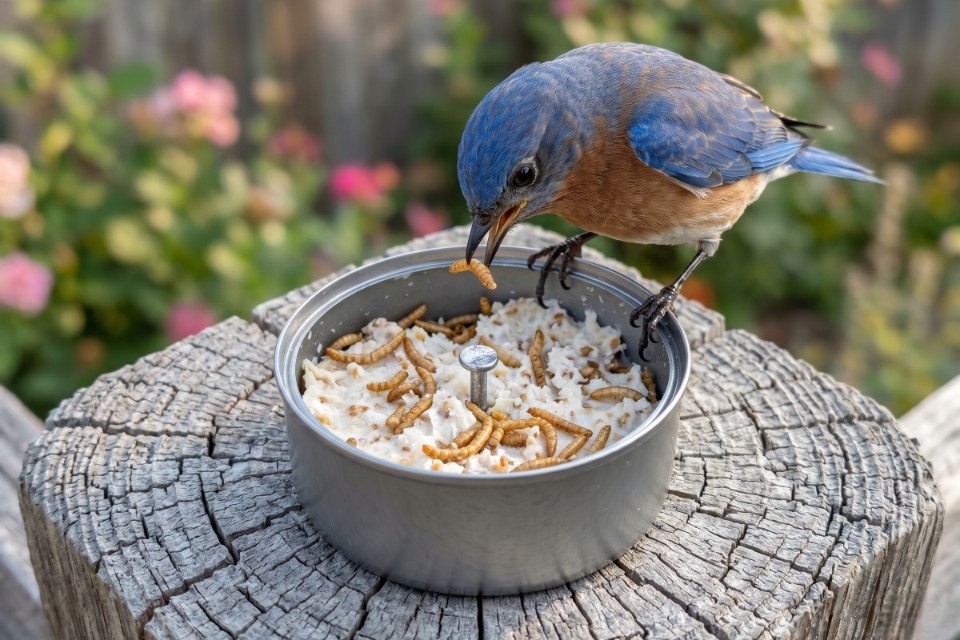
One surprisingly effective DIY feeding method combines unlikely materials into a high-performance foraging station. Learning how to attract bluebirds with a tuna can and a nail is a technique that works because it mimics their natural biological preference for small, elevated “pocket” feeding.
The Setup:
Take a clean, shallow tuna can and fill it with high-energy suet or softened peanut butter mixed with dried fruit and insects. Drive a finishing nail through the center of the can and into a wooden fence post or a dedicated “scouting perch” limb. Mount the can in a visible, open location near the trees where bluebirds commonly scout for prey.
For a detailed biological breakdown tracking seasonal insect-to-berry consumption metrics and critical digestive enzyme adaptations, review our specialized field study: What Do Eastern Bluebirds Eat? The Forensic Nutritional Blueprint.
The Forensic Advantage:
The genius of this design lies in its size-restricted geometry. The shallow rim and small diameter create a feeding zone that is difficult for larger, aggressive competitors like Blue Jays or Starlings to monopolize.
Why This Works:
- 360-Degree Visibility: Unlike deep box feeders, the tuna can allows bluebirds to maintain full peripheral vision while eating, satisfying their instinctual need to watch for ambush predators.
- Thermal Softness: The metal can slightly warms in the sun, keeping suet at a consistency that bluebirds, who lack the heavy beaks of seed-eaters, can easily digest.
- Psychological Security: The low-profile design provides a sense of security while offering the high-fat “soft foods” they require for winter survival and breeding energy.
This low-tech, high-reward hack is an elite recruitment tool. However, once you have successfully pulled bluebirds into your territory, you must ensure your nesting hardware meets their forensic standards for long-term success. For the advanced specifications required to keep a pair through the season, see our technical guide to bluebird house placement.
The Recruitment Window: March to July
Mealworm feeding is most impactful from March through July, aligned with the Eastern Bluebird’s breeding season and the period when both adults and nestlings have the highest protein demand. Early March feeding helps attract prospecting pairs before they commit to a territory. Peak feeding from May through June supports active nesting.
A late-season pulse through July covers second and sometimes third brood attempts, when natural insect availability can fluctuate with weather. Reducing or stopping supplemental feeding after late July lets birds develop normal seasonal foraging independence before winter.
What Plants Attract Bluebirds to a Backyard?
The best plants for attracting Eastern Bluebirds are native, berry-producing species that retain fruit through winter, specifically Flowering Dogwood, Eastern Red Cedar, and American Elderberry. These provide emergency food during the months when insects are unavailable and form the backbone of a year-round bluebird habitat planting scheme.
The Winter Survival Relay: A Seasonal Plant Calendar
A properly designed bluebird planting scheme staggers fruit availability across the full year. Serviceberry (Amelanchier spp.) produces fruit in late spring and early summer, coinciding with peak nesting season and giving adults a fruit supplement during the period of highest caloric demand. American Elderberry ripens in mid to late summer and bridges the gap before fall berries begin.
Flowering Dogwood provides high-fat fruit in fall, with a documented 24 percent fat content per berry that makes it one of the most energy-dense native fruit sources available to overwintering birds.
Eastern Red Cedar holds its berries through winter and into early spring, functioning as a last-resort food source during the months when no other fruit remains. Together these four species provide continuous fruit availability from May through March across most of the Eastern Bluebird’s range.
Sumac: The Starvation Food That Saves Lives
Staghorn Sumac and Smooth Sumac are documented last-resort winter foods for Eastern Bluebirds and several other frugivorous species. Sumac berries are lower in fat and less palatable than dogwood or cedar, which is why birds leave them until other options are exhausted.
During severe late-winter ice storms that coat other food sources in ice or bury them under snow, sumac’s persistent upright seed clusters remain accessible above the snow surface and provide emergency calories when nothing else is available.
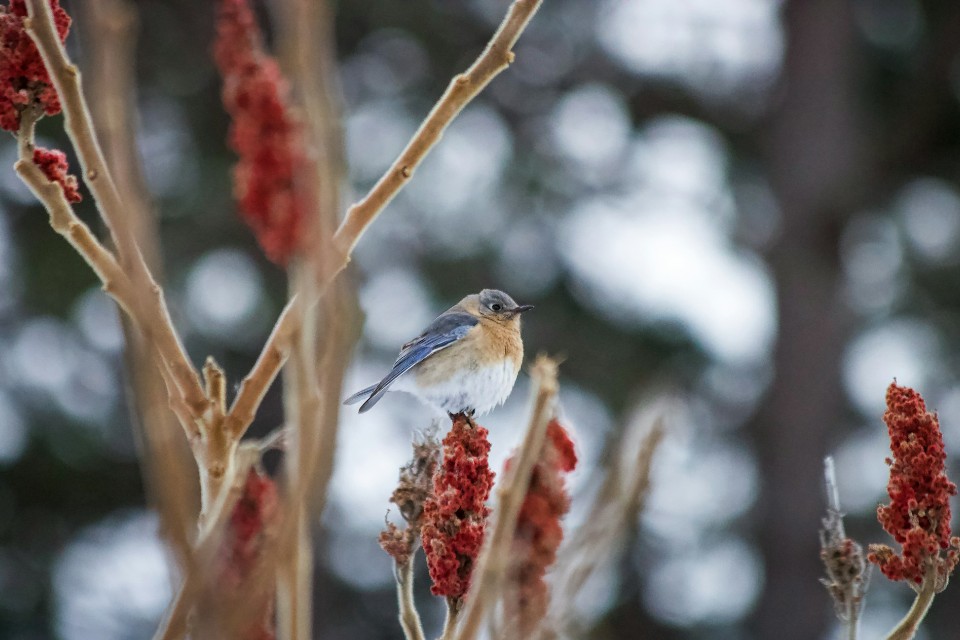
Planting a native sumac at the edge of the yard is a direct investment in bluebird winter survival during the worst weather events of the year.
The Insect Cafeteria: Native Oaks and Cherries as Larval Factories
A four-year study published in The Wilson Journal of Ornithology, based on camera-trap monitoring of 38 Eastern Bluebird broods in New Castle County, Delaware, and a review of 8,128 nest provisioning visits, found that caterpillars (larval Lepidoptera and Symphyta) were the predominant prey delivered to nestlings.
This pattern was consistent across years, sexes, and both early and late broods, highlighting caterpillars as a core food source during the breeding season.
Eastern Bluebirds fed caterpillars to nestlings approximately 40 percent of the time, with caterpillars, grasshoppers, and spiders accounting for roughly 80 percent of all food delivered to 38 monitored broods.
Native oaks, cherries, and willows host far more caterpillar species than non-native ornamentals of similar size. A single native oak supports hundreds of moth and butterfly larval species, while a non-native ornamental tree of equivalent size may support fewer than a dozen.
Adding even one native oak or cherry to a bluebird yard measurably increases the insect prey base within the foraging range of a nesting pair.
How Do You Get Bluebirds to Notice Your Yard?
The fastest way to attract a prospecting bluebird flock to your yard is with moving water. A birdbath equipped with a solar dripper or wiggler produces the sound of splashing water that bluebirds can detect from a distance and that triggers an immediate investigation response. A static bath may go unnoticed by a flock passing overhead; a moving water source is acoustically visible in a way that standing water is not.
The Acoustic Signal: Why Sound Beats Sight for Water Discovery
Bluebirds scout potential territories and stopover sites primarily from elevated perches and in flight. A static birdbath is detectable only within direct visual range and only in good light. Moving water produces broadband splashing sounds that travel through vegetation and carry well at distance, alerting birds that water is present before they can see it.
Eastern Bluebirds are documented to prefer running water over standing water, a preference noted in the University of Michigan’s Animal Diversity Web species account, and this preference is reflected in their rapid response to drippers and misters versus standard still baths.
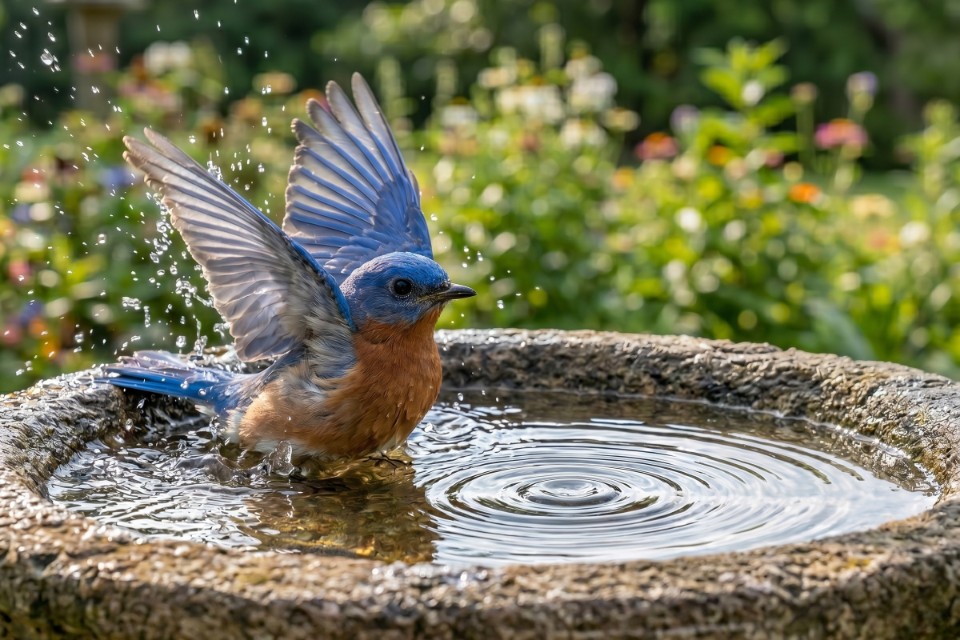
Solar-powered drippers that produce a continuous slow drip into a standard pedestal bath require no wiring, operate on any sunny day, and produce the most naturalistic water sound of any commercially available moving-water option.
A simple plastic bottle with a pinhole in the cap, hung over the bath on a stake or bracket, produces the same acoustic effect at essentially zero cost. For full technical specifications on providing water for bluebirds through summer heat, see our article on how to keep birds hydrated during summer heat.
Bath Specifications: Depth, Footing, and the Drying Perch
An Eastern Bluebird bath should be one to two inches deep at the center, with sloped sides and a textured or graveled floor. Bluebirds are not deep-water bathers. They require a gradual approach to the water rather than a steep drop-off, and they need secure footing to stand while they bathe.
A nearby branch or stake within five to ten feet of the bath serves as the essential drying perch: bluebirds typically fly to an elevated perch immediately after bathing to preen and dry before resuming normal activity.
A bath placed in open sun with no nearby perch cover will be used less frequently than one positioned with a clear perch in proximity and shrub cover within easy flight distance.
What Is the Best Birdhouse for Eastern Bluebirds?
A functional Eastern Bluebird nest box must be made of untreated wood such as cedar or pine, have a round entry hole of exactly 1.5 inches, and have no exterior perch. It must be mounted on a freestanding smooth metal pole, not on a tree or fence, to enable effective predator exclusion with a stovepipe or cone baffle.
Box dimensions matter for thermoregulation as much as for fit. An interior floor of approximately four by four inches is the standard specification because it is snug enough to retain heat during cool spring nights without creating a heat trap in summer. The interior front wall below the entry hole should be scored to give fledglings grip for climbing.
While basic box dimensions are critical, the exact geometry of where you place the box determines whether a pair will stay through multiple broods. For the technical math on flight paths and predator reach, see our Forensic Bluebird Placement Guide.
Why Are Bluebirds Disappearing from My Yard?
The three most common causes of bluebird abandonment in a yard that previously held a pair are pesticide use that eliminates the insect food base, predator pressure from cats or raccoons at the nest box, and competitive takeover of nest boxes by House Sparrows or European Starlings.
The Chemical Desert Problem: How Pesticides Remove the Food Base
Eastern Bluebirds depend entirely on live invertebrates for nestling provisioning. A lawn or garden treated with broad-spectrum insecticides eliminates the grasshoppers, beetles, caterpillars, and soil invertebrates that constitute the bluebird’s prey base within foraging range of the nest. The effect is not always immediate or visible.
A pair may begin nesting and then progressively reduce provisioning frequency as insect availability drops below the threshold needed to sustain nestlings, resulting in stunted growth, delayed fledging, or brood failure without any obvious visible cause.
Eliminating all pesticide use within approximately 300 feet of an active nest box is the single most important habitat quality action available to most suburban backyard managers.
This includes not only insecticides applied directly to the lawn but also systemic pesticides applied to trees and shrubs that persist in plant tissue and kill caterpillars weeks after application.
Neonicotinoid-treated plants sold at standard garden centers are a particularly underrecognized issue: a plant purchased at a nursery may remain toxic to leaf-feeding insects for a full growing season or more after planting.
Invasive Lockout: House Sparrows and Starlings
House Sparrows are the primary nest box competitor for Eastern Bluebirds across most of the species’ range. A House Sparrow that takes over a bluebird box does not simply occupy it: it will destroy bluebird eggs, kill nestlings, and build its own nest on top of bluebird nest material within the same box.
Unlike European Starlings, which are excluded by a correctly sized 1.5-inch entry hole, House Sparrows are small enough to enter any hole that admits a bluebird. Active monitoring every five to seven days during nesting season and immediate removal of House Sparrow nests is the only effective management strategy.
For a full breakdown of how House Sparrows exploit nest cavities, see our article on house sparrow nesting habits in urban areas. For context on European Starling cavity competition, see our article on European starling nesting habits.
How Can I Help Bluebirds Survive Winter?
To support Eastern Bluebirds through winter, provide high-energy fat-based foods and maintain a heated or frequently refreshed water source. Bluebird suet nuggets made from peanut butter, cornmeal, and rendered fat provide concentrated calories that partially compensate for reduced insect availability. Leaving nest boxes up and accessible through winter gives resident bluebirds a thermal roost on cold nights.
Roosting Boxes: Thermal Insulation on Frozen Nights
Eastern Bluebirds are not migratory across much of their range and frequently overwinter in loose flocks that roost communally in cavities on cold nights. A nest box left up and clean through winter provides a thermal microenvironment that can be significantly warmer than ambient air temperature when multiple birds roost together inside it.
Multiple bluebirds roosting in a single box on a very cold night is a documented behavior and one that the availability of nest boxes directly enables. Cleaning the box in late fall, removing old nesting material that could harbor parasites, and leaving the entry hole unobstructed ensures it is available and safe for winter roosting use.
A second box mounted within 50 to 100 feet of the primary breeding box gives roosting birds an alternative shelter option and reduces competition for the single cavity on the coldest nights, when multiple birds may attempt to roost simultaneously.
The DIY Winter Feeder: Peanut Butter Suet for Cold Snaps
A simple homemade suet mixture of one part peanut butter, four parts cornmeal, and a small amount of rendered beef fat or coconut oil can be pressed into a shallow open dish or log feeder and offered during winter cold snaps as a high-calorie supplement. Bluebirds will take suet in winter, particularly in the weeks following an ice storm when berry supplies are depleted and insect foraging is impossible.
The mixture should be offered in small amounts in a dish positioned in partial shade so it does not melt into an unworkable paste during warm winter days. Refreshing it every two to three days during active use prevents it from becoming rancid.
Attracting Bluebirds to Your Yard: The Habitat Blueprint Summary
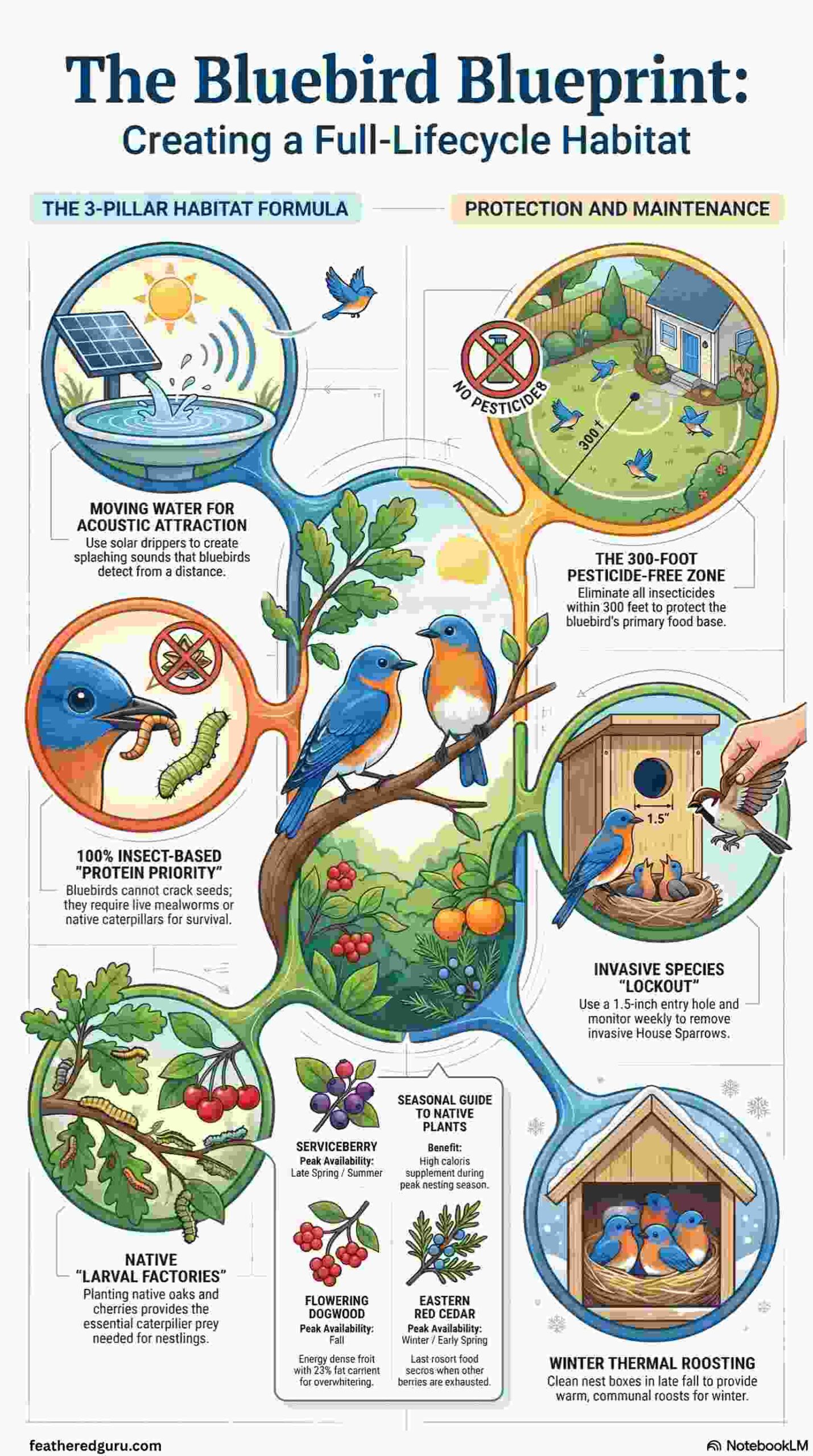
To successfully transform a suburban yard into a productive bluebird territory, you must align every environmental variable with the species’ biological requirements. The infographic below provides a Forensic Habitat Summary, illustrating the critical relationships between acoustic water signals, native “larval factory” trees, and the winter survival plantings needed to recruit and keep bluebirds in your yard year-round.
Conclusion: The Multi-Brood Yard as a Conservation Station
A yard built to the specifications described in this article does more than provide a bird-watching opportunity. It functions as a conservation station. Eastern Bluebird populations declined by an estimated 90 percent in some regions during the twentieth century before organized nest box programs and habitat management reversed the trend. Every successful bluebird breeding season in a managed backyard contributes directly to that recovery.
When the food base is intact through native plantings, the water source is accessible and moving, the nest box is correctly placed and defended, and pesticides are absent, a bluebird pair will typically return to the same territory in successive years. Young birds fledged from a well-managed yard have a measurably higher survival rate and are more likely to establish breeding territories of their own within a few kilometers of their natal site.
The pair you attract this spring may establish a lineage that uses your yard for a decade. The investment is a few mealworms, a correctly placed box, a dripper, and a native plant or two. The return is a measurably stronger local breeding population of one of North America’s most visually striking birds.
For more on managing invasive species that compete with bluebirds, see our article on invasive backyard birds and our guide to Eastern Bluebird fun facts.