
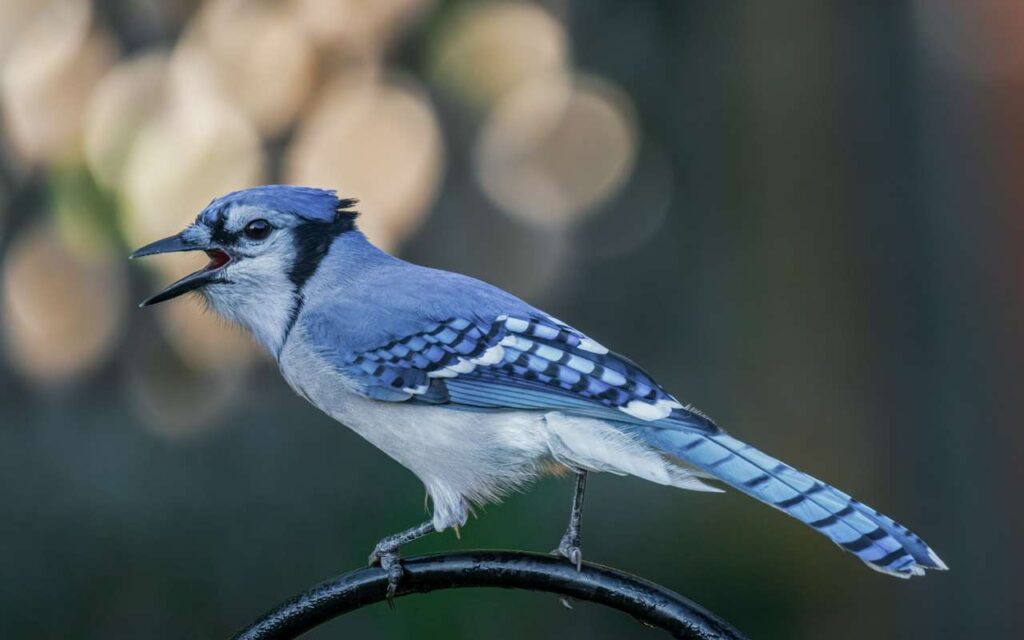
A harsh scream echoing from your highest oak tree branch instantly signals a highly strategic territory battle playing out right above your lawn. Tuning your ears to decode blue jay calls and songs reveals a hidden backyard communication system where every loud broadcast protects a family border or announces a looming threat.
While casual observers treat these daily melodies as simple morning background noise, these intelligent corvids rely on separate acoustic layers to manage their immediate survival. Separating their loud public anthems from their quiet nesting whispers allows you to confidently translate every private conversation playing out across your property lines.
Fastest Ways to Identify Blue Jay Sound Meanings
Identify high-alert situations by listening for a rapid, piercing “jay! jay!” scream, which acts as a public alarm to warn the entire neighborhood about circling hawks or incoming ground predators.
In contrast, quiet rattling clicks and whisper melodies signal calm pair interactions inside thick tree canopies, providing a private contact layer that stays hidden from competing species.
Video Explainer for Blue Jay Communication Behaviors
This animated whiteboard walkthrough illustrates the precise acoustic frequencies, vocal mimicry habits, and territorial behavioral contexts used to track corvid language patterns. Reviewing these visual steps allows backyard birdwatchers to easily separate harsh public alarm warnings from quiet social contact whispers under varying field conditions.
📝 View Video Timeline & Key Takeaways
[00:00 – 01:29]: Decoding the famous, loud Blue Jay alarm call. Understanding its role as a neighborhood-wide avian security broadcast used to slice through environmental noise, announce flying hawks, defend territory boundaries, and rally mixed species to mob nearby yard predators.
[01:30 – 02:31]: Exploring the quiet, complex private voice of the Blue Jay. Contrasting the harsh public megaphone shouts with the soft, intricate whisper songs and murmur communications used exclusively at close range to reinforce family bonds and pairs.
[02:32 – 03:47]: Analyzing strategic vocal mimicry as a predatory evasion tool. Tracking how birds accurately replicate the screams of red-tailed hawks or house cat meows to terrify smaller songbirds and temporarily clear out packed seed feeders for solo foraging access.
[03:48 – End]: Your three-step backyard interpretation method. Training your ears to evaluate nasal tone quality, track repetitive rhythms, cross-reference environmental context, and leverage mobile identification databases like Merlin Bird ID to decode daily communication cycles.
Blue jay vocal repertoire is enormous for a bird that doesn’t actually sing. Let me explain that weird statement: blue jays belong to the corvid family along with crows, ravens, and magpies. Corvids are known for being smart, social, and extremely vocal, but most don’t produce what ornithologists technically classify as “song.” Instead, they rely on complex systems of calls to communicate.
Landmark bioacoustic field research published in The Wilson Journal of Ornithology Blue Jay Call Study demonstrates that these intelligent corvids maintain one of the most complex vocal repertoires of any North American bird. During an extensive master’s field analysis capturing nearly 50 hours of continuous audio, scientists tracked over 7,000 individual vocalizations using detailed spectrogram data.
This rigorous tracking data successfully identified 36 distinct vocal call types ranging from loud territorial alarms to highly localized flock dialects. These findings confirm that backyard corvids rely on a rich and flexible communication matrix to manage their ongoing social hierarchies across the country.
Blue jay communication relies on this diverse vocal toolkit because corvids are highly social birds with complex relationships. They need to convey specific information, danger type and location, food discoveries, territorial boundaries, mate coordination, and social status. Different calls serve different functions, and blue jays switch between them seamlessly depending on context.
Blue jay vocal mimicry is particularly fascinating. Research documented in a 2025 study on corvid mimicry found that blue jays can imitate red-tailed hawks, red-shouldered hawks, Cooper’s hawks, American crows, domestic cats, and even human whistles. This mimicry ability demonstrates the vocal learning capacity that makes corvids so intelligent.
Blue jays don’t just randomly copy sounds. They learn vocalizations from their parents and flock members, modify them throughout their lives, and even develop local “dialects” where blue jay populations in different regions sound slightly different. This learned vocal behavior is relatively rare in birds and indicates sophisticated cognitive processing. For more on blue jay intelligence, check out interesting facts about the blue jay.
The Classic “Jay! Jay!” Call
The blue jay alarm call is what everyone recognizes, that loud, harsh, raspy “jay-jay-jay!” or “jeer-jeer-jeer!” that rings through suburban neighborhoods. Technically called a “jeer call” by researchers, this vocalization is rich in harmonics and carries considerable distances. It’s designed to be heard.
Blue jay territorial call functions often overlap with alarm calling. According to the Cornell Lab of Ornithology’s comprehensive species account, jays use jeer calls when defending territory, when potentially threatened by humans or predators, during mobbing behavior, and sometimes just when flying between locations. Lone jays often render jeer calls even when not obviously interacting with other jays, possibly maintaining contact or announcing their presence.
Blue jay warning calls alert not just other blue jays but the entire bird community to potential threats. I’ve watched chickadees, titmice, and nuthatches all respond to blue jay alarm calls by freezing, seeking cover, or joining in mobbing efforts. Blue jays function as the neighborhood watch system, and their warnings benefit numerous species.
Mobbing calls specifically are rapid-fire, excited jeer calls given when blue jays have located a perched hawk, owl, or other predator. Multiple jays converge, calling loudly and sometimes dive-bombing the predator until it leaves. This behavior, while annoying for the predator, is highly effective at reducing predation pressure in an area.
The jeer call varies in pitch, tempo, inflection, and whether it’s mono-tonal (single note) or di-tonal (two-part note). A downwardly inflected “JEE-er” often appears during mobbing, while a shorter, mono-tonal “jaay” might indicate milder alarm or territorial defense. Experienced listeners can distinguish these subtle variations, though it takes practice.
The Rattle and Whisper Calls
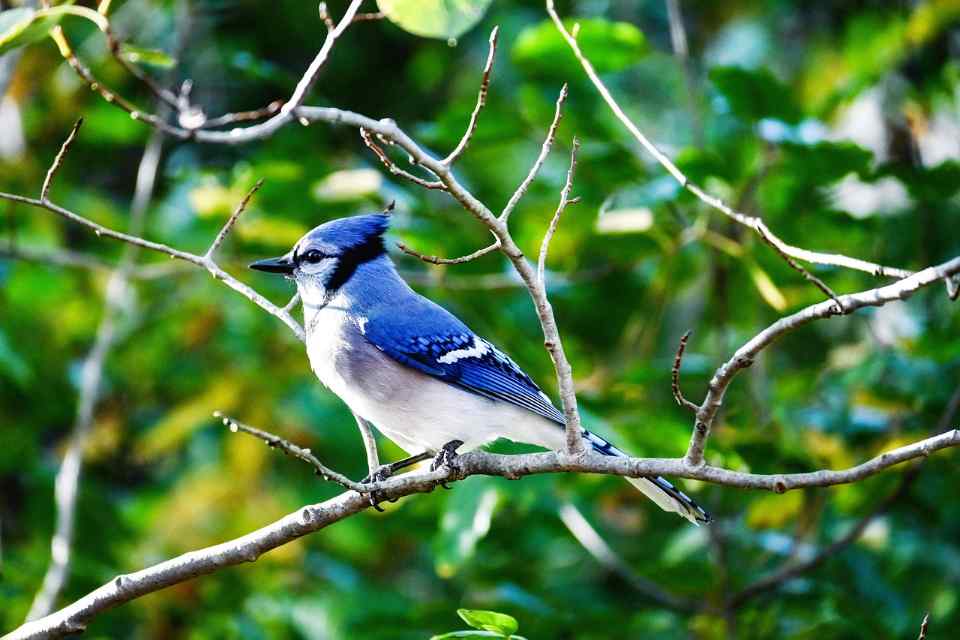
Blue jay rattling call is one of those sounds you hear constantly but rarely recognize as coming from blue jays. It’s a soft, clicking, mechanical rattle, like shaking a box of small stones. Jays use this call when relaxed, socializing, or moving through trees with flock members. It’s the complete opposite of the harsh jeer in every way.
Blue jay contact calls maintain cohesion between mates or family group members. These include the soft rattle but also various quiet notes that don’t carry far. Pairs use contact calls throughout the year to coordinate movements while foraging, during nest building, and when trading off incubation duties. They’re intimate communications not meant for broadcasting.
Blue jay whisper song is rarely noticed by casual observers because it’s so quiet and jays typically sing it from concealed perches. According to Birds of the World, whisper song is a soft, quiet conglomeration of clicks, chucks, whirrs, whines, liquid notes, and elements of other calls that can last over two minutes. It appears during courtship and pair bonding.
I first heard whisper song after reading about it and specifically listening for it near a known blue jay nest in early April. The male sat partially hidden in an oak, producing this bizarre medley of sounds, some musical, some mechanical, some mimicked from other species. It was so quiet I had to be within 15 feet to hear it clearly. This isn’t the performance vocal of birds trying to attract mates from distances; it’s intimate communication between already-bonded pairs.
These softer vocalizations reveal that blue jays aren’t constantly loud and aggressive. Much of their vocal behavior is actually quite subtle, though we rarely notice it because we’re not paying attention or the calls simply don’t carry to our ears. For tips on attracting blue jays where you can observe these behaviors, visit how to attract blue jays to your yard.
Mimicking Hawks and Other Birds
Blue jay mimicry of hawks is legendary, and honestly kind of hilarious once you know what’s happening. Blue jays produce remarkably accurate imitations of red-tailed hawks, red-shouldered hawks, Cooper’s hawks, and occasionally broad-winged hawks. Sometimes these mimics are nearly perfect; other times they’re slurred and obviously fake.
Blue jay hawk call imitation serves purposes that researchers still debate. The leading theories include: scaring competitor birds away from food sources (kleptoparasitism), warning their own flock about actual hawk presence, practicing vocalizations, or just because they can. According to research on blue jay vocalizations, most “imitations” are actually modulations of typical jeer calls rather than true mimicry, though some renditions are remarkably accurate.
Blue jay vocal learning enables this mimicry. Unlike birds with innate vocalizations, blue jays learn calls from environmental exposure. Young jays hear hawks screaming, adult jays imitating hawks, and other environmental sounds, then incorporate these into their own repertoires. This learned vocal behavior is cognitively sophisticated and characteristic of corvid intelligence.
I’ve watched blue jays clear platform feeders using hawk calls. A jay lands nearby, gives a red-tailed hawk scream, and every small bird scatters. The jay then casually flies down and eats whatever it wants. IMO, this is absolutely intentional manipulation, using mimicry to gain feeding advantages. Whether this behavior is learned socially or discovered individually isn’t entirely clear, but it’s definitely effective.
The quality of blue jay hawk mimics varies considerably. Some jays produce vocalizations so accurate that I’ve looked up searching for a hawk before realizing the source. Other attempts are obviously fake, the pitch is wrong, the inflection is off, or the call sounds slurred. According to the Audubon guide to bird mimics, real hawk screams are cleaner, louder, and more sustained than blue jay imitations, which often sound slightly hoarse or abbreviated.
Blue jay intelligence extends beyond simple vocal mimicry. Studies show corvids can solve complex problems, use tools, recognize individual humans, and plan for future events. Their sophisticated vocalizations reflect this cognitive capability, they’re not just making noise, they’re communicating specific, contextual information. For more on corvid family traits, see crow vs raven.
Beyond Hawks: The Bald Eagle Mimicry Target
Backyard tracking threads on r/birding have uncovered a fascinating geographic shift in corvid vocal target lists. While standard guides document jays imitating red-tailed or red-shouldered hawks to clear out crowded platform trays, homeowners across northern and coastal regions frequently report jays executing flawless imitations of wild Bald Eagles.
This advanced mimicry is highly effective at triggering immediate flight responses in local squirrels and larger blockader birds, allowing the clever jay to swoop down and steal abandoned nuts.
To separate a real eagle from an opportunistic mimic at your station, listen closely to the repetition cadence. A genuine bald eagle typically broadcasts its high, cackling chatter in sporadic, single bursts.
A mimicking blue jay almost universally delivers the imitation in rigidly grouped pairs or dual-burst intervals. Recognizing this specific acoustic modification allows you to identify the corvid’s audio illusion instantly before you ever scan the tree canopy with binoculars.
How Blue Jays Use Calls to Communicate
Blue jay communication behavior changes dramatically based on context, season, and social situation. The same individual jay uses different calls for mate bonding, territorial defense, foraging coordination, predator warnings, and offspring care. Understanding these contexts helps decode what jays are actually communicating.
Blue jay social signals include body language combined with vocalizations. A raised crest plus jeer calls indicates aggression or alarm. A flattened crest with soft contact calls suggests relaxation and social bonding. Tail-fanning combined with specific calls functions in courtship displays. Vocalizations rarely occur in isolation, they’re part of multimodal communication systems.
Blue jay family calls coordinate parenting duties. According to research, females may give specific contact calls from the nest to signal the male to bring food. Males and females use quiet calls to communicate during incubation changeovers. Both parents give specialized calls to nestlings that differ from adult-directed communication.
Juvenile blue jay calls sound softer, higher-pitched, and more nasal than adult calls. Fledglings give constant begging calls, raspy, insistent vocalizations that parents apparently find irresistible because they keep feeding demanding juveniles for weeks after fledging. Young jays gradually develop adult vocal repertoires through learning and practice, with full vocal competence reached by their first spring.
Call types also signal individual identity, allowing birds to recognize specific flock members by voice alone. This sophisticated level of auditory recognition directly facilitates complex social relationships and structural hierarchies within regional populations.
Consequently, the birds visiting your backyard feeding stations easily recognize each other as distinct individuals and maintain ongoing social dynamics that humans rarely perceive. Young jays gradually internalize these unique vocal signatures over time, reaching full communication competence by their first breeding spring.
Seasonal Changes in Blue Jay Songs
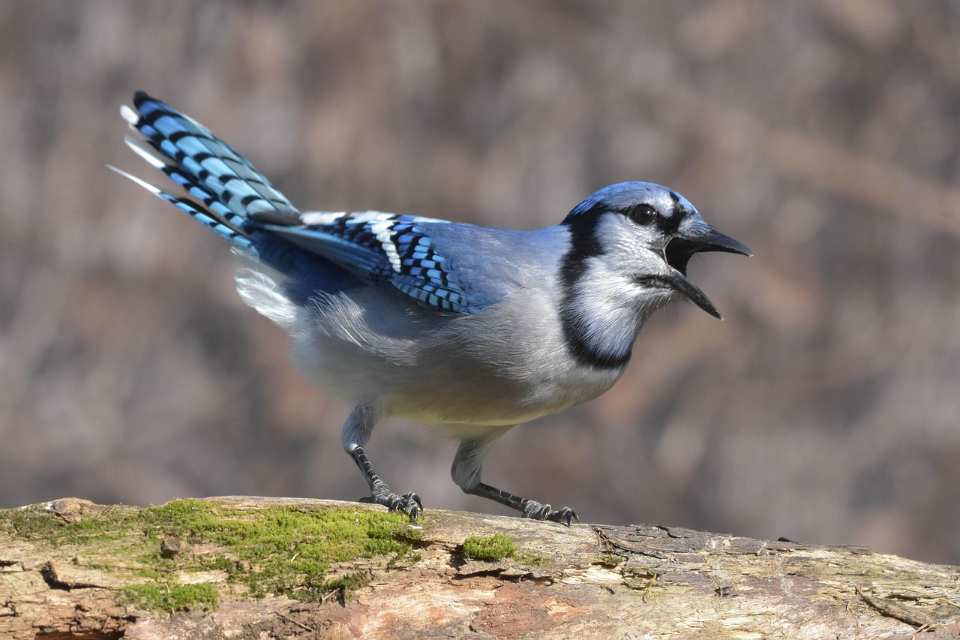
Blue jay breeding season sounds increase dramatically in volume and frequency starting in late winter and peaking through spring. Males become more vocal as testosterone rises and territories are established. According to research by Cohen (1977) cited in Birds of the World, unmated birds call more frequently than mated pairs during pre-breeding season, with calling by lone jays being 6-9 times more frequent in April than in either January-February or May-June in Michigan.
Blue jay courtship calls include specialized vocalizations that appear primarily during late winter and early spring. Pairs frequently engage in complex vocal duetting where both birds vocalize in tight coordination to reinforce their pair bonds. The quiet whisper song also appears during these intimate courtship and pair bonding periods.
Social learning variables dictate how your local flock develops its unique acoustic signature. Backyard observers on r/birding frequently document resident jays broadcasting a bizarre, highly mechanical sound resembling a rusty well pump or a squeaky gate. This unique vocalization is typically performed alongside rhythmic, vertical head-bobbing motions to mark immediate territorial borders or to quickly gather family members to a fresh food supply.
While standard field guides classify this sound as a basic innate display, bioacoustic research reveals that the pump-handle call is a strictly culturally transmitted vocalization. Nestling jays are not born with the neural pathways to produce this sequence. Instead, they must actively copy the acoustic template from adult tutors during their first summer. Captive-reared corvids raised in isolation never exhibit the squeaky gate sequence, proving that your backyard birds rely on complex social networks to pass down their unique vocal dialects through generations.
Blue jay spring vocalizations are diverse and constant. Both males and females call to coordinate nesting duties, selecting nest sites, gathering materials, defending territory from competitors, and maintaining pair bonds. The combination of territorial jeer calls, contact calls, and courtship vocalizations creates a cacophony of blue jay sound during peak breeding season.
Summer vocalizations continue but shift focus. Parents give quiet calls near nests to avoid attracting predators. They coordinate feeding trips with contact calls. Alarm calls ring out frequently to protect vulnerable nestlings from threats. Once chicks fledge, family groups maintain contact through frequent calling as juveniles learn foraging and survival skills.
Blue jay winter behavior is generally quieter, though jays remain vocal year-round unlike many songbirds. Winter flocks use contact calls to maintain cohesion while foraging. Jeer calls defend feeding territories around reliable food sources. Harsh calls alert flocks to winter predators like sharp-shinned hawks that follow bird feeders looking for prey. For winter survival strategies, check out how to attract birds during winter.
Distinguishing Blue Jay Sounds from Other Birds
Identifying blue jay calls becomes easier once you know what to listen for and what they might be confused with. Several species produce vocalizations that novice birders might attribute to blue jays or vice versa.
Backyard bird sounds that overlap with blue jay calls include crows (also corvids with harsh calls), grackles (raspy, mechanical sounds), and mockingbirds (expert mimics that sometimes copy blue jays). The key difference is typically in tone quality, pattern, and context.
Eastern blue jay call ID starts with recognizing that characteristic harsh, nasal quality. Blue jay jeer calls sound raspy and strident compared to American crow calls, which are lower, more guttural “caws.” Blue jay calls also tend to be shorter and more clipped than crow vocalizations.
Grackles produce squeaky, rusty-gate sounds that might seem blue jay-like, but they’re generally higher-pitched and lack the rich harmonics of blue jay jeers. Grackles also give these calls in different contexts, often while displaying at feeders or in large, noisy flocks.
Mockingbirds will absolutely mimic blue jays, sometimes so accurately you can’t distinguish them by sound alone. The tell is pattern: mockingbirds repeat phrases three or more times before switching to different sounds. If you hear “jay-jay-jay, jay-jay-jay, jay-jay-jay” in rapid succession followed by completely different vocalizations, you’re probably hearing a mockingbird, not a blue jay.
Listening tips for beginners include focusing on tone (blue jays sound harsh and nasal), pitch (mid-range, not as low as crows), rhythm (varied, not rigidly repeated), and most importantly, visual confirmation when possible. Watch which bird is vocalizing until you’ve internalized the sound.
Audio libraries like the Cornell Lab’s Macaulay Library and Audubon’s bird guide provide excellent reference recordings. Listen to multiple examples of blue jay calls and compare them to similar species. This comparative listening builds the mental library you need for confident field identification.
Why You Might Hear Blue Jays More Often
Suburban blue jay sounds are ubiquitous because blue jays thrive in human-modified landscapes. They love neighborhoods with mature trees, bird feeders, and varied habitat. Unlike deep-forest specialists, blue jays have adapted beautifully to suburban life.
Blue jay backyard activity peaks around feeders, especially feeders offering peanuts, sunflower seeds, or suet. Blue jays learn feeder locations quickly and visit them predictably. Once they discover a reliable food source, they check it repeatedly throughout the day, announcing their presence with calls.
Blue jay feeder calls often function as announcements or assertions of dominance. Jays frequently call upon arriving at feeders, possibly warning other birds to move aside or alerting fellow jays to food availability.
Many backyards host resident jays that develop specific peanut calls given directly when they see their hosts bringing out nuts. These unique vocalizations are noticeably louder and more insistent than their normal baseline communication profiles.
Territorial reflection wars represent a common source of seasonal anxiety that backyard observers frequently misinterpret. Homeowners on r/birding often document aggressive jays repeatedly flying into house windows or furiously pecking at exterior glass panes during the spring months.
In some unique cases, highly habituated backyard birds will even learn to intentionally tap on kitchen window glass to audibly signal their human hosts when a morning peanut delivery is running late.
This behavior is driven by an intense, hormone-fueled territorial loop. When a nesting male spots his own reflection in clean glass, his brain registers a live competitor encroaching on his family perimeter.
To permanently break this stressful cycle, you must eliminate the glass reflectivity index. Installing external mesh window screens, applying high-contrast UV-reflective decals to the outside of the pane, or temporarily drawing your interior blinds blocks the illusion. This simple modification restores immediate peace to your yard and saves your local nesting pairs from dangerous physical exhaustion.
You hear blue jays more often in morning and evening because these are peak feeding times. Blue jays are most vocal during early morning and again in late afternoon or early evening. Midday tends to be quieter as jays rest and preen during the hottest hours.
Seasonal patterns also affect detectability. Spring brings increased vocalizations during breeding. Fall brings flocking and movement, with blue jays calling to maintain flock cohesion.
Winter concentrates birds around reliable food sources like feeders, where they vocalize frequently in territorial disputes and social interactions. For more on common backyard birds and their behaviors, visit common backyard birds.
Fun Facts About Blue Jay Vocal Behavior
Blue jay vocal range includes sounds from about 200 Hz to over 8,000 Hz according to spectrographic analysis. This broad frequency range allows them to produce diverse vocalizations from low rattles to high, sharp alarm notes. The complexity rivals many species with actual song.
Blue jay sound meaning varies with context, but some calls appear to have specific functions. Research suggests that certain calls are used almost exclusively during predator encounters, while others appear only during courtship or feeding. The specificity indicates evolved signal function rather than random vocalization.
Blue jay intelligence extends to vocal behavior in fascinating ways. Jays can apparently “name” family members with unique call patterns that other group members recognize. This individual vocal recognition facilitates the complex social relationships characteristic of corvid societies.
Some blue jay vocalizations appear to be specific to local populations, essentially dialects. Birds in different regions may have slightly different versions of the same call types, developed through generations of social learning within geographically isolated populations. This cultural transmission of vocal behavior parallels human language evolution.
Blue jays can mimic individual blue jays. They don’t just imitate other species; they sometimes copy the specific vocalizations of particular neighboring jays. This ability suggests sophisticated vocal control and memory. Why they do this remains unclear, possibly social bonding, territorial deception, or just because they’re cognitively capable of it.
Captive blue jays have learned to imitate human speech, mechanical sounds, and complex sound sequences that wild jays would never encounter. This demonstrates that vocal learning isn’t limited to naturally occurring sounds, blue jays can incorporate basically any sound they’re repeatedly exposed to. Their vocal learning capacity is limited primarily by what they hear, not by cognitive constraints.
How to Record and Identify Blue Jay Calls
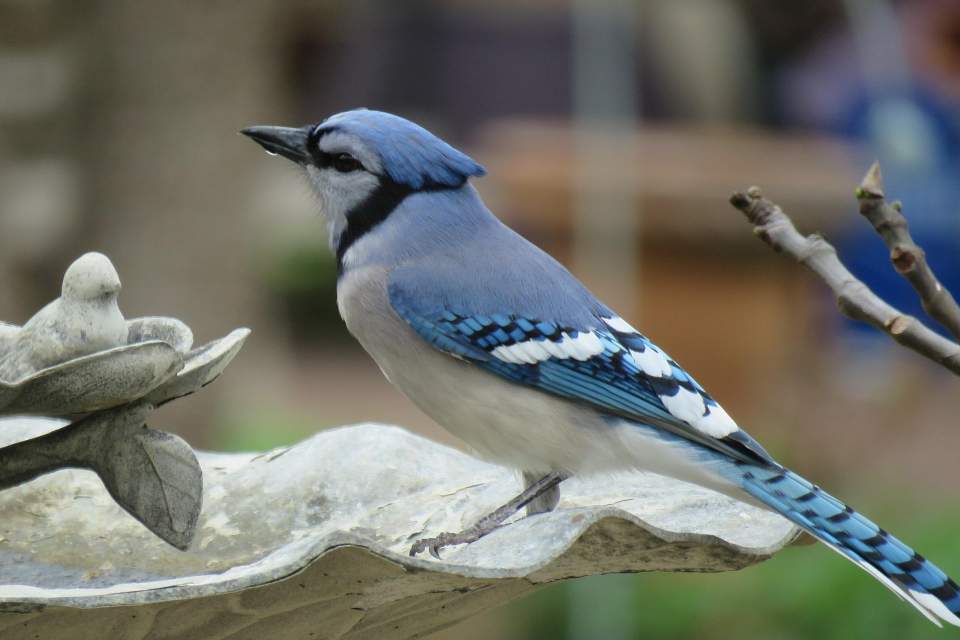
How to identify blue jay sounds starts with deliberate listening practice. Download a bird sound identification app like Merlin Bird ID or the Audubon bird guide app. Both have extensive libraries of blue jay vocalizations you can learn from.
Bird call recording tips for capturing blue jay vocalizations include using decent microphones (even phone mics work for close-range recording), recording during peak vocal times (early morning), getting as close as safely possible to vocalizing birds, and minimizing background noise like wind, traffic, and domestic sounds.
Blue jay call app options include Merlin Bird ID (free, Cornell Lab), Audubon Bird Guide (free, National Audubon Society), and iBird Pro (paid, comprehensive). These apps use visual and audio references plus sometimes AI-powered sound identification to help confirm what you’re hearing.
For serious recording, consider a dedicated microphone setup. Directional shotgun microphones capture bird sounds while minimizing background noise. Parabolic reflectors further isolate and amplify vocalizations. But honestly, modern smartphones produce surprisingly good recordings if you’re close enough to the source.
Recording blue jays specifically can be challenging because they’re wary of humans. Set up near feeders where jays are habituated to human presence. Use concealment or blinds to avoid alarming birds. Position microphones near regular calling perches and record for extended periods, you’ll capture various call types as different situations arise.
Once you have recordings, analyze them using free software like Audacity or Raven Lite to create spectrograms. Visual representations of sound help identify subtle differences between call types. You can compare your spectrograms to published examples in scientific papers or online databases.
Citizen science projects like eBird welcome audio recordings. Upload your blue jay recordings with location and date information to contribute to scientific understanding of vocal behavior and geographic variation. Your backyard recordings might help researchers study topics like dialect formation or seasonal vocal patterns.
Conclusion: Listening Changes Everything
Understanding blue jay communication transforms them from “those loud blue birds” into sophisticated communicators with complex social lives. Those harsh calls aren’t just noise, they’re coordinated warnings that protect entire bird communities. That hawk scream might be a blue jay manipulating other birds. Those soft rattles are intimate conversations between mates.
Backyard blue jay calls provide constant narration for the drama unfolding in your yard. Predators approaching, food discovered, territories defended, pairs bonding, juveniles begging, flocks coordinating, all communicated through varied vocalizations most people never consciously register. Once you start really listening, you realize how much you’ve been missing.
The diversity of blue jay vocalizations reflects their intelligence, social complexity, and adaptability. These aren’t simple birds making random sounds. They’re corvids with sophisticated cognitive abilities using learned vocal behavior to navigate complex social and ecological landscapes. Every call has context, function, and meaning within blue jay society.
I encourage you to spend time actually listening to blue jays rather than just hearing them as background noise. Record their calls, compare them to reference libraries, and pay attention to behavioral context. Notice how calls change when hawks fly over versus when jays are peacefully foraging. Observe how pairs communicate differently than solitary individuals. Watch how juveniles gradually develop adult vocal competence.
The next time you hear that familiar “jay! jay!” echoing through your neighborhood, pause and actually listen. Is it a single bird or multiple jays calling in coordination? Is the call urgent (predator warning) or more casual (territorial announcement)? Are there softer calls between the harsh jeers? Once you start paying attention, the soundscape becomes vastly more interesting.
Go outside and listen with intention. You’ll notice things you never did before. Those blue jays have been having conversations in your yard all along. Now you can start understanding what they’re saying.