
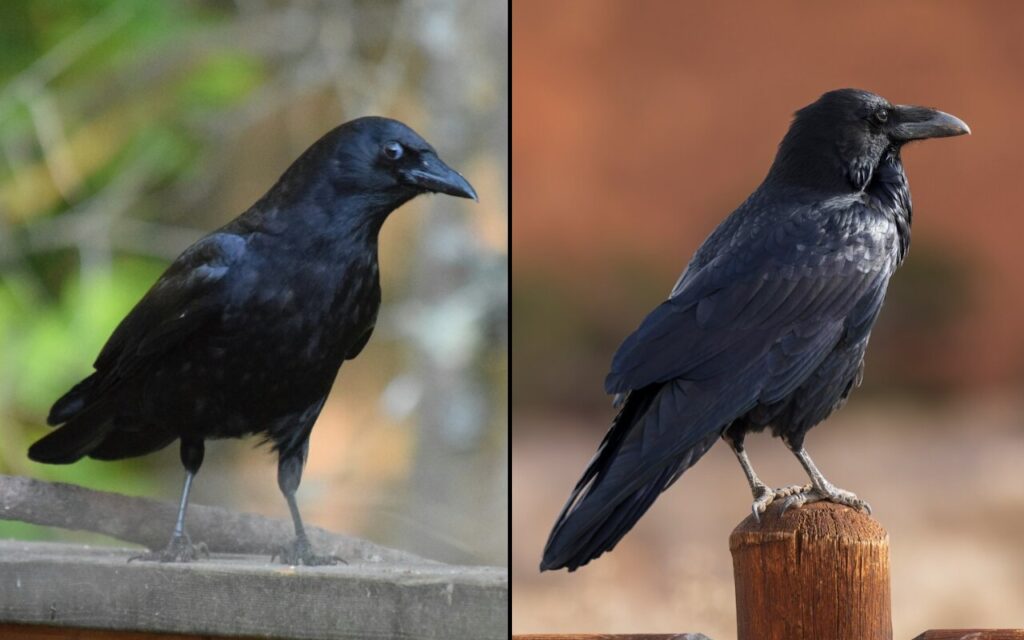
Staring up at a massive, pitch-black bird perched on a distant telephone wire routinely leaves even dedicated nature lovers scratching their heads in confusion. Because these intelligent lookalike corvids share nearly identical dark plumages and overlapping habitats, misidentifying a passing solitary traveler is one of the most common mistakes made in the field.
Fortunately, you can permanently eliminate the guesswork by shifting your observation strategy away from basic color checks and focusing entirely on fixed skeletal dimensions. This comprehensive diagnostic identification guide breaks down the subtle structural rules and vocal tells needed to separate these majestic birds with absolute confidence.
How to Tell a Crow vs Raven Apart?
The fastest method is checking the tail in flight: ravens have a wedge-shaped tail, while crows show a rounded fan shape.
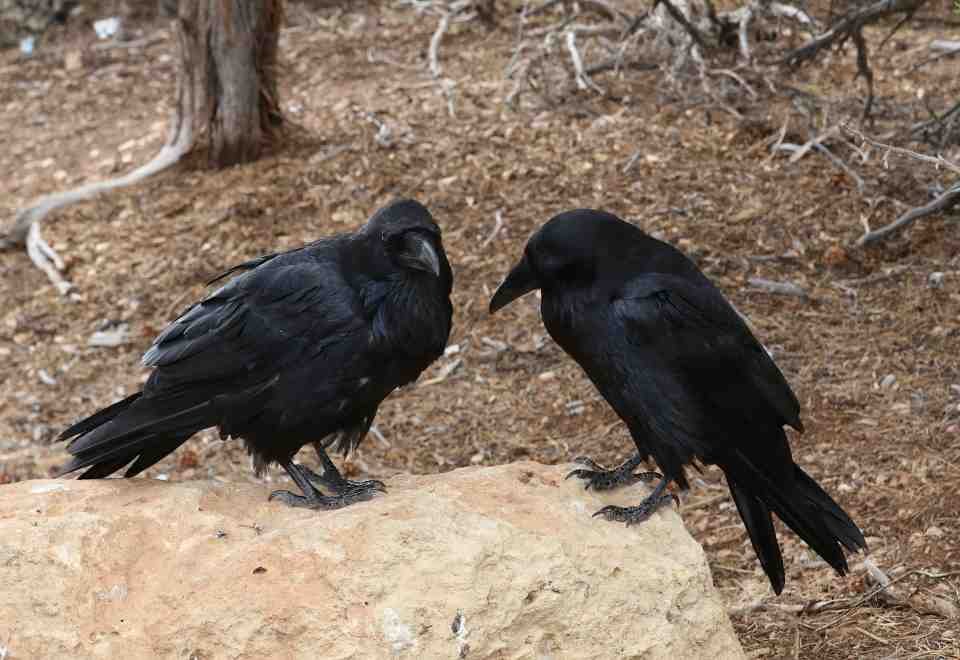
On the ground, look for the raven’s massive dagger bill and shaggy throat hackles, contrasted with the crow’s smoother, smaller profile.
Watch How to Identify Corvid Silhouettes (Animated Guide)
Reviewing an illustrated breakdown provides excellent clarity when learning these subtle corvid structural rules for the first time. This animated whiteboard video maps out geometric textures, size differences, and skeletal head structures directly on a digital canvas to help you confidently distinguish lookalike black birds.
Physical Dimension Comparisons and Structural Mass
Evaluating the structural scale and total mass boundaries of these corvids reveals a massive physical gap that is easily recognizable once you establish a real-world sizing anchor. When observed independently against a blank sky, their shared black plumage masks their true proportions, leading to frequent field mistakes.
Their underlying physical frameworks rely on completely separate sizing parameters:
| Visual Indicator Metric | American Crow (Corvus brachyrhynchos) | Common Raven (Corvus corax) |
|---|---|---|
| Average Total Length | 15.8 to 20.9 inches long | 22.1 to 27.2 inches long |
| Average Body Mass | 11.2 to 21.8 ounces total weight | 24.3 to 57.3 ounces total weight |
| Typical Wingspan Width | 33.1 to 39.4 inches wide | 45.7 to 51.2 inches wide |
| General Size Scale Reference | Matches a standard rock pigeon | Matches a massive red-tailed hawk |
A mature common raven is nearly double the physical length and three times the total body weight of an American crow. A raven carries an incredibly robust, thick-necked skeletal layout that gives it a heavy, predatory presence similar to a large raptor.
Conversely, the American crow is built as a highly streamlined, lightweight generalist. If local flock numbers become overwhelming on your property, implement the tactical adjustments detailed in our layout detailing how to discourage crows from your yard to re-establish environmental balance.
Tail Geometry and Flight Silhouette Schematics
When these birds are cruising high overhead or executing banking maneuvers across open thermal air currents, you must look directly past their coloration to map their tail borders against the open sky. Tail feathers act as primary flight stabilizers, and their geometric shapes are completely separate between these species.
According to comparative data published in the official Audubon Crow and Raven Guide, these aerodynamic configurations display highly specific outlines during flight:
- The Flat Crow Fan: The tail feathers of an American crow are practically uniform in length. When the bird flies, its tail spreads out evenly, creating a clean, slightly rounded fan outline with a flat edge.
- The Elongated Raven Wedge: The central tail feathers of a common raven grow noticeably longer than the outer edges. This specific biological pattern forces the tail silhouette into a sharp wedge shape or distinct diamond profile that becomes highly visible during banking turns.
- Wing Feather Finger Spacing: In flight, a raven shows long, deeply slotted primary wing feathers that look like extended fingers reaching into the wind. A crow displays a much smoother, shorter wing profile with minimal separation along its outer edges.
Learning to spot the diamond tail silhouette instantly eliminates lookalike confusion when birds are soaring thousands of feet up in the air. This tail-checking method provides an excellent secondary fallback when silhouettes are backlit against heavy clouds, similar to methods used in general winter bird identification surveys.
Beak Profiles and Nasal Bristle Distribution
Focusing your binoculars directly on a perched bird’s face reveals an elite anatomical marker that remains completely unchanged across all regional populations. Morphometric resource datasets curated by the Cornell Lab All About Birds Guide confirm that these distinct facial frameworks dictate how they process resources in the wild
The structural variance between their facial profiles follows separate biological paths:
- The Symmetrical Crow Bill: An American crow possesses a neat, straight, and sharply pointed beak. The top line of the bill features a very slight, gradual curve toward the tip, and its delicate nasal feathers cover less than one-third of the upper mandible base.
- The Heavy Raven Bill: A common raven carries a massive, incredibly thick, and heavily hook-tipped dagger beak. The upper line of its bill curves sharply downward like a predatory raptor, and thick, bristly nasal feathers cascade down, covering nearly half of the entire upper beak length.
The straight beak of a crow is built to probe open soil for invertebrates and flip small lawn debris, while the heavy bill of a raven is engineered to break down dense wood-boring caches. To study how these large beak shapes interact with smaller garden visitors at shared platforms, review our guide tracking invasive backyard birds to secure your feeding tiers.
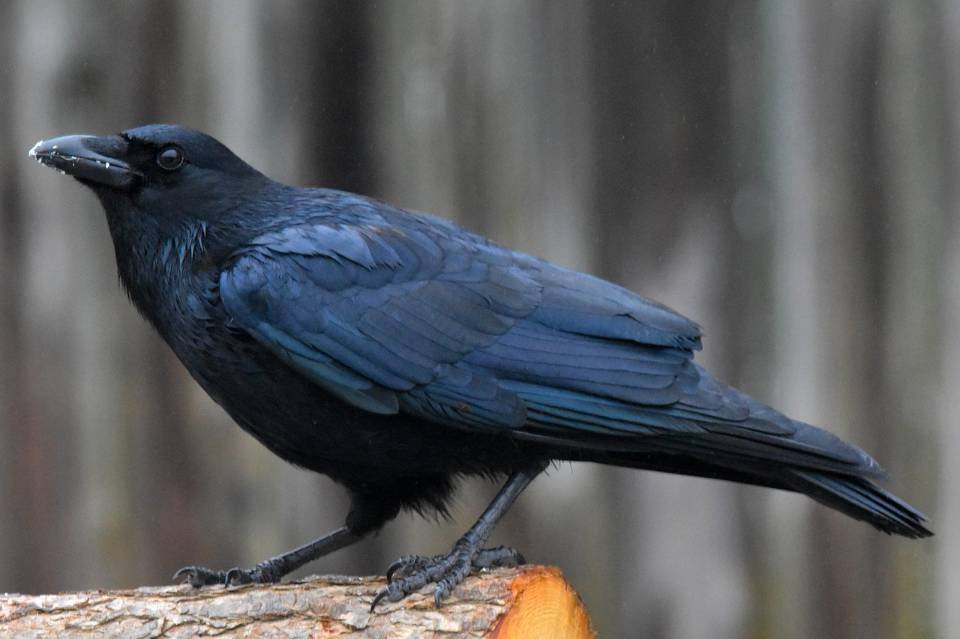
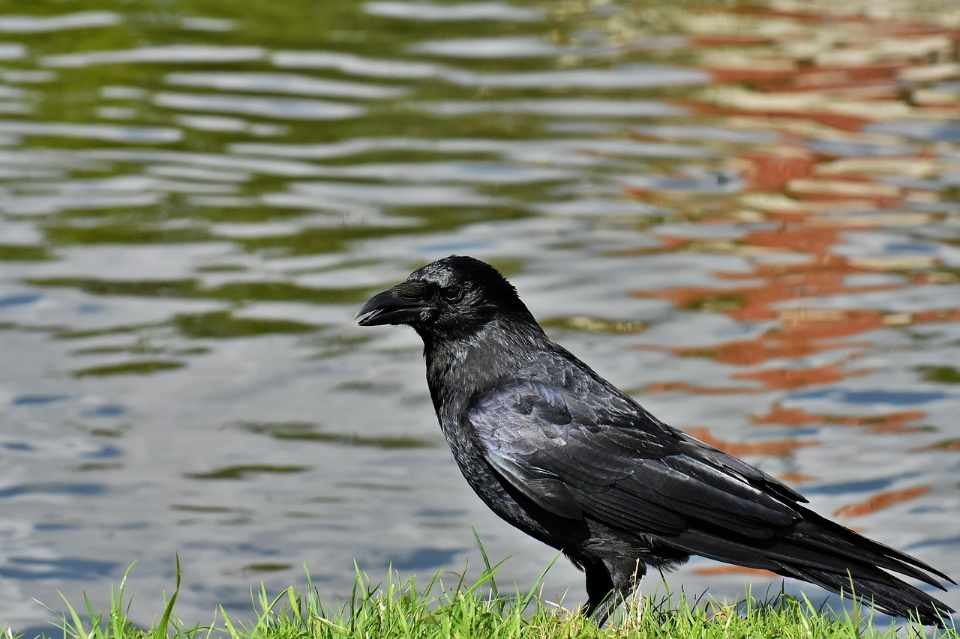
Next time you see a black bird up close, check the beak shape. It’s one of the easiest giveaways that doesn’t require measuring tape or binoculars.
Throat Hackle Textures and Head Plumage Designs
When observing these birds at close range under direct sunlight, you must shift your tracking focus down to the feathers lining their throats and necks. This plumage texture comparison provides an exceptional confirmation method when you are sorting stationary birds.
- Smooth Uniform Crow Feathers: The neck and throat plumage of an American crow is remarkably tight, flat, and uniform. When a crow vocalizes, its neck feathers remain perfectly smooth against its skin, maintaining a sleek, uninterrupted facial line.
- Shaggy Elongated Raven Hackles: A common raven features a highly distinct patch of long, lanceolate, and deeply grooved throat feathers called hackles. When a raven calls, preens, or displays territorial dominance, it intentionally flares these shaggy throat feathers outward, creating a distinctly rugged, bearded profile.
- Gloss Reflection Iridescence: While both species feature deep black plumage, their feathers reflect light differently due to microscopic structural variations. Crows display a clean violet or dark blue gloss reflection under sunlight, whereas ravens exhibit a highly intense, oily green and brilliant purple iridescence across their wings and backs.
Taking a second to check for a shaggy, bearded throat layout prevents you from making mistakes when poor lighting makes size estimation difficult. To ensure your optics capture these subtle iridescent highlights clearly during dark seasonal conditions, consult our equipment guide on the best birding binoculars under 200 to upgrade your resolution.
In-Flight Aerodynamics and Wing Motion Tempos
Watching how a bird moves through open airspace provides an exceptional behavioral clue that reveals their identification before they even land. Their completely different wingspans and muscle masses force each bird to utilize separate flight mechanics to conserve energy.
- Continuous Flapping Motion: Crows use a continuous, highly methodical flapping rhythm to travel through the air. They rarely glide for more than a second or two, maintaining a constant, active wing beat pattern that looks like a steady rowboat moving across water.
- Soaring and Somersaulting Glides: Ravens fly like predatory hawks, utilizing thermal air currents to soar effortlessly for long distances without moving their wings. They frequently execute playful, highly advanced aerial acrobatics, including complete sideways rolls, high-speed nose dives, and mid-air somersaults just for social play.
If you spot a large black bird holding its wings completely still while soaring high above an open tree line, you are watching a raven. To record these flight style milestones during your citizen data collections, apply the techniques found in our manual on how to set up a backyard bird survey.
Auditory Vocalizations and Acoustic Communication Networks
When these birds are completely hidden inside dense canopy layers, you can easily tell them apart by listening to the pitch and tempo of their sounds. Real-world citizen data tracking trends archived in the interactive Cornell Lab Crows and Ravens Guide demonstrate that matching acoustic rhythms remains a brilliant field asset, supported by the field matching tips tracked through our database on how to identify birds by song.
- The High Pitch Crow Caw highlights a loud, sharp, and highly metallic sound that fits a crisp caw-caw pattern. Listeners can reference the authentic American Crow Vocalization Clip to track this relatively high-pitched note, which repeats rhythmically in tight clusters of three or four breaks as a distinct warning alarm.
- The Deep Guttural Raven Croak demonstrates a remarkably low, hollow, and gravelly vocal profile that sounds like a deep, echoing grrr-vack or brrr-ook. Reviewing the live Common Raven Vocalization Clip illustrates how this primeval sound carries a deep wooden resonance that can travel over a mile through a quiet canopy.
Localized Habitat Segregation and Regional Range Boundaries
Evaluating the local environments of these corvids reveals clear territory preferences that narrow down your tracking choices before you even look through your binoculars. While environmental changes force occasional overlaps, their core nesting and hunting terrains remain distinctly separate across North America.
Their regional distributions rely on specific landscape preferences:
- Suburban and Agricultural Generalists: American crows are highly social, community-driven birds that thrive near human developments, busy suburban road networks, agricultural cornfields, and municipal city parks. They capitalize heavily on urban waste and open lawns where tracking earthworms is simple.
- Remote Wilderness Survivalists: Common ravens prefer rugged mountain cliffs, deep boreal timberlands, rocky coastlines, and open tundra spaces away from dense human activity. They rely on vast, undisturbed spaces to hunt, hide caches, and build massive stick nests high on transmission towers or cliff faces.
- Regional Weather Tolerances: Ravens are exceptionally hardy birds that maintain permanent residency throughout harsh northern winters and desert climates alike. Crows tend to move away from extreme northern borders during heavy winter drops, shifting down into massive communal roosts near major agricultural valleys.
Understanding these structural landscape preferences helps you make an accurate guess before a bird even lands. A large black bird patrolling a crowded suburban shopping plaza parking lot is overwhelmingly likely to be an American crow, whereas a lone silhouette circling a remote mountain ridge is almost certainly a common raven.
Social Behavioral Dynamics and Communal Roosting Habits
Watching how individual black birds interact with each other in the wild provides an exceptional behavioral clue that helps you identify them from a distance. Their social lives are completely separate, driven by distinct survival strategies and family structures.
Their community dynamics follow two distinct life paths:
- Massive Communal Crow Flocks: Crows are incredibly social creatures that are almost never seen alone. They forage in tight family groups, mob local predators together, and gather in winter roosts that can contain thousands of birds.
- Solitary or Paired Raven Duos: Ravens are highly solitary wilderness survivalists that travel almost exclusively in lifelong mated pairs or small, immediate family groups. Seeing a massive, silent black sentinel traveling completely alone across an open forest canopy is a classic sign of a mature raven.
- Juvenile Raven Exceptions: The only time ravens gather in groups is during their adolescent years, when young, unmated ravens form loose, rowdy groups to cooperatively bully older territorial pairs away from large food resources like carrion.
Paying attention to these group dynamics clarifies standalone sightings instantly. If you observe a noisy, unorganized group of ten black birds hanging around a backyard park tree, you are looking at a family of crows, as adult ravens will actively fight to keep strange birds out of their strict hunting borders.
Additional Physical Clues and Ground Foraging Postures
When bad lighting conditions or fast movements prevent you from checking tail geometry or listening to vocalizations, observing a bird’s resting posture and ground movement reveals its identity. Each corvid holds its weight differently due to variations in leg bone scale and muscle mass.
These structural ground properties follow separate visual layouts:
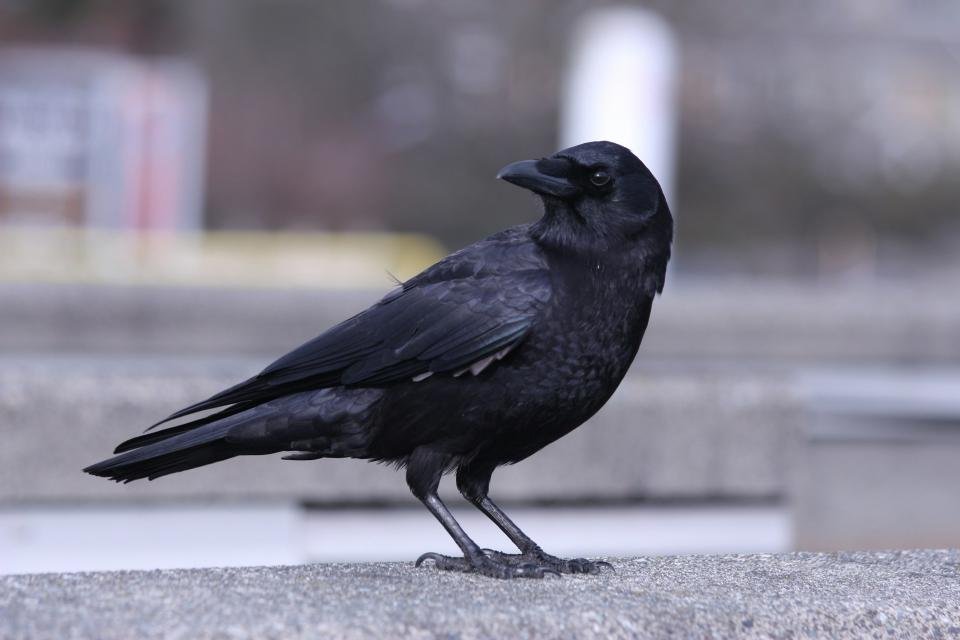
- The Agile Walking Crow: An American crow holds its body in a sleek, horizontal posture while searching for ground insects. It moves across lawns using a steady, rhythmic walk and can execute quick, vertical hops if it needs to shift directions fast.
- The Heavy Hopping Raven: A common raven carries its massive weight in a much more vertical, front-heavy posture. When moving along the ground, a raven executes a slow, deliberate walk that frequently transitions into heavy, distinct two-footed hops that make the bird look exceptionally bulky.
- Feather Sheen Contrast Updates: Under brilliant sunlight, a crow’s flat feathers reflect a smooth, clean violet or dark blue gloss. A raven’s heavy, deeply layered feather coat reflects an oily green and brilliant purple iridescence that looks like a liquid slick across its wings.
Training your eyes to check these physical ground traits ensures a highly accurate identification when birds are active on your lawn or property borders. The lightweight crow glides along smoothly, while the heavy raven moves with deliberate, bouncing hops that match its rugged wilderness build.
Cultural History and Intelligence Milestones
Studying the deep history and mental capabilities of these black corvids reveals why they have captivated human storytellers for thousands of years. Both birds possess exceptional brain-to-body mass ratios, allowing them to solve multi-step logic puzzles that match the cognitive abilities of a seven-year-old human child.
These behavioral and historical milestones follow separate paths:
- Advanced Tool Manufacturing Capabilities: Ravens do not just use existing objects as tools in the wild. They actively manufacture them by stripping leaves off twigs, bending wire hooks to extract hidden grubs, and planning several steps ahead to secure high-value food resources.
- Ironclad Human Facial Recognition: Crows possess an incredible ability to recognize individual human faces, especially those they perceive as threatening. If a person disrupts a nest, local crows will memorize that specific face, broadcast a warning call to the neighborhood flock, and hold a grudge that lasts for years.
- Mythological Wilderness Sentinels: Throughout ancient Norse mythology and indigenous Pacific Northwest cultures, ravens were rarely viewed as simple backyard pests. Instead, historical records celebrate them as powerful symbols of deep wisdom, transformational magic, and active wilderness messengers.
- Playful Social Antics: Both species engage in complex, non-survival social play just for fun. Crows frequently play catch with small pebbles in mid-air, while heavy ravens routinely slide down snow-covered roofs on their backs and playfully tease larger predators like wolves to steal bits of food.
Recognizing these incredible traits shows that these birds are far more than plain black silhouettes decorating a neighborhood tree line. Their social intelligence and deep history prove that crows and ravens are among the most successful, adaptable creatures sharing our modern suburban and wilderness spaces.
Quick Reference Crow vs Raven Comparison Table
Using the structured data grid below helps you cross-reference primary physical properties and behavioral traits to ensure absolute identification accuracy under variable field conditions.
| Diagnostic Visual Indicator | American Crow (Corvus brachyrhynchos) | Common Raven (Corvus corax) |
|---|---|---|
| Average Body Sizing | Streamlined medium frame up to twenty inches long | Massive robust structure up to twenty-seven inches long |
| Beak Profile Shapes | Neat symmetrical bill with a straight upper edge | Heavy hook-tipped dagger beak covered in deep bristles |
| Acoustic Vocalizations | High-pitched sharp metallic repeating caw alarms | Low guttural hollow gravelly echoing croaks |
| Tail Geometry Silhouettes | Uniform flat fan outline during active flapping | Elongated center feathers forming a sharp wedge shape |
| In-Flight Aerodynamics | Methodical steady rowboat flap with minimal glides | Hawk-like thermal soaring paired with acrobatic flips |
| Social Group Dynamics | Highly social family flocks and large winter roosts | Solitary wilderness survivalists or lifelong mated pairs |
| Nesting Habitat Tiers | Highly populated urban networks and city park grids | Remote undisturbed forests and rugged mountain cliffs |
| Plumage Sheen Reflections | Smooth clean violet or dark blue gloss under sun | Intense oily green and brilliant purple iridescence |
| Throat Feather Layouts | Smooth flat grooming lines tight against the neck | Shaggy elongated lanceolate throat hackle patches |
Summary Identification Checklist for Lookalike Corvids
Reviewing these advanced visual clues, anatomical proportions, and distinct behavioral habits ensures you can quickly classify individual yard visitors across all four seasons. Instead of relying on a single, uncertain size guess when a black bird lands on a tree, you can cross-reference multiple reliable field markers to make a certain identification.
Verifying a flat fan-shaped tail silhouette paired with a smooth throat profile and a sharp caw call provides immediate visual confirmation that you are watching an American crow. Conversely, tracking a heavy wedge-shaped flight tail, paired with shaggy neck hackles, a massive hooked bill, and a deep guttural croak, confirms the presence of a robust common raven.
Combining these physical checks with real-world tracking of soaring flight patterns guarantees absolute identification accuracy under any field conditions.