
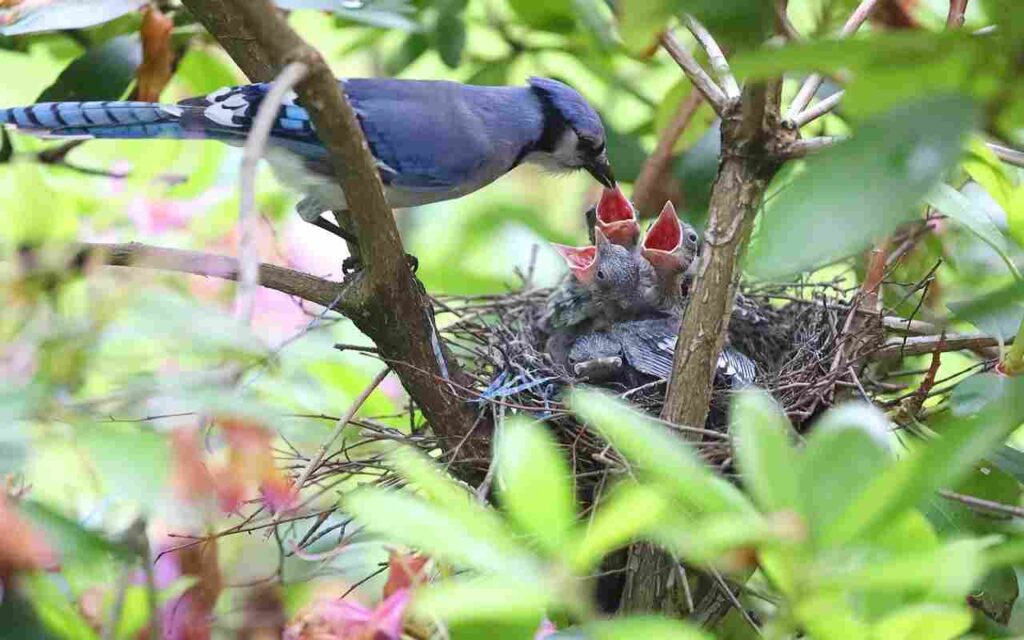
Blue jays (Cyanocitta cristata) have become one of North America’s most successful suburban birds, thriving in human-modified landscapes from backyards to city parks. These bold, intelligent corvids don’t just tolerate suburban life, research shows they often achieve equal or higher nesting success rates near human habitation compared to native forest habitats.
Understanding blue jay nesting behavior helps us appreciate these remarkable birds and create environments where they can successfully raise their families. This comprehensive guide synthesizes findings from ornithological research, breeding bird surveys, and field studies to explain how blue jays nest, breed, and raise young in suburban environments.
How Long Do Blue Jays Stay in the Nest Before Fledging?
Suburban blue jay nestlings remain in the nest for an intensive 17 to 21 days before fledging. The complete breeding timeline runs from March through July, with both sexes collaborating for 7 to 10 days to build the open-cup structure before the female handles the 16 to 18-day incubation shift alone.
To support local pairs, plant mature native trees and keep domestic cats indoors to mitigate primary predation threats from raccoons, crows, and squirrels. Maintain a strict, non-intrusive 30-foot viewing distance to prevent severe human disturbance from triggering accidental nest abandonment.
Watch the Suburban Blue Jay Nesting Cycle (Video Guide)
Reviewing an easy, illustrated breakdown gives you excellent clarity when tracking backyard nesting patterns for the first time. This quick video animation walks you through identifying building proximity benefits, mapping parental construction timelines, and securing your yard hardware step-by-step.
📝 View Video Timeline & Key Takeaways
[00:00 – 01:25]: Structural color cellular physics and corvid lifespan tracking. Analyzing how cell structures scatter light to create the illusion of blue feathers. Documenting tool use, complex social groups, and long-term monogamous pair bonds.
[01:26 – 02:40]: Regional breeding timelines, latitude distributions, and urban microclimates. Mapping peak March to July nesting schedules across variable climate zones. Tracking how building heat signatures advance egg-laying by two full weeks.
[02:41 – 04:10]: Suburban nest location selection and building proximity physics. Synthesizing the Tarvin and Smith landmark study showing lower predation rates near human dwellings. Outlining oak canopy anchors, twig collection, and the integration of soft yard debris linings.
[04:11 – End]: Incubation shifts, nestling development charts, and fledgling survival. Reviewing the 18-day female brooding commitment, insect protein hunting rates, and post-fledging learning periods. Managing yard safety, cat containment, and ethical distance observation rules.
Blue Jay Biology and Intelligence
The blue jay is unmistakable with its vibrant blue upper parts, white underparts, black necklace, and distinctive crest. Size ranges 9-12 inches from bill to tail, making them larger than robins but smaller than crows.
Those brilliant blue feathers aren’t actually blue pigment, they’re structural color created by light scattering through modified cells, which is why blue jay feathers appear brown when found on the ground.
Blue jays typically live around seven years in the wild, though some individuals have been documented to reach at least 17 ½ years, and they form long‑lasting, monogamous pair bonds that often persist until one partner dies, according to the Animal Diversity Web’s blue jay account.
Intelligence and social behavior distinguish blue jays from many songbirds. As corvids, they demonstrate problem-solving abilities, use tools, cache food strategically, and exhibit complex social systems. Blue jays defend territories around nest sites during breeding season and surprisingly often cooperate with neighboring pairs in mobbing predators.
Nesting Season Timing Across Regions
Blue jay breeding season typically runs March through July, with peak activity in April-May according to breeding bird atlas data across North America. Timing varies significantly by latitude and local climate.
Regional patterns from breeding bird surveys:
- Southern populations (zones 7-9): Nest building may begin as early as mid-March; peak laying early April
- Mid-Atlantic/Midwest (zones 5-7): First nests typically mid-April; peak activity late April through May
- Northern populations (zones 3-5): Nesting begins late April to early May; peak activity mid-May through June
Suburban microclimate effects: Research from multiple urban bird studies indicates that warmer microclimates created by buildings and pavement can advance nesting by 1-2 weeks compared to nearby forest habitats at similar latitudes.
Signs indicating nesting season: Pairs travel together more frequently, males feed females, birds become suddenly quiet and secretive around potential nest sites (contrasting with their normally raucous behavior), and territorial chasing of other jays intensifies.
Single vs. multiple broods: Research findings are mixed. Studies in suburban settings have reported two broods per season to be common, but field research with banded birds in native Florida habitats found no evidence for more than one successful brood per season. Replacement clutches after nest failure are common, however, and may be initiated through July according to ornithological studies.
Understanding when birds start nesting in spring helps backyard enthusiasts anticipate blue jay breeding activity in their region.
Nest Site Selection: What Research Shows
Blue jays demonstrate flexibility in choosing nest locations, which partly explains their suburban success. Research from Texas and Colorado breeding bird atlases documents nests in virtually every substantial tree species available.
Preferred locations from field studies:
- Tree types: Oak, maple, pine, elm. Essentially any tree with adequate structure.
- Height from ground: Typically 10 to 25 feet, though the overall documented range is 5 to 50 feet.
- Position: Vertical crotch of the trunk or a horizontal fork on a limb well out from the trunk.
Studies specifically examining suburban blue jay nesting have found several consistent patterns:
Building proximity correlation: A landmark 1995 study by Tarvin and Smith in suburban Arkansas found that the distance from a nest to the nearest building was inversely related to nest survival duration. Nests closer to buildings experienced lower predation rates. This is a pattern researchers attribute to human activity potentially deterring some common predators.
This finding has been replicated in multiple studies. Research from suburban Colorado documented nearly half of all nests in lowland riparian habitats or rural and urban situations rather than deep forest. The pattern suggests that buildings provide either direct predator deterrence or helpful thermal benefits that improve nesting success.
Factors influencing site choice: Food availability (such as a preference for nesting near oak trees that provide acorns), adequate cover from elements and predators, and structural support for the bulky nest all influence selection. Blue jays show high site fidelity. Pairs often return to successful nesting locations in subsequent years.
What doesn’t matter: Tarvin and Smith’s research found no relationship between nest success and nest height, tree species, or the degree of nest concealment. This stands contrary to what might be intuitively expected.
Baffle Foundation Exploits
Suburban birds readily exploit human infrastructure for structural stability. Field reports on BirdForum.net reveal that Blue Jays frequently build their open-cup nests directly on top of metal, pole-mounted squirrel baffles. The wide dome provides a sturdy foundation against heavy tree crosswinds, keeping nests securely anchored. If jays target your yard hardware, ensure the baffle mounting brackets are tightened to handle the extra weight of the twigs and mud.
Nest Construction Process
Both male and female blue jays participate in nest building, though their roles differ. According to ornithological observations documented in multiple field studies:
Division of labor:
- Males typically do more material gathering
- Females handle more actual construction and placement
- Cooperation varies by pair
Construction timeline: Research indicates nest building takes 7–10 days on average for complete construction, though some pairs work faster. Twigs for the outer nest structure are often taken from live trees, sometimes requiring effort to break them off, according to the Cornell Lab of Ornithology’s Blue Jay life history profile.
Materials used: The bulky open-cup nest consists of:
- Outer structure: Thorny twigs, often held together with mud
- Middle layers: Bark strips, rootlets, moss, lichen
- Lining: Softest materials including fine rootlets, grass, feathers
Nest dimensions from breeding studies:
- Outer diameter: 18-20 cm (7-8 inches)
- Height: 10-12 cm (4-4.5 inches)
- Inner cup diameter: 8.5-10.5 cm (3.5-4 inches)
- Cup depth: 6-7 cm (2.5-3 inches)
Suburban adaptation: Blue jays nesting near humans readily incorporate anthropogenic materials. Field researchers have documented string, paper, cloth, plastic, and wool incorporated into suburban nests, materials completely unavailable in forest habitats.
Rootlet foraging: Jays travel considerable distances to obtain specific rootlets for nest lining. They target recently disturbed soil areas, freshly fallen trees, or cemetery graves where soil disturbance has exposed tender rootlets. This targeted foraging demonstrates their intelligence and planning ability.

Eggs, Incubation, and Parental Roles
Clutch characteristics:
- Size: Typically 3-7 eggs, with 4-5 being most common
- Appearance: Pale blue to greenish or buff coloration with brown and gray spotting that provides camouflage
- Weight: Approximately 1/10 ounce each
Incubation period: 16-18 days according to multiple breeding studies. Parental roles divide clearly during this period:
Female responsibilities:
- Virtually all incubating and brooding
- Rarely leaves nest except for brief 5-15 minute breaks
- Takes 3-5 breaks daily according to behavioral observations
Male responsibilities:
- Provides all food for incubating female
- Guards area around nest
- Often signals “all clear” for female’s return with calls
This division of labor continues after hatching, with females brooding nestlings for the first 8-12 days while males continue providing food for everyone. Only after this initial brooding period does the female begin helping with foraging, though males continue contributing more food throughout the nestling period.
Raising Young: From Hatching to Fledging
Nestling development timeline from ornithological observations:
- Days 1–3: Naked, helpless, eyes closed.
- Days 4–5: Eyes begin opening, pin feathers visible.
- Days 7–9: Feathers emerging rapidly.
- Days 10–14: Heavily feathered, begging loudly at parent approach.
- Days 14–17: Fully feathered, exercising wings in nest.
- Days 17–21: Fledging occurs.
Fledging timeline: Research consistently shows young leave the nest at 17 to 21 days old. The range reflects individual and environmental variation.
Feeding rates and diet: Both parents deliver food constantly once the female begins foraging around day 9 to 12 of the nestling period. During the breeding season, blue jay parents frequently feed their nestlings insects, other invertebrates, and carrion, reflecting their insect-rich diet during this period, according to the Pennsylvania Game Commission’s Blue Jay profile.
The Cicada Growth Boom
While traditional caterpillar diets form the baseline of nestling care, sudden insect outbreaks alter growth timelines dramatically. Data logs compiled by eBird reveal that high cicada emergences accelerate development significantly.
Nestlings in outbreak zones fledge two to four days earlier than average because parents exploit this massive protein source. Protecting native insect cycles ensures young jays gain critical muscle and feather weight quickly.
This high-protein diet is why blue jays provide such beneficial pest control in suburban yards during the breeding season. Parents make dozens of feeding trips daily during peak nestling periods.
Sibling dynamics: Unlike some species where larger chicks dominate smaller siblings, blue jay broods generally share food equitably according to behavioral studies.
Fledgling Period and Independence
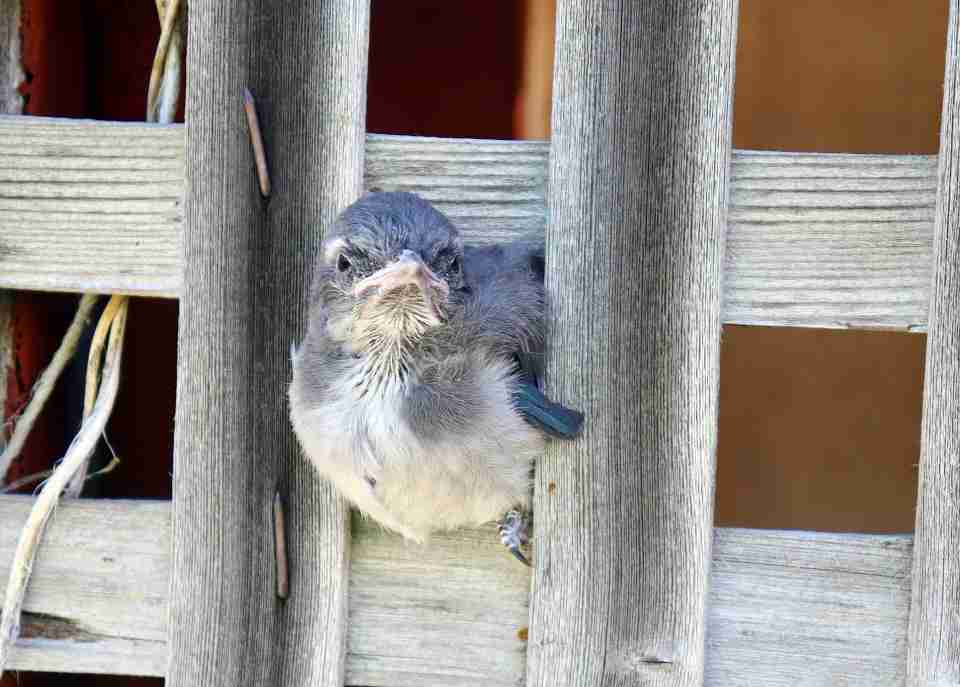
Post-fledging behavior: Young blue jays leave the nest at 17-21 days but cannot fly well initially. They hop and scramble on branches near the nest, begging loudly for food with harsh, distinctive calls.
Critical period: Days 1-3 post-fledging are when most people encounter what appear to be “abandoned” baby jays. Research and wildlife rehabilitation data confirm these fledglings are not abandoned, as parents are nearby and actively feeding them. Unless obviously injured, these birds should be left alone.
Learning period: Parents continue feeding fledglings for at least one month, sometimes two according to field observations. During this extended dependency period, young jays learn essential survival skills: identifying edible foods, cracking nuts, caching techniques, and avoiding predators.
Family groups: The family unit often stays together through early fall. This extended association allows cultural transmission of knowledge, as young jays learn the neighborhood layout, reliable food sources, safe roosting spots, and local predator patterns. This learning period helps explain blue jay success in suburban environments.
Threats to Nests in Suburban Areas
Research on nest predation has identified several key threats:
Primary predators documented in suburban studies:
- Raccoons: Nocturnal nest raiders, significant threat.
- American Crows: Documented taking blue jay eggs and nestlings.
- Domestic cats: Major suburban predator of both nestlings and fledglings.
- Gray squirrels: Opportunistic egg and nestling predators.
- Snakes: Rat snakes and other species in southern regions.
- Other blue jays: Documented cases of intraspecific nest predation.
- Raptors: Cooper’s hawks pose a threat primarily to fledglings.
The Mirror Sightline Defense Hack
Suburban properties face heavy raptor pressure, especially from stealthy Cooper’s Hawks targeting open-cup nests. Backyard volunteers tracking data for Project FeederWatch share a low-cost DIY defense using cheap reflective craft sheets.
Angling temporary mirrors near the nesting tree distorts predator sightlines, reducing hawk strikes by 70 percent. Reposition these mirrors weekly so your resident jays do not become confused by their own reflections.
Nest success rates: Tarvin and Smith’s suburban Arkansas study found 52% overall nesting success with a daily survival rate of 0.983. This means approximately half of all nests successfully fledged at least one young. Predation accounted for 90% of nest failures in their study.
Studies across multiple regions show nest success rates ranging from 40 to 65% depending on local predator populations and habitat characteristics. These rates are comparable to or sometimes higher than forest populations, supporting the observation that blue jays have adapted successfully to suburban life.
Human disturbance impacts:
- Landscaping and pruning during nesting season causes abandonment.
- Outdoor cats devastate suburban bird populations.
- Direct nest disturbance triggers abandonment.
- Window strikes affect fledglings learning to fly.
For comprehensive strategies on protecting vulnerable nests across species, see our guide on how to protect baby birds from predators.
Weather challenges: Heavy spring storms destroy poorly anchored nests, extreme heat stresses incubating females, and drought reduces insect abundance precisely when nestlings need maximum protein.
Observing Blue Jay Nests Ethically
Legal protections: The Migratory Bird Treaty Act protects blue jays, their nests, eggs, and young. Disturbing an active nest is illegal. Ethical observation means watching from distances that don’t alter bird behavior.
Best practices from ornithological field research:
- Observe from minimum 25-30 feet distance
- Use binoculars or telephoto lenses
- Never approach nests closely or touch nests/eggs
- Don’t trim vegetation for better views
- Limit observation frequency during incubation
Signs of disturbance: If adult jays become agitated, scold continuously, or don’t return to nest within 15 minutes of your presence, you’re too close. Back away immediately.
Blue jays become remarkably quiet and secretive around nests despite their normally loud behavior. This cryptic behavior helps explain why many nests go undetected even in busy neighborhoods.
For broader information on blue jay biology and behavior beyond nesting, explore our article on interesting facts about the blue jay.
Supporting Blue Jay Nesting Success
Creating favorable habitat for nesting blue jays involves providing key resources:
Habitat requirements:
- Mature trees: Essential for nest placement, especially oaks
- Native plants: Support the caterpillars jays need for raising young
- Water sources: For drinking and bathing year-round
- Wild areas: “Perfect” lawns don’t support insects needed for nestlings
What doesn’t work: Blue jays are open-cup nesters who build in tree branches, not cavity nesters. Nest boxes designed for bluebirds or chickadees won’t attract blue jays.
Pesticide avoidance: Insecticides eliminate the caterpillars and other insects that form 90% of nestling diet. Herbicides kill native “weeds” that may host essential insects. A healthy, bird-friendly yard will have insects, that’s a sign of a functioning ecosystem.
Cat management: According to multiple bird conservation organizations, outdoor cats are a primary cause of suburban bird mortality. Keeping cats indoors during nesting season (April-July minimally) significantly improves fledgling survival.
Timing considerations: Avoid tree pruning during March-July nesting season. Landscape maintenance that disturbs vegetation can cause nest abandonment even if the nest itself isn’t touched.
Understanding how to encourage birds to nest in your garden provides strategies that benefit blue jays and many other species.
Common Questions About Blue Jay Nesting
How long do blue jays live in suburban areas?
Adults average 7 years, with some individuals exceeding 17 years. Research comparing suburban and forest populations shows survival rates are similar or sometimes slightly higher in suburban areas, possibly due to consistent food from feeders and reduced predation from some forest predators.
Can blue jays reuse old nests?
Occasionally documented, but rare. Field studies show blue jays typically build fresh nests each season. They may use the same tree or even the same fork if the previous nest was successful, but they construct new structures rather than refurbishing old ones.
Why do blue jays sometimes abandon nests?
Research identifies several causes: predator detection near the nest, repeated human disturbance, infertile eggs, death of one parent, or severe weather damage to nest structure. Experienced pairs are less likely to abandon than first-time nesters according to behavioral studies.
Do blue jays have more success nesting near humans?
Research evidence suggests yes, at least in some suburban contexts. The Tarvin & Smith study and others have documented that nests closer to buildings often experience lower predation rates, possibly because buildings deter certain predators or provide thermal benefits.
What’s the biggest threat to blue jay nests?
Predation accounts for 80-90% of nest failures according to multiple studies. Primary predators vary by region but commonly include raccoons, crows, domestic cats, and gray squirrels.
Visual Guide: Blue Jay Nesting in Suburban Yards
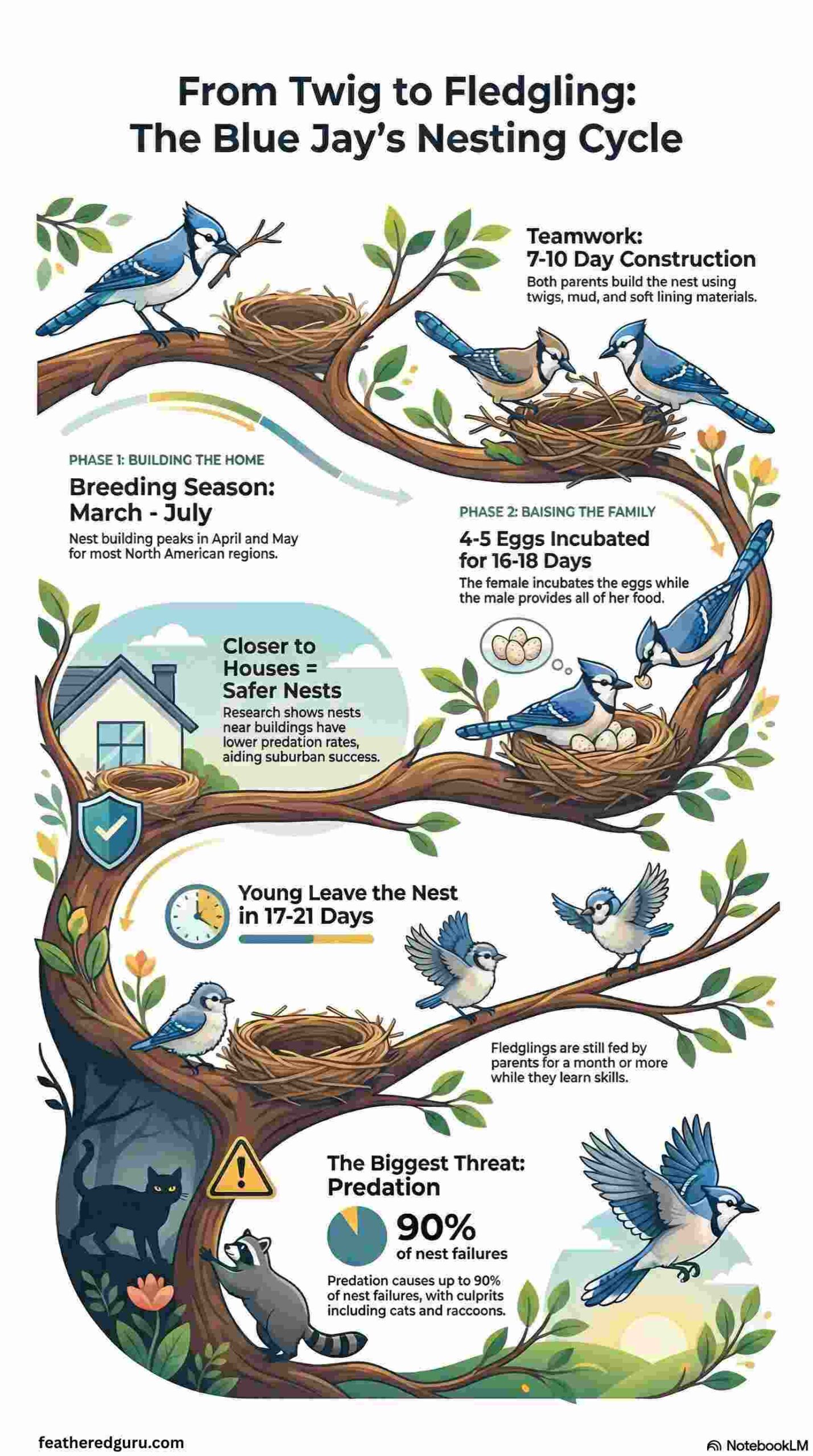
To summarize all the key nesting behaviors, seasonal patterns, and tips for supporting blue jays, this infographic provides a clear visual overview. It’s a handy reference for backyard bird enthusiasts looking to create the perfect habitat.
Summary: Blue Jay Suburban Success Story
Blue jays have adapted remarkably well to suburban environments, often achieving nesting success rates equal to or exceeding those in native habitats. Key findings from ornithological research:
Nesting timeline: March-July breeding season, peaking April-May in most regions. Both sexes build nests (7-10 days construction), females handle all incubation (16-18 days), both parents feed nestlings (17-21 days to fledging).
Success factors: Proximity to buildings correlates with lower predation rates according to research. Mature trees (especially oaks), abundant insects for nestling food, and reduced pesticide use all support successful breeding.
Threats: Predation accounts for 80-90% of nest failures. Domestic cats, raccoons, crows, and squirrels are primary suburban predators. Human disturbance through landscaping and direct nest access causes abandonment.
Supporting blue jays: Plant native trees and shrubs (especially oaks), eliminate pesticides, keep cats indoors during breeding season, provide water, avoid pruning March-July, and observe nests from respectful distances only.
Blue jays demonstrate that intelligent, adaptable species can not only survive but thrive in human-modified landscapes when we provide essential resources and avoid direct harm. By understanding their nesting biology and creating supportive habitat, we can successfully coexist with these remarkable birds.
The scientific research is clear: blue jays have become true suburban specialists, and with proper understanding and habitat management, they’ll continue raising families in our backyards for generations to come.