
Heat waves pose lethal threats to wild birds, with extreme temperatures forcing physiological adaptations that can exceed survival limits. Research demonstrates that songbirds begin experiencing dangerous heat stress at air temperatures above 104°F (40°C), making it critical for homeowners to understand how to keep birds cool in hot weather.
Understanding how to modify residential landscapes to provide thermal refugia through shade, airflow management, and cooling features transforms ordinary properties into life-saving habitats. This comprehensive guide examines research-based strategies for reducing heat stress in backyard birds, focusing on physical cooling mechanisms separate from hydration needs 🙂.
- Birds begin suffering dangerous heat stress above 104°F (40°C).
- Shade is the most effective cooling tool, especially large, dense tree canopies.
- Shaded areas can be 20–45°F cooler than sun-exposed surfaces.
- Multi-layer vegetation (trees, shrubs, ground cover) creates cooler microclimates.
- Mature trees, cavities, brush piles, and dense shrubs act as natural heat refuges.
- Airflow and breezes improve cooling and reduce heat buildup.
- Temporary shade cloth offers fast relief during heat waves.
- Misting systems lower surrounding air temperature through evaporation.
- Light-colored surfaces reduce heat absorption near bird areas.
- Native high-transpiration plants boost natural cooling and habitat quality.
How to Keep Birds Cool in Hot Weather
Watch the video below for a step-by-step breakdown on helping birds survive extreme heat waves:
Show Transcript:
0:00
When a massive heat wave hits, your first instinct might be to put out a bird bath. That’s a good start, but it’s far from enough. Extreme heat waves are genuinely lethal for backyard birds. Today, we’ll explore the science behind avian heat stress and show you how to turn your yard into a life-saving refuge.
0:25
First, let’s clarify: a hot summer day and a heat wave are very different. Birds can handle occasional heat, but relentless days of extreme temperatures push them past their biological limits. Your help can literally mean the difference between life and death.
0:48
Research shows danger starts at 104°F (40°C). Imagine being a tiny songbird at that temperature—your body is under extreme stress. This isn’t just discomfort; it’s a physiological crisis.
1:17
Birds use a fascinating strategy called controlled hyperthermia. Essentially, they let their body temperature rise slightly to conserve water and energy. This is a risky survival tactic, pushing them close to lethal limits. For each degree the air temperature rises, a bird’s body temperature increases by about 0.25°C, and during multi-day heat waves, this can become fatal.
2:22
Temperate birds tolerate slightly more heat than tropical birds, but hitting around 113°F (45°C) is deadly for any species. Signs of extreme distress include panting with an open beak or fluttering the throat—this is an emergency, signaling critical heat stress.
3:05
Now that we understand the science, let’s talk solutions. What can you do immediately during a heat wave? Here’s a simple emergency action plan:
3:22
- Temporary Shade: Use shade cloth over feeders and bird baths. It drastically reduces heat exposure.
- Misting Systems: Run a mister during peak heat hours, typically 2–6 p.m., creating a cool microclimate birds flock to.
- Cool Hot Surfaces: Spray water on patios, dark pavers, or concrete to lower surface temperatures.
3:56
While these emergency steps help, permanent solutions are key. Transform your yard into a resilient, bird-friendly refuge.
4:14
A single tree isn’t always enough. One study found 63% of trees provided no meaningful thermal refuge. Strategic planting is essential. The right tree can drop ground-level temperatures by up to 22°F, turning a deadly heat trap into a life-saving oasis.
4:55
Key features of life-saving trees: Dense, tall canopies with a high leaf area index. Native species like oaks and maples excel at transpiration, acting like natural air conditioners by releasing cool water vapor.
5:25
Your yard should be a multi-layered “apartment building” for birds. Canopy trees are the penthouse, but ground-dwelling species need dense shrubs and understory plantings. This vertical layering creates safe, cool microhabitats throughout your property.
5:47
Don’t underestimate unconventional shelters. Dead trees, snags, and brush piles provide insulated cavities and microclimates that stay cooler than surrounding areas. These “messy” features are critical for bird survival.
6:13
Landscape features matter too. Light-colored mulch, pavers, and permeable surfaces help reduce heat. Dark asphalt and concrete act as heat traps. Ensure airflow by avoiding solid barriers that block natural breezes.
6:40
Let’s simplify everything into three essentials for keeping birds safe during extreme heat:
- Shade is King: Dense, effective shade is your top priority.
- Layers Save Lives: Create vertical habitats from ground cover to canopy.
- Act Early: Prepare your yard before heat waves hit. Use weather forecasts to get ready.
7:21
The survival of backyard birds increasingly depends on us. With rising temperatures due to climate change, our yards are more than personal spaces—they’re essential wildlife sanctuaries. The question is: how will you make your yard a lifeline? Birds are counting on you.
Understanding Avian Heat Stress Physiology
Birds face unique thermoregulatory challenges during heat waves due to their high baseline body temperatures and limited cooling mechanisms. According to research published in PLOS One on body temperature regulation, birds in hot environments let their body temperature increase in direct relation to ambient temperatures, rising by 0.22°C for each degree of increased ambient temperature. This controlled hyperthermia, while reducing energy and water costs, brings body temperatures dangerously close to lethal limits during extreme heat.
Research on heat tolerance published in Functional Ecology comparing temperate and tropical birds found that temperate species had significantly higher heat tolerance limits (45.2°C versus 43°C for tropical species). However, both groups face mortality when temperatures exceed these thresholds for extended periods, making provision of cooling features critically important during heat waves.
According to research on thermoregulation in desert birds, evaporative heat dissipation represents a key aspect of avian thermoregulation in hot environments, but this cooling mechanism becomes energetically expensive and promotes excessive water loss. To alleviate these costs, providing physical cooling through shade and shelter reduces birds’ reliance on metabolically expensive evaporative cooling.
The Critical Role of Shade
Shade represents the single most effective physical cooling mechanism for heat-stressed birds. Research on urban heat mitigation demonstrates that properly positioned shade structures can reduce surface and air temperatures by dramatic margins that directly translate to bird survival.
Tree Canopy Cooling Effects
According to research published in Nature Communications Earth & Environment, trees can lower pedestrian-level temperatures by up to 12°C through large radiation blockage and transpiration. This cooling occurs through two mechanisms: direct shading that prevents solar radiation from heating surfaces, and evapotranspiration that redistributes energy for water vaporization rather than air heating.
EPA research on using trees to reduce heat islands documents that shaded surfaces may be 20-45°F (11-25°C) cooler than peak temperatures of unshaded materials. For birds seeking thermal refugia, this temperature differential means the difference between survival and lethal heat stress.
Research from Frontiers in Ecology and Evolution on Australian songbirds found that at air temperatures above 28°C (82°F), birds withdrew to shade and reduced physical activity. Tree size affected the thermal benefit significantly, with bigger trees providing cooler refuges. Importantly, 63% of trees offered no potential thermal refuges, highlighting that not all vegetation provides equal cooling value.
Optimal Tree Characteristics for Bird Cooling
According to research published in Arboriculture & Urban Forestry on urban trees and cooling, dense, tall canopies provide broad-scale daytime cooling. Tree characteristics including high leaf area index (LAI) and canopy height play pivotal roles in cooling effectiveness, with multi-layered plantings providing enhanced cooling through strengthened shade-transpiration synergy.
Research analyzing tree shade benefits in tropical environments found that tree shade led to a 12°C surface temperature reduction, while the combination of shade and ground cover vegetation provided surface temperatures consistent with prevailing air temperatures. This demonstrates that trees with understory plantings create the most effective cooling zones.
For providing bird-friendly garden design that includes cooling features, properties should prioritize native deciduous trees with broad, dense canopies positioned to provide afternoon shade. According to research, in tropical, temperate, and continental climates, mixed use of deciduous and evergreen trees provides approximately 0.5°C more cooling than single-species approaches.
Understory and Shrub Layer Cooling
While canopy trees provide broad cooling coverage, understory shrubs and mid-story vegetation create essential low-level thermal refugia. According to the Australian songbird research, birds utilizing cooler microhabitats during heat stress often select shaded perches at varying heights, requiring multi-layer vegetation structure.
Dense shrub plantings create shaded ground-level zones where temperatures remain significantly cooler than exposed areas. Native plants provide superior structure compared to non-native ornamentals, with species like native viburnums, serviceberries, and dogwoods creating dense, cooling canopies at 3-8 feet heights where many bird species forage and rest.
Natural Shelter Structures
Beyond living vegetation, natural and constructed shelter features provide critical thermal refugia during extreme heat events.
Tree Cavities and Hollow Refuges
The Australian research on Jacky Winters found that tree-base crevices and hollows provided significantly cooler refuges than open perches, with bigger trees offering cooler options. Tree-base hollows did not occur in trees with trunk circumferences below 30 cm, emphasizing that mature trees provide irreplaceable cooling resources.
Standing dead trees (snags) containing cavities offer particularly valuable thermal refugia. The combination of thick wood insulation and cavity air space creates temperature-buffered microenvironments where birds can escape peak heat. According to research, cavity-nesting birds like chickadees and wrens use these refuges not only for nesting but also for heat avoidance during non-breeding seasons.
Property owners should preserve mature trees, standing snags, and large logs that provide natural cooling refuges. Trees with trunk diameters exceeding 12 inches (30 cm circumference) prove most valuable, with older specimens offering superior thermal buffering compared to younger trees.
Brush Piles and Dense Vegetation Clusters
Brush piles constructed from fallen branches create shaded microenvironments with enhanced airflow compared to solid structures. According to principles of thermal refuge design, loosely stacked branches 3-6 feet high and 6-10 feet in diameter provide multiple entry points and internal spaces where birds can select preferred temperature zones.
Dense evergreen plantings like junipers, hollies, and native rhododendrons maintain year-round cooling value. Their thick foliage blocks solar radiation even during summer’s most intense heat, while their structural density creates calm air pockets protected from hot winds.
Managing Airflow for Cooling
While still air promotes heat accumulation, strategic airflow management enhances natural cooling through convective heat dissipation.
Natural Ventilation Corridors
According to research on heat stress in tropical birds during flight, birds dissipate heat during flight through forced convection via exposed wing surfaces. Similarly, perched birds benefit from ambient breezes that promote convective cooling without requiring energetically expensive behaviors like panting.
Property design should preserve or create air movement corridors that channel cooling breezes through bird habitat areas. Avoid creating solid barriers (walls, dense hedges, buildings) perpendicular to prevailing summer winds. Instead, use interrupted plantings that allow air movement while still providing shade and shelter.
Position water features and shaded perching areas in locations receiving natural air movement. According to research, birds select perches based on multiple environmental factors including wind velocity, with moderate airflow providing cooling benefits while strong winds create additional stress.
Avoiding Heat Trap Configurations
Certain landscape configurations inadvertently create heat traps where temperatures exceed ambient conditions. Enclosed courtyards, areas surrounded by heat-absorbing surfaces (concrete, asphalt, buildings), and spaces with restricted air movement concentrate heat and offer poor thermal refugia.
When establishing bird habitat, avoid creating “canyons” between buildings and solid fences where heat accumulates. If such spaces exist, enhance them with overhead shade structures and ensure adequate ventilation openings at ground level and above head height to promote air circulation.
Cooling Features and Structures
Supplementing natural shade with purpose-built cooling features provides additional thermal relief during extreme heat events.
Shade Cloth and Temporary Structures
Shade cloth suspended over bird feeding areas, water sources, or known perching zones provides immediate temperature reduction during heat waves. According to urban cooling research, even temporary shade structures significantly reduce surface temperatures and improve thermal comfort.
Select shade cloth with 50-70% shade density that blocks direct solar radiation while allowing air circulation. Lighter colors reflect more heat than dark fabrics. Position shade cloth 6-10 feet above ground to create cooled zones while maintaining airflow beneath the structure.
Temporary shade can be installed quickly when heat wave forecasts emerge and removed after events pass, making this an adaptive strategy for managing occasional extreme heat without permanent landscape changes.
Misting and Evaporative Cooling Features
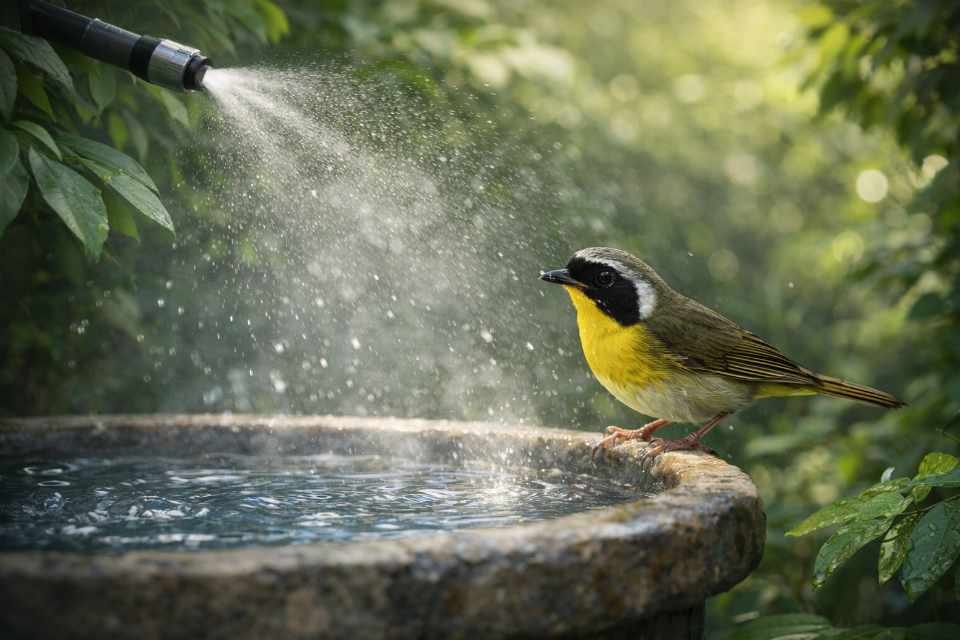
While separate from drinking water provision, misting systems create evaporatively cooled microclimates that reduce local temperatures. According to research on thermoregulation, evaporative cooling through environmental moisture reduces birds’ need to pant, conserving energy and water resources.
Simple misting systems connected to garden hoses deliver fine water droplets that evaporate rapidly, cooling surrounding air without creating standing water. Position misters to create cooling zones near established perching areas, running systems during peak heat hours (typically 2:00-6:00 PM).
Low-pressure misters work effectively for backyard applications. Avoid high-pressure systems that waste water or create excessive moisture that could promote mold growth. Operate misters intermittently (15 minutes per hour) rather than continuously to balance cooling benefits with water conservation.
Strategic Surface Treatment
Dark surfaces absorb and re-radiate heat, creating localized hot zones that exacerbate heat stress. The tropical environment research found that concrete exposed to solar radiation peaked at 53°C (127°F), while the same surface in shade measured 5°C cooler.
Replace dark asphalt or concrete near bird habitat with lighter-colored materials that reflect rather than absorb solar radiation. Permeable pavers in light colors, crushed stone, or light-colored mulch all reduce surface heating compared to standard dark paving.
For existing dark surfaces that cannot be replaced, apply light-colored sealants or paints designed for outdoor use. This simple modification can reduce surface temperatures by 10-20°F during peak summer heat.
Plant Selection for Maximum Cooling
Not all plants provide equal cooling value. Strategic species selection maximizes temperature reduction in bird habitat areas.
High-Transpiration Native Species
According to research on tree cooling efficacy, physiological traits including stomatal conductance and transpiration rate determine evaporative cooling capacity. Species with high transpiration can reduce ambient temperatures by approximately 0.5-2°C compared to species with lower transpiration capacity.
Native oaks, maples, and willows demonstrate high transpiration rates that enhance cooling beyond simple shade provision. These keystone species also support the insect populations that birds require for summer feeding, creating multi-functional habitat. For guidance on selecting appropriate species, see our article on best plants to attract birds in spring.
Avoid drought-stressed plants that close stomata and reduce transpirational cooling. During heat waves, strategic irrigation of key shade trees maintains their cooling function, though this must be balanced against water conservation needs.
Multi-Layer Canopy Design
Research demonstrates that multi-layered vegetation communities enhance overall cooling benefits through strengthened shade-transpiration synergy. Properties designed with canopy trees (30+ feet), understory trees (15-25 feet), tall shrubs (8-15 feet), and low shrubs (3-6 feet) create graduated shade zones and multiple thermal refuge options.
This vertical diversity allows birds to select preferred temperature zones based on species-specific tolerances and current heat load. Ground-dwelling species like towhees benefit from low, dense shrub shade, while canopy foragers like warblers utilize upper-story tree shade.
Dense ground cover vegetation provides additional cooling at the lowest level where reflected heat from bare soil would otherwise accumulate. Native ferns, sedges, and low-growing wildflowers create cool, moist microenvironments while supporting the insect populations birds need.
Seasonal Timing and Heat Wave Preparation
Proactive preparation before heat waves arrive ensures cooling features function when birds need them most.
Spring and Early Summer Installation
Install permanent cooling features including shade trees, dense shrubs, and structural refuges during spring when temperatures remain moderate. This timing allows plants to establish root systems before summer stress and ensures features are functional when heat waves strike.
According to guidance on preparing gardens for nesting birds, complete major planting and construction work before breeding season begins. However, installing emergency shade structures during active nesting requires care to avoid disturbing active nests.
Monitoring Weather Forecasts
Heat waves typically develop with several days warning, allowing preparation of temporary cooling features. Monitor forecasts for predicted temperatures exceeding 95°F (35°C) for multiple consecutive days, particularly when combined with high humidity that impairs evaporative cooling.
When heat wave warnings issue, deploy temporary shade cloth, check irrigation systems for key shade trees, and ensure misting systems function properly. These proactive measures provide maximum benefit when extreme temperatures arrive.
Post-Heat Wave Assessment
After heat waves pass, assess which cooling features proved most utilized by birds. Look for concentrated activity around specific shade trees, heavy use of particular brush piles, or frequent perching in certain shaded areas. These observations inform future cooling feature placement and design.
Document any areas where birds appeared heat-stressed despite available cooling features, indicating need for additional shade or shelter in those locations.
Regional Considerations
Cooling strategies must adapt to regional climate patterns and bird communities.
Temperate Regions
In temperate zones, heat waves typically occur sporadically rather than as sustained conditions. Focus cooling efforts on providing temporary refuge during occasional extreme heat events rather than designing for continuous summer cooling.
Deciduous trees optimized for summer shade naturally lose leaves in winter, avoiding excessive cooling during cold months. Mixed plantings combining deciduous and evergreen species provide balanced year-round habitat while maximizing summer cooling.
Arid Regions
According to research, in arid climates, evergreen species predominate and demonstrate more effective cooling within compact plantings. However, these species require irrigation to maintain transpirational cooling during drought and heat stress.
Desert-adapted birds show higher heat tolerance limits than temperate species but still require thermal refugia during extreme events. Focus on creating dense shade pockets rather than attempting broad cooling across entire properties.
Humid Tropical Regions
The tropical research found that the combination of shade and evapotranspirational cooling provides surface temperatures consistent with ambient air temperatures. Humid regions benefit more from shade optimization than from transpiration enhancement, as high ambient humidity limits evaporative cooling effectiveness.
Dense, multi-layer evergreen plantings provide year-round cooling in tropical climates where seasonal variation remains minimal.
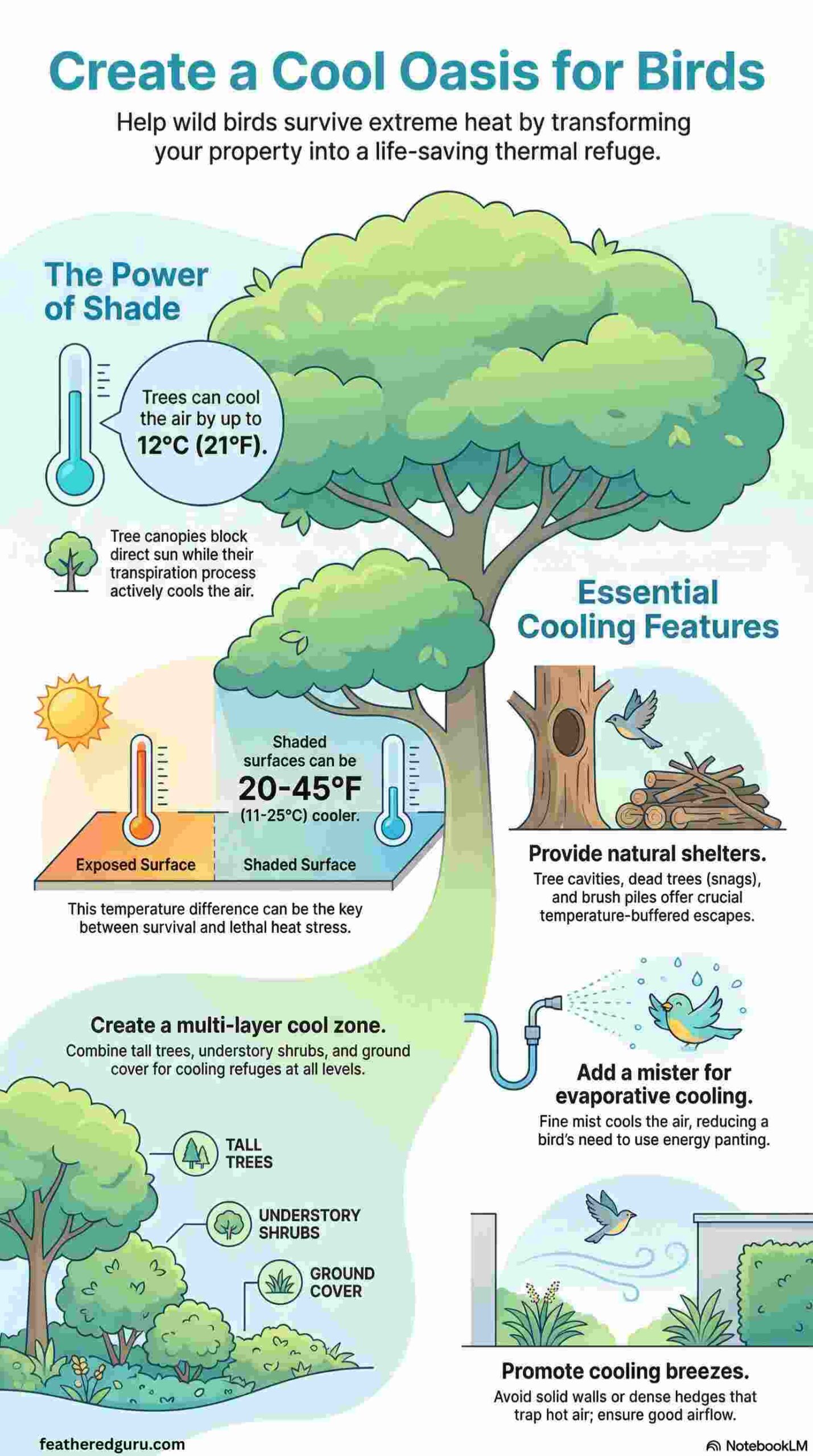
Cheat Sheet: Summer Bird Care & Heat Stress Symptoms
If you’re in a hurry or want a shareable guide for your local bird-watching group, we’ve summarized the critical signs of heat stress and cooling solutions in the visual guide below:
Conclusion
Providing effective cooling for backyard birds during heat waves requires comprehensive strategies addressing shade provision, natural shelter availability, airflow management, and purpose-built cooling features. Research demonstrates that trees can reduce local temperatures by up to 12°C through combined shading and transpiration, while natural refuges like tree cavities offer thermally buffered microenvironments where birds escape lethal heat.
Multi-layer native plantings create graduated cooling zones that accommodate species-specific thermal preferences, with dense canopy trees providing broad temperature reduction and understory shrubs offering low-level shade. Strategic airflow management enhances natural convective cooling without creating heat traps, while supplemental features like shade cloth and misting systems provide additional temperature relief during extreme events.
The increasing frequency and intensity of heat waves driven by climate change makes provision of thermal refugia increasingly critical for maintaining backyard bird populations. Properties designed with comprehensive cooling features support birds during their most vulnerable periods, reducing mortality from heat stress while providing the shade and shelter necessary for successful summer survival and reproduction.