
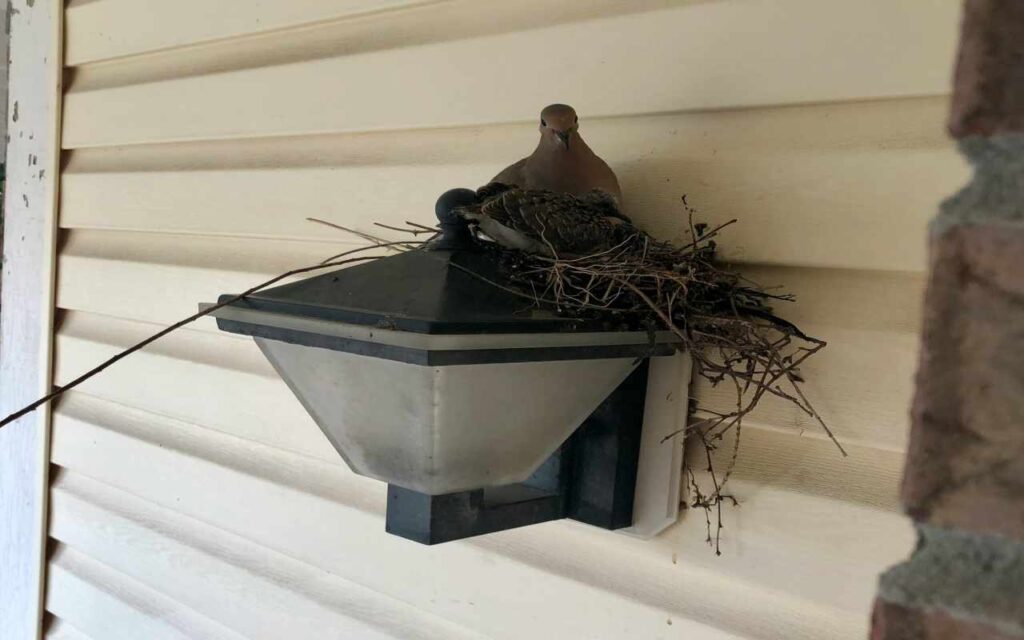
Every spring, Mourning Doves build some of the flimsiest nests in North American backyards. It is often just a platform of loosely woven twigs so thin you can see the white eggs through the base, leaving many birders wondering how to safeguard these vulnerable nests from backyard predators. The whole operation takes just 2 to 4 days and looks like it might fall apart in the first wind.
And yet, Mourning Doves are among the most successful breeding birds on the continent, with a U.S. population of roughly 350 million. That success comes not from a fortress nest, but from a combination of strategic site selection, constant parental presence, and behavioral defenses that compensate for structural simplicity.
Quick Answer: How do you protect a mourning doves nest from predators?
The most effective nest protections are elevated placement on a stable artificial ledge or nesting cone with overhead cover, an indoor-only cat policy within 100 feet, exterior window marking to prevent parental panic-strikes, and a strict hands-off monitoring protocol. Fake owls and reflective tape near an active nest will likely scare the parents away. Note that the Migratory Bird Treaty Act makes it illegal to disturb or move an active nest with eggs or chicks.
How to Safeguard Mourning Dove Nests: A Visual Explainer
To help you visualize the specific predator-proofing techniques discussed in this guide, we have included a video breakdown below. This analysis deconstructs the structural physics of nesting cones and the precise timing of the “10-to-4” incubation shift
Show Transcript:
0:00
So, a few weeks ago, something pretty wild happened right on my back porch. I walk out one morning and there it is, a morning dove, just sitting on this tiny
0:08
little pile of twigs perched on a narrow ledge right under the eaves. And let me tell you, what started as just a simple bird nest ended up being a complete
0:17
masterclass in survival. My first reaction, pure excitement. My second reaction, oh, immediate panic. I mean,
0:24
this spot just seemed unbelievably bad.
0:27
It was right next to the door I use every single day on a ledge that was barely wider than the bird itself. On one hand, I was thrilled to have a front row seat to this little drama, but on
0:35
the other, I was just absolutely convinced it was doomed from the start.
0:39
And the nest itself, oh man, you could barely even call it a nest. It was well,
0:46
it was kind of pathetic. Seriously, it was so flimsy that when the parent bird moved, I could almost see the two little white eggs right through the bottom. It
0:55
looked like the laziest construction project I had ever seen in my life. I just thought, there is no way this thing in this spot is going to make it. So,
1:03
naturally, I started googling and what I found just completely blew my mind. It turns out the morning dove population in the US is something like 350 million.
1:14
All of a sudden, I realized this flimsy nest wasn’t some mistake. It was part of this enormous continent-wide success story. And that’s when it finally hit
1:23
me. I was looking at this all wrong. I didn’t understand their strategy at all.
1:27
So, my whole perspective just flipped. I stopped looking at the nest as the problem and I started looking at my own backyard. And suddenly, this familiar,
1:35
peaceful space completely transformed.
1:38
It felt, well, it felt menacing. I started seeing danger lurking everywhere, all from the perspective of two tiny, very vulnerable eggs. My
1:47
research gave me this kind of predator watch list: blue jays, crows, raccoons,
1:52
even house cats. And my entire view of the neighborhood wildlife just changed.
1:56
You know those blue jays I always enjoyed watching? Well, they started to look a lot less charming and a lot more like these calculating aerial scouts
2:03
just patrolling for their next meal. But just as my anxiety about all these predators was hitting its peak, I started to notice things and my fear for
2:12
the doves slowly started turning into this deep admiration. I began to realize they weren’t just sitting ducks. They
2:20
had their own playbook, their own really sophisticated defense systems that I had just completely missed. The first thing
2:27
that really amazed me was discovering that the nest was never ever empty. I started noticing this little swap out they were doing. What I learned was the
2:36
male takes the day shift from about morning to mid-afternoon and then the female takes the long night watch. They
2:42
had this strict 24/7 guard schedule. And this discovery completely changed how I saw those bright white eggs. I’d been
2:50
looking at them as this huge liability, like a bright beacon for predators. But then I read this and it all just clicked. The eggs don’t need camouflage
2:59
because the whole strategy is to never leave them exposed. That white color isn’t a weakness. It’s a sign of their incredible commitment. And then I saw
3:08
something truly incredible. One afternoon, I accidentally got a bit too close and the parent on the nest flew down to the grass. It started fluttering
3:16
around, dragging its wing, just looking desperately injured. My heart sank. I thought I’d caused a terrible accident.
3:23
But just as I took a step towards it, it suddenly flew off, perfectly healthy. It was a trick, a brilliant, calculated
3:31
performance designed to lure a threat like me away from the nest. Okay, so I was starting to understand their defenses, but I still couldn’t get past
3:39
the location. I mean, of all the trees and shrubs and safe spots in my neighborhood, why this exposed artificial ledge right next to my door?
3:47
It just seemed like the one big thing they got completely wrong. And then I found this data. And this was the big
3:54
aha moment. A study from way back found that nests on artificial sites like my porch ledge had a success rate of nearly
4:02
61%, nests in natural places like trees only about 44%. The key is that their flimsy nest is actually made more secure
4:11
by the stability of a man-made structure. They weren’t making a mistake. They knew exactly what they were doing. So, at this point, I decided
4:19
I couldn’t just be a worried bystander anymore. I wasn’t going to interfere, of course, but I realized there were a few small non-invasive things I could
4:26
probably do to help tip the scales just a little more in their favor. I had to shift from being a passive observer to
4:33
an active but very careful ally. So, I made a plan. I learned that a lot of the common ideas like putting up a fake owl
4:41
or some shiny tape can actually scare the parents into abandoning the nest.
4:46
And trying to improve their nest is a definite no-go. So, instead, I focused on what I could control. I made the nearby window safer, and I set up a
4:54
strict perimeter for myself and my family. My whole goal was just to reduce any risks that I might be creating. For the window, I learned about this simple
5:02
little trick called the 2×4 rule. A bird in a panic might not see the glass. So,
5:07
I just used some basic tape on the outside of the window to create a grid pattern. It breaks up the reflection,
5:12
makes the glass visible, and helps prevent a really tragic collision during one of their quick entrances or exits.
5:18
So, after I made the window safe, my only job left was to wait. And I’ve got to be honest, this was the hardest part
5:26
of the entire experience. I had to learn the art of just doing nothing at all.
5:32
And this is why it was so important. I read this sentence and it just hit me like a ton of bricks. Getting too close,
5:40
checking on them too often. My own curiosity could literally scare a baby bird out of the nest before it was ready
5:47
to fly. My good intentions could directly cause the worst possible thing to happen. So, I came up with a simple
5:55
three-step protocol for myself. Number one, stay back at least 10 ft at all times. Two, check on them very rarely,
6:03
just a quick glance every couple of days from a distance. And three, the most important rule, never ever get close enough to flush the parent off the nest.
6:13
That sitting bird is the nest’s entire security system, and me causing it to flee would create the exact kind of danger they work so hard to prevent. And
6:22
then about 28 days after I first saw that dove, I came out one morning and the nest was empty. There was no sign of
6:29
a struggle, no feathers, nothing. Just a quiet, empty pile of twigs. And you know, instead of feeling sad, I just
6:37
felt this huge wave of relief and this quiet satisfaction. They did it. They actually did it. Looking back, this
6:44
whole experience really taught me three huge lessons. First, that flimsy-looking nest isn’t a flaw. It’s a brilliant design, especially when you pair it with the stability of our own structures.
6:56
Second, a parent on a nest is an active guard, and flushing them off is like disabling the alarm system. And finally,
7:02
and maybe this is the most important one. Sometimes the most helpful thing you can possibly do is just admire from a distance and leave them alone. It really makes you wonder, doesn’t it?
7:12
This whole intricate drama of survival and strategy and instinct was playing out just a few feet from my door, and I almost completely missed it. It leaves
7:20
me with this one last thought. How many other stories just like this are unfolding right outside our windows,
7:27
just waiting for us to stop and pay attention?
The Vulnerability Gap: Why Doves Choose High-Risk Nest Sites
Why the Flimsy Nest Strategy Creates Visible Egg Exposure
The Mourning Dove’s open-cup twig platform is a speed-optimized design. Built in 2 to 4 days, it allows a pair to complete multiple nesting cycles across a single season, up to six broods in warm climates. The trade-off is structural transparency.
Unlike the deep cup nests of robins or the cavity nests of chickadees, the dove’s platform conceals very little. The white eggs are sometimes visible through the base of the nest when viewed from below.
When the nest is placed in an exposed location with sightlines from multiple directions, corvids such as Blue Jays and American Crows can locate it visually during their routine territory surveillance.
This is why site selection matters so much. The nest’s structural design cannot be improved, but its placement can significantly limit the angles from which predators can approach and visually detect it.
The Artificial Ledge Advantage: 60.9% vs. 44.2% Success Rate
Despite the nest’s apparent fragility, doves on artificial structures fare significantly better than those on natural sites. A study published in the Proceedings of the Iowa Academy of Science by Gary Nelson (1976) tracked 293 total nesting attempts across artificial and natural sites in central Minnesota: 69 attempts in artificial nests and 224 in natural nests.
Artificial nest sites achieved a 60.9% success rate. Of 224 nesting attempts in natural nests, only 44.2% succeeded. The difference was statistically significant and driven primarily by reduced predator access and structural stability.
A flat ledge 10 feet above a porch is harder for raccoons and snakes to reach, harder for corvids to approach from multiple angles, and does not sway in wind the way a tree branch does. The flimsy nest performs considerably better when the platform it sits on is stable and the approach routes are limited.
Convective Heat Loss and Structural Placement
Beyond predation, exposed nest sites create a thermal vulnerability. Young doves are altricial: hatched helpless, featherless, and unable to thermoregulate. For the first several days of life, the squabs depend entirely on parental brooding to maintain body temperature.
A nest site exposed to full wind on all sides accelerates convective heat loss from the nest cup during the brief windows when a parent is absent at shift change. A site with overhead cover from an eave, overhang, or dense branch canopy breaks the wind above the nest and significantly reduces this thermal drain.
This is why placement under a 12-inch or deeper porch overhang is the gold standard for suburban dove nesting sites. The overhang simultaneously blocks hawk stoops from above, limits corvid approach angles, and reduces convective heat exposure during incubation and the nestling’s first week.
Identifying the Threat: Common Backyard Nest Raiders
Aerial Predators: How Corvids Use Visual Scouting to Find Exposed Nests
Animal Diversity Web’s Mourning Dove account from the University of Michigan lists the confirmed known predators explicitly: falcons, hawks, raccoons, domestic cats, domestic dogs, and black rat snakes. Corvids and grackles are documented as nest raiders in other ornithological literature but are not included in ADW’s confirmed predator list for this species.
Corvids are visually oriented hunters. Research published in Animal Biology by Husby (2019) used paired artificial nests to test how corvids locate nest sites. Within 10 days, 62.9% of monitored nests were predated. The study found that nests near corvid territories suffered significantly higher predation rates, and that auditory cues such as nestling begging calls elevated predation risk substantially over nests that were silent.
The practical implication for suburban dove nests is that corvid predation pressure peaks in the 8 to 12 day window of the nestling period, when squabs are producing the begging calls that signal their presence to nearby jays and crows. Keeping foot traffic, noise, and disturbance near the nest to a minimum during this period reduces the likelihood of corvids investigating the area.
Climbing Mammals: Raccoons, Opossums, and Nocturnal Raids
Raccoons and opossums are the primary mammalian nest predators for suburban dove nests, conducting most of their raids during the overnight period when the female parent is on the nest. Raccoons are capable climbers that can reach nests on gutters, low eaves, and horizontal branches with relative ease.
Nest height is an important protective factor. The Springer study on nest predation and height shows that mammalian predators are more likely to target lower and more accessible nests, supporting findings that Mourning Dove nests are especially vulnerable when placed close to the ground or in exposed locations.
Placement above 10 feet on a smooth-posted artificial structure without footholds significantly reduces raccoon access compared to a nest in a shrub or on a low branch.
Smooth metal post baffles, the same design used to protect bird feeders from squirrels, can be used below an artificial nest platform to prevent raccoon climbing. A baffle installed below the mounting post creates a physical barrier that raccoons cannot pass even with their substantial climbing ability.
The Feline Factor: Why Ground-Level Nesting Requires a Strict Cat Buffer
Mourning Doves occasionally nest on or near the ground, and fledgling doves spend several days on the ground after leaving the nest while the male parent continues to feed them. During this period they cannot fly at escape speed and are highly vulnerable to domestic cats.
The Cornell Lab of Ornithology’s Mourning Dove overview notes that these birds spend much of their time on the ground and specifically advises keeping cats indoors, as ground-feeding species like Mourning Doves are especially vulnerable to prowling predators. A free-roaming cat does not need to be a skilled hunter to represent a lethal threat to a fledgling dove that has just left the nest for the first time.
The indoor-only standard within 100 feet of a known nest or recent fledging site is not excessive. The ground vulnerability window lasts approximately 10 to 15 days after fledging. After that period, the young doves have developed the flight speed to escape a charging cat consistently.
For additional guidance on seasonal food that supports resident dove pairs year-round, the resource on what Mourning Doves eat covers seed selection and feeder setup across all four seasons.
Structural Security: How to Protect a Mourning Dove Nest
The Nesting Cone Solution: 360-Degree Platform Stability
Cornell Lab of Ornithology’s Mourning Dove species overview recommends installing a nesting cone to attract and support breeding pairs, noting it should be placed before breeding season begins. A nesting cone is a cone-shaped wire mesh or wooden platform mounted to a tree or post that provides the stable horizontal surface doves select for while containing the loose twig nest within its walls.
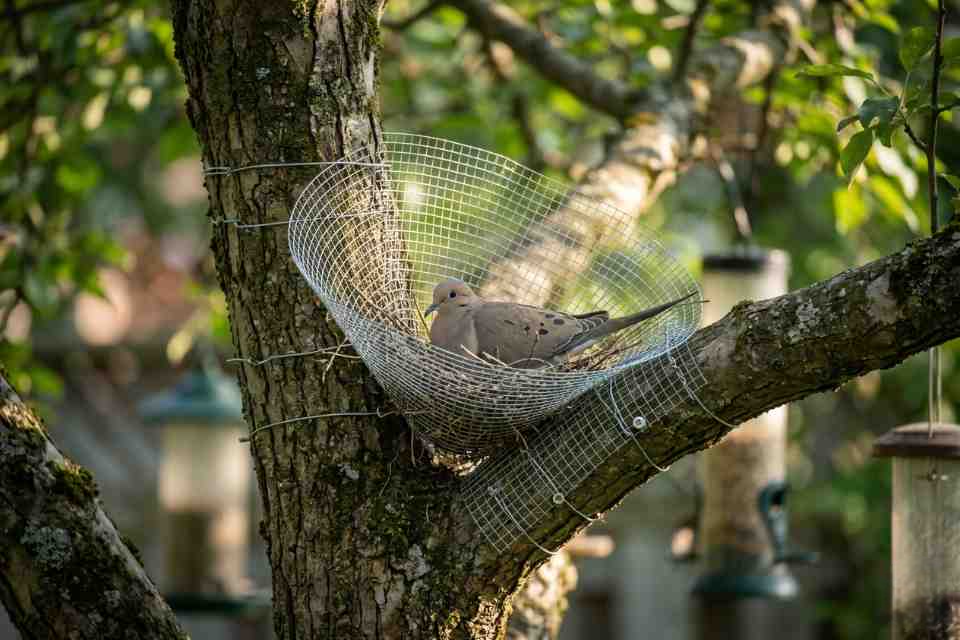
The cone shape is the key feature. A flat platform allows the loose twig nest to shift and drift in wind. The cone’s raised edges retain the nest structure, preventing the platform from sliding or blowing away during the sudden summer storms that are the most common non-predation cause of suburban nest failure.
Placement should be at 8 to 15 feet, under some overhead cover such as a branch or eave, with a clear flight approach from at least one direction and no dense vegetation at the base that would provide concealment for ground predators approaching the post.
Artificial Ledges and Shelters: The 12-Inch Overhang as Hawk Defense
A porch ledge or artificial shelf mounted directly under a 12-inch or deeper overhang provides the most complete predator protection available in a suburban setting. The overhang above physically blocks a hawk from completing a stoop attack: a Cooper’s Hawk or Sharp-shinned Hawk cannot fold its wings fast enough to follow a trajectory that requires a 90-degree downward approach through a gap less than 12 inches.
The same overhang limits the corvid approach angles to a horizontal flight entry from the front, which requires the bird to land on the ledge itself rather than dropping from above. A ledge positioned against a wall with overhang above and solid wall behind reduces the number of viable approach angles to essentially one, compared to a nest in open canopy that can be approached from any direction.
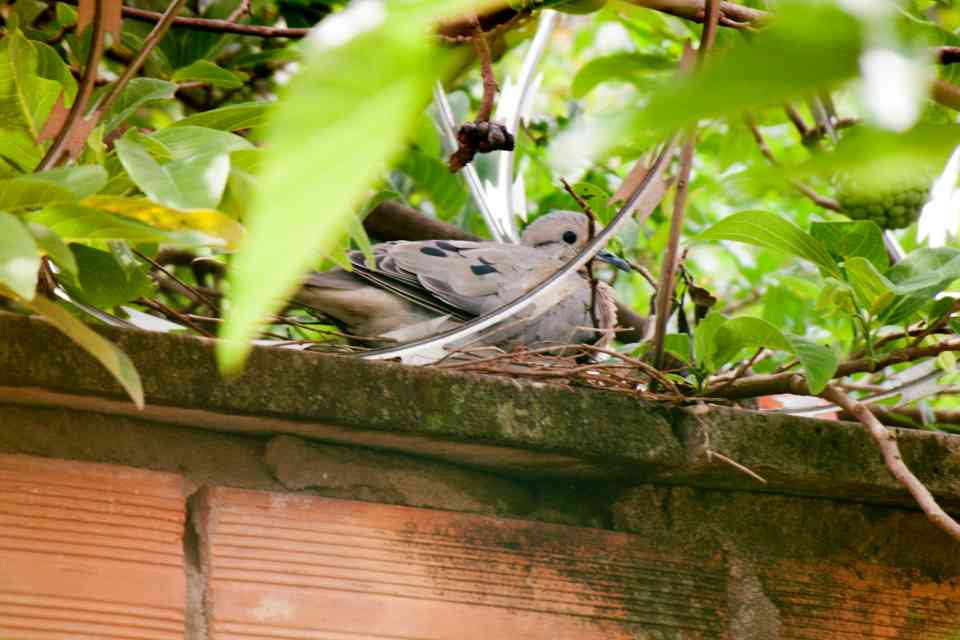
For a complete overview of substrate selection and why doves show such strong preference for artificial porch structures, the comprehensive guide to Mourning Dove nesting habits in suburban environments covers the full site selection decision-making process backed by research.
Gutter Security: Legal Obligations Under the Migratory Bird Treaty Act
Finding a Mourning Dove nest in a gutter is one of the most common suburban nesting scenarios, and one governed explicitly by federal law. U.S. Fish and Wildlife Service guidance on bird nest protection states that under the Migratory Bird Treaty Act, it is illegal to destroy a nest containing eggs or chicks, or young birds still dependent on the nest for survival.
This means a nest with active eggs or live squabs cannot legally be removed from a gutter without a federal permit, which is rarely granted for residential situations. The legal and practical response is to wait: the fledging period is only 14 to 15 days from hatching, and once the nest is fully inactive with no eggs or dependent young, it can be removed and gutter guards installed to prevent recurrence.
Attempting to relocate an active nest without a permit, even with good intentions, constitutes a federal violation. Gutter guards installed outside the nesting season (typically late autumn through early February in most of the United States) prevent the situation entirely without any legal risk.
Behavioral Defenses: The “Broken-Wing Feign” and Nest Shifts
The 10-to-4 Rule: The Male’s Daytime Incubation as Active Lookout
Birds of the World’s Mourning Dove breeding account documents the incubation shift schedule precisely: the male incubates from midmorning until late afternoon, the female during the remainder of the 24-hour period. In practice, this means the bird on a nest at midday is almost certainly the male, and the bird on a nest at dawn is almost certainly the female.
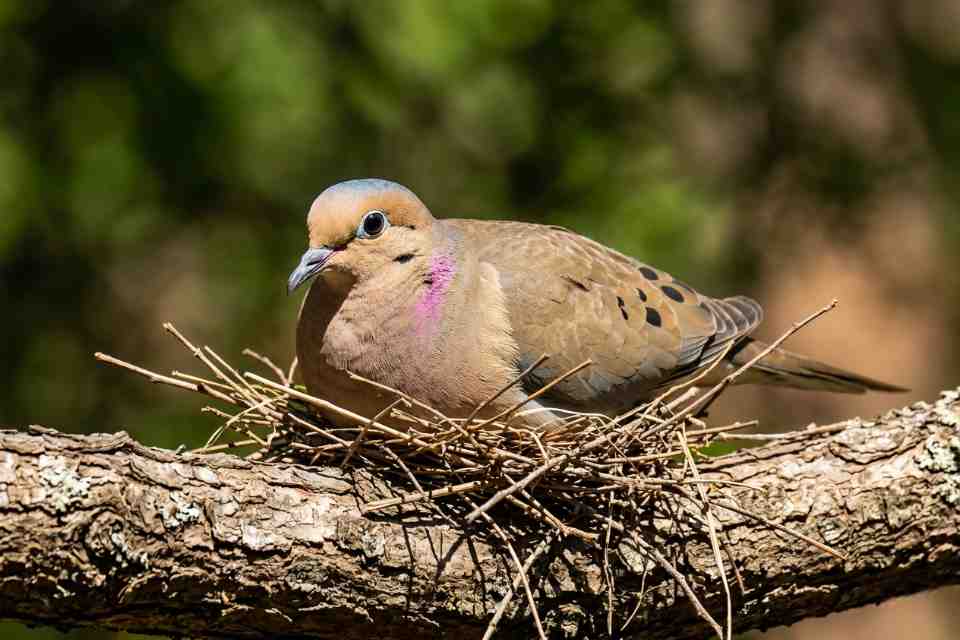
This continuous parental coverage is not simply an incubation strategy. It functions as a 24-hour nest guard. Because one parent is always present on the nest, the white unspeckled eggs are never left exposed and unprotected. White eggs in birds are typically a signal of continuous parental coverage: there is no evolutionary pressure to camouflage eggs that are never left unattended long enough for a visual predator to locate and exploit them.
Any disturbance that causes both parents to flush simultaneously, even briefly, removes this protection during the exposure window. This is why human disturbance near the nest is actively harmful: it creates the unguarded exposure window that the doves’ entire incubation strategy is designed to prevent.
The Distraction Display: How Parents Lead Ground Predators Away
When a ground predator approaches a Mourning Dove nest, the parent on the nest does not simply flush and fly away. The Pigeon Wiki account for Mourning Dove notes that when an incubating adult is flushed from the nest, it may perform a nest‑distraction display — fluttering along the ground as if injured to lure a predator away before flying off once the threat has been drawn a safe distance from the eggs or squabs (“broken‑wing” feign).
The bird drags one wing along the ground, moves erratically, and calls in a pattern that convinces a visually oriented predator it has found easy prey. When the predator has followed the bird far enough from the nest, the dove suddenly takes flight at full speed and the deception ends.
This “broken‑wing” or nest‑distraction display is documented in Wikipedia’s Distraction display, which notes that species including the mourning dove perform injury‑feigning behavior to lure predators away from nests, citing sources such as Ecology and Management of the Mourning Dove (Baskett et al., 1993).
This behavioral defense is specifically effective against ground-based visual predators such as cats, foxes, and humans. It is not effective against corvids, which are aerial and can approach the unguarded nest while the parent is executing the ground display away from it. This is the key reason why aerial predator deterrence through site selection (overhang placement, approach angle limitation) is necessary in addition to the doves’ own behavioral defenses.
White, Unspeckled Eggs: A Biological Signal of 24/7 Parental Coverage
The white color of Mourning Dove eggs is not a vulnerability. It is a documented feature of species with continuous parental nest coverage. Audubon Society’s Mourning Dove fun facts confirm that the female lays two white eggs and both parents trade off incubation duties for the full two weeks until hatching, with one parent always on the nest.
Cryptically patterned eggs are an adaptation for species whose eggs are regularly left unattended and must rely on camouflage for protection. Mourning Dove eggs never need camouflage because the nest is never left exposed.
The practical implication for homeowners is clear: any action that causes extended parental absence, including frequent nest checks, noisy activity near the nest, or deliberate flushing of a sitting parent, removes the protection that makes white unspeckled eggs viable in the first place. The eggs’ survival strategy depends entirely on one parent being present at all times.
Managing the Sanctuary: Infrastructure for Success
The 2×4 Safety Grid: Preventing Parental Panic-Strikes at Windows
A dove flushing rapidly from a nest located near a reflective window is traveling at full flight speed within two wingbeats. If the departure path passes a glass surface, the collision risk is real and repeated across every incubation shift change and every disturbance event over the nest’s 28-day active period.
The American Bird Conservancy’s recommended exterior window marking standard, coined by ABC’s Bird Collisions Campaign Director Christine Sheppard, is a 2-inch by 4-inch grid: no gaps larger than 2 inches vertically and 4 inches horizontally across the full exterior glass surface. UV-reflective film, adhesive dot-pattern tape, and scored window film all achieve this if applied to the outside of the glass.
Interior treatments do not work. The reflective surface is the exterior glass face, and a decal on the inside does not interrupt the reflection a dove sees while flushing. For a comprehensive guide to window strike prevention techniques across all seasons, the resource on preventing birds from hitting windows covers the full range of verified exterior solutions.
For the fall period when doves and other yard birds are most active near structures, the guide to preventing window strikes in fall covers timing and peak risk periods.
Visual Deterrents: Why Fake Owls and Reflective Tape Can Backfire Near Active Nests
Plastic owl decoys and reflective tape are among the most commonly marketed bird deterrent products, and both carry a significant risk when placed near an active dove nest: they may deter the predator, but they may also deter the parents.
Research cited by EWASH’s analysis of owl decoy effectiveness, drawing on a study published in Applied Animal Behaviour Science, found that birds habituated to stationary fake owls rapidly, often within days, rendering them ineffective against the target predators. Meanwhile, Mourning Doves, which are prey for real Great Horned Owls, may respond to a plastic owl decoy near their nest by abandoning the nest entirely before habituation occurs.
Corvids, which are the primary aerial predator threat to dove nests, habituate to fake owls faster than most species. Several field reports document crows perching on or near plastic owl decoys within days of their installation. Placing a fake owl near an active dove nest risks scaring the parents while providing no meaningful deterrence to the actual corvid threat.
Reflective tape and flash tape near an active nest carry the same risk: they create unpredictable movement and light patterns that may trigger a parental flush response on every shift change, producing exactly the sustained disturbance and nest exposure that most increases corvid predation risk.
The Protection Checklist: A 2026 Summary
The Hands-Off Protocol: Monitoring Without Creating a Predator Trail
Human disturbance is a documented cause of Mourning Dove nest failure. Westmoreland and Best (1985) in The Auk compared 51 nests checked at 3-day intervals, flushing the parent at each visit, against 50 undisturbed nests monitored passively from a distance. Disturbed nests had significantly lower daily survival probabilities, with the effect strongest during incubation. The mechanism was predator attraction to human scent trails and nest exposure during flushed-parent windows.
The disturbance effect on fledging timing is directly documented: Westmoreland and Best (1985) found that disturbed nestlings fledged prematurely at around 10 days compared to the normal 13 to 14 days in undisturbed nests. A prematurely fledged squab at 10 days cannot fly effectively and faces greatly increased ground predation risk. The most common single cause of suburban nestling mortality is premature fledging triggered by repeated human disturbance.
The correct monitoring approach is passive and distant. A brief visual observation from at least 10 feet, once every 2 to 3 days, is sufficient to track nest status without triggering a flush response or leaving a fresh scent trail. Avoid checking during the first 48 hours after hatching, when the unfledged squabs are most vulnerable to temperature exposure if a parent is flushed.
If a squab is found on the ground before day 14 with no visible injury, leave it in place. The male parent will continue feeding a grounded fledgling for up to two weeks after it leaves the nest. Removing it interrupts that feeding relationship and causes the harm it is intended to prevent.
For attracting and supporting Mourning Dove pairs across the full nesting season, the complete guide to attracting Mourning Doves to your backyard covers food, water, and nesting infrastructure decisions that support resident pairs across multiple seasons.
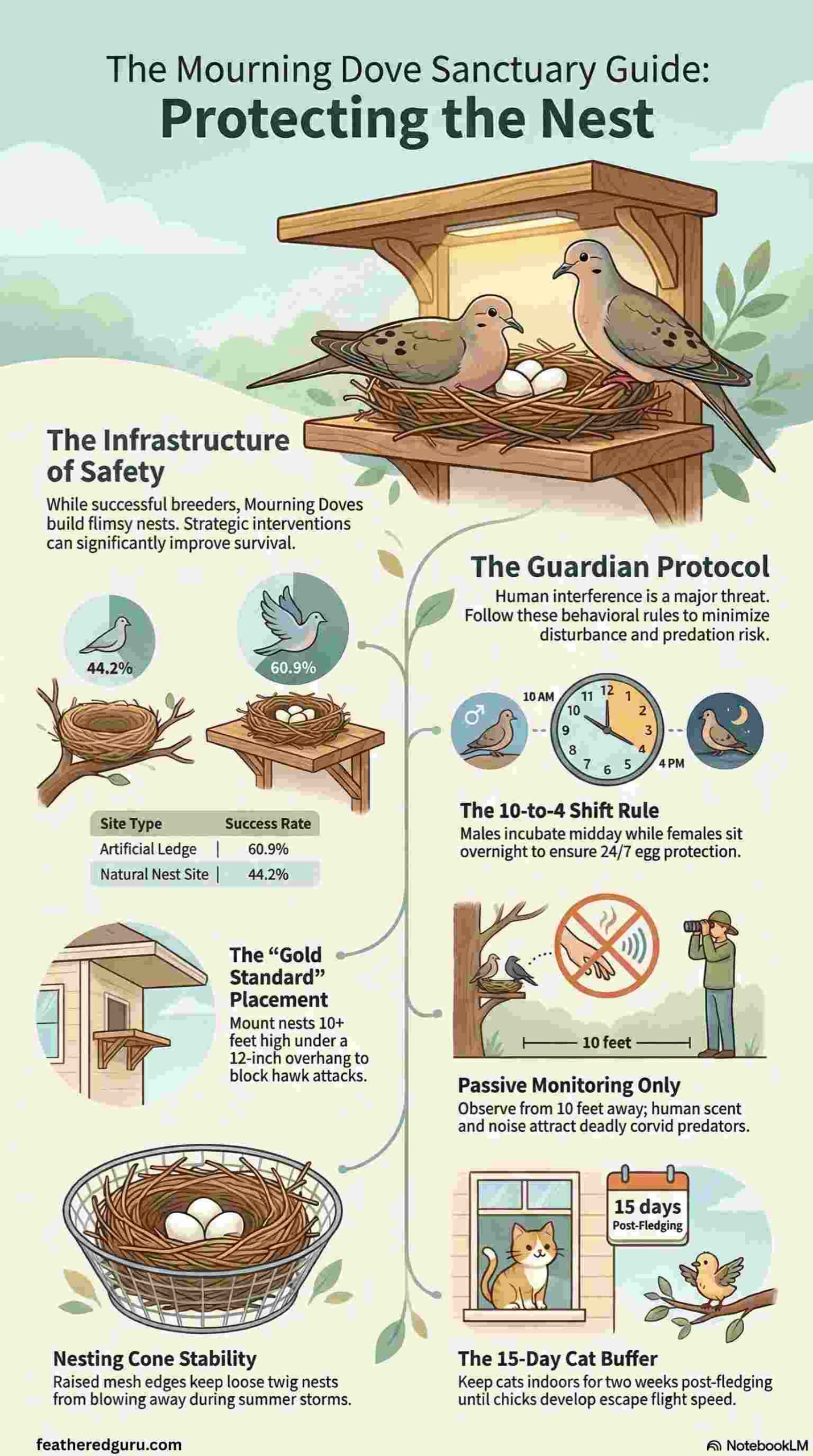
Visualizing the Sanctuary Shield: The Nest Protection Infographic
To synthesize the structural security measures and behavioral defenses required for nest success, we have created the Mourning Dove Protection Infographic below. This visual checklist provides a side-by-side reference for the 12-inch overhang defense, the 2×4 window safety grid, and the 100-foot feline buffer
Conclusion: Mastering the Science of Nest Security
Successfully protecting a mourning dove nest is a lesson in both structural physics and behavioral observation. Because the species utilizes a high-speed, “flimsy” nesting strategy, their survival depends on moving beyond a simple platform and optimizing for the 60.9% success rate found in artificial sites and protected ledges. These locations are the ultimate defense, physically blocking hawk stoops with 12-inch overhangs and reducing the convective heat loss that threatens altricial squabs.
While structural security is the foundation, understanding the behavioral “clocks” of the species provides the final layer of protection. By respecting the “10-to-4” nest shift and maintaining a strict hands-off protocol, you move from being a mere observer to an active sanctuary steward. Whether you are installing a nesting cone or enforcing a 100-foot cat buffer, these precise interventions turn a vulnerable backyard site into a masterclass in avian residency and suburban stewardship.