
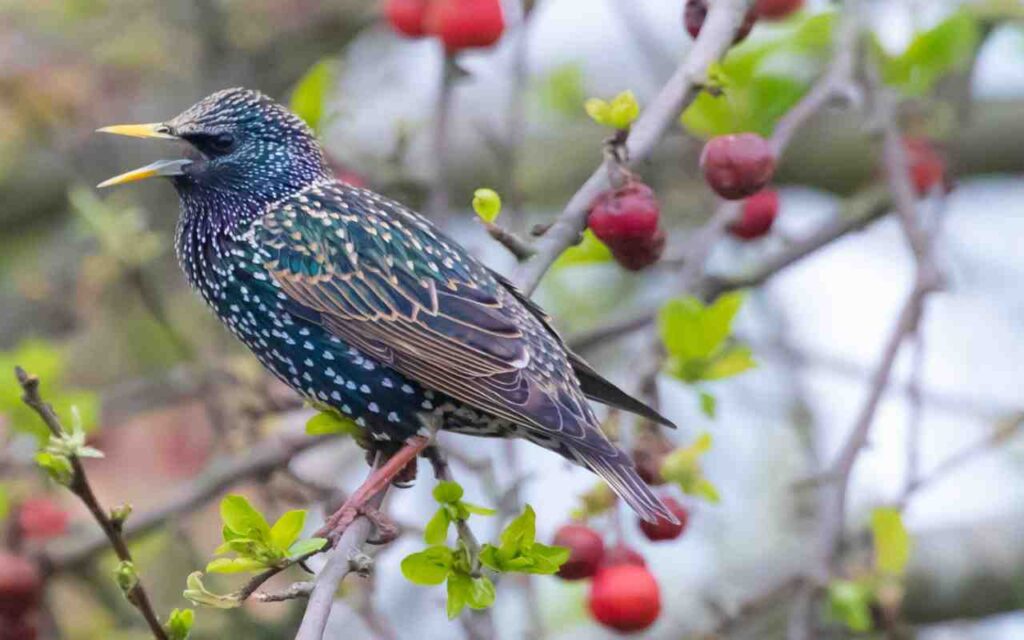
Most people recognize the European Starling as a shimmering iridescent pest, but few realize they are actually living biological recorders. For those interested in understanding starling calls and songs, it is vital to realize that this species has re-engineered its brain to archive and replicate sounds of the human and natural world with terrifying precision. While other birds are born with a fixed set of vocalizations, the starling is a master of vocal plasticity.
From the mechanical click-whir of a digital camera to the piercing cry of a Red-tailed Hawk, the starling’s repertoire is a complex vocal mosaic. This is not just random noise. It is a sophisticated survival strategy involving polyphonic singing and a dual-syrinx anatomy that allows them to produce two independent notes simultaneously. In this dossier, we move beyond basic bird calls to decode their secret language and explore the neurobiology behind their mimicry.
Quick Answer: How do starlings mimic so many sounds?
Starlings mimic sounds by using a unique dual syrinx anatomy that allows them to produce two independent notes simultaneously, a talent known as polyphonic singing. As open-ended learners, they archive environmental sounds ranging from predatory hawk cries to mechanical car alarms and incorporate them into their vocal repertoire to manipulate competitors and attract high status mates.
Watch: How Do Starlings Mimic So Many Sounds?
For a forensic breakdown of how these birds use their dual voice boxes to replicate everything from hawks to human speech, watch our explainer video below:
Show Transcript:
0:00
If I’m being honest, I never paid much attention to starlings. To me, they were just noisy flocks taking over bird feeders. I had no idea I was ignoring one of the most fascinating backyard birds right outside my window.
0:20
That changed one morning in my yard. I started hearing an incredible mix of sounds. First a red-tailed hawk call, then a meadowlark, then strange mechanical clicking noises. It made no sense. All of it was coming from the same spot behind my shed.
0:36
I looked closer and found a single European starling sitting on the fence. One bird producing all those sounds. It felt like a one-bird orchestra, and I had no idea how it was possible. That moment sparked a deep curiosity about starling behavior and bird vocalization.
1:03
To understand what I was hearing, I had to break it down. My list of sounds included a hawk, a meadowlark, and a killdeer, plus those odd clicking and mechanical noises. It sounded impossible, yet it was all coming from one bird.
1:33
The first big realization was that not all starling sounds are the same. Starlings produce both calls and songs. Calls are short, simple sounds used for alarms. Songs are much more complex and are learned over time, especially by males.
1:54
What I heard that morning was not just noise. It was a full starling song. These songs are long, layered, and constantly evolving. Male starlings build their songs throughout their lives, adding new sounds and patterns.
2:11
Even more surprising, starling songs follow a structure. They often begin with soft warbling to attract a mate, followed by loud whistles to warn other males. Then come the mechanical clicks used in close courtship, and finally the mimicry phase where the bird shows off its sound collection.
2:41
Once I understood the structure, the next question was how a single bird could produce such a wide range of sounds. The answer lies in a specialized vocal organ called the syrinx.
2:56
Unlike humans, who have one voice box, birds have a syrinx located where the windpipe splits. This gives them two independent sound sources. A starling can produce two different sounds at the same time, almost like singing a duet alone.
3:19
Each side of the syrinx has a role. The left side produces low warbles and tones, while the right side handles high-pitched whistles and mimicry. This allows starlings to blend sounds into complex and realistic sequences.
3:36
The speed is incredible. The muscles controlling the syrinx can adjust sound up to 250 times per second. This makes starling vocalizations some of the fastest and most complex among birds.
3:53
That explains what and how, but the biggest question is why. Why do starlings mimic other birds and even mechanical sounds like alarms or phones?
4:09
There are three main reasons. First, attracting mates. Males with larger and more varied song libraries are more appealing because it signals intelligence and survival skills.
4:19
Second, strategy. A starling can mimic a hawk call to scare other birds away from feeders, giving it access to food. This makes mimicry a powerful feeding advantage.
4:27
Third, communication. Starling flocks develop local sound patterns or dialects, which help them stay connected as a group.
4:35
What makes this even more interesting is that starlings do not limit themselves to bird sounds. They copy anything in their environment. Car alarms, camera shutters, phone notifications, and other urban noises can all become part of their song.
4:52
This leads to one of the most fascinating traits of starlings. They are open-ended learners. This means they continue learning new sounds throughout their entire lives.
5:06
An older starling does not just sing. Its song becomes a record of everything it has heard and experienced. Each sound reflects a place, a season, or an environment it has lived in.
5:19
There is even a famous example involving Wolfgang Amadeus Mozart. He owned a pet starling that learned the melody of one of his piano pieces and added its own variations. Mozart was so impressed that he reportedly held a funeral for the bird when it died.
5:43
After learning all of this, my perspective completely changed. That bird in my yard was not just making noise. It was telling a story through sound.
5:52
The hawk call might have come from a nearby field. The meadowlark song could reflect a past habitat. Each sound was part of a larger acoustic map of its life.
6:07
Instead of seeing starlings as pests, I started seeing them as recorders of their environment, capturing and replaying the sounds of the world around them.
6:11
So next time you hear a mix of strange bird calls or unusual sounds in your yard, stop and listen carefully. You might be hearing a starling building its song.
6:20
Think about your own surroundings. Traffic, phones, neighborhood noise. What sounds would a starling learn from your environment, and what story would it tell through its song?
What is the Difference Between Starling Calls and Songs?
The primary difference is that starling calls are short, hardwired vocalizations used for immediate communication like alarms, while songs are long, learned performances used by males to attract mates and defend territory. While calls are functional sounds every starling is born knowing, songs are complex acoustic biographies that include mimicry and original phrases assembled over the bird’s entire lifetime.

The practical acoustic difference is straightforward. A starling call is brief and often harsh: a rattle, a chip note, a metallic screech. According to Cornell Lab’s All About Birds, male and female starlings use around ten distinct call types to communicate flock location, danger level, and aggression.
The song is the opposite: fluid, variable, often exceeding a minute in length, and architecturally organized into recognizable stages. If you hear something that sounds like it might be two or three different birds, then changes character entirely and starts sounding like a meadowlark, you are listening to one male starling in mid-performance.
Distinguishing a starling from a Northern Mockingbird in the field comes down to two tells. The mockingbird repeats each imitated phrase three to six times before moving on. The starling blends its imitations into a continuous stream and rarely repeats.
The starling also produces a signature cluster of mechanical clicking and bill-rattling sounds that no mockingbird uses, described in more detail in Anatomy of a Masterpiece section. That combination of non-stop variety plus mechanical clicking is what ornithologists informally call the “whistle and click” signature of the species.
How is a Starling Song Structured?
A starling song is structured into four distinct phases: introductory whistles, a complex warbling section, a mimicry phase, and a high-frequency clicking finale. This consistent internal architecture is not random; rather, it is a predictable sequence that moves from simple attention-getting notes to highly complex learned phrases that signal a male’s age and physical quality to potential mates.
Research on the organization of warbling song in European starlings has established that a bout moves through these predictable phases and that the sequence itself carries functional meaning.
The bird begins with loud whistles to establish territory before transitioning into the rapid-fire warble that showcases his vocal range. The mimicry usually appears near the end of the bout, followed by the signature mechanical clicks that close the performance.
Why Do Starlings Warble?
Starlings warble to attract mates by demonstrating their physical quality and age through a long, complex sequence of rapid acoustic transitions. Because repertoire size increases as a bird gets older, a sophisticated warbling phase serves as a reliable signal to females that a male is experienced and in peak physical condition.
The warbling phase is the longest component of a full song bout and the most acoustically complex. It consists of low-frequency, variable chatter, with rapid transitions between dozens of phrase types.
Research from Behavioral Ecology and Sociobiology found that males with more complex warbling repertoires acquired mates faster than males with simpler songs, even when territory quality was controlled. The warble is a living record of the bird’s survival; only a bird that has survived multiple seasons has the experience to sing the most complex songs.
What is a Starling Whistle Call?
A starling whistle call is a short, high-volume broadcast signal used primarily to establish territory and communicate with rival males over long distances. Unlike the complex warbling song, whistles are acoustically simple and penetrating, designed to carry across a breeding territory to function as an audible boundary marker among neighbors.
Whistles are typically only a few seconds long. According to Cornell Lab’s All About Birds, these are the broadcast signals most often directed at rival males in territorial contexts. Whistle types tend to be shared between neighboring males in the same area, creating localized dialects that distinguish one breeding group from another.
Why Do Starlings Make Clicking and Rattling Sounds?
Starlings make clicking and rattling sounds using bill-clapping to enhance their courtship displays and act as aversive signals that disrupt the attention of competing males. These percussive bursts are a signature mechanical component of the starling song that distinguishes them from other mimics like mockingbirds, which do not incorporate bill-rattling into their vocal performances.
The mechanical clicking and rattling sounds that punctuate a starling song have no direct vocal equivalent in other common backyard species. Male starlings produce these sounds as part of their warbled song, generating percussive bursts that are distinct from anything produced by mockingbirds or thrushes. Acoustic analysis suggests that at close range, these sounds serve to both attract females and repel rival males simultaneously.
When Do Starlings Perform Their Mimicry?
Starlings typically perform their mimicry at the end of a song bout, saving their most complex imitations for a high-frequency finale after an initial series of whistles and warbles. This sequential organization allows the bird to establish its territory first before transitioning into a display of individual skill and repertoire complexity to attract potential mates.
High-frequency imitations of other species tend to cluster toward the end of a song bout, not the beginning. Research on the sequential organization of starling song shows that the performance typically opens with whistles and transitions into warbling. Saved for the finale, these imitations are the acoustically most distinctive moments of the performance, where the bird’s individual skill and memorized repertoire are most legibly on display.
How Does Starling Mimicry Work?
How Can Starlings Produce Two Sounds at Once?
Starlings can produce two independent notes simultaneously because of their dual syrinx, an avian vocal organ with two separate sound generators controlled by independent muscles. This biological lateralization allows the left side of the syrinx to produce low frequencies while the right side produces higher notes, enabling the bird to perform complex, layered songs known as polyphonic singing.
Research published in the Journal of Experimental Biology found that starling syringeal muscles are composed of fast oxidative and superfast fiber types, ranking them among the fastest vertebrate skeletal muscles. These muscles allow the bird to modulate sound amplitude up to 250 times per second.
Critically, a study in PLOS ONE on syrinx morphology confirmed a functional asymmetry where the two sound generators specialize in different acoustic ranges to create a layered, multi-instrument effect.
Additional research in PLOS ONE involving direct muscle stimulation of starling syringeal muscles in situ, proved that these muscles produce sound modulations at the same 250 Hz frequencies observed during natural singing, allowing for the rapid acoustic transitions heard in a starling’s warble.
That rate of modulation is what allows a single bird to produce the rapid, dense acoustic transitions heard in warbling song, where phrases change character in fractions of a second.
Why Do Starlings Mimic Mechanical Sounds?
Starlings mimic mechanical sounds because their vocal learning system is designed to maximize acoustic novelty, treating any complex high-frequency sound in their environment as valuable currency for mate attraction and territorial defense.
Because starlings are open-ended learners, they apply their neural machinery indiscriminately to both natural bird calls and anthropogenic sounds like car alarms and phone ringtones to create a unique and diverse repertoire.
Cornell Lab’s All About Birds notes that starlings can learn the calls of up to 20 different species, ranging from Killdeer to Red-tailed Hawks. The functional explanation is that any unusual, high-frequency sound in the environment is potentially valuable. A male whose repertoire contains a sound that no neighboring male has heard functions as a novel stimulus to both rivals and potential mates.
The mimicry of human-made sounds is a byproduct of a vocal learning system that evolved to maximize repertoire diversity. This system is applied indiscriminately to the full spectrum of available sounds in whatever environment the bird inhabits, from deep forests to urban city centers.
How Do Starlings Develop Their Song Repertoire?
European starlings develop their song repertoire by archiving sounds throughout their entire lives, creating a vocal map that serves as an acoustic biography of every location they have inhabited. Because they are open-ended learners, an older male’s song contains layers of mimicry that correspond to different geographic locations and seasons, reflecting years of acoustic exposure.
Field research has documented that starlings incorporate new syllables heard only in adulthood, meaning the mimicry sequences in an older male’s performance include sounds from multiple geographic locations and seasons. In that sense the repertoire functions as a vocal map: a record of acoustic exposure across years and environments.
Why Do Starlings Mimic Other Sounds?
Do Complex Songs Help Starlings Find Mates?
Yes, starlings mimic other sounds to build complex song repertoires that serve as high-quality signals for mate choice and physical health. Research published in Behavioral Ecology and Sociobiology (Springer) indicates that males with more complex songs acquire mates faster because a large repertoire is a reliable indicator of an older, more experienced bird in peak physical condition.
This preference exists because repertoire size in starlings increases with age, making it an “age-indicator” under sexual selection. By choosing a male with a diverse range of mimicked phrases, a female is obtaining a bird that has proven its ability to survive multiple seasons, rather than just selecting for acoustic novelty.
Why Do Starlings Mimic Hawks?
Starlings mimic hawks to act as acoustic camouflage, triggering a natural flight response in other birds to clear feeding areas and territorial boundaries without physical confrontation. By imitating predators like the Red-tailed Hawk, a starling can secure immediate access to a food source by tricking competitors into fleeing the area.
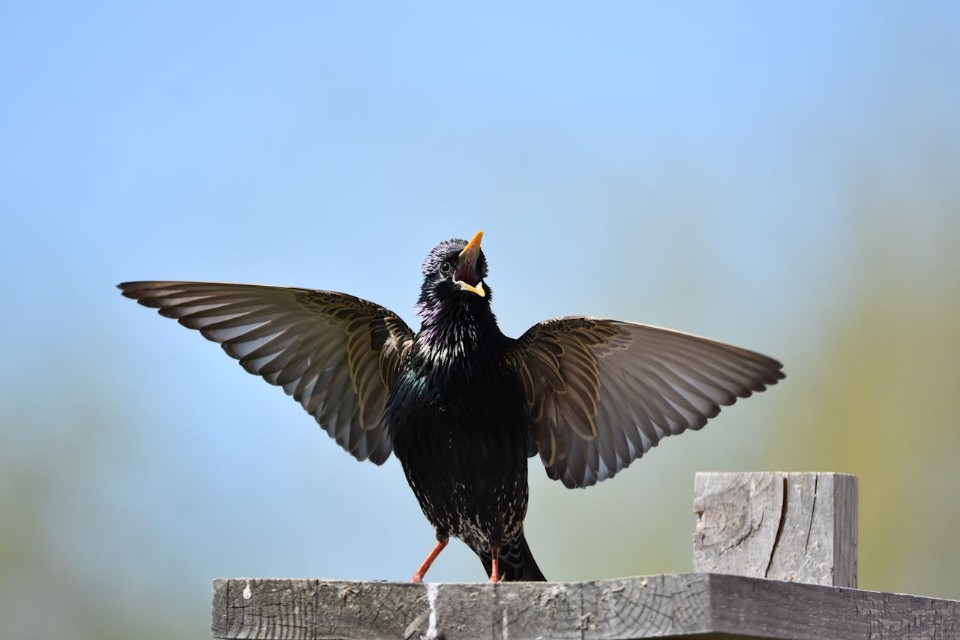
One of the most striking functional applications of starling mimicry is the documented use of predator vocalizations in competitive contexts. According to Cornell Lab’s All About Birds guide to European Starlings, these birds frequently imitate Red-tailed Hawks as part of their song repertoire.
Field observations have documented starlings deploying hawk vocalizations at feeders and territorial boundaries, where the call produces a flushing response in other species.
This tactical use of mimicry functions as acoustic camouflage: the starling does not appear threatening in the way a hawk does visually, but its acoustic signal can clear a feeding area without any physical confrontation. The cost is zero and the benefit can be immediate access to a resource.
Do Starlings Have Local Dialects?
Yes, starlings develop local dialects by selectively mimicking the sounds of nearby birds rather than distant ones, which helps them identify members of their own breeding group. These shared acoustic signatures act as social markers that contribute to flock cohesion, allowing birds to recognize and respond preferentially to individuals within their specific murmuration.
The result is local dialects that distinguish one breeding group from another. Within a murmuration, these shared elements contribute to flock cohesion: birds recognizing shared vocal signatures respond preferentially to those individuals, creating acoustic subgroups within what appears externally to be a single coordinated mass.
How Do You Identify Starling Alarm Calls?
What Do Different Starling Alarm Calls Mean?
You can identify starling alarm calls by distinguishing between a harsh, rattling sound for ground predators and a high-pitched ‘seet’ call for aerial threats. These functionally distinct vocalizations allow the flock to communicate the specific category of danger, such as a cat on the ground or a hawk in the sky, before the predator is even visible to a human observer.
The high-pitched “seet” call, shared by many songbird species, is produced specifically in response to aerial predators and has acoustic properties that make it genuinely difficult to localize, a feature that protects the calling bird from the same predator it is warning against.
According to European Starling sound data from Cornell Lab, these birds also produce metallic chip notes when mobbing or harassing predators. Recognizing the distinction between the ground-predator rattle and the aerial-predator seet allows a backyard observer to identify what type of threat the flock has detected before the predator itself becomes visible.
How Do Starlings Tell Each Other Where Food Is?
Starlings tell each other where food is located through a combination of visual cues and soft contact calls rather than a single dedicated recruitment vocalization. When a bird finds a productive feeding site, nearby flock members respond to the visual signal of active foraging and the specific rate of contact calls, allowing the group to coordinate their efforts through social information transfer.
Birds at a productive feeding location produce soft contact calls that differ in rate and character from those of a bird that has found nothing. Nearby flock members respond to both the visual cue of active foraging and these acoustic shifts, and recruitment occurs through the combined social signal rather than a single dedicated “food here” vocalization.
How Do Young Starlings Learn to Sing?
Young starlings learn to sing through a practice phase called subsong, which is a period of low-amplitude vocalization that functions as a motor rehearsal for their adult repertoire. During this phase, juvenile starlings test different acoustic sounds and compare their output against memorized templates to crystallize the specific phrase types they will use in full adult performances.
Research on song learning in captive European starlings has documented that yearling males show significantly larger increases in repertoire size than older males, reflecting the intensive acquisition phase of early adulthood.
The subsong phase is when mimicry templates first emerge: a young bird that has heard a Killdeer call many times will begin incorporating fragmented versions of that call into its subsong long before it appears in polished form in an adult song bout.
How Do You Identify Starling Mimicry?
The most reliable way to identify starling mimicry is to listen for imitations that are slightly more metallic than the original species and inserted into a continuous song bout without the natural pauses. By comparing the timing and acoustic precision of the sound against the original bird’s call, you can identify a starling performance through its unique lack of descending rasps or specific rhythmic gaps.
The phonetic mirror test is the most reliable method for confirming that what you are hearing is a starling imitation rather than the original species. The key comparison points are timing, repetition, and acoustic precision. A genuine Killdeer call is a sharp, two-syllable “kill-dee” with consistent pitch and phrasing.
The starling version is slightly more metallic and often inserted mid-stream into a continuous song bout without the pause a real Killdeer would use between calls. The Red-tailed Hawk imitation is perhaps the most dramatic example: the real hawk call descends with a raspy, trailing quality at its end.
The starling version captures the initial pitch and timbre but typically lacks that descending rasp, producing something that sounds close but slightly cleaner than the original.
| Imitated Sound | Original Species Character | Starling Version Difference |
|---|---|---|
| Killdeer call | Sharp, two-syllable, consistent phrasing | Slightly more metallic; lacks natural pause between repeats |
| Red-tailed Hawk | Descending with trailing raspy finish | Captures opening pitch; missing the downward rasp at the end |
| Human whistles | Variable in pitch and length | Often near-perfect but delivered in repetitive sets |
| Eastern Wood-Pewee | Slow, contemplative “pee-a-wee” | Faster insertion; embedded in song flow without natural spacing |
| Northern Flicker | Loud, laughing “wicka-wicka” | Good tonal match; often faster and more clipped |
The simplest field confirmation is context. If you see a single bird producing a hawk call from a fence post while other songbirds continue feeding undisturbed, you are almost certainly hearing a starling.
A genuine Red-tailed Hawk screech produces a visible flushing response from every bird in the area. The starling’s version, while acoustically plausible, lacks whatever additional contextual cues real hawks provide, and experienced birds in the area do not flee it.
How Do Starlings Learn New Sounds Throughout Their Lives?
Can Adult Starlings Learn New Songs?
Yes, adult starlings can learn new sounds throughout their lives because they are open-ended learners with high levels of neural plasticity. Unlike closed-ended learners that only memorize songs during a juvenile critical period, starlings possess brains with less dense perineuronal nets, allowing them to incorporate new syllables and mechanical sounds at any age.
According to research published in Frontiers in Neuroscience (PubMed Central), European starlings are clearly able to incorporate new syllables heard only in adulthood into their repertoires, and have been documented learning new song elements during all phases of the annual cycle.
This is directly connected to neural architecture: the study found that perineuronal nets, protein structures in the brain that limit synaptic plasticity, are significantly less dense in starlings than in closed-ended learners like zebra finches.
The starling’s brain retains the structural flexibility for new acoustic learning that zebra finches lose after their juvenile critical period. The behavioral result is a bird that can add a new species call, a new mechanical sound, or an entirely new phrase type at any age.
Did Mozart Own a Starling?
Yes, Wolfgang Amadeus Mozart owned a starling for three years and famously documented the bird’s ability to learn and reproduce a specific melody from his Piano Concerto No. 17. This historical exchange serves as one of the most precisely recorded examples of starling vocal learning, proving the species’ ability to acquire complex human-composed phrases and incorporate them into their repertoire within weeks.
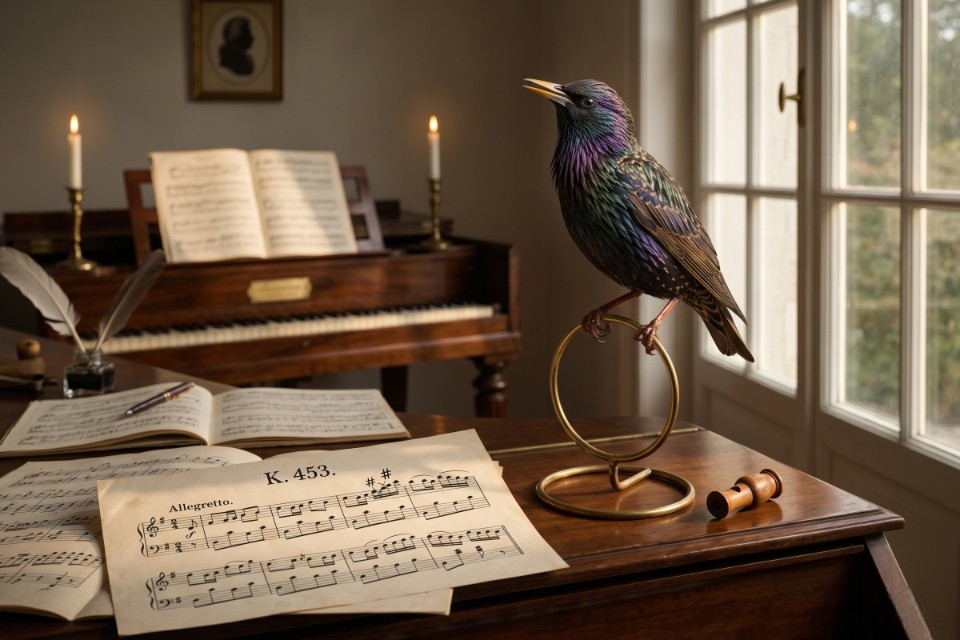
On May 27, 1784, Wolfgang Amadeus Mozart noted in his expense book the purchase of a starling at a Viennese pet shop, and alongside the price he transcribed the melody the bird was singing, which corresponded closely to the opening bars of the third movement of his Piano Concerto No. 17 in G, K. 453, completed a few weeks earlier.
The bird inserted a G-sharp where the score had a G and added a fermata not present in the original, small but characteristic alterations consistent with how starlings modify memorized templates when reproducing them.
The story was analyzed in depth in a widely cited 1990 article in American Scientist by ornithologists Meredith West and Andrew King, who concluded that Mozart’s extensive funeral ceremony for the bird three years later, including a procession, hymns, and a graveside poem he composed himself, reflected a genuine bond rather than theatrical humor.
West and King also argued that several passages in Mozart’s “A Musical Joke” (K. 522), completed shortly after the bird’s death, bear acoustic similarities to starling song patterns, including fractured phrases and abrupt key changes consistent with the improvisational character of a bird’s warbling song.
Whether or not that connection is accepted, the factual core of the account stands as evidence that a starling in a human household acquired and reproduced a specific melody within weeks of its composition, an example of the open-ended vocal learning described above playing out in a historically documented context.
For more on how this species uses its vocal intelligence at feeders and in social competition, see our article on characteristics of European starlings.
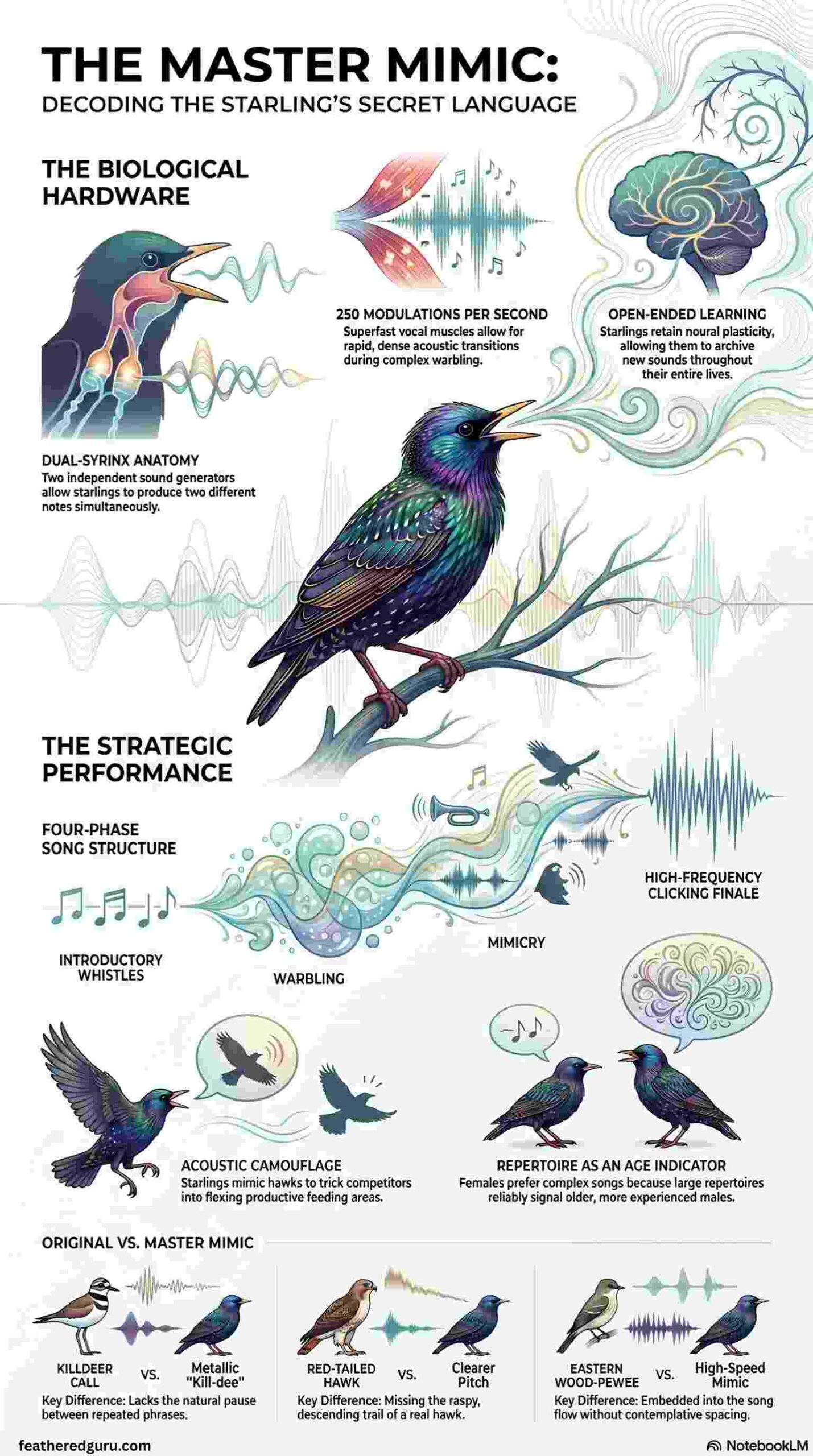
Visual Guide: The Mechanics of Starling Mimicry
If you want a quick forensic breakdown of the vocal anatomy and behavioral strategies we have covered, this visual guide summarizes how starlings use their dual syrinx to dominate the acoustic landscape.
Summary: How Complex is European Starling Mimicry?
European starling mimicry is among the most sophisticated in the avian world, utilizing a dual syrinx to produce polyphonic songs that incorporate everything from predator calls to mechanical environmental sounds. By archiving these sounds throughout their lives as open-ended learners, starlings create a structured vocal map that serves as a high-quality signal for mate selection and social coordination.
The European starling is, by any measure, the most acoustically complex bird that a North American backyard birder is likely to encounter on a daily basis. Its song is not noise.
It is a structured performance built from two independently controlled sound generators, organized into a consistent architectural sequence, expanded throughout a lifetime of open-ended learning, and calibrated by sexual selection pressure that rewards males whose repertoires are the most diverse, the most novel, and the most acoustically demanding to produce.
The mimicry that makes starlings simultaneously fascinating and occasionally maddening is the most visible expression of this system. Every car alarm, every hawk call, every meadowlark phrase in a starling’s song is a verified data point about where that individual has been, what it has heard, and how long it has been learning.
In that sense the repertoire of a single male starling is a biological recorder of the acoustic environment it has moved through, a living archive of sounds both natural and human-made.
Understanding the structure behind that recording, the syrinx that produces it, the neural plasticity that enables it, and the evolutionary pressures that shaped it, changes the experience of hearing one. For more on how starlings compete with native species in the backyard ecosystem, see our articles on Decoding European Starling Nesting Habits, deterring starlings from bird feeders, preventing finches from being bullied, and invasive backyard birds.