

The European starling does not nest randomly. For those analyzing European starling nesting habits and their aggressive suburban behavior, it is clear that every site selection follows a predictable logic: thermal efficiency and foraging proximity. Research categorizes them as urban exploiters, a term describing species that thrive specifically where human disturbance is highest.
By utilizing chimneys, dryer vents, and south-facing eaves, starlings inhabit locations that native birds cannot. These man-made structures act as thermal batteries, radiating retained heat to accelerate egg incubation. This provides a thermally assisted head start on the breeding season that a natural forest cavity simply cannot match. This article explores the forensics of how they claim these sites and how to protect your backyard from their expansion.
Quick Answer: European Starling Nesting Habits
European starlings are secondary cavity nesters known for aggressive suburban behavior and the physical displacement of native species. They typically begin nesting in early spring, prioritizing cavities with an entrance diameter of at least 1.5 inches. Their success in human landscapes is driven by interspecific competition, where they evict smaller birds like bluebirds to claim established nest boxes. Effective management relies on using 1.125 to 1.25 inch entrance holes to create a mechanical lockout that starlings cannot penetrate.
How Starlings Take Over Birdhouses: A Visual Guide
To see how starlings use open-bill probing and social learning to take over nesting sites, watch the forensic video breakdown below. While the thermal logic of their site selection is important, seeing these biological strategies in motion provides the ultimate clarity on how starlings dominate suburban birdhouses.
Show Transcript:
0:00
So I want to tell you a story. It is about a backyard bird feeder war I never expected. It all happened right outside my kitchen window. What started as a peaceful yard quickly turned into a full takeover by one aggressive species.
0:07
Have you ever felt that shift when your backyard bird balance suddenly disappears? The birds you enjoy watching are gone, replaced by something disruptive. That is exactly what happened to me.
0:25
The invader was the European starling. I quickly learned these birds do not compete fairly. They dominate feeders, nest sites, and push out native birds with aggressive behavior.
0:41
One spring morning I looked outside and everything had changed. My yard felt empty. The native birds that made it feel alive were gone, replaced by a single loud and dominant species.
0:55
I used to see flashes of blue from eastern bluebirds and watch tree swallows flying overhead. Now all I heard was constant noise from starlings. It felt like a complete takeover.
1:18
I was frustrated, but also curious. If I wanted to take back my backyard, I needed to understand how these birds operate. So I started researching their behavior and habits.
1:35
The first big discovery was timing. I called it their spring advantage. European starlings begin nesting weeks before native birds like bluebirds even start looking for nesting sites.
1:47
By the time native birds arrive, the best nesting cavities are already taken. This gives starlings a built in advantage that is hard to overcome without intervention.
1:58
Then I learned about their feeding and nesting technique called open bill probing. They use their beaks to pry open small gaps and inspect cavities without even entering them.
2:07
This allows them to quickly evaluate nesting spots for size, moisture, and safety. It is an efficient system that helps them secure prime locations faster than other birds.
2:19
Another surprising discovery was how quickly they learn. Starlings in groups figure out new food sources and nesting spots much faster than individual birds.
2:30
They watch each other, adapt quickly, and spread information across the flock. This makes them highly efficient and difficult to outcompete at feeders and nest boxes.
2:40
The more I learned, the more I realized I was not dealing with a simple nuisance bird. I was dealing with a highly adaptable species that can dominate backyard bird habitats.
2:48
They remove native birds, destroy nests, and take over cavities. A single pair can raise many young each season, increasing their numbers quickly.
2:55
They even build nests using certain plants that help reduce bacteria, improving survival for their chicks. Once they find a good location, they attract more starlings to the area.
3:09
At this point, it felt overwhelming. It seemed like they had every advantage. But then I found one critical weakness that changed everything.
3:24
I kept asking how I could possibly compete with their numbers and behavior. Then I came across one simple number that made all the difference.
3:43
That number was 1.5 inches. It may seem small, but it is based on physical limitations. European starlings cannot fit through entrance holes smaller than this size.
4:00
This is not about behavior. It is about biology and physics. Their body structure prevents them from entering properly sized nest boxes designed for smaller birds.
4:18
That small measurement became the key to protecting native birds. A slightly larger hole allows starlings in, but a properly sized hole keeps them out completely.
4:30
With the correct entrance size, nest boxes become safe for species like eastern bluebirds and tree swallows while blocking starlings entirely.
4:43
At that moment, I realized I was not powerless. I did not need to fight the birds directly. I needed to design my backyard bird setup more intelligently.
4:50
So I created a simple plan. First, I replaced my birdhouses with ones that had precisely sized entrance holes.
5:03
Second, I removed exterior perches that starlings use to dominate and guard nest boxes.
5:13
Third, I committed to regular maintenance to ensure the entrance holes stayed the correct size over time.
5:21
This became my backyard bird defense strategy. A 1.5 inch entrance works for bluebirds and tree swallows. Smaller birds like chickadees and wrens benefit from even smaller openings.
5:33
These small design adjustments create safe nesting spaces that invasive birds cannot access.
5:40
And it worked. The bluebirds returned. The swallows came back. The starlings were still around, but they could no longer take over the nest boxes.
5:54
The conflict over nesting space was resolved. My yard was no longer a battleground.
6:03
More importantly, my mindset changed. I stopped thinking about controlling birds and started thinking about designing a better habitat.
6:07
The goal is not to eliminate species, but to create an environment where native birds can thrive safely.
6:15
It is the difference between reacting to a problem and building a system that prevents it.
6:23
That small shift in approach makes a huge difference in backyard birding success.
6:32
We often think conservation happens in large protected areas, but it also starts at home.
6:35
Sometimes the most effective tools are simple. A ruler, a drill bit, and the right knowledge can completely transform your backyard bird habitat.
When Do European Starlings Nest?
European starlings typically begin nesting in mid-March in the southern United States and mid-April in northern populations. This early timeline allows them to claim prime nesting cavities before many native species even return from migration.
The timing of starling nesting is not incidental. It is a competitive weapon. According to research published in Avian Conservation and Ecology, European starlings begin breeding earlier than native cavity-nesting species in the same environment, producing clutches of four to six eggs with an incubation period of approximately 12 days. In the southern United States, first egg laying can begin as early as mid-March.
In northern populations it shifts to mid-April, but the competitive logic is identical: starlings claim prime cavities before Eastern Bluebirds, Tree Swallows, and Northern Flickers return from or initiate their own breeding cycles.
Research from the USDA APHIS technical series confirms that starlings exploit a wide range of suburban artificial structures for nesting, including dryer vents and traffic signals. This capability allows them to thrive in highly urbanized locations, providing a competitive advantage over native species.
By the time native species are actively prospecting for nest sites, a starling pair may already have a clutch underway in the best available cavity in your yard. The asymmetry is structural, not accidental.
How Do Starlings Find Nesting Sites?
The starling’s competitive success at nest sites is partly behavioral, but it is also partly anatomical. Two physical features in particular make this species exceptionally effective at locating and claiming cavities in suburban environments.
Understanding them reframes the bird’s behavior from aggression into biomechanics. For a broader look at the physical adaptations of this species, see our article on characteristics of European starlings.
How Do Starlings Use Their Bills to Find Nests?
European starlings use a sensory technique called “open-bill probing” to evaluate potential nesting cavities from the outside. By inserting their straight, pointed bill into a gap and forcing it open with powerful jaw muscles, they can detect the size, moisture levels, and safety of a cavity in seconds without even entering it.
The starling’s long, straight, pointed bill operates as a sensory probe. When a male investigates a potential nest site, he inserts his closed bill into gaps, crevices, and openings and then forces it open using the unusually strong jaw-opening muscles described in foraging research.
The bill tip contains mechanoreceptors that allow the bird to detect the dimensions of a space, the presence of previous nesting material, moisture levels, and the texture of the substrate without having to see inside.
This is the same open-bill probing technique the bird uses to detect soil invertebrates in lawns, applied to cavity assessment. A starling can evaluate the quality of a nest cavity in seconds from the outside, which explains the speed with which males stake claims and begin filling a space with nesting material even before a female has paired with them.
What Size Hole Can a Starling Fit Through?
European starlings cannot fit through an entrance hole smaller than 1.5 inches in diameter because of their skeletal width.
The single most important biological fact for any nest box manager to understand about the European starling is its minimum entry diameter. According to Cornell Lab’s NestWatch program, starlings cannot squeeze through a hole smaller than one and a half inches in diameter. This is not a guideline or an approximation. It is a hard biological constraint imposed by the bird’s skeletal width.
A nest box with a correctly sized entry hole of exactly 1.5 inches admits Eastern Bluebirds, Tree Swallows, and Carolina Chickadees while physically excluding starlings. Enlarging that hole by even a fraction of an inch opens the box to colonization.
Hole degradation caused by weather, woodpecker enlargement, or soft wood wear is therefore not a cosmetic issue. It is a conservation issue, and it should be monitored every season.
How Do Starlings Take Over Other Bird Nests?
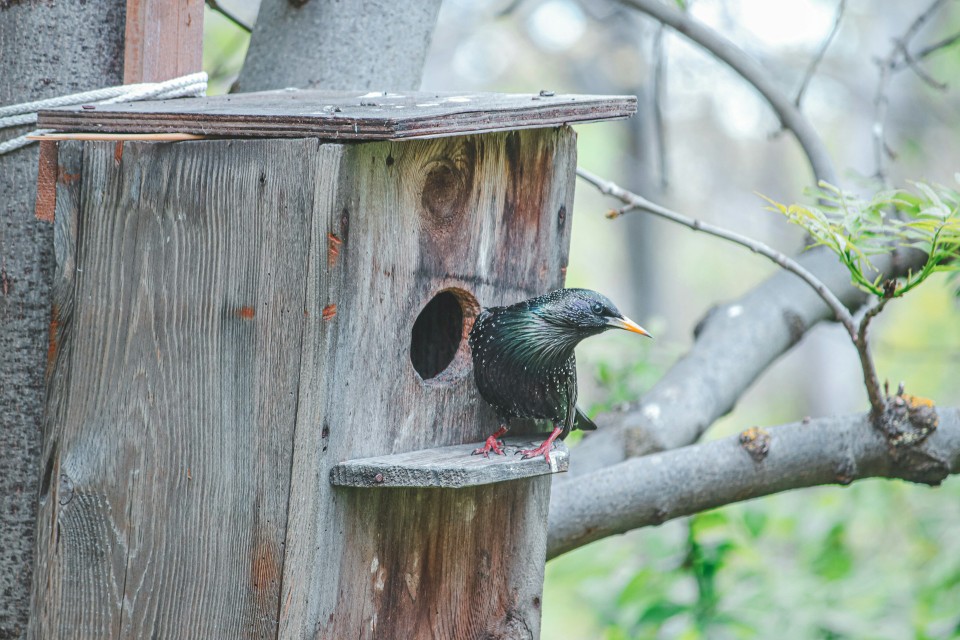
European starlings take over other bird nests through a process of aggressive displacement, where they physically evict native birds, remove existing nesting material, and destroy eggs or nestlings. This deliberate eviction process is often fatal for the displaced species; starlings typically claim the cavity within one to three days, making it impossible for the original owners to return.
When a European starling decides it wants a cavity that is already occupied, it does not simply wait. The eviction process is deliberate and, from the standpoint of the displaced native species, often fatal. Understanding the precise mechanics of how this happens makes the importance of proactive management clear.
Which Bird Species Do Starlings Displace Most?
European starlings primarily displace secondary cavity-nesting birds such as Eastern Bluebirds, Tree Swallows, and Northern Flickers.
According to the Cornell Lab of Ornithology, European starlings aggressively compete for nest cavities and have been documented displacing native species such as bluebirds, woodpeckers, and swallows.
The process typically begins with the male repeatedly entering the target cavity and removing or burying the existing nest material. If eggs are present, they are thrown out or damaged. If nestlings are present, documented cases include direct attacks.
The starling pair then fills the cavity with their own material rapidly, often completing a functional nest in one to three days according to Cornell Lab’s life history data, making reversal by the evicted species effectively impossible once the takeover is complete.
For backyard birders trying to support Eastern Bluebirds in particular, this is the primary threat to manage. See our article on how to attract Eastern Bluebirds to your yard for habitat strategies that also reduce starling competition.
How Does Noise Affect Starling Nesting Behavior?
European starlings use ambient noise patterns to evaluate the safety of nesting sites, often interpreting consistent human-generated sounds as a sign of low predator pressure. Research shows that starlings adjust their territorial singing and nesting activities based on predictable suburban noises like traffic and machinery, which they perceive as cues for a stable and productive environment.
High levels of consistent human-generated noise, such as traffic, machinery, and lawn equipment, that occur on predictable schedules signal low predator pressure and stable human activity rather than disturbance.
Starlings interpret regular suburban noise as a cue that the environment is safe and productive. Conversely, sudden irregular sounds, particularly those resembling distress calls or predator vocalizations, can temporarily suppress nest initiation activity.
This acoustic sensitivity is one reason that distress call recordings are sometimes used as a deterrent near structures, though starlings habituate to these broadcasts relatively quickly.
When Do European Starlings Nest?
European starlings typically begin nesting in mid-March in the southern United States and mid-April in northern regions, often producing two broods per season. This early timeline allows them to claim prime nesting cavities before many native species return from migration, giving starlings a significant mathematical advantage in suburban habitats.
How Many Broods Do Starlings Have per Season?
European starlings typically rear two broods per breeding season, with a single pair producing between eight and twelve fledglings each year. This double-clutching strategy allows the population to grow rapidly, as females often begin incubating a second clutch immediately after the first brood fledges.
Research published in Avian Conservation and Ecology confirms that European starlings typically rear two broods per breeding season, with the female beginning incubation of a second clutch shortly after the first brood fledges.
Each clutch of four to six eggs requires approximately 12 days of incubation, followed by 18 to 21 days in the nest before fledging. A successful first brood in March or early April in southern populations leaves ample time for a second attempt by June.
The energetic cost of this double-clutching behavior is considerable, particularly for the female, but the reproductive payoff in a territory with abundant foraging habitat nearby is substantial.
A single pair can produce eight to twelve fledglings in a single season, which is why a small local starling population can translate rapidly into a large one over just a few breeding cycles.
Are European Starlings Colonial Nesters?
European starlings are semi-colonial nesters that often recruit other breeding pairs to the same area, with some studies showing they can occupy up to 76 percent of available nesting sites.
Research from the Wilson Journal of Ornithology studying nest box use, nest boxes were spaced approximately 60 meters apart to accommodate these semi-colonial habits. This social signaling means that one male singing at a nest site acts as a public advertisement, attracting other starlings to investigate every suitable cavity within the immediate suburban radius.
The mechanism behind this density is social signaling: a male singing at an established nest site, particularly one near productive foraging habitat such as a mowed lawn, functions as a public advertisement of site quality. Other males in the area respond by investigating nearby cavities.
In a suburban context, this means that one successful starling nest in a yard or on a neighboring property generates active prospecting of every other suitable opening within a few hundred meters.
The GPS foraging data from a study published in PLOS ONE showed that breeding starlings forage primarily within 200 meters of the nest and select intensively against foraging areas beyond 500 meters, meaning suburban lots with short grass lawns function as ideal staging grounds precisely because nesting and foraging can be conducted within the same small radius.
How Do You Keep Starlings Out of Birdhouses?
The most effective way to keep starlings out of birdhouses is to use precisely sized entrance holes between 1.125 inches and 1.25 inches. While starlings are physically blocked by any opening smaller than 1.5 inches, a 1.125-inch (one and one-eighth inch) lockout is required to exclude both starlings and house sparrows while still allowing chickadees and wrens to enter.
The good news for backyard birders is that the same biological constraints that make the starling predictable also make it manageable. Effective starling deterrence does not require generalized exclusion of all birds. It requires targeted exploitation of the species’ physical limits and habitat preferences.
What is the Best Entrance Hole Size to Stop Starlings?
A round entry hole of 1.125 inches is the best size to stop both starlings and house sparrows from entering birdhouses. While the 1.5-inch threshold excludes starlings from bluebird boxes, smaller native cavity nesters require even tighter specifications.
According to Cornell Lab’s NestWatch, a round entry hole of 1.125 inches (one and one-eighth inches) will exclude both European Starlings and House Sparrows while still admitting Carolina Chickadees, Black-capped Chickadees, and House Wrens.
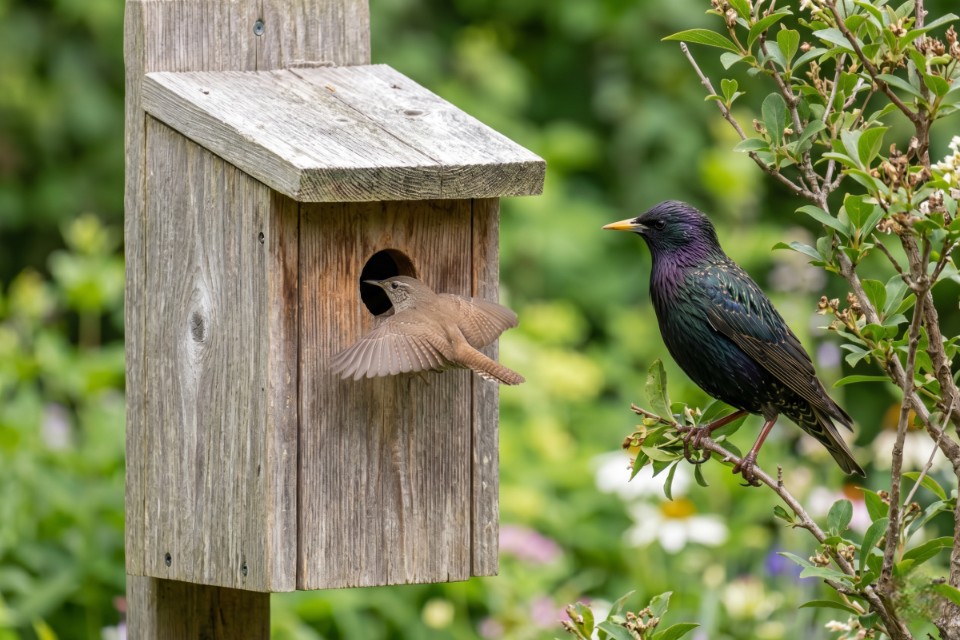
This specification is the tightest effective exclusion available for cavity-nesting songbirds and makes these boxes essentially immune to starling competition without any active monitoring beyond ensuring the hole does not degrade. For species like chickadees, which are also under pressure from House Sparrow competition, the 1.125-inch hole is the single most powerful structural protection available short of direct nest management.
It is important to note that European Starlings are not protected under the Migratory Bird Treaty Act, meaning their nests, eggs, and adults may legally be managed or removed at any time without permit requirements, unlike all native cavity-nesting birds.
What Birdhouse Design Best Deters Starlings?
The best birdhouse design to deter starlings is a box with a smooth front panel, no exterior perch, and a steeply angled roof. Starlings have a documented preference for perch-equipped designs that allow them to defend the site; by removing the perch and using a slanted roof, you create a physical barrier that makes it difficult for larger birds to gain purchase or enter the cavity.
A box with a flush, smooth front panel and correctly sized hole offers far less behavioral scaffolding to a prospecting starling male. Second, a steeply angled roof with a generous overhang forces any approaching bird to approach the entrance hole from below and in front, making it more physically difficult for a larger bird to gain purchase and enter.
Combined with a predator guard baffle on the mounting pole, these design choices layer multiple discouragement signals without any of them functioning as a general deterrent that would also suppress native species. For comparison with how House Sparrows approach the same nesting resources, see our article on house sparrow nesting habits in urban areas.
How Do Starlings Learn Where to Nest?
European starlings learn where to nest through a combination of open-ended vocal learning and social observation, which allows them to train younger colony members in local nest site exploitation. This neural flexibility means starlings don’t just rely on instinct; they actively pass down information about which specific suburban structures and cavity types are the most productive nesting sites in a given neighborhood.
How Do Starlings Learn Mimicry and Nesting Calls?
European starlings learn mimicry and territorial nesting calls through a process called open-ended vocal learning, which allows them to incorporate new sounds throughout their entire adult lives. This neural flexibility starts with a ‘subsong’ phase in young starlings, where they practice low-amplitude vocalizations in sheltered areas to refine the acoustic templates they learn from more experienced males in the colony.
The same neural flexibility that allows a male starling to add new mimicry phrases to his song repertoire also allows younger birds to learn and refine the territorial and contact calls associated with nest site claiming. A first-year male on his first breeding attempt is drawing on acoustic templates learned from experienced males around him, not operating from fixed instinct.
This means that a starling colony in a suburban neighborhood effectively trains its younger members in local nest site exploitation, with each generation passing on information about which cavity types, which orientations, and which structural features constitute productive nesting opportunities in that specific environment.
How Fast Do Starlings Learn New Behaviors?
European starlings learn new tasks approximately 6.67 times faster in a social context than they do when learning alone. Research published in Behavioural Processes found that European starlings learning a novel foraging task in a social context did so at a rate approximately 6.67 times faster than individuals learning the same task alone.

Applied to nesting behavior, this finding has direct implications for understanding how a starling colony escalates its exploitation of a suburban environment over successive breeding seasons.
A new nest site type, whether a dryer vent, a gap in soffit boards, or an unprotected nest box, that is successfully colonized by one pair in a season is likely to be identified and used by additional pairs the following season, not because word spreads in any anthropomorphic sense, but because the social observation and local enhancement mechanisms that drive the 6.67-times learning advantage are operating continuously across the colony.
Closing one access point is therefore never sufficient on its own. It must be followed by systematic assessment of all comparable openings in the same structure. The Northern Flicker is among the most directly affected native species in this competition dynamic, as its excavated woodpecker cavities are a preferred target.
For more on that species, see our article on fun facts about the Northern Flicker.
Why Do Starlings Put Green Leaves in Their Nests?
European starlings put green leaves and fresh plant material in their nests to act as a natural pesticide that kills bacteria and parasites. By selecting specific plants rich in volatile chemical compounds, starlings create a biological infrastructure that improves the health and survival rates of their nestlings.
According to research published in Oecologia, starlings actively select plant species whose volatile compounds are more likely to inhibit arthropod hatching and bacterial growth relative to randomly available vegetation. The preferred plants contain higher concentrations of mono- and sesquiterpenes, the chemical classes associated with insecticidal and antimicrobial properties.
Research published in the Journal of Ornithology found that in a controlled field experiment comparing herb-lined nests to grass-only controls, nestlings from herb-enriched nests fledged with significantly higher body mass, and more yearlings from these nests were identified in the colony the following year, indicating improved survival through to recruitment age.
This chemical nest management has a practical implication for anyone removing starling nests from structures. Fresh green material in the nest is a reliable indicator of an active, invested nesting attempt rather than exploratory nest building.
A nest that contains freshly replenished herbs has a pair that has already made a significant behavioral investment in the site and is likely to return persistently. Removal should be followed immediately by physical exclusion of the entry point to prevent reinvestment in the same location.
The Suburban Defense Blueprint: A Forensic Summary
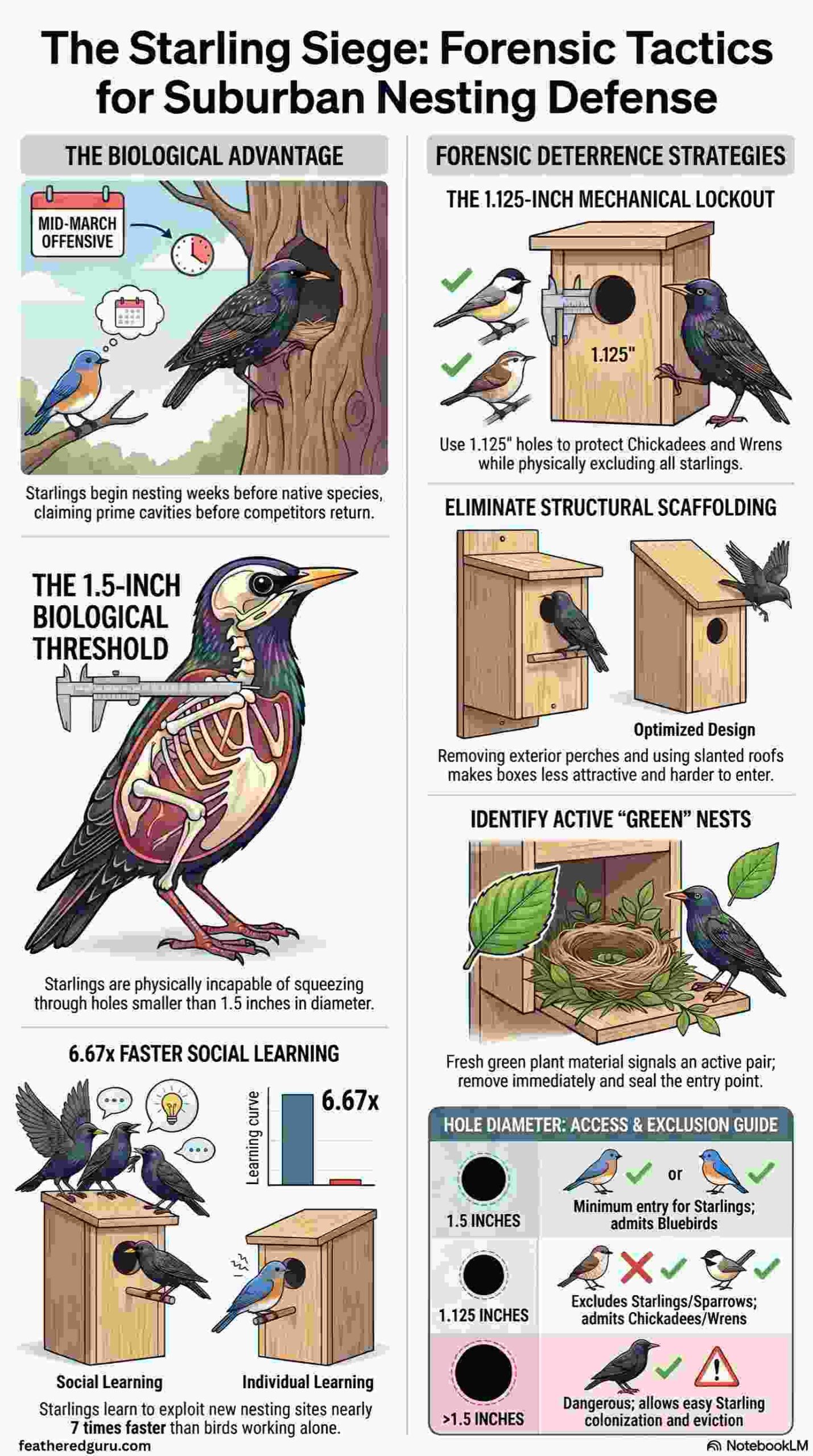
We have synthesized the thermal logic and biological data from this dossier into a single visual master key for backyard management. Use this guide to quickly identify the 1.125-inch lockout specifications and the “thermal battery” locations that starlings exploit most aggressively.
Frequently Asked Questions About Starling Nesting
Can starlings nesting in my house cause damage?
Yes, starlings nesting in dryer vents, chimneys, or eaves can block airflow and create fire hazards. Their nesting material also harbors bird mites and bacteria, which can occasionally migrate into human living spaces if the nest is not removed and the entry point sealed.
Do starlings reuse the same nest every year?
Starlings are highly site-faithful and will return to a successful nesting cavity year after year. They often remove old material or build directly on top of the previous year’s nest, frequently adding fresh green plants to help manage bacteria levels for the new brood.
Is it legal to remove a starling nest?
Yes. Because European starlings are an invasive species in North America, they are not protected by the Migratory Bird Treaty Act. This means their nests, eggs, and young can be legally removed from private property at any time without a permit.
Why do starlings put green leaves in their nests?
Starlings select specific green plants rich in volatile chemical compounds to act as a biological pesticide. These “herbal” additions inhibit the growth of bacteria and parasites, which helps their nestlings grow faster and improves their overall survival rate.
Conclusion: Restoring the Suburban Balance
The European starling’s dominance of suburban nesting habitat is not an accident of aggression alone. It is the product of a precise biological toolkit: a thermally sensitive site selection system, a bill anatomy that functions as a cavity scanner, a breeding calendar that consistently beats native competitors to available cavities, a double-brood reproductive strategy, and a social learning network that spreads successful exploitation techniques through the local colony faster than most species can adapt to them.
The evidence-based response to each of these advantages is specific. The spring timing advantage is countered by installing and preparing nest boxes before February in most of North America, so that native species can claim them before starlings begin prospecting. The bill and entry threshold advantage is countered by maintaining precisely sized entrance holes and inspecting them every season for degradation.
The social learning and colonial recruitment advantage is countered by closing every comparable opening near any active nest box, not just the box itself. The double-clutch reproductive advantage is countered by monitoring nest boxes throughout the full season, from first occupancy in early spring through the second brood attempt in early summer.
None of these measures require eliminating the starling from your backyard entirely. They require denying it the specific structural conditions it needs while preserving exactly the conditions that native species require. That distinction is the difference between a reactive pest management approach and a genuinely bird-friendly yard design.
For a complete strategy on feeder-level starling management alongside nesting deterrence, see our article on how to deter starlings from bird feeders.